
Cat Not Eating After Spay? What's Normal and When to Call
By RexVet Team | Reviewed by Dr. Tiffany Delacruz, DVM
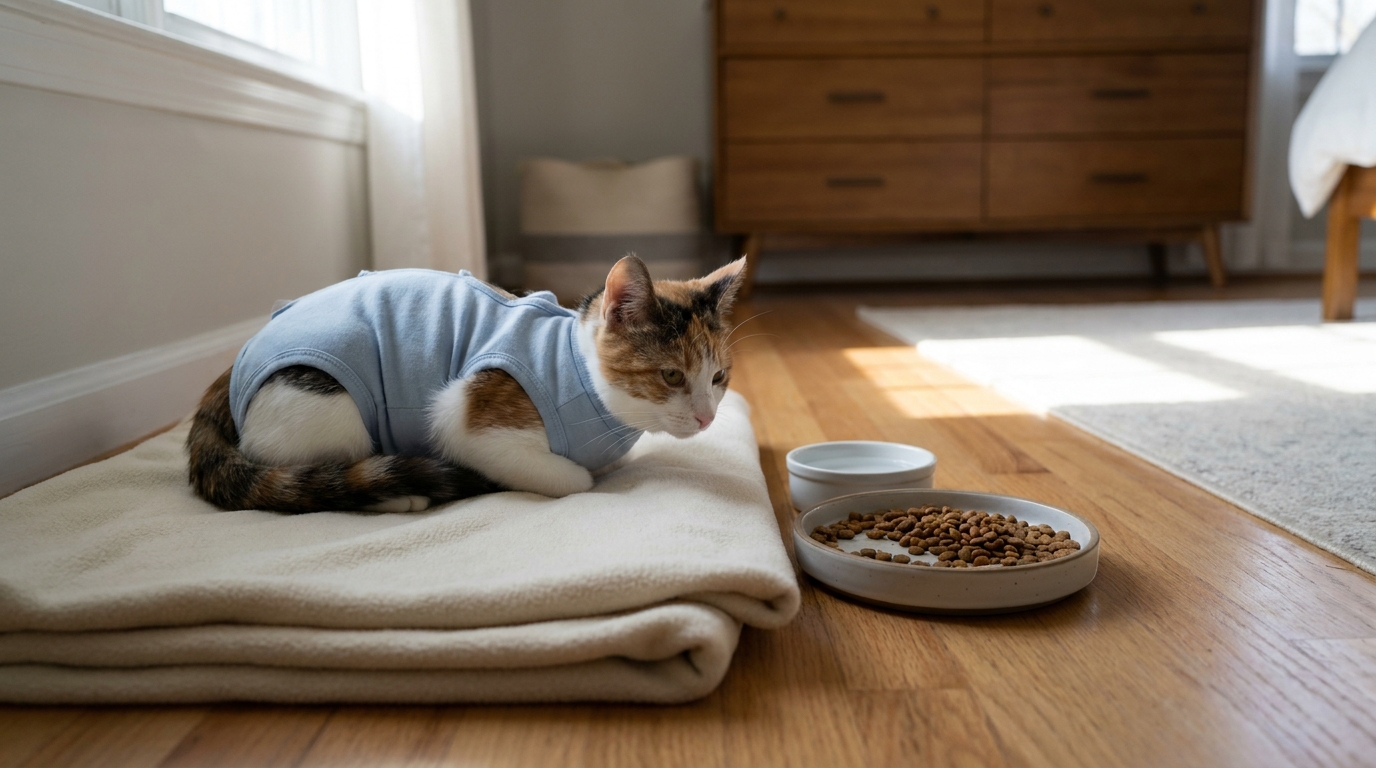
Cat not eating after spay surgery? Skipping dinner the first night is common, but refusing food and water for more than a day needs a vet call.
Call the clinic that did the surgery or go to an emergency vet now if your cat is hard to wake, has pale or white gums, a swollen or painful belly, trouble breathing, bleeding or discharge from the incision, or strains to pee with nothing coming out.
This guide covers what the first night usually looks like, the point at which PetMD says to call the vet, the signs that mean you should act now, and how to help her eat safely at home.
Cat not eating after spay: what's normal the first night
It's common for a cat to come home sleepy, a little wobbly and not very interested in her bowl. She has just had an anesthetic and surgery, so a quiet, picky first evening is not a surprise.
Start small. VCA's post-operative guide for cats suggests offering about half her usual dinner a few hours after she gets home. VCA also notes that some cats experience nausea after general anesthesia, so "dividing the meal into smaller portions may decrease the risk of nausea and vomiting."
For the first drink, PetMD's spayed-cat aftercare guide suggests offering only a small amount of water when you get home (about half as usual, with ice cubes), since she may be nauseous from the procedure. That is a tip for the first offering, not a reason to keep water from her. VCA's guide is clear: "Unless otherwise instructed, your cat's access to water should not be restricted." If your surgical clinic sent you home with its own food and water instructions, follow those.
Don't force food, and don't swap her usual food for something new to tempt her. Offer, wait, and offer again later.
Then watch the trend. VCA explains that the anesthetic can leave some cats drowsy for about a day, and that "Over the next 24–48 hours, your cat's behavior should gradually return to normal." You want a cat who is a little brighter each time you check on her. If she isn't heading that way, VCA's advice is not to hesitate to contact the hospital if you are concerned.
Emergency signs: call the surgical clinic or go to an ER now
PetMD puts it plainly: spaying a cat is an invasive surgical and anesthetic procedure and life-threatening complications can occur. Its list of signs that mean you should contact your veterinarian immediately includes:
- Difficult to rouse
- Pale or white gums
- Fever
- A swollen belly, or one that is tender when touched
- Difficulty breathing
- Bleeding, a foul odor, or any discharge from the incision
- The wound opening, or stitches coming loose
- Straining to urinate, or not being able to pass urine
If you see any of these, call the clinic that did the surgery right away. If it's closed, go to an emergency vet tonight rather than waiting to see whether she eats.
For a broader walk-through of what counts as urgent, see our practical pet emergency checklist for dog and cat owners.
When not eating becomes a problem
A skipped dinner the first night is one thing. A cat who keeps turning food down is another. PetMD's list of reasons to call the vet after a spay also includes:
- Refusal to drink or eat for more than 24 hours after surgery
- Lack of stool for more than two days after surgery
- Excessive vomiting and/or diarrhea
Read that first line carefully. It says drink or eat. A cat who is sipping water but still hasn't eaten by that point needs a call too.
Cats should not go long without food, and your vet will want to hear about it early rather than late. Nausea after anesthesia is one known reason a cat won't eat after being spayed, but a refusal that drags on is something for a vet to assess, not something to wait out. Our post on an older cat who stops eating after a new kitten arrives explains why a cat that stops eating needs attention, even when the cause seems simple.
Vomiting follows the same logic. VCA's small-portion tip is there to lower the risk of it, but excessive vomiting is on PetMD's call list, whether or not she is also eating.
Helping her eat safely at home
A calm setup gives her the best chance to eat on her own:
- A quiet room. Put her food, water and litter box in a small, calm room away from other pets, children and household noise.
- Small portions of her usual food. Offer a little at a time and take it away if she ignores it, then try again later.
- Bowls on the floor. Keep everything at floor level so she doesn't need to jump up to reach food or water.
- Same food as always. PetMD advises you to "ensure her diet stays consistent, since sudden changes can lead to gastrointestinal upset." This isn't the week to try a new brand or flavor.
- No human foods or medicines. Never give your cat any human medicine. Questions about pain or nausea go to the clinic that did the surgery.
- Indoors only. VCA's discharge guide is clear: "Under no circumstances should a cat with a fresh surgical incision be allowed to go outdoors."
If she's wearing a cone, a wide, shallow dish on the floor may be easier for her to reach than a deep bowl.
It also helps to jot down a few notes: roughly when she last ate, whether she drank, and what showed up in the litter box. If you do need to call, the clinic can use that history.
Check the incision while you're there
When you offer food, take a quick look at the incision without touching it. VCA's surgical discharge instructions for cats and its post-operative guide describe what healthy looks like:
- The incision should be clean and the edges should be together.
- Mild redness and swelling are part of the healing process and should be expected for the first few days after surgery.
What isn't normal: VCA says that for routine elective surgeries, any discharge from the incision site is abnormal. Discharge, bleeding, a foul smell or edges pulling apart are all on PetMD's contact-immediately list, so treat them like the emergency signs above, whether or not she is eating. That means the surgical clinic now, or an emergency vet if the clinic is closed.
Don't clean it on your own. VCA warns: "Never put hydrogen peroxide or rubbing alcohol on the incision." Don't put anything on it that the clinic didn't give you.
If you find a lump under the incision, our post on a lump under a spay incision is written about dogs, but the questions to ask the clinic are much the same.
Pain, licking and the cone
PetMD advises contacting your veterinarian immediately if you think your cat is in pain or if she chews or tries to lick the incision site. Follow the clinic's discharge instructions, and don't add or change anything without talking to them first.
The cone is there to keep her tongue and teeth off the incision, so keep it in place as the clinic directed. If it seems to be getting in the way of eating or moving, ask them before you take it off or swap it. And if you weren't sent home with one, VCA says that if she begins licking or chewing the incision, you should contact the hospital and request one.
Our post on a dog crying all night after surgery walks through the pain-or-anesthesia question for dogs.
What a RexVet online vet can and cannot do after a spay
For anything about the surgery itself, the clinic that did it is your first call. But it may be closed by the time she turns down her dinner, and that's where a video visit can help. If any sign from the emergency list is present, though, go to an emergency vet, not a video visit.
A RexVet veterinarian can:
- Help after hours when the surgical clinic is closed
- Look at the incision on camera
- Check how alert she is, and look at her gums and breathing
- Go through her food, water and litter-box history since surgery
- Help you decide between the ER tonight, a call to the surgical clinic in the morning, or careful watching at home
A video vet cannot run bloodwork, give fluids or re-close an incision, and will not change the surgical clinic's plan or medicines without talking to them.
If the veterinarian decides medication is appropriate, they can prescribe where state rules allow. In Florida, a veterinarian who has seen your pet only by video may prescribe only FDA-approved animal drugs used as labeled, for up to 14 days (1 month for flea-and-tick-only products), and cannot renew without an in-person exam.
Clear pictures make the visit more useful. Our guide on how to upload pet photos and videos for an online vet review has tips for getting a good view.
RexVet's veterinarians are licensed in Florida, New York and Virginia and are available 24/7, including nights, weekends and holidays. If her surgical clinic is closed and you're not sure what you're seeing, a video visit is $64.99. Book a RexVet video visit now.
When to be seen in person in Florida, New York or Virginia
The clinic that did the surgery knows her history, so it comes first for anything about the incision or the operation. After hours, any sign on the emergency list means an emergency vet. If you are ever unsure whether it's an emergency, go in.
Keep the discharge paperwork handy, with the clinic's phone number and any after-hours instructions.
In Florida, when the first exam is done by telehealth, state law (Fla. Stat. 474.2021) requires the veterinarian to give you "the contact information for at least one physical veterinary clinic in the vicinity of the patient's location," so you have somewhere to go in person if you need it. You can read more about video visits in your state on our pages for online vet care in Florida, online vet care in New York and online vet care in Virginia.
Frequently Asked Questions
How long can a cat go without eating after being spayed?
Not long. PetMD lists refusing to eat or drink for more than 24 hours after surgery as a reason to call your vet, and any emergency sign means calling right away rather than waiting for that point.
Is vomiting after a spay normal?
It can happen. Some cats feel queasy after anesthesia, which is why VCA suggests splitting the first meal into small portions. Repeated vomiting is different: PetMD lists excessive vomiting as a reason to call.
Should my cat drink water after spay surgery?
Yes. Keep fresh water where she can reach it. A smaller first offering is fine if she seems nauseous, but VCA says her access to water shouldn't be restricted unless your clinic tells you otherwise. Not drinking at all counts toward the same call-the-vet rule as not eating.
Why hasn't my cat pooped since her spay?
If she goes more than two days after surgery without passing stool, PetMD says to call the vet. Straining to urinate is a different matter and belongs on the emergency list.
Can a cone stop my cat from eating?
It can make a deep bowl awkward. Try a shallow dish at floor level, and check with the clinic before you remove or change the cone. If she still won't eat, the same call-the-vet rule applies.
A smooth recovery looks like a sleepy evening, a small meal, and a cat who is a bit more herself each day. If something doesn't look right and her surgical clinic is closed, you don't have to guess alone. For any emergency sign, go to an emergency vet first. For everything else, RexVet's veterinarians are licensed in Florida, New York and Virginia and are available 24/7, and a video visit is $64.99. Book a video visit now.
FAQs
How long can a cat go without eating after being spayed?
Not long. PetMD lists refusing to eat or drink for more than 24 hours after surgery as a reason to call your vet, and any emergency sign means calling right away rather than waiting for that point.
Is vomiting after a spay normal?
It can happen. Some cats feel queasy after anesthesia, which is why VCA suggests splitting the first meal into small portions. Repeated vomiting is different: PetMD lists excessive vomiting as a reason to call.
Should my cat drink water after spay surgery?
Yes. Keep fresh water where she can reach it. A smaller first offering is fine if she seems nauseous, but VCA says her access to water shouldn't be restricted unless your clinic tells you otherwise. Not drinking at all counts toward the same call-the-vet rule as not eating.
Why hasn't my cat pooped since her spay?
If she goes more than two days after surgery without passing stool, PetMD says to call the vet. Straining to urinate is a different matter and belongs on the emergency list.
Can a cone stop my cat from eating?
It can make a deep bowl awkward. Try a shallow dish at floor level, and check with the clinic before you remove or change the cone. If she still won't eat, the same call-the-vet rule applies.
A smooth recovery looks like a sleepy evening, a small meal, and a cat who is a bit more herself each day. If something doesn't look right and her surgical clinic is closed, you don't have to guess alone. For any emergency sign, go to an emergency vet first. For everything else, RexVet's veterinarians are licensed in Florida, New York and Virginia and are available 24/7, and a video visit is $64.99. Book a video visit now.
Medically Reviewed
Reviewed by Dr. Tiffany Delacruz, DVM — licensed veterinarian and CEO of RexVet. Last reviewed September 26, 2026.
Content is for informational purposes and does not replace professional veterinary advice.
Chief Executive Officer · Licensed Veterinarian
Dr. Delacruz is a licensed Doctor of Veterinary Medicine specializing in preventive care and veterinary telehealth. She reviews all health content on RexVet to ensure accuracy and clinical relevance.
Sources & References
- · American Veterinary Medical Association — Telehealth Guidelines
- · AVMA — Pet Care Resources
- · U.S. FDA — Animal & Veterinary
Need an Expert Opinion on This Topic?
Connect with a certified vet via video call in minutes
Talk to Vet Now