
Cat Limping but No Visible Injury? Wait or See a Vet Now
By RexVet Team | Reviewed by Dr. Tiffany Delacruz, DVM
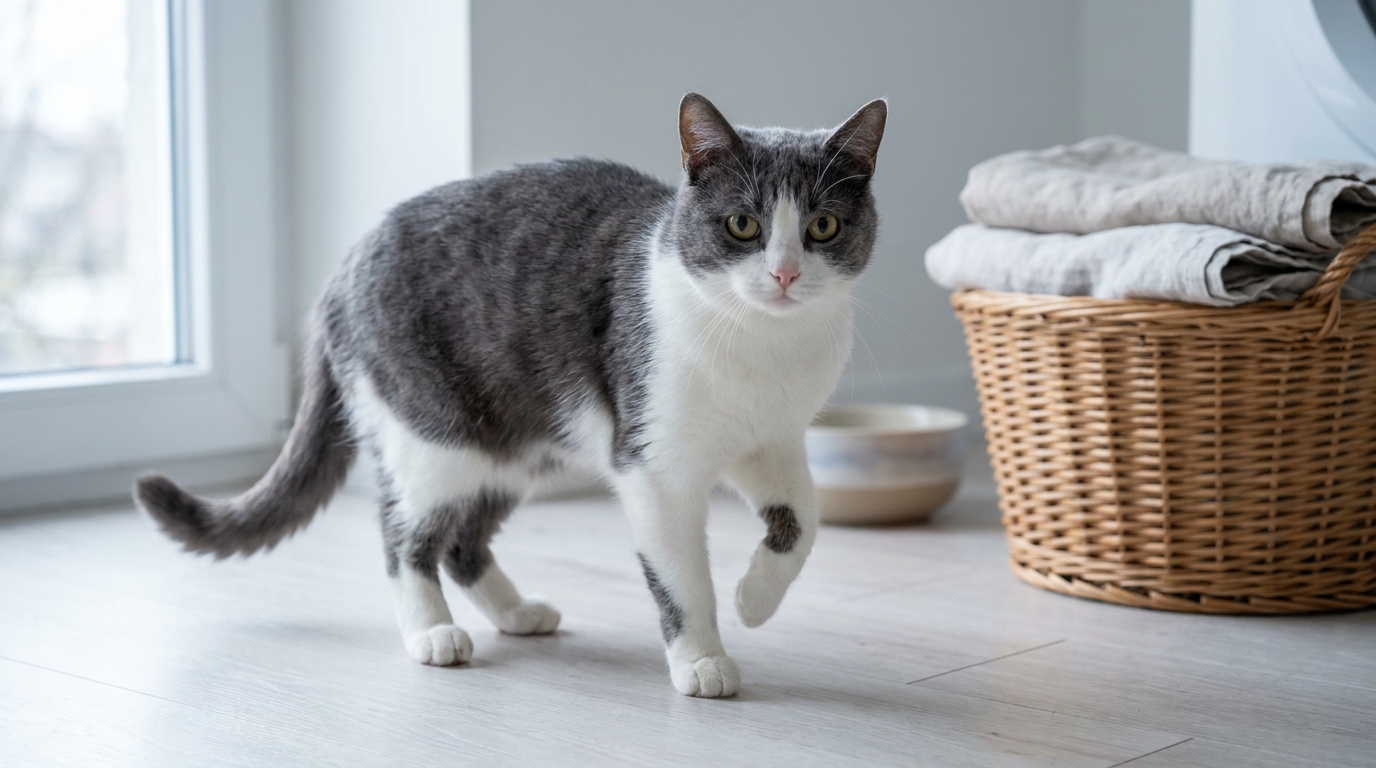
Cat limping but no visible injury often means a sprain, sore paw or hidden bite; see a vet if it lasts past a day or two or the leg won't bear weight.
Go to an in-person emergency vet now if your cat suddenly cannot use one or both back legs, is crying in pain, has cold paw pads, is breathing with an open mouth, has a leg that looks bent or has bone showing, or fell from a window or was hit by a car.
Why is my cat limping but no visible injury? The hidden causes
The Merck Veterinary Manual puts it simply: "Lameness is not a disease, but it may indicate a disorder in the musculoskeletal system." In other words, the limp is the sign, and the cause is usually something you cannot see from across the room. PetMD notes that feline limping is often related to trauma, illness or a degenerative condition, and its list of trauma causes covers most of what hides under fur and between toes:
- A torn toenail, or a toenail that has grown around into the pad.
- Debris lodged between the toes or in a paw pad, which PetMD says is very common: a thorn, splinter or burr.
- An overworked, strained or torn muscle after a bad landing.
- An insect sting or bite on a paw or leg.
- A bite from another animal, a tiny puncture hidden under fur.
- A broken bone, which does not always look bent.
In older cats, PetMD adds, a limp is often one of the first visible signs of joint discomfort from a chronic condition such as arthritis.
Emergency signs: go to an in-person ER now, not a video call
Go now, not in the morning, if your cat:
- Suddenly cannot use one or both back legs, or is dragging a leg.
- Is crying or yowling in pain.
- Has paw pads that feel cold.
- Is breathing with an open mouth.
- Has a leg that looks bent, or has bone showing.
- Fell from a window, or was hit by a car.
PetMD's own emergency list matches: a cat that is dragging a leg or cannot move it, has a bone poking through the skin, or has been through trauma such as a car strike or an attack by another animal needs a veterinarian right away.
The back-leg sign matters because of the heart. In cats with hypertrophic cardiomyopathy (HCM), the Cornell Feline Health Center explains, blood clots "most commonly result in blockage of blood flow to the hind limbs, causing acute hind limb pain or, in extreme cases, hind limb paralysis." A cat that suddenly cannot stand on its back legs, cries and has cold pads needs an in-person emergency clinic now, not a video visit. If you are unsure, use the pet emergency checklist.
The quick home check before you decide anything
If none of those apply, check the cat in a quiet, well-lit room. PetMD's safety note comes first: pain can make even a gentle cat bite or scratch, so handle it carefully.
- Calm the cat, and wrap it loosely in a towel if that helps.
- Compare both front paws or both back paws side by side.
- Look between every toe and at each pad for a thorn, splinter or other debris.
- Check every claw, including the dewclaw, for a split or a claw curling into the pad.
- Run a hand gently from paw to shoulder or hip, feeling for heat, swelling or a flinch.
- Note whether any weight goes on the leg.
- Film the cat walking on a hard floor. PetMD's advice: "If your cat's limping comes and goes, it can help to take a video at home to show your veterinarian."
Stop if the cat struggles; a veterinarian can guide the rest on camera. Whether or not the check turns up a hidden cause, keep the cat in one quiet room while you decide.
The hidden bite abscess: why an outdoor cat's limp can get worse instead of better
A bite on a leg or near the tail base is a tiny puncture hidden under fur, so there is nothing to see at first. VCA Animal Hospitals notes that a bite from another animal is one of the most common causes of an abscess, because the bite pushes bacteria under the skin, and that cats that fight or go outside are at higher risk. The swelling shows up later, after the bite itself is no longer visible, which is why the limp gets worse instead of better.
VCA describes the abscess as "a painful swelling that may be either firm to the touch or compressible like a water balloon." VCA also notes that a cat with an abscess will often run a fever and is likely to be lethargic or withdrawn, with a poor appetite. PetMD's list of abscess signs includes "Limping (if a limb is affected)," so a limp plus a hot, tender lump plus a cat that stops eating points to a bite you never saw.
Treatment is hands-on. VCA explains that the key is removing the pocket of pus, either surgically or by "draining and flushing." A suspected abscess is an in-person visit; never squeeze or lance a swelling at home.
Back leg limp in an older cat: sprain or arthritis?
A back-leg limp that starts right after a bad jump may be a strain that settles with rest, but a fracture or a torn ligament can look the same at first. A short watch is only reasonable if the cat still puts weight on the leg and has none of the emergency signs; a fall from a height is an in-person exam even if the cat walks away. Arthritis comes on slowly, and families often read it as slowing down with age. VCA Animal Hospitals lists the signs to notice:
- Difficulty getting up and down
- Walking stiffly
- Lameness in one or more legs
- Reluctance to jump up or down, onto or off furniture
- Hiding more than usual
VCA says diagnosis takes a physical examination, palpation and "radiographs (X-rays)," which is why arthritis is confirmed in person. See the senior cat care guide and how to tell if your cat is in pain for the quieter signs.
Still jumping and acting normal? How long you can safely wait
If your cat is limping but still jumping and running, eating, putting some weight on the leg, and has no emergency signs, PetMD's rule applies: "If the limping doesn't improve within a day or two, reach out to your veterinarian." That is the whole window. PetMD explains why: a limp from a mild injury may improve with rest, but a fracture, an infection or joint disease needs prompt evaluation by a veterinarian, and you cannot tell those apart from the couch.
Rest means one quiet room with food, water and litter at floor level: no stairs, furniture or chase toys.
Improving means a little more weight on the leg each day and a normal appetite. Not improving means the same or a worse limp, new swelling, a warm leg, hiding or skipped meals: call a veterinarian. The rule never applies to a cat that will not bear weight, drags a leg or has cold paw pads; those cats are seen today or right now.
Never give a limping cat human pain medicine
There is nothing in the family medicine cabinet to give a limping cat. The FDA is blunt: "Acetaminophen is fatal to cats." The FDA explains that cats lack the liver enzymes needed to break the drug down, so it must never be given to a cat. On NSAIDs, the FDA says "Currently, no NSAIDs are approved for long-term use in cats," adds that cats are especially sensitive to their side effects, and tells owners to talk with a veterinarian before giving any NSAID to a dog or cat.
PetMD's advice is the same: never give a cat human pain medication, because many are toxic to cats. VCA's arthritis page says it plainly: "never reach into your own medicine cabinet when your cat limps." Pain relief is a veterinarian's decision after an exam. If you have already given your cat something, call a veterinarian or an animal poison control line now.
What a RexVet online vet visit can and cannot do for a limping cat
The Merck Veterinary Manual says a lameness exam "may include observing the cat while it rests, stands up, and walks." A video visit can do that on your own floor, where the cat does not freeze the way it might in a clinic. The veterinarian can also guide your hands through the paw, claw and leg check on camera, ask about falls, open windows, fights, age and appetite, and decide between emergency clinic now, in-person vet within a day, or rest and recheck.
What it cannot do is the rest of the Merck exam. Merck notes that the veterinarian may also feel the cat's bones, joints and soft tissue for swelling, pain or instability, and may use X-rays or ultrasound to find the cause; none of that happens over video. A video visit also cannot drain an abscess, give injections or fluids, or rule out a fracture, a clot or an abscess.
If the veterinarian decides medication is appropriate, they can prescribe where state rules allow. Florida's statute says "Prescriptions based solely on a telehealth evaluation may be issued for... up to 14 days of treatment for other animal drugs," and such prescriptions "may not be renewed without an in-person examination." No controlled substances by video.
RexVet's veterinarians are licensed in Florida, New York and Virginia. If your cat is eating, moving and free of the emergency signs, you can book a RexVet video visit for $64.99, 24/7, for pet parents in Florida, New York and Virginia only; the online vet for cats page explains how a visit runs.
When a limping cat must be seen in person in Florida, New York or Virginia
Some limps are an in-person visit however calm the cat seems:
- A suspected fracture, or a limp still there after a day or two: both need X-rays.
- A swelling that may be an abscess and needs draining.
- A leg that will not bear weight at all.
- A kitten or senior cat that stops eating.
- Every emergency sign above.
Florida's statute requires a telehealth veterinarian to give the owner the contact details of at least one physical veterinary clinic near the patient, and RexVet's veterinarians point families in all three states to local care when hands-on treatment is needed.
Florida: outdoor cats, fights and hot pavement year-round mean pad and bite injuries, and the 14-day telehealth prescribing limit sends longer treatment to an in-person clinic (online vet in Florida).
New York: apartment cats fall from unscreened windows and stairs, and a fall is an in-person exam even if the cat walks away (online vet in New York).
Virginia: outdoor and rural cats roam and fight, so a limp with no visible wound can be a bite that has not swollen yet (online vet in Virginia).
You do not have to make this call alone at midnight. If your cat has none of the emergency signs, you can book a video visit now with a RexVet veterinarian for $64.99, 24/7; RexVet's veterinarians are licensed in Florida, New York and Virginia only. The visit helps you choose between rest, an in-person appointment and the emergency clinic; it cannot replace X-rays or a hands-on exam.
Frequently asked questions
How long should a cat limp before going to the vet?
A day or two, and only if the cat still puts some weight on the leg, eats and acts normally. Go sooner for any emergency sign or a leg that will not bear weight.
Will a cat's limp heal on its own?
A mild sprain or sore paw may improve with rest and confinement. A bite abscess, fracture or joint disease will not; PetMD says those need prompt evaluation by a veterinarian.
Why is my cat limping but still jumping and running?
Cats hide pain, so a cat limping but acting normal is not necessarily pain-free. Do the paw and leg check, confine the cat and watch appetite; the day-or-two rule still applies.
What will the vet do for a limping cat?
An in-person veterinarian watches the cat walk, feels the leg and joints, and takes X-rays if needed. On a RexVet video visit, the veterinarian watches the cat move on your floor, guides the home check and helps decide between rest, an in-person appointment and an emergency clinic.
Can I give my cat anything for pain at home?
No. The FDA warns that acetaminophen is fatal to cats and that no NSAID is approved for long-term use in cats. Rest and confinement are the only home care; if you already gave something, call a veterinarian or an animal poison control line now.
Sources
FAQs
How long should a cat limp before going to the vet?
A day or two, and only if the cat still puts some weight on the leg, eats and acts normally. Go sooner for any emergency sign or a leg that will not bear weight.
Will a cat's limp heal on its own?
A mild sprain or sore paw may improve with rest and confinement. A bite abscess, fracture or joint disease will not; PetMD says those need prompt evaluation by a veterinarian.
Why is my cat limping but still jumping and running?
Cats hide pain, so a cat limping but acting normal is not necessarily pain-free. Do the paw and leg check, confine the cat and watch appetite; the day-or-two rule still applies.
What will the vet do for a limping cat?
An in-person veterinarian watches the cat walk, feels the leg and joints, and takes X-rays if needed. On a RexVet video visit, the veterinarian watches the cat move on your floor, guides the home check and helps decide between rest, an in-person appointment and an emergency clinic.
Can I give my cat anything for pain at home?
No. The FDA warns that acetaminophen is fatal to cats and that no NSAID is approved for long-term use in cats. Rest and confinement are the only home care; if you already gave something, call a veterinarian or an animal poison control line now.
Sources
Medically Reviewed
Reviewed by Dr. Tiffany Delacruz, DVM — licensed veterinarian and CEO of RexVet. Last reviewed September 16, 2026.
Content is for informational purposes and does not replace professional veterinary advice.
Chief Executive Officer · Licensed Veterinarian
Dr. Delacruz is a licensed Doctor of Veterinary Medicine specializing in preventive care and veterinary telehealth. She reviews all health content on RexVet to ensure accuracy and clinical relevance.
Sources & References
- · American Veterinary Medical Association — Telehealth Guidelines
- · AVMA — Pet Care Resources
- · U.S. FDA — Animal & Veterinary
Need an Expert Opinion on This Topic?
Connect with a certified vet via video call in minutes
Talk to Vet Now