
Accidentally Stepped on My Cat? Signs to Check Tonight
By RexVet Team | Reviewed by Dr. Tiffany Delacruz, DVM
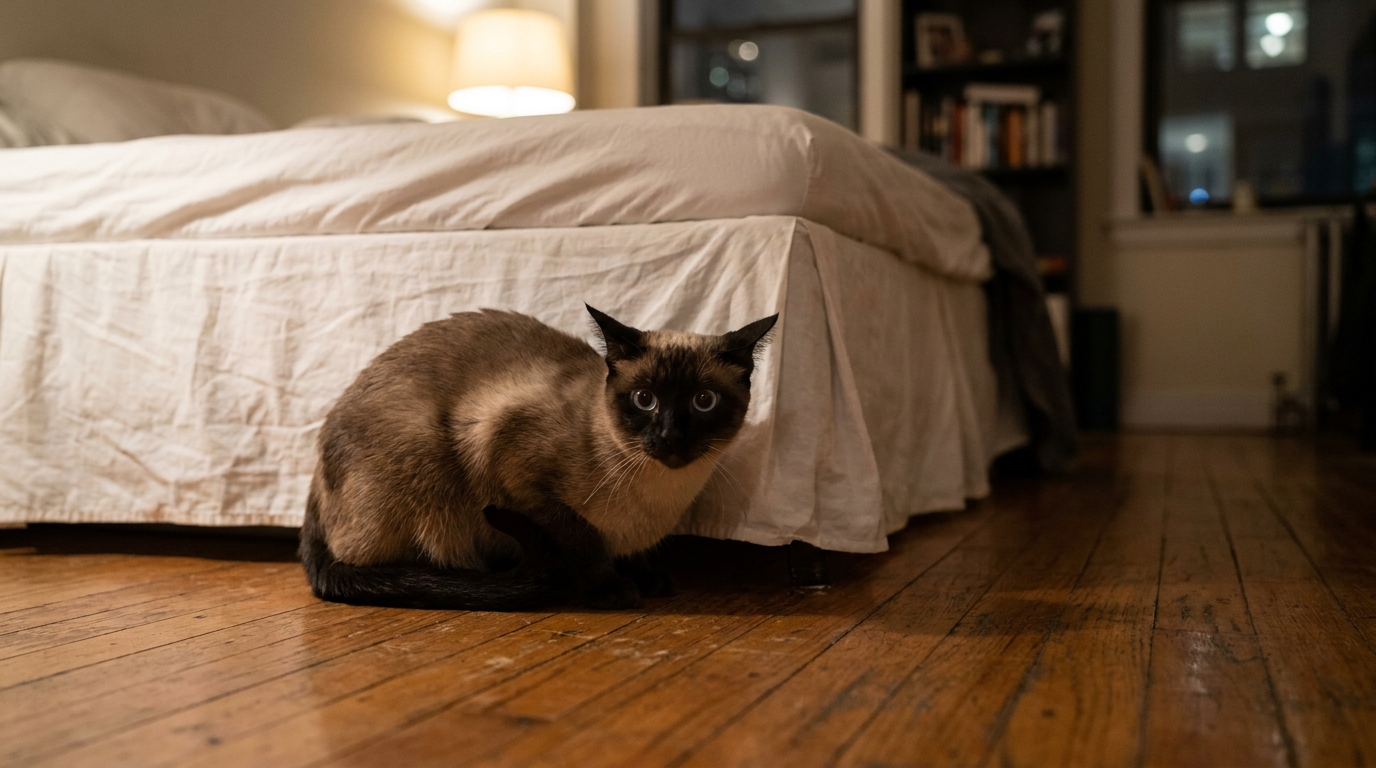
Accidentally stepped on my cat and she hid? Check her breathing, gums and walk tonight; any struggle to breathe means an ER visit now.
Go to an emergency vet now if your cat is breathing with her mouth open or struggling to breathe, has pale, white or bluish gums, collapses or can't get up, drags or won't put weight on a leg, has blood in her eyes, nose or mouth, is wobbly or dazed, has a swollen belly or cries out or flinches whenever she is picked up, or can't pee.
That yowl underfoot is awful, and the guilt is real. What helps her now is a calm look at how she is breathing, moving and behaving.
Accidentally Stepped on My Cat: Why She Ran and Hid
A yowl, a bolt and a hiding spot under the bed can follow a sudden fright, so hiding alone does not prove she is hurt. It does not rule an injury out either, because cats hide pain.
The Cornell Feline Health Center puts it this way: "A cat may want to conceal its disability for fear of alerting a potential predator to its vulnerability." The Merck Veterinary Manual adds: "Some animals hide pain."
The Merck Veterinary Manual notes that "Some common sites of fractures in cats include the thigh bone (femur), pelvis, jaws, and tail vertebrae." It also explains that "Signs of fracture are general and include lameness, pain, and swelling," so a limp on its own cannot tell you whether a bone is broken.
If you stepped on a small kitten, lower your bar for help: have a vet look at her the same night, even if she seems to bounce back.
If the only sore spot seems to be her tail, read our guide to tail injury signs after a door or a tug.
Emergency Signs: Go to an ER Now, Not a Video Call
Take her to an emergency vet now if you see any of these:
- She breathes with her mouth open or is struggling to breathe.
- Her gums are pale, white or bluish.
- She collapses or can't get up.
- She drags a leg, won't use it, or it looks swollen.
- There is blood in her eyes, nose or mouth.
- She is wobbly or seems dazed.
- Her belly looks swollen, or she cries out or flinches whenever she is picked up.
- She can't pee.
On breathing trouble, the Merck Veterinary Manual notes that "Cats might crouch or sit in an upright position." It adds: "Open-mouth breathing and a bluish tinge to the gums or skin indicate severe oxygen loss." VCA's first-aid advice on falls explains that cats are "nose breathers," so "panting is a sign of respiratory distress." A cat who pants after being stepped on needs an emergency vet now.
Watch for shock, too. In Merck's words, "Signs of shock include rapid heart rate, pale gums, low blood pressure, low urine output, and weak pulses." Pale gums are a reason to go now.
VCA's first-aid advice on falls also points out that blood from the eyes, nose or mouth can mean a head injury, and that a cat who cannot get up at all may have a back injury and should be kept as still as possible. The Merck Veterinary Manual lists "Suspected broken bones or a limb that can't move" among the emergencies that need immediate care.
Do not press on or feel her belly to check it. A belly that looks swollen, or a cat who cries whenever she is lifted, is enough reason to go. If you aren't sure whether a sign fits, go now.
A Quick Check You Can Do Without Handling Her Much
If you can see her and none of the emergency signs fit, give her a few minutes to settle and let her come out on her own; do not drag her out. If she is hidden where you cannot see her breathing, cannot get up, or won't come out to be checked, go to an emergency vet now, moving her gently as described below.
Safety first, in the Merck Veterinary Manual's words: "Any injured or painful animal might bite or scratch, so protect yourself first." A normally sweet cat who hisses or swats right now is often hurting or scared. Our article on why a cat suddenly turns aggressive explains more.
Then watch her from a short distance:
- Breathing: is she breathing quietly through her nose while she rests, or with visible effort or her mouth open? Effort or open-mouth breathing means the ER now.
- Gums: only if she lets you lift a lip without a struggle, check that her gums are pink. Pale, white or blue gums mean the ER now. If she objects, don't force it.
- Walking: does she walk on all four legs, or favor one? A leg she holds up or won't use means the ER now; any other limp means an in-person exam now, at an ER if your vet is closed.
- Tail: does she carry her tail the way she usually does?
- Jumping: does she jump onto the couch or bed as she normally would?
If she won't stand or walk, you can't check her gums, or you aren't sure whether she is working to breathe, go to an emergency vet now, not a video call.
Writing about cats with sore joints, the Cornell Feline Health Center notes that a cat in pain "may have trouble hopping in and out of its litter box," and "it may avoid going up and down stairs."
Offer a favorite treat and see whether she eats it. Then film a short clip of her walking across a non-slip floor, her tail, and her breathing while she rests.
Watching Her Tonight and Over the Next Two Days
VCA's first-aid advice on falls, which covers a similar blunt knock, warns: "Some injuries are immediately obvious, while others are not apparent until hours or days after the fall."
Signs to watch for:
- limping or favoring a leg
- skipping the jumps or stairs she usually takes
- carrying her tail differently, or not lifting it
- turning down a favorite treat or eating less than usual
- seeming weak or low on energy, such as sleeping more than usual
Watch the litter box, too. VCA's advice on falls says: "If she does not urinate within 24 hours, or have a normal bowel movement within 48 hours, seek help." Treat any problem peeing as an emergency: if she tries to pee and can't, or has not peed within 24 hours, go to an emergency vet now.
Set her up in one quiet room with food, water and a low-sided litter box, and discourage jumping. Do not give her any human pain reliever or any leftover pet medicine.
Any sign from the emergency list above, including not standing or walking or a swollen leg, and any new weakness or low energy mean an emergency vet now, whenever they appear. Any limp means an in-person exam now, at an ER if your vet is closed. Any other new or worsening sign means a vet the same day. See our guide on a cat limping with no visible injury.
How a Vet Checks an Injured Cat in Person
According to the Merck Veterinary Manual, "The vet will examine your pet fully: listen to the heart and lungs, check the abdomen for pain, and examine limbs for swelling or pain." If a broken bone is suspected, Merck notes that "X-rays are useful in determining the type and extent of the fracture."
What a RexVet Online Vet Can and Cannot Do After You Stepped on Your Cat
If her gums looked pink, her breathing was quiet and she shows no emergency sign or limp, a video visit lets a veterinarian see her tonight. On camera, a vet can:
- watch her walk and see whether she bears weight on every leg
- count her breathing rate and look at how hard she is working to breathe
- look at her gum color if she allows it
- look closely at a paw, toe or tail you point the camera at
- read her posture and pain behavior
- review the clip you filmed
- sort the next step: the ER now, an in-person exam, or quiet rest and watching at home, with a list of signs that change the plan
A video vet cannot feel her belly or ribs, listen to her chest, take x-rays, or treat a fracture or internal injury. Anything that needs hands on her means an in-person exam, and any sign from the emergency list means the ER, not a call.
If the veterinarian decides medication is appropriate, they can prescribe where state rules allow.
If you're sure she has no emergency sign or limp, and you want a vet to watch her walk and posture tonight, you can book a RexVet video visit. A video visit is $64.99, vets are available 24/7, and RexVet's veterinarians are licensed in Florida, New York and Virginia.
Moving Her Safely, and Preventing the Next Misstep
If she needs to go in, call ahead. As Merck puts it, "Emergency care often starts with your phone call to the veterinarian."
Merck advises: "When you need to move your injured pet, minimize movement of its head, neck, and spine." Merck also says: "Wrap cats in a towel to limit movement, and put them in a dark box with breathing holes."
Later, a hallway night light, feeding her before you cook, and sliding your feet when she circles you can help prevent another misstep.
When to Be Seen in Person in Florida, New York or Virginia
Go to an emergency vet now for:
- breathing trouble
- pale, white or blue gums
- collapse, or not being able to get up or walk
- a leg she drags, will not use, or that looks swollen
- blood in her eyes, nose or mouth
- being wobbly or dazed
- a swollen belly, or crying out whenever she is picked up
- not being able to pee, or no pee within 24 hours
- new weakness or low energy
Any limp, even if she still puts weight on the leg, means an in-person exam now, which may include x-rays, at an ER if your vet is closed.
Book a hands-on exam the same day for:
- a tail she stops lifting
- not eating
- no normal bowel movement within 48 hours, per VCA's guidance above
In Florida, a vet who sees your pet by telehealth must give you the contact information for at least one physical veterinary clinic near your location.
If you're sure none of the signs above fit and you want a vet to look at her walk and posture tonight, you can book a video visit with RexVet for $64.99. RexVet's veterinarians are licensed in Florida, New York and Virginia and available 24/7.
Frequently Asked Questions
How do I know if my cat is hurt after I stepped on her?
Watch her breathing, walking, eating and litter box use from a short distance, and, if she lets you lift a lip, check that her gums are pink. Struggling or open-mouth breathing, pale, white or blue gums, collapse or not being able to get up, a leg she drags, won't use or that looks swollen, blood from the eyes, nose or mouth, a wobbly or dazed look, a swollen belly or crying out when she is picked up, or not being able to pee means an emergency vet now; any limp means an in-person exam now, at an ER if your vet is closed. The Cornell Feline Health Center notes that cats may hide a disability, so a quiet cat is not proof that she is unhurt.
My cat is hiding after I stepped on her. Is that normal?
Hiding can follow a fright, but cats also hide pain, so hiding alone does not tell you whether she is hurt. Go to an emergency vet now if she is struggling or breathing with her mouth open, has pale, white or blue gums, collapses or can't get up, drags or won't use a leg, has blood in her eyes, nose or mouth, is wobbly or dazed, has a swollen belly or cries out when picked up, or can't pee, or if she won't come out so you can check her breathing, walk, legs and gums. Do not drag her out; wrap her gently in a towel to move her.
Can a cat have internal injuries that don't show up right away?
Yes. VCA's first-aid advice on falls notes that some injuries only show up hours or days later, so keep watching her breathing, energy, appetite and litter box. Whenever it appears, struggling or open-mouth breathing, pale, white or blue gums, collapse or not being able to get up or walk, a leg she drags, won't put weight on or that looks swollen, new weakness or low energy, blood from the eyes, nose or mouth, a wobbly or dazed look, a swollen belly or crying out when she is picked up, or not being able to pee means an emergency vet now. A new limp means an in-person exam now, at an ER if your vet is closed, and any other new or worsening sign means a vet the same day.
My cat is limping after I stepped on her paw. Can it wait until morning?
No. A limp can mean a broken bone, and the Merck Veterinary Manual lists suspected broken bones among the emergencies that need immediate care. Go to an emergency vet now if she drags the leg or won't put weight on it, the leg looks swollen or she cries out when picked up, or if you see breathing trouble, pale, white or blue gums, collapse, blood from the eyes, nose or mouth, a wobbly or dazed look, a swollen belly, or she can't pee. Even if she is putting weight on the leg, have her examined in person now, at an ER if your vet is closed, rather than waiting for morning or a video call.
Can I give my cat something for the pain tonight?
No. Don't give her a human pain reliever or a leftover pet medicine. Severe pain is an emergency: go to an emergency vet now, just as you would for breathing trouble, pale, white or blue gums, collapse, a leg she drags or won't use, blood from the eyes, nose or mouth, a wobbly or dazed look, a swollen belly or crying out when she is picked up, or not being able to pee. If the veterinarian decides medication is appropriate, they can prescribe where state rules allow.
FAQs
How do I know if my cat is hurt after I stepped on her?
Watch her breathing, walking, eating and litter box use from a short distance, and, if she lets you lift a lip, check that her gums are pink. Struggling or open-mouth breathing, pale, white or blue gums, collapse or not being able to get up, a leg she drags, won't use or that looks swollen, blood from the eyes, nose or mouth, a wobbly or dazed look, a swollen belly or crying out when she is picked up, or not being able to pee means an emergency vet now; any limp means an in-person exam now, at an ER if your vet is closed. The Cornell Feline Health Center notes that cats may hide a disability, so a quiet cat is not proof that she is unhurt.
My cat is hiding after I stepped on her. Is that normal?
Hiding can follow a fright, but cats also hide pain, so hiding alone does not tell you whether she is hurt. Go to an emergency vet now if she is struggling or breathing with her mouth open, has pale, white or blue gums, collapses or can't get up, drags or won't use a leg, has blood in her eyes, nose or mouth, is wobbly or dazed, has a swollen belly or cries out when picked up, or can't pee, or if she won't come out so you can check her breathing, walk, legs and gums. Do not drag her out; wrap her gently in a towel to move her.
Can a cat have internal injuries that don't show up right away?
Yes. VCA's first-aid advice on falls notes that some injuries only show up hours or days later, so keep watching her breathing, energy, appetite and litter box. Whenever it appears, struggling or open-mouth breathing, pale, white or blue gums, collapse or not being able to get up or walk, a leg she drags, won't put weight on or that looks swollen, new weakness or low energy, blood from the eyes, nose or mouth, a wobbly or dazed look, a swollen belly or crying out when she is picked up, or not being able to pee means an emergency vet now. A new limp means an in-person exam now, at an ER if your vet is closed, and any other new or worsening sign means a vet the same day.
My cat is limping after I stepped on her paw. Can it wait until morning?
No. A limp can mean a broken bone, and the Merck Veterinary Manual lists suspected broken bones among the emergencies that need immediate care. Go to an emergency vet now if she drags the leg or won't put weight on it, the leg looks swollen or she cries out when picked up, or if you see breathing trouble, pale, white or blue gums, collapse, blood from the eyes, nose or mouth, a wobbly or dazed look, a swollen belly, or she can't pee. Even if she is putting weight on the leg, have her examined in person now, at an ER if your vet is closed, rather than waiting for morning or a video call.
Can I give my cat something for the pain tonight?
No. Don't give her a human pain reliever or a leftover pet medicine. Severe pain is an emergency: go to an emergency vet now, just as you would for breathing trouble, pale, white or blue gums, collapse, a leg she drags or won't use, blood from the eyes, nose or mouth, a wobbly or dazed look, a swollen belly or crying out when she is picked up, or not being able to pee. If the veterinarian decides medication is appropriate, they can prescribe where state rules allow.
Medically Reviewed
Reviewed by Dr. Tiffany Delacruz, DVM — licensed veterinarian and CEO of RexVet. Last reviewed September 30, 2026.
Content is for informational purposes and does not replace professional veterinary advice.
Chief Executive Officer · Licensed Veterinarian
Dr. Delacruz is a licensed Doctor of Veterinary Medicine specializing in preventive care and veterinary telehealth. She reviews all health content on RexVet to ensure accuracy and clinical relevance.
Sources & References
- · American Veterinary Medical Association — Telehealth Guidelines
- · AVMA — Pet Care Resources
- · U.S. FDA — Animal & Veterinary
Need an Expert Opinion on This Topic?
Connect with a certified vet via video call in minutes
Talk to Vet Now