
Cat Hiding and Not Eating After Guests: Stress or Sick?
By RexVet Team | Reviewed by Dr. Tiffany Delacruz, DVM
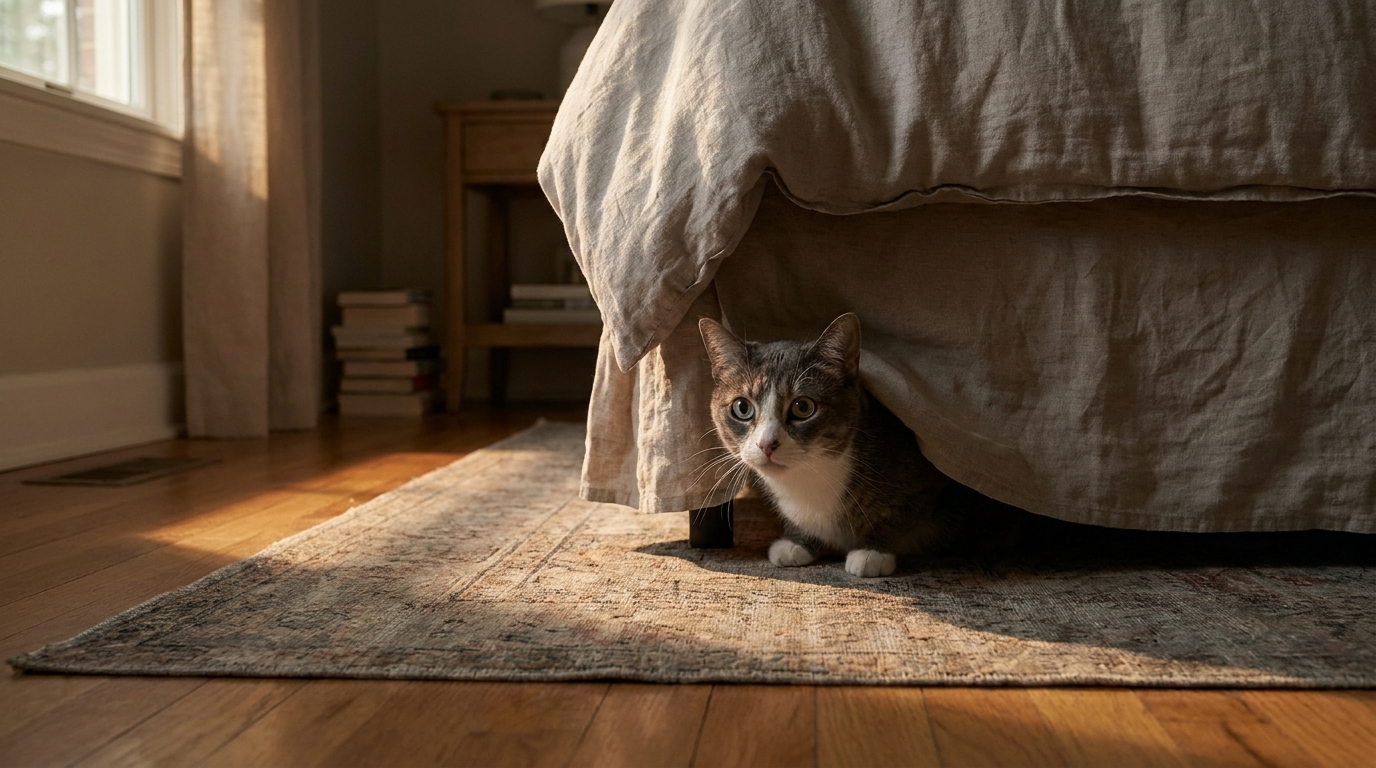
How to tell stress from sickness in a cat hiding from visitors, and which signs mean a vet today or an ER now.
Quick answer: Hiding while guests are over is normal if your cat still eats, drinks and pees once the house is quiet. An adult cat that has eaten nothing for 24 hours, or a kitten that refuses food, needs an in-person vet the same day; senior, overweight or diabetic cats sooner. Any cat straining with little or no urine, especially a male, needs an emergency vet now.
This article is general information, not a diagnosis. If you think your pet is in danger, go to the nearest emergency animal hospital.
Emergency signs: go now, not a video call
A cat needs an emergency vet now for straining with little or no urine; a male making many small trips, passing pink urine or vomiting with a litter-box change; urinary signs while it is also hiding, crying, vomiting or not eating; open-mouth breathing that lasts more than a few minutes or starts again at rest; blue, gray, pale or yellow gums; collapse; any contact with a true lily or daylily, including pollen or vase water; a swallowed string or ribbon; or a swallowed guest's pill.
For a swallowed pill or alcohol, call ASPCA Animal Poison Control at (888) 426-4435 (a consultation fee may apply) or the Pet Poison Helpline at (855) 764-7661 (a per-incident fee applies) on the way. See what lilies do to cats, why swallowed string must never be pulled, and where to go if your vet is closed.
| Sign | Do this |
|---|---|
| Hides, still eats and pees | Let it hide |
| Won't come out to eat or pee | Vet today; ER now if male or no urine |
| No food 24 hours | Vet today; sooner if senior, overweight or diabetic |
| Kitten won't eat | Call a vet now; seen today |
| Weak or cold kitten | ER now |
| Straining, little or no urine | ER now |
| Unsure if peeing at all | ER now |
| Urinary signs plus crying, vomiting or hiding | ER now |
| Many trips, small pees | Male: ER now; others: vet today |
| Pink or bloody urine | Male: ER now; others: vet today |
| Male vomits, litter change | ER now |
| Male licking genitals a lot | ER now |
| No urine in 24 hours | ER now |
| Open-mouth breathing stops within a few minutes | Watch closely; call a vet today |
| Open-mouth breathing keeps going | ER now |
| Labored breathing at rest | ER now |
| Blue, gray, pale or yellow gums | ER now |
| Collapse, cold to touch, wobbly, tremors or seizure | ER now |
| Back legs suddenly drag | ER now |
| Hurt, bleeding, fell, stepped on or caught in a door | ER now |
| Lily, pollen, vase water | ER now |
| Swallowed string or ribbon | ER now; never pull |
| Licked potpourri or oil | ER now, even if fine |
| Drooling or pawing at mouth | ER now |
| Ate a cooked bone | Call a vet now |
| Ate fat, skin or grease, now dull, hiding or eating less | Vet today |
| Gravy or stuffing with onion or garlic | Call a vet or poison line now |
| Raided the trash or carcass | Call a vet now |
| Got a guest's pills or alcohol | ER now; call a poison line on the way |
"Others: vet today" means a cat that is not straining and is out, eating and acting normally.
Why do cats hide when guests come over?
Cats hide from guests because strangers, noise, new smells and a broken routine feel like a threat, and a hiding spot is how a cat copes. Cornell's Feline Health Center notes that many cats "avoid strangers and prefer to hide when guests arrive."
How long will a cat hide when guests visit?
Many cats stay hidden until the guests leave or the house settles, which is fine as long as the cat eats, drinks and pees once it is quiet; an adult cat that hides and eats nothing for 24 hours needs an in-person vet that day. Cornell's Dr. Pamela Perry notes, "Some like to wait till everyone is settled in before coming out from hiding." No set number of hours applies to every cat. A cat still hiding or eating less the next day needs a vet call; one that won't come out even to eat or pee needs an in-person vet today, or an emergency vet now if it is male or you cannot find any fresh urine.
Stress or sick? What to check tonight
To tell stress from sickness in a hiding cat, count meals, check the litter box for normal clumps, look at the gums and watch the breathing: a cat that eats and pees normally once guests leave is likely stressed, one that eats nothing for 24 hours or vomits twice in a day needs an in-person vet today, and one passing little or no urine or with pale, yellow, blue or gray gums needs an emergency vet now.
International Cat Care says stress signs in cats are often very subtle, such as withdrawing and becoming quiet, and lists hiding and not eating normally among signs of longer-term stress. Hiding can also mean illness: Cornell notes that cats with fatty liver disease "become reclusive." Also check whether the cat got into scraps or bones, a guest's pills, potpourri or oils, a lily bouquet or string; slipped outside (vet check today for bite wounds); was shut in a closet; or touched a visiting dog's fresh flea treatment, which Cornell warns can poison cats (poison line now; ER now for twitching, tremors or a seizure).
| Check | Likely stress | Get help |
|---|---|---|
| Food | Eats when quiet | None in 24 hours: vet today |
| Litter | Normal clumps | Tiny or none: ER now |
| Peeing | In the box | Male, small spots: ER now |
| Hiding | Only with guests | Still hiding next day: call a vet |
| Gums | Pink | Pale, blue, gray or yellow: ER now |
| Breathing | Calm at rest | Open-mouth, keeps going: ER now |
| Vomiting | None | 2+ in a day, or once in a senior that isn't eating: vet today |
How long can a cat go without eating when stressed?
An adult cat that has eaten nothing for 24 hours needs an in-person vet that day: Cornell's Feline Health Center says anorexia can have a severe impact on a mature cat's health if it persists for as little as 24 hours, and that for a kitten younger than six weeks of age, food avoidance for just 12 hours can pose a lethal threat. Senior, overweight and diabetic cats need a vet sooner.
The main risk is fatty liver disease (hepatic lipidosis). Cornell's Dr. Sharon Center says more than 90 percent of cases are a secondary consequence of another underlying condition, and that it seems much more common in obese cats. Yellow gums, ears or eye whites mean an emergency vet now. A diabetic cat on insulin that won't eat or vomits needs a call to the prescribing vet before the next dose, or an ER now if weak or wobbly.
How do I get a scared cat to eat while guests are here?
To get a scared cat to eat while guests are over, put its usual food and water near its hiding spot, with the litter box in the same quiet room but away from the food, then close the door and let the cat eat alone. Skip scraps: Cornell says onions and garlic are toxic to cats, meat fat can predispose a cat to pancreatitis and bones can cause blockages (see the cat turkey guide). Never give an appetite stimulant, a human medicine or a supplement on your own.
A guest-day plan for cats
Set up a closed safe room for a cat a few days before guests arrive, with litter, food, water, a bed and a hiding spot, keep meal and play times the same, and ask guests to keep that door shut. Cornell advises a separate room away from guests and making sure the cat is "safely tucked away so he doesn't run out the door." Shut the door for arrivals, departures and busy hours, and keep children and visiting dogs out.
| When | Do this |
|---|---|
| Days before | Set up the safe room |
| At the door | Cat shut in its room; ID on |
| Meal time | No scraps or bones; lidded trash |
| Flowers | No lilies or daylilies inside |
| Guests' bags | Closed and up high |
| After guests | Count meals and clumps; check closets and bags |
Advent to New Year: repeat the plan for every gathering
From the first Sunday of Advent (Nov 29, 2026) through New Year's Day, repeat the same safe-room plan before every gathering, count a cat's meals and litter clumps after each one, and keep chocolate advent calendars, tinsel, ribbon, lily bouquets, candles and potpourri out of the cat's reach. Count the 24 hours without food from the cat's last normal meal; a new gathering never resets it.
Cornell says "chocolate is poisonous to cats and dogs" and that wrappers can be hazardous when swallowed; its Dr. Perry calls swallowed tinsel "very life-threatening," and Cornell advises tying up cords, anchoring the tree and using plain tree water (see the cat Christmas tree guide). Swallowed essential oils can burn a cat's mouth, so keep potpourri lidded; a burned mouth or a swallowed string can look like simple hiding. Give only advent-calendar treats your cat already eats, and use the same safe room on New Year's Eve.
| What happened | Do this |
|---|---|
| Ate chocolate | Call a vet or poison line now |
| Foil or wrapper, then vomits | ER now |
| Tinsel, ribbon or string missing | ER now; never pull or cut it |
| Bit a plugged-in cord | Unplug first; ER now, even if fine |
| Ate glass or a hook | ER now |
| Amaryllis bulb chewed | Poison line now; ER if any signs |
| Poinsettia nibble, cat bright | Watch at home; keep water available; vet today if vomiting repeats |
| Tree water with additives | Call a poison line now |
Peeing outside the box after guests: stress cystitis?
In a male cat, straining, many small pees, small spots or pink urine after guests is an emergency because he may be blocked, and so are urinary signs in any cat that is also hiding, crying, vomiting or not eating; a female cat that is out, eating and acting normally with small, frequent pees can have stress cystitis and needs a vet today, or an ER if no clinic can see the cat today.
Cornell calls a urethral obstruction "an absolute emergency, requiring immediate veterinary treatment," and says the time from complete obstruction until death may be less than twenty-four to forty-eight hours. Males are at greater risk, and stress and changes in routine may also increase the risk. An otherwise well cat peeing outside the box with normal clumps needs a vet today and a clinic urine test (see the stress cystitis guide).
What not to do
Don't drag a hiding cat out, punish accidents, force-feed it, give it any human medicine or a guest's pills, or start a new food or calming product on the holiday itself. Cornell lists aspirin, acetaminophen and ibuprofen among common causes of feline poisoning. Ask a vet before trying a synthetic pheromone diffuser.
When a video visit helps and when it does not
A video visit helps a cat that is hiding and eating less around guests but still eats, drinks and pees, and it does not replace an emergency vet for a cat that is straining, struggling to breathe or ate something dangerous.
For a cat in Florida, New York or Virginia that is hiding and eating less around holiday guests but is still eating some, drinking and passing normal urine, RexVet, a nonprofit online vet service, offers a $64.99 live video visit with a veterinarian licensed in the cat's state, about 8 AM to 11 PM Eastern.
RexVet serves pets located in Florida, New York and Virginia by video visit, and the cat must be in one of those states during the visit. A visit with a licensed RexVet vet fits a cat that is hiding and eating less but still eating, drinking and passing normal clumps; one still picky the next day; a female cat that is out of hiding, eating and acting normally but peeing outside the box with normal-size clumps and no straining; or a cat with past stress-cystitis flares that is well now and needs a plan before the next gathering. A video visit is not a refill of the medicine from the last flare; the veterinarian decides what is appropriate and legal in your pet's state.
On camera, the veterinarian watches the cat and its hiding spot, looks at litter clumps and the safe room, and says whether an in-person exam or tests are needed and how soon. Video cannot rule out pain, illness or a blockage, so an adult cat with no food for 24 hours needs an in-person vet today, and a male with any change in peeing needs an in-person vet today, not video (an ER now if he is straining, making many small trips, leaving small spots, passing pink urine, crying in the box, licking his genitals a lot, vomiting with a litter-box change or passing no urine).
Go to an emergency hospital instead of booking a video call for a cat straining with little or no urine; a male making many small trips, leaving small spots, passing pink urine or vomiting with a litter-box change; urinary signs in a cat that is also hiding, crying, vomiting or not eating; open-mouth breathing that keeps going or labored breathing at rest; pale, blue, gray or yellow gums; any lily contact; a swallowed string; or a swallowed guest's pill.
From RexVet's own visit data across all pets: "Anxiety visits spiked around the Fourth of July: 15% of RexVet visits from June 28 to July 8 named anxiety, compared with 9% during the rest of the summer." And: "28% of RexVet video visits started between 6 PM and 11 PM in the pet owner's local time." These describe past visits, not open slots.
Live slots run about 8 AM to 11 PM ET when a slot is open, with no overnight visits. Thanksgiving Day (Nov 26), Christmas Day and New Year's Day hours are not confirmed, so check the booking page for open slots and go to an emergency hospital if none is open and you are worried.
No prescription is promised. Calming medicines for guest stress in cats are controlled, off-label or human-labeled, so they need an in-person exam first. Florida law (s.474.2021) limits telehealth-only prescriptions to FDA-approved animal drugs used on-label for up to 14 days (1 month for products labeled solely for flea and tick), with no renewal without an in-person exam and no human-labeled, controlled or compounded anti-infective drugs. Federal rules (21 CFR 530.3) require an in-person VCPR for extralabel or human-drug use in all three states; Virginia lets the state exam be electronic, but that federal rule still applies, and New York's rules are unsettled. RexVet is not a pharmacy; a pharmacy transfer fee applies when it sends a prescription to an outside pharmacy.
Need an Expert Opinion on This Topic?
Book a video visit with a licensed vet, evenings and weekends included
See open timesFrequently Asked Questions
My cat has been hiding since our guests left and won't eat. What should I do?
If your adult cat has eaten nothing for 24 hours, it needs an in-person vet today, sooner if it is senior, overweight or diabetic. If it is still eating some, put food and water near the hiding spot and leave it alone. Any cat straining, peeing differently while hiding, or with pale or yellow gums needs an emergency vet now, and so does a male making many small trips or passing pink urine.
Is it normal for a cat not to eat when strangers are in the house?
Sometimes: a skipped meal can be stress, but an adult cat that eats nothing for 24 hours needs an in-person vet that day. Cornell says most fatty liver cases follow another illness, so a cat that stops eating around guests may be sick, not just nervous.
Can I give my cat a calming treat or a guest's medicine?
No: never give a cat a guest's medicine or any human medicine, and ask a vet before any calming treat. If your cat swallowed a guest's pill, go to an emergency vet now and call a poison line on the way.
My cat peed on a guest's bag. Is it stress or a UTI?
A cat peeing outside the box needs a vet today, stress or not; one straining with little or no urine needs an emergency vet now. So does a male leaving small spots or pink urine, or a cat also hiding or not eating. Cornell says urinary signs often have more than one cause, including infection, diet and behavior.
Should I shut my cat in a room for Thanksgiving or Christmas?
Yes, for arrivals, departures and the busiest hours, in a quiet room with its litter box, food, water, bed and a hiding spot. Set it up a few days early, and never leave a cat in a carrier all day.
Can an online vet help my stressed cat in Florida, New York or Virginia?
Yes, if your cat is hiding but still eats, drinks and pees normally; no if it has eaten nothing for 24 hours or is straining. The cat must be in Florida, New York or Virginia during the visit. On camera, the veterinarian can check the cat and say if an in-person exam is needed; urine tests need a clinic. No prescription is promised: calming medicine for guest stress needs an in-person exam first in all three states. Florida limits telehealth-only prescriptions to FDA-approved animal drugs used on-label for up to 14 days (1 month for flea and tick-only products), federal rules require an in-person exam for extralabel or human-drug use, and New York's rules are unsettled.
FAQs
My cat has been hiding since our guests left and won't eat. What should I do?
If your adult cat has eaten nothing for 24 hours, it needs an in-person vet today, sooner if it is senior, overweight or diabetic. If it is still eating some, put food and water near the hiding spot and leave it alone. Any cat straining, peeing differently while hiding, or with pale or yellow gums needs an emergency vet now, and so does a male making many small trips or passing pink urine.
Is it normal for a cat not to eat when strangers are in the house?
Sometimes: a skipped meal can be stress, but an adult cat that eats nothing for 24 hours needs an in-person vet that day. Cornell says most fatty liver cases follow another illness, so a cat that stops eating around guests may be sick, not just nervous.
Can I give my cat a calming treat or a guest's medicine?
No: never give a cat a guest's medicine or any human medicine, and ask a vet before any calming treat. If your cat swallowed a guest's pill, go to an emergency vet now and call a poison line on the way.
My cat peed on a guest's bag. Is it stress or a UTI?
A cat peeing outside the box needs a vet today, stress or not; one straining with little or no urine needs an emergency vet now. So does a male leaving small spots or pink urine, or a cat also hiding or not eating. Cornell says urinary signs often have more than one cause, including infection, diet and behavior.
Should I shut my cat in a room for Thanksgiving or Christmas?
Yes, for arrivals, departures and the busiest hours, in a quiet room with its litter box, food, water, bed and a hiding spot. Set it up a few days early, and never leave a cat in a carrier all day.
Can an online vet help my stressed cat in Florida, New York or Virginia?
Yes, if your cat is hiding but still eats, drinks and pees normally; no if it has eaten nothing for 24 hours or is straining. The cat must be in Florida, New York or Virginia during the visit. On camera, the veterinarian can check the cat and say if an in-person exam is needed; urine tests need a clinic. No prescription is promised: calming medicine for guest stress needs an in-person exam first in all three states. Florida limits telehealth-only prescriptions to FDA-approved animal drugs used on-label for up to 14 days (1 month for flea and tick-only products), federal rules require an in-person exam for extralabel or human-drug use, and New York's rules are unsettled.
Medically Reviewed
Reviewed by Dr. Tiffany Delacruz, DVM — licensed veterinarian and CEO of RexVet. Last reviewed November 21, 2026.
Content is for informational purposes and does not replace professional veterinary advice.
Chief Executive Officer · Licensed Veterinarian
Dr. Delacruz is a licensed Doctor of Veterinary Medicine specializing in preventive care and veterinary telehealth. She reviews all health content on RexVet to ensure accuracy and clinical relevance.
Sources & References
- · American Veterinary Medical Association — Telehealth Guidelines
- · AVMA — Pet Care Resources
- · U.S. FDA — Animal & Veterinary