
Cat Ate a Hair Tie, Rubber Band or String: What to Do
By RexVet Team | Reviewed by Dr. Tiffany Delacruz, DVM
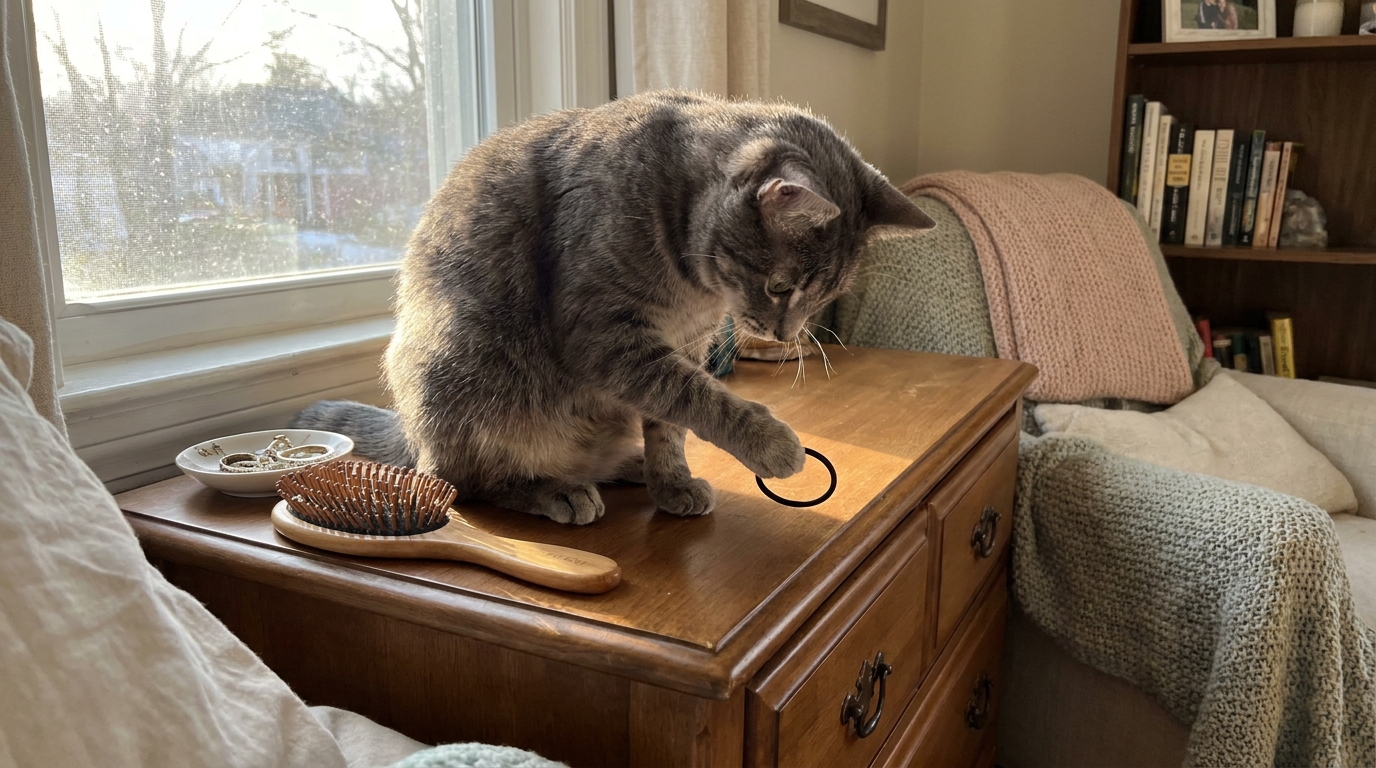
A swallowed hair tie, rubber band or string can block or tear a cat's intestine. What to do now, what to skip and what the emergency vet checks.
Quick answer: If your cat may have swallowed a hair tie, rubber band, string, thread or ribbon, go to an emergency vet now, even if your cat is eating normally; there is no safe time to wait at home. Do not make your cat vomit, and never pull or cut anything hanging from the mouth or bottom. VCA Animal Hospitals calls intestinal tearing the most serious complication of swallowed string.
This article is general information, not a diagnosis. If you think your pet is in danger, go to the nearest emergency animal hospital.
What should I do right now if my cat ate a hair tie?
If a cat ate or may have eaten a hair tie, take it to an emergency vet now and call on the way so the team can get ready. VCA Animal Hospitals advises contacting a veterinarian as soon as possible if you think your cat swallowed a foreign object, and says time is critical. Go even if your cat seems fine.
- Note the time and what is missing, including any broken or chewed pieces.
- Bring a matching tie, the rest of the spool or the packaging.
- Put your cat in a carrier for the trip, and keep it from chewing or swallowing more of any visible strand.
| Home step | Do or skip | Why |
|---|---|---|
| Make cat vomit | Skip | Can cause harm |
| Pull string | Skip | Can tear gut |
| Cut string | Skip | Vet does it |
| Force mouth open | Skip | Bite risk |
| Give bread, oil, pumpkin | Skip | Delays care |
| Wait for poop | Skip | Loses time |
| Bring a matching tie | Do | Helps the vet |
| Remove other ties | Do | Stops repeats |
| Call ER on the way | Do | They prepare |
When does a missing hair tie count as swallowed?
Treat a missing hair tie, rubber band or strand as swallowed if your cat could have reached it, and go to an emergency vet now. You do not need to see it happen: missing thread, yarn, dental floss, curling ribbon or tinsel counts too.
| What you see | What it means | What to do |
|---|---|---|
| Saw it eat a tie | Can block gut | ER now |
| Tie or band missing | Treat as eaten | ER now |
| String at mouth or bottom | May be anchored | ER now; never pull |
| Thread with a needle | Needle can pierce | ER now |
| One tie in poop or vomit | More may remain | ER now |
| Vomits after a possible swallow | Possible blockage | ER now |
| Pale gums, weak or collapsed | Possible shock | ER now |
| Male cat straining in litter box | Urine may be blocked | ER now |
| Nothing missing, vomits 2+ times a day | Needs a check | Vet same day |
| Chewed it, every piece matched | Not swallowed | Watch; hide ties |
If you cannot match every chewed piece back to the whole tie, treat it as swallowed and go to the ER.
The only watch-at-home case is a chewed tie where every piece matches back to the whole tie and your cat is eating, playing and pooping normally; hide every tie and spool of thread afterward. If your cat later vomits, stops eating or seems lethargic, go to the ER now. If a dog in the home also got into the ribbon or string, see what to do when a dog eats string, tinsel or ribbon.
What are the signs of a blockage in a cat?
Vomiting, not eating, dehydration and lethargy are the most common signs of a string-type blockage in cats, VCA Animal Hospitals says; some cats also have belly pain, won't lie down or hide more than usual. VCA also lists diarrhea, straining to poop or passing only small amounts, biting or growling when the belly is handled, and pawing at the mouth when string is wrapped around the base of the tongue. After a possible swallow, any of these signs means the ER now.
A cat that is not vomiting can still have a blockage. The Merck Veterinary Manual says string-type and small objects more often cause a partial blockage, the physical exam may look unremarkable, and vomiting may be less common when the blockage is lower in the small intestine. Cats can seem to cope with a swallowed strand and may show signs for a few days before it is found, according to veterinary surgical proceedings published on VIN.
Trouble breathing, repeated retching with nothing coming up, repeated vomiting with lethargy, a swollen or painful belly, weakness, collapse, or pale, white, blue or gray gums mean the ER now, and so does a male cat straining in the litter box, which can be a urinary blockage.
If nothing could have been swallowed, vomiting more than once in a day, not keeping water down, about 24 hours without food (sooner for a kitten, senior, overweight or diabetic cat), or hiding, hunched or low energy but still alert means an in-person vet the same day; see why a cat throws up white foam.
Should I pull string or a band hanging from my cat's mouth or bottom?
No; never pull string, thread or a band hanging from a cat's mouth or bottom; leave it and go to an emergency vet now. The Merck Veterinary Manual says a string anchored in the mouth must never be pulled, and VCA Animal Hospitals warns not to pull ribbon or tinsel coming out of a cat's bottom. Merck explains that a strand in the mouth may be embedded in the tissue and pulling can perforate the gut; the veterinarian cuts it at its anchor point, so do not cut it yourself. Don't force your cat's mouth open to look; the emergency vet will check under the tongue.
Even when a vet cuts the strand, that is often not the end: Vet Times reports that in one older study (Basher and Fowler, 1987), 10 of 19 cats whose tongue-anchored thread was cut and who were then watched in hospital still needed surgery.
Should I make my cat throw up?
No; the ASPCA says hydrogen peroxide should not be given to cats, and there is no safe way to make a cat vomit at home. The ASPCA also says a finger or object pushed down a pet's throat can injure it. Do not try to push the object through with bread, pumpkin, oil, laxatives or hairball paste either; they only delay care.
Will a cat pass a hair tie or rubber band on its own?
A cat may pass a hair tie or rubber band, but nobody can tell from home which one will stick, so take your cat to an emergency vet now instead of waiting. When an object might pass, VCA Animal Hospitals says a vet may keep the cat in the hospital for close observation and follow-up X-rays.
If a vet decides to watch an object seen on X-ray in a stable pet, the Merck Veterinary Manual says it should come out if it fails to pass, stops moving or the pet gets worse. That is a decision made under a vet's care, never a home wait, and it does not apply to string, thread or a broken band. Going now gives the vet the best chance of reaching a tie while it is still in the stomach.
A case from the UK veterinary press: Vet Times reported in September 2023 on an eight-year-old cat in North Yorkshire that kept vomiting and had already passed two hair bands. Emergency surgery removed a clump of 43 tangled hair ties, and the cat made a full recovery. Passing one or two ties does not mean the rest will pass.
Why are string, thread and broken bands so dangerous for cats?
String, thread and broken bands are dangerous for cats because one end can catch under the tongue or in the stomach while the intestine bunches up along the rest, and VCA Animal Hospitals says the sawing strand can tear the intestinal wall. Leaking gut contents then cause peritonitis, and VCA names this tearing (perforation) as the most serious possible complication. VCA says string-type (linear) foreign bodies such as string, yarn and tinsel are seen most often in cats, and Vet Times lists hairbands and rubber bands among foreign bodies vets remove from cats.
RexVet's dog blockage guide sends a dog that swallowed a hair tie to a vet in person now; a cat goes straight to the ER because the Merck Veterinary Manual says cats are more likely than dogs to develop intestinal obstruction from a linear foreign body, and VCA Animal Hospitals says the spines on a cat's tongue make thread hard to spit out.
Neither Merck nor VCA classes a whole hair tie as string, so going to the ER for a whole tie is this guide's own cautious rule. Merck calls a gut obstruction an emergency and says very small objects can block a small cat's gut. A snapped band can also leave thin strands that act like string.
What will the emergency vet do?
An emergency vet will usually check under a cat's tongue and take X-rays, adding an ultrasound if the X-rays are unclear, then remove the object or watch it in the hospital. X-rays are the usual first test, VCA Animal Hospitals says; the strand itself may not show, but bunched intestine can, and bloodwork is likely.
Endoscopy is typically limited to objects still in the stomach, and the Merck Veterinary Manual says it should not be used when a string-type object is suspected; objects past the stomach that must come out need surgery.
VCA says cats typically stay in hospital one to three days after a string-type object is removed. VCA also says most leaks show within the first 72 hours; the Merck Veterinary Manual says intestinal incisions most commonly break down 3 to 5 days after surgery, so leak signs on any day after discharge mean going straight back. Leak signs include vomiting, a swollen or painful belly, lethargy or not eating.
Ask the hospital for an estimate.
Why do cats eat hair ties, and how do I stop it?
Cats tend to swallow string-type objects while playing with them, the Merck Veterinary Manual says, and some cats chew from pica, which VCA Animal Hospitals links to conditions such as anemia, diabetes and hyperthyroidism. A cat that keeps chewing deserves a vet check; see why cats chew plastic bags and cords for the causes to rule out.
VCA recommends supervision, enrichment and barriers. In practice:
- Keep hair ties and rubber bands in a closed drawer or lidded bin.
- Store sewing kits, yarn, thread and dental floss behind a closed door or lid.
- Put away curling ribbon, gift wrap and tinsel from Thanksgiving through New Year's; see keeping a cat safe around the tree and tinsel.
- Use wand and string toys only while you are watching, then put them away.
- Give your cat daily play sessions and puzzle feeders.
When a video visit helps and when it does not
A cat that may have swallowed a hair tie, rubber band, string or ribbon needs an emergency vet in person now: a video visit cannot look under the tongue, feel the belly or take X-rays, so do not book one instead of going.
RexVet, a nonprofit online vet service, serves pets located in Florida, New York and Virginia by video visit. A $64.99 live video visit with a licensed RexVet vet, a veterinarian licensed in your pet's state, is offered about 8 AM to 11 PM ET when a slot is open. It can fit in two situations:
- Every tie and strand is accounted for, every chewed piece matches, and your cat is eating, playing and pooping normally, but you want a plan for a cat that keeps chewing ties, cords or plastic. The veterinarian can talk through prevention and enrichment and say whether pica needs in-person tests; any medicine for the chewing habit itself needs an in-person exam first.
- After the emergency visit or surgery, you have questions about the e-collar, activity limits or the home set-up while you follow the hospital's discharge instructions. Any drop in appetite or worry about the incision goes to the surgical hospital first, and pain medicine after surgery comes from the surgical hospital. Vomiting, a swollen or painful belly, lethargy or not eating after surgery means going straight back to the surgical hospital or an ER.
Not a fit: anything stringy or elastic may have been swallowed, something is hanging from the mouth or bottom, or a cat that could have reached a tie, band or string is vomiting, not eating, has belly pain, is lethargic or is hiding: go to the nearest emergency vet now.
No prescription is promised; any medicine is the veterinarian's decision after the visit and subject to state rules, covered in the last FAQ below. RexVet is not a pharmacy; a pharmacy transfer fee applies when RexVet sends a prescription to an outside pharmacy.
If one of those two fits, you can book a video visit with a licensed RexVet vet.
Need an Expert Opinion on This Topic?
Book a video visit with a licensed vet, evenings and weekends included
See open timesFrequently Asked Questions
Will my cat poop out a hair tie?
Sometimes, but nobody can tell from home which hair tie will pass, so a cat that may have swallowed one needs an emergency vet now. Any watching happens in the hospital under a vet's care, not at the litter box.
How long does it take a cat to pass a hair tie or rubber band?
There is no safe time to wait at home; only a vet with X-rays or ultrasound can tell whether a rubber band is moving. A band can stay in the stomach, lodge in the intestine, or break into strands that act like string. Go to an emergency vet now and bring a matching band.
My cat ate a hair tie or string but is acting normal. Do I really need the emergency vet tonight?
Yes; acting normal does not rule out a blockage, so take your cat to an emergency vet now. A cat that is not vomiting can still have a blockage, and the Merck Veterinary Manual says the exam may look unremarkable.
Can a cat die from eating a hair tie?
Yes, a blockage or torn intestine can kill a cat, so go to an emergency vet now. VCA Animal Hospitals says peritonitis from a torn intestine can be life-threatening, but the Merck Veterinary Manual says the outcome is good when a blockage is treated quickly, and removal by endoscope or surgery has a high survival rate.
Is a small or broken rubber band safer if my cat or kitten swallows it?
No; a broken band can act like string, and the Merck Veterinary Manual says even very small objects can block a small cat's gut. Merck also says young cats are more likely than older cats to develop a foreign-body blockage, so a kitten that may have swallowed any piece goes to the ER now, the same as an adult.
My cat swallowed thread with a needle. What should I do?
Go to an emergency vet now and bring the sewing kit. VCA Animal Hospitals says a needle attached to thread can pierce the stomach or intestine and stop the thread from passing. A needle missing from a sewing kit counts too.
My cat threw up a hair tie. Does that mean it's over?
Not necessarily; one tie coming up does not show that none remain, so take your cat to an emergency vet now. In the 2023 case Vet Times reported, the cat had already passed two hair bands and surgery still removed 43 more. Keep the tie that came up and bring it with you.
Can an online vet help if my cat swallowed a hair tie?
No; a video visit cannot X-ray, feel the belly or check under the tongue, so a possibly swallowed hair tie means an emergency vet now. For a pet located in Florida, New York or Virginia, a licensed RexVet vet (a veterinarian licensed in your pet's state) can help with prevention and aftercare, not the emergency itself: a prevention plan once every piece is accounted for, or e-collar and home set-up questions after surgery. A belly exam, X-rays, ultrasound and surgery need an in-person or emergency vet. If medicine comes up, it is the veterinarian's decision. In Florida, a prescription based only on a video visit is limited to FDA-approved animal drugs used as labeled, for up to 14 days (1 month for products labeled only for fleas and ticks), with no renewal until an in-person exam, and no human-labeled, controlled or compounded anti-infective drugs. Federal rules require an in-person exam before a vet uses a human or off-label drug. Virginia lets the exam happen electronically. New York's rules for video care are not settled, so a visit there may cover less.
FAQs
Will my cat poop out a hair tie?
Sometimes, but nobody can tell from home which hair tie will pass, so a cat that may have swallowed one needs an emergency vet now. Any watching happens in the hospital under a vet's care, not at the litter box.
How long does it take a cat to pass a hair tie or rubber band?
There is no safe time to wait at home; only a vet with X-rays or ultrasound can tell whether a rubber band is moving. A band can stay in the stomach, lodge in the intestine, or break into strands that act like string. Go to an emergency vet now and bring a matching band.
My cat ate a hair tie or string but is acting normal. Do I really need the emergency vet tonight?
Yes; acting normal does not rule out a blockage, so take your cat to an emergency vet now. A cat that is not vomiting can still have a blockage, and the Merck Veterinary Manual says the exam may look unremarkable.
Can a cat die from eating a hair tie?
Yes, a blockage or torn intestine can kill a cat, so go to an emergency vet now. VCA Animal Hospitals says peritonitis from a torn intestine can be life-threatening, but the Merck Veterinary Manual says the outcome is good when a blockage is treated quickly, and removal by endoscope or surgery has a high survival rate.
Is a small or broken rubber band safer if my cat or kitten swallows it?
No; a broken band can act like string, and the Merck Veterinary Manual says even very small objects can block a small cat's gut. Merck also says young cats are more likely than older cats to develop a foreign-body blockage, so a kitten that may have swallowed any piece goes to the ER now, the same as an adult.
My cat swallowed thread with a needle. What should I do?
Go to an emergency vet now and bring the sewing kit. VCA Animal Hospitals says a needle attached to thread can pierce the stomach or intestine and stop the thread from passing. A needle missing from a sewing kit counts too.
My cat threw up a hair tie. Does that mean it's over?
Not necessarily; one tie coming up does not show that none remain, so take your cat to an emergency vet now. In the 2023 case Vet Times reported, the cat had already passed two hair bands and surgery still removed 43 more. Keep the tie that came up and bring it with you.
Can an online vet help if my cat swallowed a hair tie?
No; a video visit cannot X-ray, feel the belly or check under the tongue, so a possibly swallowed hair tie means an emergency vet now. For a pet located in Florida, New York or Virginia, a licensed RexVet vet (a veterinarian licensed in your pet's state) can help with prevention and aftercare, not the emergency itself: a prevention plan once every piece is accounted for, or e-collar and home set-up questions after surgery. A belly exam, X-rays, ultrasound and surgery need an in-person or emergency vet. If medicine comes up, it is the veterinarian's decision. In Florida, a prescription based only on a video visit is limited to FDA-approved animal drugs used as labeled, for up to 14 days (1 month for products labeled only for fleas and ticks), with no renewal until an in-person exam, and no human-labeled, controlled or compounded anti-infective drugs. Federal rules require an in-person exam before a vet uses a human or off-label drug. Virginia lets the exam happen electronically. New York's rules for video care are not settled, so a visit there may cover less.
Medically Reviewed
Reviewed by Dr. Tiffany Delacruz, DVM — licensed veterinarian and CEO of RexVet. Last reviewed November 5, 2026.
Content is for informational purposes and does not replace professional veterinary advice.
Chief Executive Officer · Licensed Veterinarian
Dr. Delacruz is a licensed Doctor of Veterinary Medicine specializing in preventive care and veterinary telehealth. She reviews all health content on RexVet to ensure accuracy and clinical relevance.
Sources & References
- · American Veterinary Medical Association — Telehealth Guidelines
- · AVMA — Pet Care Resources
- · U.S. FDA — Animal & Veterinary