
Can Cats Eat Turkey? Skin, Bones, Deli Meat and When to Call a Vet
By RexVet Team | Reviewed by Dr. Tiffany Delacruz, DVM
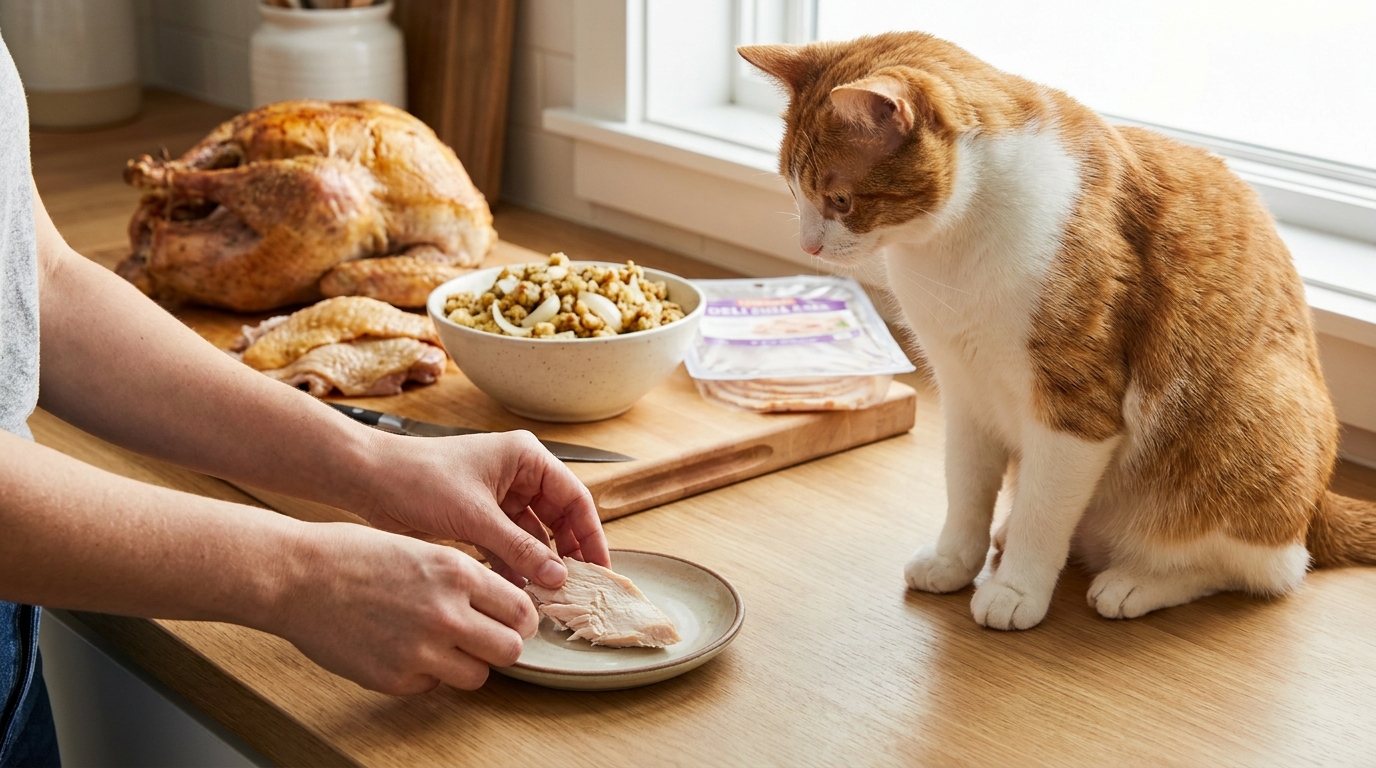
A very small piece of plain cooked turkey is fine for most cats. Skin, bones, deli slices, gravy and the string around the roast are not.
Quick answer: Yes, as a very small, occasional treat: plain, cooked, boneless, skinless turkey breast, never a meal. Skip skin, fat, gravy, stuffing, deli turkey and anything with onion or garlic. If your cat swallowed string, twine or a bone, call a vet now; for onion or garlic, call a poison line or vet now, before any signs. Vomiting more than once in a day, or about 24 hours without food, needs a same-day vet.
This article is general information, not a diagnosis. If you think your pet is in danger, go to the nearest emergency animal hospital.
Which parts of a turkey are safe for cats?
Can cats have turkey at all? The Cornell Feline Health Center says a very small piece of lean turkey is likely OK as a special treat.
| Turkey part | OK for cats? | Why |
|---|---|---|
| Plain cooked breast, no skin or seasoning | Yes, a very small piece | Lean; a treat, not a meal (Cornell, WSAVA) |
| Dark meat | A small bite at most | Fattier; fatty foods can upset the stomach (VCA) |
| Skin, fat or grease | No | Rich; can upset the stomach; linked to pancreatitis (FDA) |
| Bones, cooked or raw, neck, wishbone | No | Can lodge in the throat or block the gut (Merck, Cornell, WSAVA) |
| Giblets, cooked plain | A tiny piece, rarely | Liver is high in vitamin A; a liver-heavy diet harms bones (Merck) |
| Raw turkey or raw giblets | No | Salmonella and Listeria risk to cats and people (CDC, FDA) |
| Deli turkey, lunch meat, slices | No | Salty; some are seasoned with onion or garlic |
| Turkey bacon, sausage, pepperoni, jerky | No | Salty, fatty and often seasoned |
| Gravy, stuffing, drippings | No | Often contain onion or garlic, plus fat |
| Cat food or cat treats made with turkey | Yes | Made for cats; treats still count toward the day's total (WSAVA) |
Some deli turkeys, usually seasoned or rotisserie styles, are coated with dehydrated onion and garlic. Under federal rules (9 CFR 381.118), "natural flavor" on a poultry label can stand for powdered onion or garlic, and some enhanced or self-basting whole turkeys list it, so check the label.
Signs that mean an emergency vet now
Go to an emergency vet now, without waiting for things to settle, for any of these:
- String, twine, ribbon or roast netting at the mouth, under the tongue or under the tail. Don't pull it or cut it.
- Gagging, heavy drooling, pawing at the mouth, bringing food back up or swallowing over and over after a bone.
- Vomiting again and again, or retching that brings nothing up.
- A hunched posture, a tense or painful belly, no bowel movements after a bone or string, vomit with blood or coffee-ground bits, or black, tarry stool.
- Straining in the litter box. If little or no urine comes out, especially in a male cat, it may be a urinary blockage rather than constipation from a bone.
- Any contact with a true lily or daylily, including pollen on the fur or vase water. Go before signs appear. If you can't tell what kind of lily it was, treat it as a true lily.
- Fast, labored or open-mouth breathing, weakness, collapse, pale or yellow gums, or red-brown urine, including days after eating onion or garlic.
- Hiding, low energy and no appetite after a trash or carcass raid.
For onion, garlic, a lily or another toxin, call a poison line on the way: ASPCA Animal Poison Control at (888) 426-4435 (a consultation fee may apply) or Pet Poison Helpline at (855) 764-7661 (a per-incident fee applies).
My cat already ate turkey: what to do now
If several rows fit, follow the most urgent one.
| What your cat got into | What to do | How fast |
|---|---|---|
| A few bites of plain cooked meat | Watch as usual | No rush |
| Skin, fat or grease | No more treats; same-day vet if dull, hiding, eating less or vomiting more than once in a day | Watch several days |
| Gravy or stuffing that may contain onion or garlic | Call a poison line or vet; don't make your cat vomit; watch gums, energy, urine | Now, then several days |
| Cooked or raw bone, not choking | Call a vet; no home vomiting, no bread or pumpkin | Now |
| Gagging, drooling or pawing at the mouth | Emergency vet | Now |
| String or twine at the mouth or under the tail | Don't pull or cut it; emergency vet | Now |
| Swallowed string, twine or netting, nothing showing | Call a vet even with no signs | Now |
| Trash or carcass raid | Call a vet; don't just watch | Now |
| Raw turkey or raw giblets | Watch for vomiting or diarrhea; clean surfaces, wash hands | Several days |
| Any lily from a bouquet (pollen, vase water) | Emergency vet; call a poison line on the way | Now |
Don't make your cat vomit: hydrogen peroxide is never safe for cats, and neither are salt, ipecac or activated charcoal at home. Don't pull or cut string, or give bread, rice, pumpkin, oil, a laxative or hairball paste to help a bone or string pass. For any bone, call a vet: the Merck Veterinary Manual notes that bones are the most common objects stuck in a cat's esophagus and can tear it, and a bone stuck there must be removed by a vet as soon as possible.
See a vet in person the same day if vomit comes up more than once in a day, your cat can't keep water down, or it has gone about 24 hours without food (sooner for a kitten, senior, overweight or diabetic cat). That is our own cautious line, as in the guide to a cat throwing up white foam; VCA Animal Hospitals gives the same 24-hour advice.
Thanksgiving dangers that aren't the meat
String, twine and netting. VCA and Pet Poison Helpline both warn that turkey trussing twine can get stuck in the digestive tract. Merck explains that swallowed string may anchor under the tongue while the rest moves down the gut, and the American College of Veterinary Surgeons (ACVS) says strings can make holes in the intestines and may show at the anus. VCA lists vomiting, refusing food, belly pain, lethargy and hiding as signs. If you see string, don't pull or cut it; go to a vet now. As a RexVet precaution, leave string at the tail end alone too. Bin roast netting, oven-bag ties, greasy foil and the pop-up timer right away.
Trash raids. An open bin can serve bones, twine, drippings and onion stuffing at once, so call a vet now if your cat got in, and keep the carcass in a lidded bin.
Onion and garlic in the sides. The ASPCA notes these are common in Thanksgiving dishes. Many store-bought turkey gravies and stuffing mixes list onion powder or dried onion, so read the label.
Lilies in the centerpiece. VCA warns that holiday arrangements may hold lilies. The ASPCA says true lilies (Easter, Asiatic, Stargazer, Oriental, tiger) and daylilies can cause kidney failure in cats; every part is toxic, including pollen and vase water, and delayed treatment is often fatal. Go to an emergency vet after any contact, without waiting for signs. Peace and Peruvian lilies don't cause that kidney failure but can upset the mouth or stomach; lily of the valley is a different, serious heart poison and also an emergency.
Onion and garlic: why fine tonight isn't the all-clear
Onion, garlic, chives, leeks and shallots damage red blood cells and cause Heinz body hemolytic anemia. Merck says cats are the most susceptible species, followed by dogs.
Stomach upset such as vomiting or diarrhea can come early (the ASPCA notes onion and garlic irritate the stomach), but Merck says red cells typically break down 3 to 5 days after exposure, so a cat that seems fine tonight is not in the clear. Call a poison line or your vet as soon as you know, before any signs, and follow their plan.
Onion and garlic stay toxic cooked, dried or powdered. Concentrated forms such as onion powder, dehydrated flakes and dry onion soup mix are most often involved, and garlic is about 3 to 5 times more toxic than onion (Merck). For several days, watch for tiredness, not eating, fast breathing, a racing heartbeat, weakness, pale or yellow gums and red-brown urine; any of these means an emergency vet. The onion and garlic guide has more detail, including a section on cats.
Turkey skin, fat and pancreatitis: what's known in cats
The FDA advises skipping high-fat scraps such as fat trimmings and roasted turkey skin, because rich foods can upset the stomach and have been linked to pancreatitis, and it notes the signs are harder to notice in cats.
But the Cornell Feline Health Center reports that over 95% of feline pancreatitis cases have no obvious underlying cause, and the most common signs are vague: lethargy and eating less. Only about half of affected cats vomit or lose weight. So don't wait for vomiting. A cat that seems dull, hides, eats less or stops grooming after a rich meal needs a vet the same day.
Why not eating is its own risk
A cat that goes off its food can develop hepatic lipidosis (fatty liver), which Merck calls the most common acquired and potentially lethal liver disease in cats. Cornell says it is almost always preceded or accompanied by loss of appetite, is much more common in overweight cats, and is likely to be fatal if not treated promptly. That is why about 24 hours without food means a same-day vet, whatever the cause.
How much turkey can a cat have, and how to serve it
WSAVA's guide to cat treats says treats should be a small part of the diet and never replace a complete and balanced meal; for many cats, even a small serving of lean turkey breast could use up the whole day's treat allowance. Follow Cornell: a very small piece, as a special treat, not every day.
Turkey can't replace cat food. Meat contains taurine, but cats need taurine, arachidonic acid and preformed vitamin A in the right balance (Merck), which a complete cat food supplies and a single meat doesn't.
- Use breast meat cooked through, with no rub, butter, gravy or seasoning.
- Remove all skin, fat, bone and twine.
- Offer one very small, cooled piece, then put the rest away and bin the carcass.
Skip raw turkey. The CDC does not recommend raw food or treats for cats, because raw meat can carry Salmonella and Listeria, which also threaten children under 5, adults 65 and older, pregnant women and people with weakened immune systems. Clean surfaces raw turkey touched and wash your hands (CDC, FDA). If you have a dog too, the dog version of this guide covers its risks.
Cats that need a vet's OK first
WSAVA says regular treats may not suit a cat with a medical condition or dietary sensitivity, or on a vet-prescribed diet. Ask your vet first if your cat:
- Has kidney disease. Cornell calls diet change an important, proven part of treating chronic kidney disease.
- Eats a urinary, thyroid or hydrolyzed diet, or is in a food-elimination trial. WSAVA's prescribed-diet advice applies.
- Has IBD. Merck says no treats of any kind on an IBD diet unless the vet approves.
- Has diabetes or is on a weight plan. A cat on insulin that vomits or skips a meal needs your vet's missed-meal plan; don't give the next injection until a vet says to. If your cat takes a daily oral diabetes medicine instead of insulin, eating less, vomiting, diarrhea, tiredness or weakness means stop the medicine and call the prescribing vet now. See the cat diabetes guide for warning signs.
- Has had pancreatitis. Skip skin and fat completely.
- Is a kitten. Kittens need complete kitten food. Merck notes that vitamin A toxicity can occur when growing kittens are fed a diet high in liver, with bone changes in the neck.
When a video visit helps
If your cat got into a little turkey skin or grease (no onion or garlic gravy or stuffing, no bone, no string) and is a bit off but not in crisis, a $64.99 live video visit with Dr. Tiffany Delacruz, DVM, can help you decide between watching at home and an in-person exam, and what to watch for over the next few days. For example, it vomited once, or it skipped one meal but is drinking, using the litter box and acting mostly like itself. About 24 hours without food (sooner for a kitten, senior, overweight or diabetic cat) or vomiting more than once in a day means an in-person vet the same day. If your cat is on insulin and skipped its usual meal, follow your vet's missed-meal plan or call the prescribing vet before the next dose.
If the gravy or stuffing may have had onion or garlic, call a poison line or your vet first and follow their plan, including any in-person exam or blood test. Don't make your cat vomit at home. A video visit can't test red blood cells, but it can help with questions during the several-day watch.
RexVet is a 501(c)(3) nonprofit. Dr. Delacruz is licensed in Florida, New York and Virginia, so your cat must be in one of those states at the time of the call. Slots usually run about 8 AM to 11 PM ET. Thanksgiving availability isn't confirmed, so check open slots when you book a live video visit. Traveling elsewhere for the holiday? Use a local vet or emergency clinic.
A video visit is the wrong call for string at the mouth or under the tail (don't pull or cut it), gagging, drooling or pawing at the mouth after a bone, repeated retching, straining in the litter box, a painful belly, any lily contact, weakness, fast breathing, pale or yellow gums, red-brown urine or collapse. Go to an emergency vet now, and for a toxin, call a poison line on the way: ASPCA Animal Poison Control, (888) 426-4435 (a consultation fee may apply), or Pet Poison Helpline, (855) 764-7661 (a per-incident fee applies). Both poison lines answer 24 hours a day; RexVet's video visits do not.
No prescription is promised. Many anti-nausea options for cats are clinic injections or are used off-label, which federal rules allow only after an in-person exam. If Dr. Delacruz prescribes something and sends it to an outside pharmacy, a pharmacy transfer fee applies (Terms 5.4); RexVet is not a pharmacy.
Need an Expert Opinion on This Topic?
Book a video visit with a licensed vet, evenings and weekends included
See open timesFrequently Asked Questions
Can cats eat turkey lunch meat?
Better to skip it. Deli turkey is salty, and some seasoned or rotisserie styles contain onion and garlic, which "natural flavor" on a label can hide. If it had onion or garlic, or you can't tell, call a poison line or your vet now.
Is turkey bacon safe for cats?
No. Turkey bacon, sausage, pepperoni and jerky are salty, fatty and often seasoned. See a vet the same day if your cat vomits more than once in a day or stops eating afterwards, and call a poison line or your vet now if the label lists onion or garlic.
Can cats eat raw turkey necks or raw giblets?
No. The CDC does not recommend raw food or treats for cats because raw poultry can carry Salmonella and Listeria, and WSAVA warns that bones, cooked or raw, can be very dangerous. If your cat swallowed any bone, even raw, call a vet now; otherwise watch for vomiting or diarrhea and clean up well.
Can kittens eat turkey?
Kittens need complete kitten food, so turkey is an extra they don't need. Ask your vet before offering even a very small piece of plain cooked breast, and never make liver a regular food (Merck). A kitten that skips meals needs a vet sooner than an adult.
What if my cat ate a turkey bone?
Call a vet now, even if your cat seems fine: bones can lodge in the throat or block the gut (Merck, Cornell). Don't make your cat vomit or feed it bread. Gagging, drooling or pawing at the mouth means an emergency vet.
Can cats eat turkey every day?
Not as a habit. WSAVA notes that for many cats, even a small serving of lean turkey breast could use up the whole day's treat allowance. A very small piece on a holiday is fine for most healthy adult cats.
Is turkey OK for cats with kidney disease?
Ask your vet first. Cornell says kidney diets limit protein, phosphorus and sodium and are a proven part of treatment. WSAVA says regular treats may not suit a cat on a vet-prescribed diet.
Can I talk to a vet online if my cat ate turkey?
Sometimes. If your cat is in Florida, New York or Virginia at the time of the call and is a little off but not in crisis, a RexVet video visit can help you plan the next few days (see "When a video visit helps"). String, any swallowed bone, onion or garlic, a lily, a painful belly or vomiting again and again need in-person care now or a poison line, not a video visit.
FAQs
Can cats eat turkey lunch meat?
Better to skip it. Deli turkey is salty, and some seasoned or rotisserie styles contain onion and garlic, which "natural flavor" on a label can hide. If it had onion or garlic, or you can't tell, call a poison line or your vet now.
Is turkey bacon safe for cats?
No. Turkey bacon, sausage, pepperoni and jerky are salty, fatty and often seasoned. See a vet the same day if your cat vomits more than once in a day or stops eating afterwards, and call a poison line or your vet now if the label lists onion or garlic.
Can cats eat raw turkey necks or raw giblets?
No. The CDC does not recommend raw food or treats for cats because raw poultry can carry Salmonella and Listeria, and WSAVA warns that bones, cooked or raw, can be very dangerous. If your cat swallowed any bone, even raw, call a vet now; otherwise watch for vomiting or diarrhea and clean up well.
Can kittens eat turkey?
Kittens need complete kitten food, so turkey is an extra they don't need. Ask your vet before offering even a very small piece of plain cooked breast, and never make liver a regular food (Merck). A kitten that skips meals needs a vet sooner than an adult.
What if my cat ate a turkey bone?
Call a vet now, even if your cat seems fine: bones can lodge in the throat or block the gut (Merck, Cornell). Don't make your cat vomit or feed it bread. Gagging, drooling or pawing at the mouth means an emergency vet.
Can cats eat turkey every day?
Not as a habit. WSAVA notes that for many cats, even a small serving of lean turkey breast could use up the whole day's treat allowance. A very small piece on a holiday is fine for most healthy adult cats.
Is turkey OK for cats with kidney disease?
Ask your vet first. Cornell says kidney diets limit protein, phosphorus and sodium and are a proven part of treatment. WSAVA says regular treats may not suit a cat on a vet-prescribed diet.
Can I talk to a vet online if my cat ate turkey?
Sometimes. If your cat is in Florida, New York or Virginia at the time of the call and is a little off but not in crisis, a RexVet video visit can help you plan the next few days (see "When a video visit helps"). String, any swallowed bone, onion or garlic, a lily, a painful belly or vomiting again and again need in-person care now or a poison line, not a video visit.
Medically Reviewed
Reviewed by Dr. Tiffany Delacruz, DVM — licensed veterinarian and CEO of RexVet. Last reviewed October 23, 2026.
Content is for informational purposes and does not replace professional veterinary advice.
Chief Executive Officer · Licensed Veterinarian
Dr. Delacruz is a licensed Doctor of Veterinary Medicine specializing in preventive care and veterinary telehealth. She reviews all health content on RexVet to ensure accuracy and clinical relevance.
Sources & References
- · American Veterinary Medical Association — Telehealth Guidelines
- · AVMA — Pet Care Resources
- · U.S. FDA — Animal & Veterinary