
Can Dogs Eat Cranberries? Sauce, Dried, Juice and UTIs
By RexVet Team | Reviewed by Dr. Tiffany Delacruz, DVM
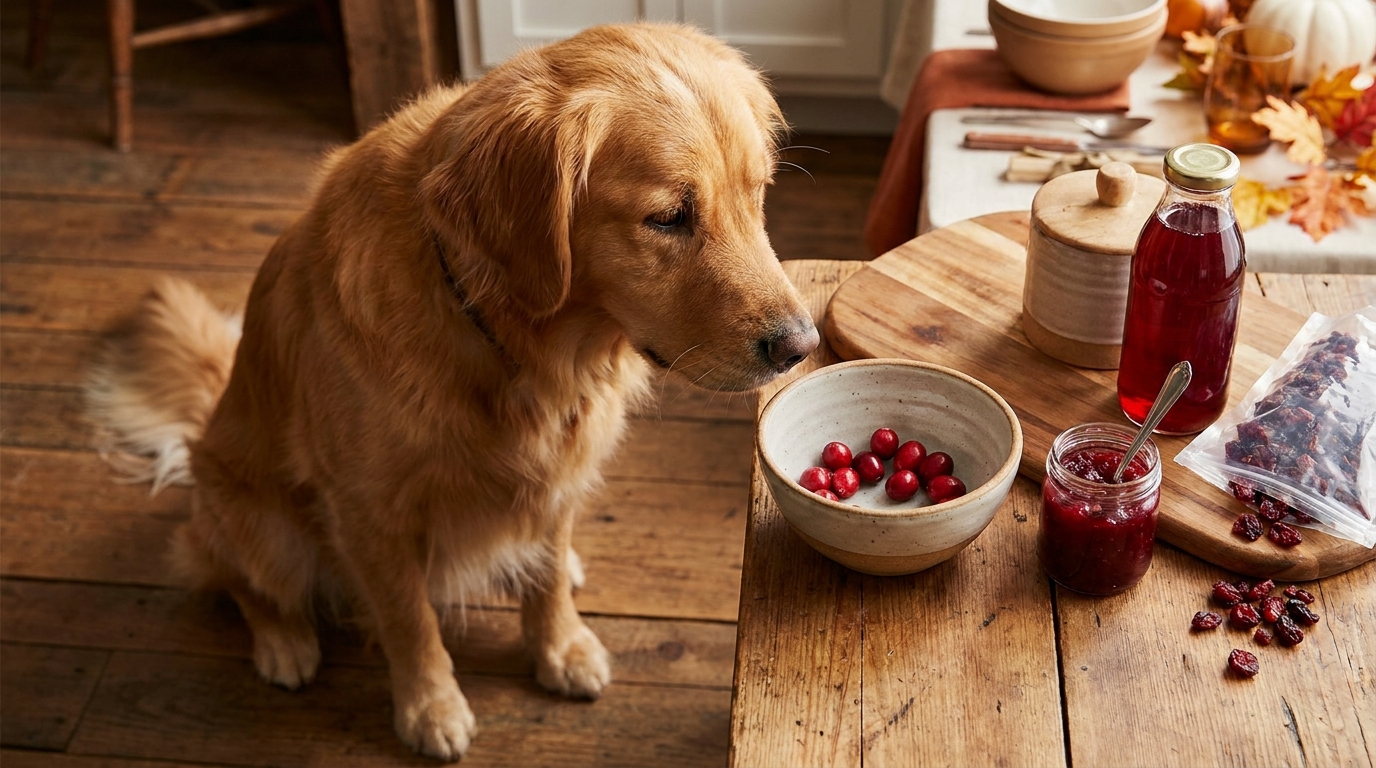
Plain cranberries are not toxic to dogs. See which sauces, dried mixes, juices and pills carry real risk, and why cranberry does not treat a UTI.
Quick answer: A few plain fresh or cooked cranberries are safe for dogs; sauce, juice and dried ones are sugary. Xylitol: an ER now. Alcohol: a vet or poison line now. Raisins: that plus an in-person visit, even if your dog seems fine. Cranberry is unproven for UTIs: straining with little or no urine, clots, dark red urine, pale gums or weakness mean an ER now; bloody urine in a normal-acting dog, a vet within 24 hours.
This article is general information, not a diagnosis. If you think your pet is in danger, go to the nearest emergency animal hospital.
Are cranberries safe for dogs?
Plain fresh or cooked cranberries are not toxic to dogs, but they are tart, and too many can upset a dog's stomach, so offer only a few. The American Kennel Club (AKC) says cranberries that are fresh or cooked, when plain, are not toxic to dogs. Pet Poison Helpline lists plain cranberries, both raw and processed, as safe for pets, and cranberry is not on the ASPCA's toxic plant lists for dogs or cats.
Pet Poison Helpline notes that most cranberries are sold dried or as juice, sauce or jelly with added sugar or sweeteners. Before sharing any cranberry product, read the label or recipe for xylitol (also called birch sugar or wood sugar), grape juice or raisins, alcohol, nuts, onion, garlic or chocolate.
Cranberry sauce, relish and Thanksgiving recipes
Canned or homemade cranberry sauce is high in added sugar, according to USDA nutrient data, and some recipes add wine, port or orange liqueur, raisins, nuts, onion or a sugar-free sweetener such as xylitol, so the recipe decides the risk. The AKC says cranberry sauce can cause stomach upset, so skip it even when plain.
Before serving, read any sugar-free label or recipe for xylitol (birch sugar); a dog that ate any sauce, gummy, chewable or pill listing xylitol needs an ER now. If more than one row fits, follow the most urgent.
| Cranberry food | Risk | Do this |
|---|---|---|
| Fresh, plain | Low | A few OK |
| Cooked, plain | Low | Small taste |
| Canned sauce | Sugar | Skip |
| Juice cocktail | Sugar | Skip |
| Dried, plain | Sugar | Rare treat |
| Raisin mix | Kidney harm | Vet now, in person |
| Grape blend | Grape | Call vet or poison line |
| With alcohol | Alcohol | Poison line or vet now |
| Sugar-free sauce | Xylitol | Ate it: ER now |
| Relish with onion | Onion, garlic | Poison line now |
| Dipped in chocolate | Chocolate | Poison line now |
| With macadamia | Macadamia | Poison line or vet now |
| Pecans or walnuts | High fat | Call vet today |
| Moldy sauce | Mold toxins | Clinic now |
| Raw dough | Rises, alcohol | ER now |
| Human pills | Add-ins | Ask a vet first |
Cooking does not remove all the alcohol, according to USDA nutrient retention data, so a sauce made with wine, port, brandy or liqueur means a poison line or vet now. Savory cranberry relish, chutney, salsa or stuffing can contain onion, garlic or shallot: call a vet or pet poison line now, even if your dog seems fine. The Merck Veterinary Manual says onion and garlic damage red blood cells whether raw, cooked, dried or powdered (see what to do if a dog ate onion or garlic). Red cell damage can take 3 to 5 days to show; red or brown urine, pale or yellow gums or weakness in the week after means an ER now. Raw yeast dough, such as cranberry bread or rolls before baking, keeps rising in the stomach and makes alcohol, so go to an emergency vet now, even if your dog seems fine, and call a poison line on the way (see the raw bread dough guide). The Thanksgiving food chart for dogs covers the rest of the table.
Dried cranberries, trail mix and baked goods
Dried cranberries alone are not toxic but are high in added sugar, and trail mixes, granola and holiday baked goods often add raisins, chocolate or macadamia nuts, which mean a call to a vet or poison line now. The AKC notes that dried cranberries are sometimes mixed with raisins.
- Raisins, sultanas or currants: even one means an emergency vet or poison line call now and an in-person visit, even if your dog seems fine, because no safe amount has been established. The grapes and raisins guide explains why.
- Chocolate-covered cranberries: a poison line now, whatever the amount, even if your dog seems fine; tremors or a seizure mean an ER now.
- Macadamia nuts: a poison line or vet now; the ASPCA says they can cause weakness, wobbliness, vomiting, tremors and overheating in dogs. A wobbly, trembling, seizing or collapsed dog needs an ER now.
- Pecans or walnuts: the ASPCA says these high-fat nuts can cause vomiting, diarrhea and possibly pancreatitis, so call a vet the same day and watch for 4 days.
Skip sweetened dried cranberries for a diabetic dog.
If your dog ate cranberry sauce
An alert, healthy adult dog that ate plain cranberry sauce may get a mild stomach upset; call a vet if loose stool lasts more than two days, see a vet in person today after one vomit or if the dog refuses food, and go to an emergency vet now for repeated vomiting, belly pain, black stool or weakness. Cornell's Riney Canine Health Center gives that two-day line for loose stool.
Check the can or recipe, then follow the most urgent line:
- Xylitol (birch sugar): emergency vet now, even if your dog seems fine, with a poison line called on the way. The FDA says xylitol can cause a dangerous drop in a dog's blood sugar within 10 to 60 minutes.
- Raisins or currants: emergency vet or poison line now, and an in-person visit even if your dog seems fine.
- Wine, port or liqueur: poison line or vet now; ER now if your dog is wobbly, trembling, seizing, collapsed or breathing slowly.
- Onion or garlic: poison line now.
- Mold on old sauce or nuts: a clinic now (an emergency hospital if yours is closed), before tremors start, because Pet Poison Helpline warns of tremor-causing mycotoxins. Tremors or a seizure mean an ER now, with a poison line on the way.
Any puppy with diarrhea needs an in-person vet today, and toy breeds and seniors with diarrhea need a same-day call. A diabetic dog that vomits or has diarrhea after sugary cranberry foods needs a same-day call to the vet who manages the insulin. Do not make your dog vomit, with hydrogen peroxide or anything else, unless a vet or poison line tells you to. The guide to diarrhea after table food or holiday leftovers covers the next few days.
ASPCA Animal Poison Control: (888) 426-4435 (a consultation fee may apply). Pet Poison Helpline: (855) 764-7661 (a per-incident fee applies). Both lines take calls every day, including holidays.
Can dogs drink cranberry juice?
Cranberry juice cocktail is high in added sugar, according to USDA nutrient data, and does not treat a dog's urinary infection, so skip it; for a cranberry-grape blend, call your vet or a pet poison line for advice. The AKC flags cranberry-grape juice blends as risky. Grape juice has not been clearly linked to the same kidney injury as raisins, but it comes from the same fruit.
Does cranberry help a dog's UTI?
Cranberry has not been shown to prevent or treat urinary tract infections in dogs; the 2019 ISCAID urinary infection guidelines say there is not enough evidence to recommend cranberry products, and that every suspected bladder infection should get a urine test, ideally with a culture.
A 2026 systematic review in the Journal of Veterinary Pharmacology and Therapeutics found only three small studies (122 dogs and cats), rated the evidence low to very low certainty, and found none showing that cranberry prevented or treated urinary infections.
Before the visit, do not give human pain relievers, which can be dangerous for dogs, or leftover or human antibiotics, which can make a urine test harder to read. The guide to a dog peeing blood but acting normal explains the urine test and how fast to act.
Signs a dog needs a vet, not cranberry
A dog straining with little or no urine needs an emergency vet now, especially a male dog, and blood in a dog's urine needs a vet within 24 hours even if the dog acts normal. The American College of Veterinary Surgeons says a pet that cannot urinate should be seen by a veterinarian immediately, and that stones often lodge behind the penile bone in male dogs. Female dogs can block too.
Stop at the first row that fits your dog.
| Sign | Do now |
|---|---|
| Straining, little or no urine | ER now |
| Any cat straining | ER now |
| Clots, dark red or brown urine | ER now |
| Pale or yellow gums, weakness | ER now |
| Painful, swollen belly | ER now |
| Vomits more than once | ER now |
| One vomit, peeing OK | Vet today |
| Tired or poor appetite | Vet today |
| Unspayed, after a heat | Vet today; ER if ill |
| Blood, acting normal | Vet within 24 hours |
| Peeing often | Vet visit, urine test |
| New accidents | Vet visit, urine test |
| Licking urinary opening | Vet visit, urine test |
| Drinking more | Vet visit, urine test |
Blood in the urine with any chance of rat or mouse poison, or after a fall, car strike or hard hit to the belly, means an emergency vet now; for possible poison, call a poison line on the way. "Within 24 hours" applies only when no ER or same-day sign is present.
Cranberry pills and supplements
Human cranberry pills are concentrated extracts, and some add vitamin C or other ingredients, so ask a vet before giving any cranberry supplement to a dog, especially one with a history of bladder stones or on a prescription urinary diet, and check chewables for xylitol. The FDA lists chewable vitamins and dietary supplements among products that may contain xylitol. A chewable or gummy that lists xylitol means an emergency vet now, even if your dog seems fine, with a poison line called on the way. If your dog got into a bottle of human cranberry pills or gummies, call a poison line now. Never use a supplement in place of a urine test.
Can cats eat cranberries?
Plain cranberries are not a known toxin for cats, but cats cannot taste sweetness, and a cat straining in the litter box with little or no urine needs an emergency vet now, not cranberry. The Cornell Feline Health Center calls urethral obstruction "an absolute emergency," and the Merck Veterinary Manual says male cats are uniquely predisposed and owners may mistake a blocked cat for a constipated one. Cornell also says bladder inflammation with no known cause (feline idiopathic cystitis) is the most common diagnosis in cats with urinary signs. Cats are the species most sensitive to onion and garlic (Merck Veterinary Manual), so savory cranberry relish or stuffing means a poison line now.
When a video visit helps
A video visit helps when a dog is peeing more often, having new accidents or licking at the urinary opening but is still passing normal amounts, eating and acting normally.
Go to an emergency vet now, not a video call, for straining with little or no urine (especially a male dog, and any cat), clots or dark red urine, pale gums, weakness, a painful belly or repeated vomiting. Tiredness, poor appetite or one vomit while still peeing normally, or an unspayed female drinking or peeing more in the months after a heat, means an in-person vet the same day. If your dog ate raw dough, moldy food, or a sauce, mix or chewable with xylitol, raisins, chocolate, alcohol, macadamia nuts, onion or garlic, follow the emergency vet and poison line steps above instead of booking a video visit. A video visit does not treat poisoning and never replaces a poison line or an emergency hospital.
For a dog that fits, a $64.99 live video visit connects you with a licensed RexVet vet, a veterinarian licensed in your pet's state (Florida, New York or Virginia, with your pet located there during the visit). The veterinarian reviews the signs and your dog's diet, watches a short video of your dog urinating if you can record one, looks at a urine photo on a white paper towel, and tells you whether a urine test at a local clinic within 24 hours is enough or your dog needs to be seen in person now. A video visit cannot test urine or prove the red is real blood, so treatment may need a clinic visit. The veterinarian can also tell you whether any cranberry product is safe for your dog. If your dog ate a plain cranberry sauce (no raisins, nuts, alcohol, chocolate, onion, garlic or sugar-free sweetener), has not vomited and is acting normally, the veterinarian can help you read the recipe and decide what to watch.
RexVet is a 501(c)(3) non-profit. No prescription is promised. Antibiotics usually need a urine test first, and any medicine is the veterinarian's decision after the visit, within the state limits in the FAQ below. Live slots run about 8 AM to 11 PM ET; holiday availability is not guaranteed. Book a live video visit.
Need an Expert Opinion on This Topic?
Book a video visit with a licensed vet, evenings and weekends included
See open timesFrequently Asked Questions
Can dogs eat cranberry sauce?
No, skip it: cranberry sauce is high in added sugar, and some recipes add alcohol, raisins, onion or xylitol. Even plain sauce is high in sugar, which the AKC says can cause stomach upset. Xylitol (birch sugar) means an emergency vet now, with a poison line called on the way, and raisins mean an emergency vet or poison line now plus an in-person visit, even if your dog seems fine. Alcohol, onion or garlic means a poison line or vet now.
Are dried cranberries bad for dogs?
Plain dried cranberries are not toxic, but sweetened ones are sugary, so keep them a rare treat; any mix with raisins is an emergency. Even one raisin, sultana or currant means an emergency vet or poison line now and an in-person visit, even if your dog seems fine. Chocolate-covered cranberries mean a poison line now.
Can I give my dog cranberry juice for a UTI?
No. Cranberry juice does not treat a urinary infection, and a 2026 systematic review found no study showing cranberry prevents or treats them in dogs. The ISCAID guidelines say there is not enough evidence to recommend cranberry products, and juice cocktail is high in added sugar. Blood in the urine in a dog that is peeing normal amounts and acting normally needs a vet within 24 hours; clots, dark red urine, pale gums, weakness, repeated vomiting or straining with little or no urine need an emergency vet now.
How many cranberries can a dog eat?
A few plain fresh or cooked cranberries make an occasional treat; there is no set number by weight, and too many can upset the stomach. Serve them with no sugar, sauce or sweetener, and stop if you see vomiting or loose stool. Ask your own vet first if your dog has diabetes, past pancreatitis, kidney or stomach disease, a prescription or urinary diet, or a history of bladder stones.
Can cats eat cranberries?
Plain cranberries are not a known toxin for cats, but cats cannot taste sweetness, and cranberry is no substitute for a vet. Any cat straining in the litter box with little or no urine, especially a male cat, needs an emergency vet now. Relish or stuffing with onion or garlic means a poison line now.
Can an online vet help with my dog's urinary signs in Florida, New York or Virginia?
Partly: a video visit can judge how urgent the signs are, but it cannot test urine, and diagnosing an infection needs a urine test. Your dog must be located in Florida, New York or Virginia during the visit. A veterinarian licensed in that state can review the history, how often and how much your dog pees, a short video of urinating and a urine photo, then tell you whether a urine test at a local clinic within 24 hours is enough or your dog needs to be seen in person now. Straining with little or no urine, clots, pale gums, weakness or repeated vomiting means an emergency vet now, not a video call. No prescription is promised, and antibiotics usually need a urine test first. If medicine comes up: under Florida law (section 474.2021), after a video-only exam a Florida-licensed veterinarian can prescribe only FDA-approved animal medications used as labeled, for up to 14 days (up to 1 month for products labeled only for fleas and ticks), with no renewal until your pet has an in-person exam; human-labeled medications, controlled substances and compounded anti-infectives need an in-person exam. Virginia allows the exam to be electronic, and New York's telehealth prescribing rules are not settled. In every state, federal rules allow off-label or human-drug use only after an in-person exam. RexVet is not a pharmacy; if a prescription is written and you ask RexVet to send it to an outside pharmacy, a pharmacy transfer fee applies.
FAQs
Can dogs eat cranberry sauce?
No, skip it: cranberry sauce is high in added sugar, and some recipes add alcohol, raisins, onion or xylitol. Even plain sauce is high in sugar, which the AKC says can cause stomach upset. Xylitol (birch sugar) means an emergency vet now, with a poison line called on the way, and raisins mean an emergency vet or poison line now plus an in-person visit, even if your dog seems fine. Alcohol, onion or garlic means a poison line or vet now.
Are dried cranberries bad for dogs?
Plain dried cranberries are not toxic, but sweetened ones are sugary, so keep them a rare treat; any mix with raisins is an emergency. Even one raisin, sultana or currant means an emergency vet or poison line now and an in-person visit, even if your dog seems fine. Chocolate-covered cranberries mean a poison line now.
Can I give my dog cranberry juice for a UTI?
No. Cranberry juice does not treat a urinary infection, and a 2026 systematic review found no study showing cranberry prevents or treats them in dogs. The ISCAID guidelines say there is not enough evidence to recommend cranberry products, and juice cocktail is high in added sugar. Blood in the urine in a dog that is peeing normal amounts and acting normally needs a vet within 24 hours; clots, dark red urine, pale gums, weakness, repeated vomiting or straining with little or no urine need an emergency vet now.
How many cranberries can a dog eat?
A few plain fresh or cooked cranberries make an occasional treat; there is no set number by weight, and too many can upset the stomach. Serve them with no sugar, sauce or sweetener, and stop if you see vomiting or loose stool. Ask your own vet first if your dog has diabetes, past pancreatitis, kidney or stomach disease, a prescription or urinary diet, or a history of bladder stones.
Can cats eat cranberries?
Plain cranberries are not a known toxin for cats, but cats cannot taste sweetness, and cranberry is no substitute for a vet. Any cat straining in the litter box with little or no urine, especially a male cat, needs an emergency vet now. Relish or stuffing with onion or garlic means a poison line now.
Can an online vet help with my dog's urinary signs in Florida, New York or Virginia?
Partly: a video visit can judge how urgent the signs are, but it cannot test urine, and diagnosing an infection needs a urine test. Your dog must be located in Florida, New York or Virginia during the visit. A veterinarian licensed in that state can review the history, how often and how much your dog pees, a short video of urinating and a urine photo, then tell you whether a urine test at a local clinic within 24 hours is enough or your dog needs to be seen in person now. Straining with little or no urine, clots, pale gums, weakness or repeated vomiting means an emergency vet now, not a video call. No prescription is promised, and antibiotics usually need a urine test first. If medicine comes up: under Florida law (section 474.2021), after a video-only exam a Florida-licensed veterinarian can prescribe only FDA-approved animal medications used as labeled, for up to 14 days (up to 1 month for products labeled only for fleas and ticks), with no renewal until your pet has an in-person exam; human-labeled medications, controlled substances and compounded anti-infectives need an in-person exam. Virginia allows the exam to be electronic, and New York's telehealth prescribing rules are not settled. In every state, federal rules allow off-label or human-drug use only after an in-person exam. RexVet is not a pharmacy; if a prescription is written and you ask RexVet to send it to an outside pharmacy, a pharmacy transfer fee applies.
Medically Reviewed
Reviewed by Dr. Tiffany Delacruz, DVM — licensed veterinarian and CEO of RexVet. Last reviewed November 1, 2026.
Content is for informational purposes and does not replace professional veterinary advice.
Chief Executive Officer · Licensed Veterinarian
Dr. Delacruz is a licensed Doctor of Veterinary Medicine specializing in preventive care and veterinary telehealth. She reviews all health content on RexVet to ensure accuracy and clinical relevance.
Sources & References
- · American Veterinary Medical Association — Telehealth Guidelines
- · AVMA — Pet Care Resources
- · U.S. FDA — Animal & Veterinary