
Bump on a Dog Eyelid: Stye, Cyst or Tumor? When to Worry
By RexVet Team | Reviewed by Dr. Tiffany Delacruz, DVM
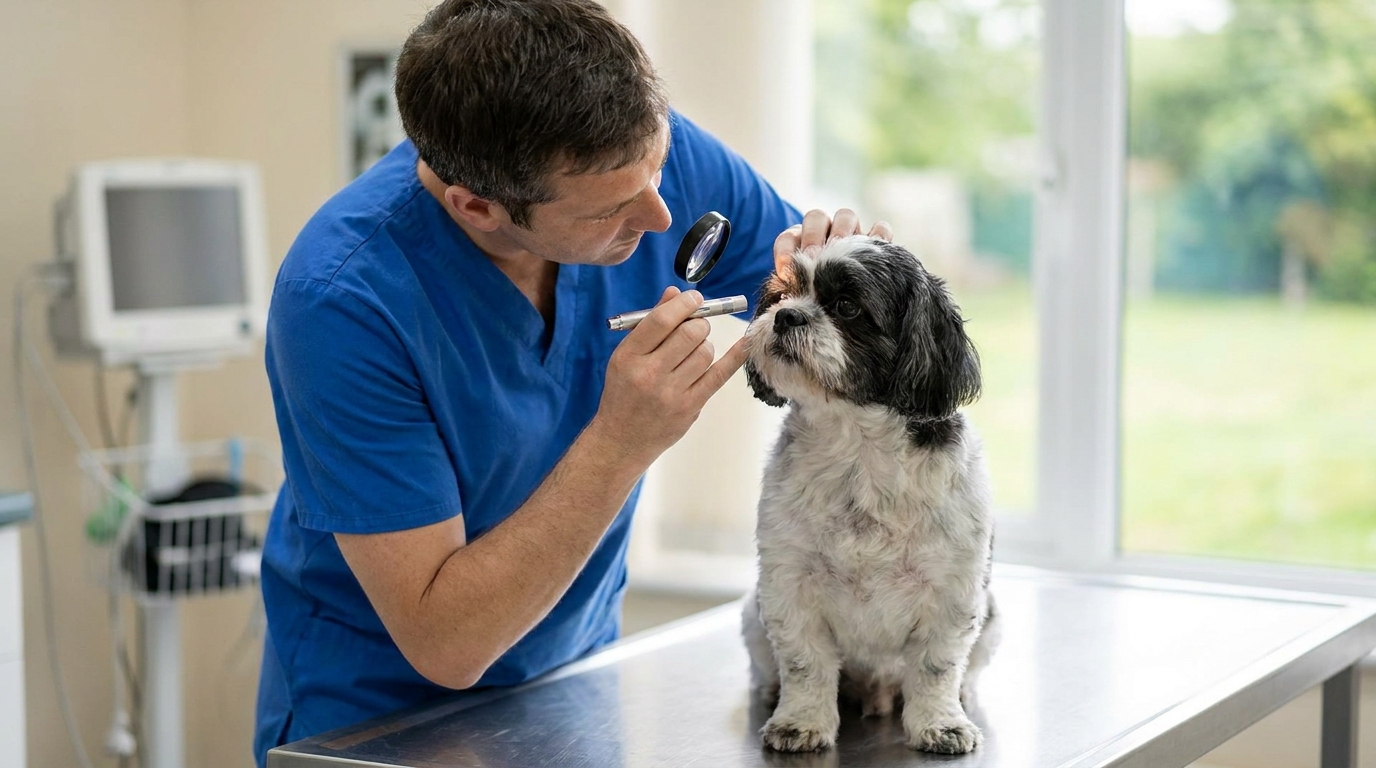
Most eyelid tumors in dogs are benign, but the eye next to the bump, and whether the bump grows fast or bleeds, decide how soon a vet must see it.
Quick answer: Oil-gland growths are the most common eyelid tumors in older dogs, the Merck Veterinary Manual says, and Today's Veterinary Practice says dog eyelid tumors are at least 3 to 8 times more likely to be benign than malignant. A small bump with an open, comfortable eye needs an in-person vet within days. Redness, squinting or discharge means the same day; a cloudy, bulging or shut eye, an emergency vet now.
This article is general information, not a diagnosis. If you think your pet is in danger, go to the nearest emergency animal hospital.
Is a bump on my dog's eyelid an emergency?
A bump on a dog's eyelid is an emergency when the eye turns cloudy, hazy or bluish, bulges or stays shut, the lid is torn or bitten, or the bump still bleeds freely after several minutes of gentle pressure; then go to an emergency vet now.
Also go now for any eye problem after a fight, fall or car accident, unequal pupils, blood or a white or yellow layer inside the eye, a dent, crater or bubble on the eye, sudden vision loss, something stuck in the eye (leave it), pain on opening the mouth, the third eyelid coming across the eye, or a puppy with a swollen face or lids that is weak, wobbly, cold or hard to wake. A bulging eye counts even in a calm dog: the Merck Veterinary Manual notes that tumors behind the eye usually cause no pain. Never push the eye back.
Squinting, pawing, tearing, redness, thick discharge or a bump rubbing the eye means an in-person vet the same day, since only a clinic stain test can rule out a corneal ulcer (see the guide to a dog squinting one eye). A flat-faced breed (such as a Pug, Bulldog, French Bulldog, Shih Tzu, Pekingese or Boston Terrier) with any eye redness, squinting or discharge needs an in-person vet right away, not video.
Sudden puffy lids or face need a vet in person within the hour, and an emergency vet now with vomiting, diarrhea, drooling, pale gums, weakness, breathing trouble, tongue or throat swelling or collapse, in a flat-faced breed, or within 1 hour of a sting, shot or new medicine; see the guide to hives and sudden bumps. A goopy pink eye with no distinct bump fits the guide to pink eye in dogs, and redness in the white of the eye fits the guide to dog red eyes.
| Sign | Means | Next step |
|---|---|---|
| Small bump, eye clear | Often benign | Exam within days |
| Red, sore lid bump | Stye or rub | Same day |
| Bump grows fast | Needs a look | Same day |
| Bled, oozes or sore | Needs a look | Same day |
| Squint, pawing, tearing | Eye pain | Same day |
| Thick or yellow discharge | Infection, rub | Same day |
| Sudden puffy lid or face | Allergy, sting | Within the hour |
| Bleeds after minutes of pressure | Bleeding | ER now |
| Cloudy, bulging or shut eye | Eye danger | ER now |
| Torn or bitten lid | Injury | ER now |
Same day means an in-person vet today; if no clinic can see your dog in time, or it is after hours, go to an emergency hospital.
What is this bump? The common causes
The common causes of a bump on a dog's eyelid are oil-gland growths, styes, chalazions, warts and pigmented growths; where the bump sits and whether it hurts are the best first clues, but only a vet exam, and sometimes a lab test, tells them apart.
| Bump | Looks like | How soon (in person) |
|---|---|---|
| Oil-gland growth | Pink, tan, gray or black; lid edge | Exam within days |
| Stye | Red, sore, swollen lid edge | Same day, in person |
| Chalazion | Firm, painless lump in the lid | Exam within days |
| Wart | Rough, warty; often a young dog | Exam within days |
| Dark spot or mass | Brown or black, on lid skin | Exam within days |
| Lump inside the lid | On the pink lining or third eyelid | Within days; same day if red |
| Cherry eye | Red-pink, inner corner | Within a few days |
| Grows fast or bled | Any color, open sore | Same day, in person |
Cherry eye, a slipped tear gland of the third eyelid, needs the same day if the gland looks dry or the eye squints; do not push on it. Papilloma warts spread between dogs, VCA Animal Hospitals reports; the guide to warts on dogs covers wart-like eyelid bumps.
Some look-alikes need a vet in person the same day. Swelling just below the eye can be an upper tooth root abscess, which VCA says is often mistaken for an eye infection. A lump with a small hole can hold a botfly larva; never squeeze it or try to pull anything out, because a larva that breaks apart can cause a bad reaction. Both lids red and crusty, a puppy with swollen, crusty lids, or a bump with fever, lethargy or not eating also need the same day. A bump that swells and shrinks can be a mast cell tumor: never squeeze it, and get a needle sample within days, or the same day if it turns red or itchy.
Dog stye vs chalazion vs tumor: how can you tell?
A stye on a dog's eyelid is a painful, red swelling at the lid edge from a blocked gland that can become infected, a chalazion is a firm, painless lump from a blocked oil gland, and an oil-gland growth is often a cauliflower-like bump on the lid edge; only a vet can tell them apart, sometimes only with a lab test after removal.
Stye: VCA Animal Hospitals says it may become infected; because it hurts, go in person the same day.
Chalazion: the firm lump many owners call an eyelid cyst. Today's Veterinary Practice describes it as a painless swelling of an oil gland from built-up secretions; it is not a tumor itself, though a gland tumor blocking the duct often, but not always, causes it. Book an exam within days.
Oil-gland growth (meibomian gland tumor): VCA describes a small "pimple" at a gland opening, a flat cauliflower-like bump on the inner lid, or a cauliflower-like bump on the lid edge that is usually darker than the skin around it.
Is an eyelid lump on a dog cancer?
Most eyelid lumps on dogs are not cancer: Today's Veterinary Practice, a peer-reviewed veterinary journal, says eyelid tumors in dogs are at least 3 to 8 times more likely to be benign than malignant, but only a lab test can confirm what any lump is.
The Merck Veterinary Manual says meibomian (oil-gland) adenomas and adenocarcinomas make up about 60% of eyelid tumors in older dogs, and that these adenocarcinomas are locally invasive but not known to spread elsewhere. Other eyelid tumors can invade or spread, Today's Veterinary Practice notes, and VCA Animal Hospitals warns that squamous cell carcinoma can be malignant.
- Grows fast, bled, or a sore that will not heal: an in-person vet the same day.
- Dark brown or black: an exam within days. Benign gland growths can be gray or black too, Today's Veterinary Practice says, so dark does not always mean melanoma.
- On the pink lining inside the lid or the third eyelid: an exam within days, never left alone, because Merck says tumors there grow faster and tend to spread; the same day if it grows, bleeds or the eye is red.
Color alone cannot tell benign from malignant.
Why does a benign eyelid bump still matter?
Even a benign bump on a dog's eyelid can grow until it rubs the cornea and causes a painful ulcer, VCA Animal Hospitals says, and Today's Veterinary Practice says eyelid tumors are best treated early, while they are small.
VCA notes that an untreated ulcer can scar and affect vision. Size matters for surgery too: Today's Veterinary Practice explains that only so much lid can be removed without major reconstruction, typically 25% to 33% of its length while still closing it directly, though this varies widely by breed.
A bump that stops the lid from closing fully needs an exam within days, or the same day if the eye is red or your dog squints.
What can I do at home?
At home, keep a dog from rubbing or pawing an eyelid bump (a cone helps if you have one), gently wipe any discharge off the fur with a soft, damp cloth, and take a dated photo next to a ruler or coin; never squeeze, pop, lance or press the bump, and put nothing in or on the eye unless a vet who has examined your dog says to.
Bring the photo to the exam, and after a diagnosis, follow that vet's recheck plan. The Merck Veterinary Manual says products not made for the eye should stay off the eyelids, so skip human creams and wart or acne removers.
A veterinarian may recommend warm compresses after examining the eyelid, VCA Animal Hospitals says; do not start them before a vet has looked at the bump.
If the bump bleeds, hold a clean cloth gently on the lid, never the eyeball; still bleeding freely after several minutes means an emergency vet now, and if it stops, a vet in person the same day.
If your dog licked or ate a human wart, acne or callus remover, go to an emergency vet now if it vomits, seems weak or acts off; otherwise call ASPCA Animal Poison Control at (888) 426-4435 (a consultation fee may apply) or Pet Poison Helpline at (855) 764-7661 (a per-incident fee applies).
What will the vet do?
A vet examining a dog's eyelid bump checks where its base sits, whether it touches the eye and whether the dog can blink fully, may stain the eye to look for an ulcer, and may take a needle sample before deciding whether and when to remove it.
Removal options a vet may use:
- Wedge removal: VCA Animal Hospitals says the most common method removes a V-shaped wedge of lid under general anesthesia, closed with stitches.
- Trim and freeze (cryotherapy): Today's Veterinary Practice says it is done under sedation or general anesthesia plus local anesthetic, is shorter and needs no stitches.
- CO2 laser: best for masses with a small base, since it can leave a notch in the lid edge, the same journal says.
The tissue goes to a lab to confirm what it was.
Age alone does not rule out anesthesia, AAHA's senior care guidelines say, and for fragile older dogs a brief general anesthetic is often preferred over sedation; the treating vet decides. See the guide to anesthesia for senior pets.
Older dogs and eyelid bumps
Eyelid oil-gland growths are most often found in middle-aged and older dogs, with an average age of 8 years, VCA Animal Hospitals says, so a new bump on an older dog is common, but any eyelid mass should still be checked by a vet.
In a dog over about 8, a slow, even blue-gray haze in both eyes is usually normal aging, but an eye next to an eyelid bump that turns cloudy, hazy or bluish needs an emergency vet now.
When a video visit helps, and when it does not
A small bump on a dog's eyelid, with an eye that is open, clear and comfortable, can get a first look on a live video visit, where the veterinarian checks it on camera and says how urgent it looks, but the bump still needs an in-person exam within days.
For a dog located in Florida, New York or Virginia with a new small eyelid bump and a clear, comfortable eye, RexVet, a nonprofit online vet service, offers a $64.99 live video visit with a veterinarian licensed in the dog's state, about 8 AM to 11 PM Eastern, every day, as a first look before the in-person exam the bump still needs within days.
RexVet serves pets located in Florida, New York and Virginia by video visit, and your dog must be in one of them during the visit. A same-day slot is not guaranteed, there are no overnight visits, and holiday hours are not confirmed, so check open slots when you book a live video visit.
From RexVet's own visit data, across all visit reasons: Ear and eye problems came second, named in 22% of RexVet video visits. That figure covers all ear and eye concerns, not eyelid bumps alone.
Video also fits rechecking a diagnosed bump against your photos, or anesthesia questions for an older dog. The veterinarian checks where the bump sits, whether it touches the eye, and its color and surface; no vet can tell on camera whether a bump is cancer. Film the lid close, in good light, without pressing on it.
Video does not fit a sore, red stye-like bump, squinting, discharge, a bump rubbing the eye, or a bump that grows fast or bled: those need an in-person vet the same day, and puffy lids or face need one within the hour, or an emergency vet now with vomiting, diarrhea, drooling, weakness, breathing trouble or collapse, or within 1 hour of a sting, shot or new medicine. Removal, needle samples and lab tests happen in person.
Skip the video visit and go to an emergency vet now if the eye turns cloudy, hazy or bluish, bulges, stays shut or has blood inside it, the pupils differ in size, the lid is torn or bitten, or the bump is still bleeding freely after several minutes of gentle pressure on the lid.
No prescription is promised; the veterinarian decides. Many eye drops and ointments used in dogs are human-labeled, and federal rules (21 CFR 530.3) require an in-person exam for human-labeled or off-label drug use in every state. Florida law (s.474.2021) limits telehealth-only prescriptions to FDA-approved animal drugs used as labeled, for up to 14 days (1 month for products labeled solely for fleas or ticks), with no renewal without an in-person exam and no human-labeled, controlled or compounded anti-infective drugs. Virginia allows an electronic exam, though the federal rule still applies, and New York's telehealth prescribing rules are not settled, so a visit there may cover less. RexVet is not a pharmacy; a pharmacy transfer fee applies if a prescription is sent to an outside pharmacy.
Need an Expert Opinion on This Topic?
Book a video visit with a licensed vet, evenings and weekends included
See open timesFrequently Asked Questions
Will a stye on my dog's eyelid go away on its own?
Don't wait to find out: a red, sore bump on a dog's eyelid needs an in-person vet the same day. Never squeeze it, and ask the vet before trying a warm compress. A bump that looks like a stye can also be a chalazion or an oil-gland growth. Go to an emergency vet now if the eye turns cloudy, bulges or stays shut.
Can I pop or squeeze the bump on my dog's eyelid?
No: never squeeze, pop, lance or press a bump on a dog's eyelid. Some lid lumps are mast cell tumors or hold a botfly larva, and pressing near the eye can hurt the cornea. Book an exam within days, or the same day if the bump is red, sore, bleeding or growing fast.
Is a pink bump on my dog's eyelid cancer?
Usually not, but color can't tell you: Today's Veterinary Practice says eyelid oil-gland tumors can be pink, tan, gray or black. Only a lab test is definitive, so a pink bump with a comfortable eye needs an exam within days, or the same day if it grows fast or bleeds.
Does an eyelid tumor on my dog need to be removed?
Often yes: the Merck Veterinary Manual says most eyelid tumors will require surgery, and the examining vet decides whether and when. Merck adds that the surgery is usually successful. Today's Veterinary Practice says eyelid tumors are best treated early, while small, because only so much lid can be removed and still closed directly. VCA Animal Hospitals calls removing an oil-gland adenoma curative, though it can regrow if any affected tissue is left.
How fast do eyelid tumors grow in dogs?
Growth speed varies; any eyelid bump that grows quickly, bleeds or opens into a sore needs an in-person vet the same day. The Merck Veterinary Manual says tumors of the pink inner lid lining grow faster than tumors of the eyelid itself. Every new bump needs an exam within days.
Can an online vet look at my dog's eyelid bump if I live in Florida, New York or Virginia?
Yes, as a first look while the eye is clear and comfortable, but the bump still needs an in-person exam within days. For a dog located in Florida, New York or Virginia, a veterinarian licensed in the dog's state can review the bump on camera and say how soon a clinic must see it; removal, samples and eye stain tests need a clinic, and a red, sore bump or squinting needs an in-person vet the same day. No prescription is promised: Florida limits telehealth-only prescriptions to FDA-approved animal drugs used as labeled for up to 14 days (1 month for products labeled solely for fleas or ticks), federal rules require an in-person exam for human-labeled eye products, Virginia allows an electronic exam though the federal rule still applies, and New York's rules are not settled, so a visit there may cover less.
FAQs
Will a stye on my dog's eyelid go away on its own?
Don't wait to find out: a red, sore bump on a dog's eyelid needs an in-person vet the same day. Never squeeze it, and ask the vet before trying a warm compress. A bump that looks like a stye can also be a chalazion or an oil-gland growth. Go to an emergency vet now if the eye turns cloudy, bulges or stays shut.
Can I pop or squeeze the bump on my dog's eyelid?
No: never squeeze, pop, lance or press a bump on a dog's eyelid. Some lid lumps are mast cell tumors or hold a botfly larva, and pressing near the eye can hurt the cornea. Book an exam within days, or the same day if the bump is red, sore, bleeding or growing fast.
Is a pink bump on my dog's eyelid cancer?
Usually not, but color can't tell you: Today's Veterinary Practice says eyelid oil-gland tumors can be pink, tan, gray or black. Only a lab test is definitive, so a pink bump with a comfortable eye needs an exam within days, or the same day if it grows fast or bleeds.
Does an eyelid tumor on my dog need to be removed?
Often yes: the Merck Veterinary Manual says most eyelid tumors will require surgery, and the examining vet decides whether and when. Merck adds that the surgery is usually successful. Today's Veterinary Practice says eyelid tumors are best treated early, while small, because only so much lid can be removed and still closed directly. VCA Animal Hospitals calls removing an oil-gland adenoma curative, though it can regrow if any affected tissue is left.
How fast do eyelid tumors grow in dogs?
Growth speed varies; any eyelid bump that grows quickly, bleeds or opens into a sore needs an in-person vet the same day. The Merck Veterinary Manual says tumors of the pink inner lid lining grow faster than tumors of the eyelid itself. Every new bump needs an exam within days.
Can an online vet look at my dog's eyelid bump if I live in Florida, New York or Virginia?
Yes, as a first look while the eye is clear and comfortable, but the bump still needs an in-person exam within days. For a dog located in Florida, New York or Virginia, a veterinarian licensed in the dog's state can review the bump on camera and say how soon a clinic must see it; removal, samples and eye stain tests need a clinic, and a red, sore bump or squinting needs an in-person vet the same day. No prescription is promised: Florida limits telehealth-only prescriptions to FDA-approved animal drugs used as labeled for up to 14 days (1 month for products labeled solely for fleas or ticks), federal rules require an in-person exam for human-labeled eye products, Virginia allows an electronic exam though the federal rule still applies, and New York's rules are not settled, so a visit there may cover less.
Medically Reviewed
Reviewed by Dr. Tiffany Delacruz, DVM — licensed veterinarian and CEO of RexVet. Last reviewed November 17, 2026.
Content is for informational purposes and does not replace professional veterinary advice.
Chief Executive Officer · Licensed Veterinarian
Dr. Delacruz is a licensed Doctor of Veterinary Medicine specializing in preventive care and veterinary telehealth. She reviews all health content on RexVet to ensure accuracy and clinical relevance.
Sources & References
- · American Veterinary Medical Association — Telehealth Guidelines
- · AVMA — Pet Care Resources
- · U.S. FDA — Animal & Veterinary