
Are Kalanchoe and Cyclamen Toxic to Cats and Dogs?
By RexVet Team | Reviewed by Dr. Tiffany Delacruz, DVM
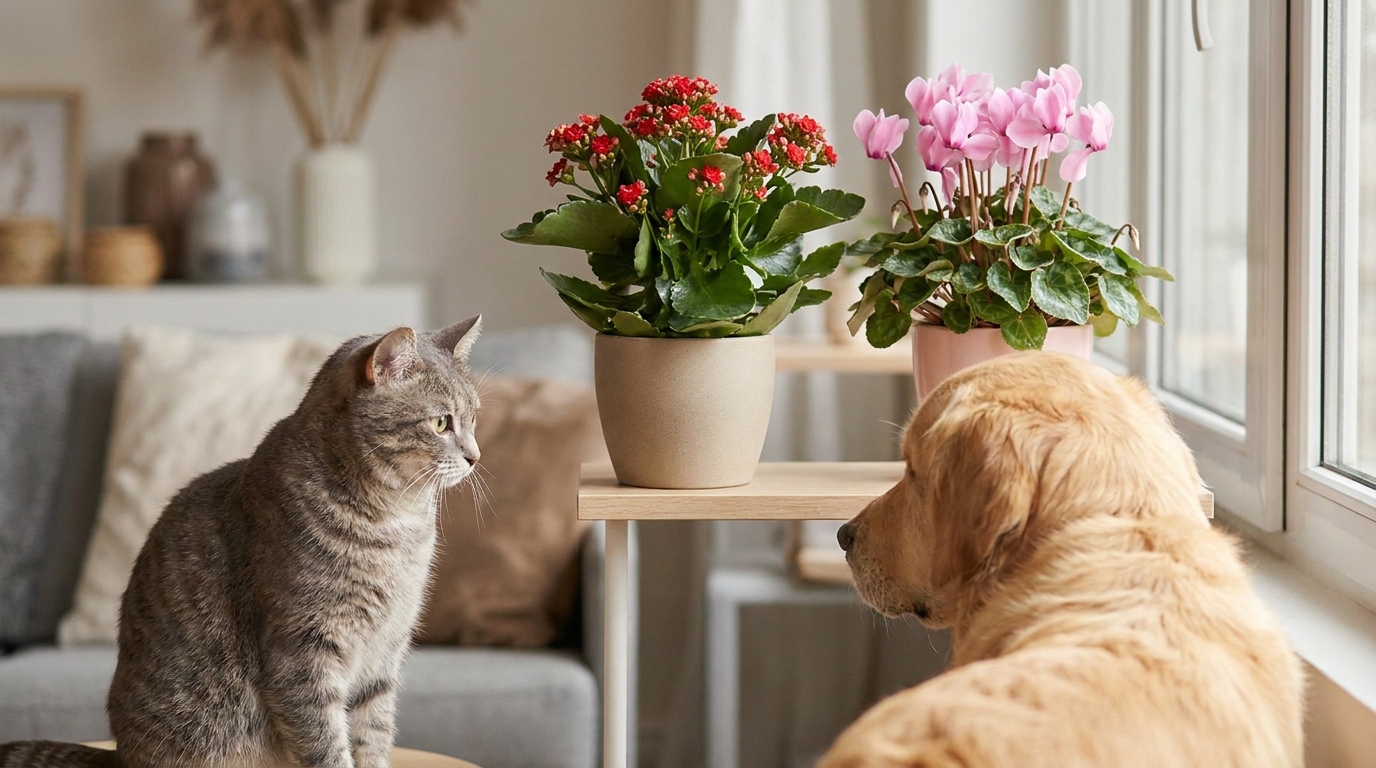
Both holiday gift plants are toxic to dogs and cats. See which part matters most, the signs to watch, and when to call a poison line or go to the ER.
Quick answer: Yes. The ASPCA lists kalanchoe and cyclamen as toxic to dogs and cats, and Pet Poison Helpline says the cyclamen tuber (root) is especially dangerous. Most bites cause drooling, vomiting or diarrhea, but no amount is known to be safe, so call a pet poison line now. Go to an emergency vet now for weakness, collapse, a seizure, repeated vomiting, or a slow, racing or uneven heartbeat.
This article is general information, not a diagnosis. If you think your pet is in danger, go to the nearest emergency animal hospital.
Where to go: ER now, poison line now or watch
Any kalanchoe or cyclamen bite is a call to a pet poison line now, even if your pet seems fine, and weakness, collapse, a seizure, repeated vomiting, blood in vomit or stool, or a slow, racing or uneven heartbeat means an emergency vet now.
Poison lines: ASPCA Animal Poison Control, (888) 426-4435 (a consultation fee may apply), or Pet Poison Helpline, (855) 764-7661 (a per-incident fee applies). If more than one row fits, follow the most urgent.
| What happened | Signs | Do this |
|---|---|---|
| Licked or nibbled a leaf or flower | None yet | Poison line now |
| Drooling or one vomit, pet bright | Early | Poison line now |
| Several leaves or flowers eaten | Any | Poison line now; go in if told |
| Cyclamen tuber (root) chewed | None yet | Poison line now; ER if told or any signs |
| Whole cyclamen tuber swallowed | Any | ER now; call on the way |
| Chewed plant food or a fertilizer spike | Any | Poison line now; have the label |
| Repeated vomiting or no water kept down | Moderate | ER now |
| Blood in vomit or stool, or black stool | Any | ER now |
| Weak, wobbly, pale gums or cold paws | Severe | ER now |
| Slow, racing or uneven heartbeat | Severe | ER now |
| Collapse, fainting, seizure, tremors or trouble breathing | Severe | ER now |
| Cat bit, licked or brushed a lily, or drank vase water | Any | ER now, even with no signs |
| Cat chewed a bouquet or plant you can't name | Any | ER now |
| Poison line says watch at home | None | Watch 24 hours, then for days; video check if you want help |
| Tired, hiding or not eating in the days after | Late | Same day: vet in person; ER if weak or cold |
Is kalanchoe toxic to cats and dogs?
Yes: the ASPCA lists kalanchoe, a flowering succulent sold as a holiday gift plant, as toxic to dogs and cats because it contains bufadienolides, heart-affecting compounds that most often cause vomiting and diarrhea and rarely an abnormal heart rhythm.
Every part of a kalanchoe is toxic: NC State Extension lists the flowers, leaves and stems. A 2004 Veterinary Medicine toxicology brief says the flowers carry the most heart toxin, based on livestock cases, but the Merck Veterinary Manual lists the heart toxins in the leaves, so a chewed leaf still needs a poison-line call.
Pet Poison Helpline says kalanchoe most often upsets the stomach, but if enough is eaten, heart rate and rhythm can change and weakness and collapse can follow. The 2004 brief says the toxic dose in dogs and cats is unknown, so no amount is known to be safe.
The ASPCA also lists the kalanchoe relatives mother of millions and chandelier plant as toxic to dogs and cats. The 2004 brief notes that some kalanchoe species grow wild in the US, especially in Florida and Hawaii, so yard plants count too.
Is cyclamen poisonous to cats and dogs?
Yes: the ASPCA lists cyclamen as toxic to dogs and cats, its saponins usually cause drooling, vomiting and diarrhea, and the ASPCA says large amounts of the tuber (root) can cause heart rhythm problems, seizures and death.
Pet Poison Helpline says cyclamen roots are especially dangerous and the plant can cause severe vomiting, while heart rhythm problems and seizures after large amounts are possible but uncommon. The Merck Veterinary Manual says the saponins are found in the tuber and lists convulsions among the signs.
A 2002 Veterinary Medicine toxicology brief puts cyclamen in its moderate-to-severe gut irritation group, with vomiting and diarrhea that may be bloody, and warns that bulbous roots can block the gut, especially when swallowed whole. Nobody knows how much is too much, so call a poison line for any bite, leaf and flower included.
Kalanchoe and cyclamen symptoms and when they start
Kalanchoe signs usually start within a few hours and can last 4 to 5 days, while no onset time is published for cyclamen, so call a pet poison line now instead of waiting for signs.
For kalanchoe, the Merck Veterinary Manual says signs from heart-toxin plants are expected within the first 2 hours. The 2004 brief lists early kalanchoe signs as dullness, drooling, vomiting, diarrhea that can be bloody, and belly pain; cyclamen most often causes drooling, vomiting and diarrhea. Any of the signs below means an emergency vet now:
- Weakness, wobbliness, collapse or fainting
- Cold paws or legs, or pale gums
- Trouble breathing, tremors or seizures
- A slow, racing or uneven heartbeat
- Repeated vomiting, no water kept down, blood in vomit or stool, or black, tarry stool
Because kalanchoe signs can last 4 to 5 days, a pet that seemed fine and later turns weak, cold or wobbly needs an emergency vet now.
My pet chewed kalanchoe or cyclamen: what to do right now
Take the plant away, photograph it and its pot tag, note which part was eaten and when, and call ASPCA Animal Poison Control at (888) 426-4435 (a consultation fee may apply) or Pet Poison Helpline at (855) 764-7661 (a per-incident fee applies); make a dog vomit only if a poison line or vet tells you to, and never try it at home in a cat.
- If you can do it without being bitten, take plant pieces out of your pet's mouth.
- Check the pot for a chewed tuber, plant food and fertilizer spikes. Missing ribbon, or string hanging from the mouth or bottom, means an ER visit now; don't pull or cut it.
- Call a poison line and write down the case number. Treat a plant you can't name as toxic.
- Never make a dog vomit if it is already vomiting, weak, wobbly or seizing, or has a slow heartbeat. See when making a dog throw up helps and when it harms.
- Skip home remedies: no peroxide, salt, milk, oil or activated charcoal.
- If the line says go in, go now with the plant and case number. If it says watch at home, watch closely for 24 hours, then check appetite, energy and warmth for several days.
During a home watch, keep food and water available, and never hold back food from a cat. A cat that hasn't eaten for about 24 hours (sooner for a kitten, senior, overweight or diabetic cat) needs a vet in person the same day.
Kalanchoe, Christmas cactus, jade or cyclamen? How to tell them apart
Christmas cactus has flat, jointed, segmented stems and is rated non-toxic, while kalanchoe has thick, fleshy, scalloped leaves and clusters of tiny flowers and is toxic, and jade, a succulent with thick egg-shaped leaves, is also listed as toxic by the ASPCA.
- Kalanchoe: thick, oval, dark green leaves with scalloped edges and clusters of tiny red, orange, yellow, pink or white flowers (NC State Extension).
- Christmas cactus: flat, jointed, spineless stem segments with rounded notches; non-toxic per the ASPCA.
- Jade plant: thick, egg-shaped leaves on a plant that grows into a miniature tree; the ASPCA lists vomiting, dullness and wobbliness.
- Cyclamen: heart-shaped leaves marbled with silver and butterfly-like flowers, growing from a tuber.
Kalanchoe and holiday cacti are often sold side by side, so check the tag, and see whether Christmas cactus is toxic and when to worry.
Which holiday gift plants are safer for pets?
Christmas cactus, rosemary, moth orchids and African violets are safer holiday gift plants, since the ASPCA lists all four as non-toxic to dogs and cats, while it calls poinsettia "generally over-rated in toxicity" and Pet Poison Helpline rates poinsettia mild, but any plant can still upset a stomach.
| Plant | Rating | Main risk |
|---|---|---|
| Kalanchoe | Toxic | Vomiting; rare heart rhythm change |
| Mother of millions | Toxic | Like kalanchoe |
| Cyclamen | Toxic | Root (tuber); vomiting, diarrhea |
| Jade plant | Toxic | Vomiting, wobbly |
| Amaryllis | Toxic | Bulb most toxic |
| Poinsettia | Mild | Drooling, vomiting |
| Lilies | Cats: toxic | Kidney failure; ER now |
| Christmas cactus | Non-toxic | Upset stomach |
| Rosemary | Non-toxic | Upset stomach |
| Moth orchid | Non-toxic | Upset stomach |
| African violet | Non-toxic | Upset stomach |
Ratings are the ASPCA's, except poinsettia's "Mild", from Pet Poison Helpline.
For a known non-toxic plant such as Christmas cactus or rosemary, one vomit in a bright pet that is eating and drinking can be watched; vomiting more than once in a day, or no water kept down, means a vet in person the same day. Kalanchoe and cyclamen always call for a poison line.
Check the pot too: remove foil and ribbon (swallowed wrap plus vomiting means an ER visit now), and look for lilies tucked into arrangements. See poinsettia, mistletoe and holly safety, amaryllis and paperwhite risks and, for a cat near the tree, Christmas tree water, tinsel and lights.
Holiday bouquets and cats: check for lilies
Holiday bouquets often include lilies, and the FDA says a small piece of leaf or petal, a few pollen grains licked off fur, or a sip of vase water can cause fatal kidney failure in a cat, so any possible lily contact in a cat means an emergency vet now.
The FDA says kidney failure follows within 24 to 72 hours, and a treatment delay of 18 hours or more generally means kidney failure that can't be reversed; go now even if more time has passed or you don't know when. The ASPCA warns that many lilies in holiday bouquets are highly toxic to cats.
If your cat bit a leaf, licked pollen or drank vase water, go now even with no signs, and read more about what lilies do to cats and what to do immediately.
How vets treat kalanchoe and cyclamen poisoning
Vets treat kalanchoe and cyclamen poisoning in a clinic with supportive care: a vet may empty the stomach soon after eating if it is safe, give activated charcoal and IV fluids, and monitor the heart and electrolytes.
For kalanchoe, the 2004 brief says the pet is kept quiet, IV fluids support the heart, and an ECG tracks any heart problems that are found. The Merck Veterinary Manual says the outlook is excellent when no heart abnormalities or high potassium develop, which is why those checks matter. For cyclamen, the 2002 brief and the Merck Veterinary Manual say treatment targets the signs.
When a video visit helps and when to go in person
Any kalanchoe or cyclamen bite, or a bite from a plant you can't name for sure, is a pet poison line call first, and a video visit never replaces that call.
Go to an emergency vet now, without booking or waiting, for any ER sign in the table above, including a swallowed whole cyclamen tuber, any possible lily contact in a cat, or a cat that chewed an unknown plant. A chewed tuber isn't a video-visit case either: call a poison line, and go in if it sends you or at any sign.
RexVet, a nonprofit online vet service (a 501(c)(3)), serves pets located in Florida, New York and Virginia by video visit. A video visit fits after a poison line has said it's OK to watch your pet at home and your dog or cat is alert, keeping water down and breathing normally, or when nothing was eaten and you want help telling plants apart or planning pet-safe swaps for a cat that chews plants. If your pet is in one of those states during the visit, you can book a $64.99 live video visit with a licensed RexVet vet when a slot is open (usually about 8 AM to 11 PM ET; holiday hours may differ). Outside video hours, call a poison line or go to an emergency vet that's open now.
On camera, the veterinarian can help identify the plant from photos, go over the poison line's instructions (have the case number ready), watch your pet's breathing, gum color and behavior, and say which signs mean leaving for the ER. They can tell you whether your pet needs an in-person exam and point you to clinics nearby.
A video visit can't treat a poisoning: it can't make your pet vomit, give charcoal or fluids, listen to the heart, check heart rhythm or blood pressure, or run an ECG or bloodwork. No medicine is promised; any medicine is the veterinarian's decision after the visit, within state and federal rules.
Need an Expert Opinion on This Topic?
Book a video visit with a licensed vet, evenings and weekends included
See open timesFrequently Asked Questions
Is kalanchoe toxic to cats?
Yes. The ASPCA lists kalanchoe as toxic to cats, so call a pet poison line now for any bite, even if your cat seems fine. The Merck Veterinary Manual says cats are believed to be more sensitive than dogs to heart-toxin plants, the group that includes kalanchoe. Never make a cat vomit at home. Go to an emergency vet now for weakness, collapse, a seizure, trouble breathing, or a slow, racing or uneven heartbeat.
Is cyclamen toxic to dogs?
Yes. The ASPCA lists cyclamen as toxic to dogs, and Pet Poison Helpline says its roots (tubers) are especially dangerous. Drooling, vomiting and diarrhea are common, while heart rhythm problems and seizures after large amounts of tuber are uncommon. Call a pet poison line now, and go to an emergency vet if your dog swallowed a tuber whole or shows weakness, collapse, a seizure or repeated vomiting.
My cat chewed a kalanchoe leaf and threw up. What do I do?
Call a pet poison line now, even if your cat threw up once and now seems fine. No amount of kalanchoe is known to be safe. If the line says watch at home, watch closely for 24 hours, then check energy, appetite and warmth for days. Repeated vomiting, no water kept down, weakness, collapse or an uneven heartbeat means an emergency vet now, even days later.
Are kalanchoe and Christmas cactus the same plant?
No. The ASPCA lists Christmas cactus as non-toxic and kalanchoe as toxic to dogs and cats. Kalanchoe has thick, scalloped leaves and clusters of tiny flowers, while Christmas cactus has flat, jointed stem segments. If you can't tell which one your pet chewed, treat it as toxic and call a pet poison line.
Is a rosemary Christmas tree safe for cats?
For the plant, yes: the ASPCA lists rosemary as non-toxic to cats, dogs and horses, but non-toxic doesn't mean harmless. Any plant can upset a stomach, and the rating covers the plant, not sprays, glitter or decorations on rosemary trees sold for the holidays, so remove foil, ribbon and ornaments, and call a pet poison line if your cat chewed something on the tree you can't identify. Vomiting more than once in a day means a vet in person the same day.
My dog dug up and chewed a cyclamen bulb. What should I do?
Call a pet poison line now. Go to an emergency vet if it tells you to, at any sign, or for a tuber swallowed whole. The ASPCA says large amounts of the tuber (the bulb-like root) can cause heart rhythm problems and seizures, which Pet Poison Helpline calls uncommon, and a whole tuber can block the gut. Don't make your dog vomit unless the poison line or a vet tells you to, and never if your dog is already vomiting, weak, wobbly, seizing or has a slow heartbeat.
Can an online vet help if my pet chewed kalanchoe or cyclamen in Florida, New York or Virginia?
Sometimes: only after a poison line call, and only for a pet that is acting normally. If the poison line says it's OK to watch at home and your dog or cat is in Florida, New York or Virginia during the visit, a licensed RexVet vet can see your pet on live video when a slot is open (usually about 8 AM to 11 PM ET; holiday hours may differ). The veterinarian can go over the poison line's instructions, watch breathing and behavior, and tell you whether to go in. A chewed tuber, any warning sign, heart checks and fluids need an in-person clinic. No medicine is promised. If medicine comes up, Florida limits video-only prescriptions to FDA-approved animal drugs used as labeled, for up to 14 days (1 month for products labeled only for fleas and ticks), with no renewal without an in-person exam; human-labeled drugs, compounded anti-infectives and controlled substances need an in-person exam. Virginia allows the exam to be done electronically, but federal rules still require an in-person exam before extralabel or human-drug use in any state. New York's rules for video-only prescribing are still unsettled. If a prescription is sent to an outside pharmacy, a pharmacy transfer fee applies; RexVet is not a pharmacy.
FAQs
Is kalanchoe toxic to cats?
Yes. The ASPCA lists kalanchoe as toxic to cats, so call a pet poison line now for any bite, even if your cat seems fine. The Merck Veterinary Manual says cats are believed to be more sensitive than dogs to heart-toxin plants, the group that includes kalanchoe. Never make a cat vomit at home. Go to an emergency vet now for weakness, collapse, a seizure, trouble breathing, or a slow, racing or uneven heartbeat.
Is cyclamen toxic to dogs?
Yes. The ASPCA lists cyclamen as toxic to dogs, and Pet Poison Helpline says its roots (tubers) are especially dangerous. Drooling, vomiting and diarrhea are common, while heart rhythm problems and seizures after large amounts of tuber are uncommon. Call a pet poison line now, and go to an emergency vet if your dog swallowed a tuber whole or shows weakness, collapse, a seizure or repeated vomiting.
My cat chewed a kalanchoe leaf and threw up. What do I do?
Call a pet poison line now, even if your cat threw up once and now seems fine. No amount of kalanchoe is known to be safe. If the line says watch at home, watch closely for 24 hours, then check energy, appetite and warmth for days. Repeated vomiting, no water kept down, weakness, collapse or an uneven heartbeat means an emergency vet now, even days later.
Are kalanchoe and Christmas cactus the same plant?
No. The ASPCA lists Christmas cactus as non-toxic and kalanchoe as toxic to dogs and cats. Kalanchoe has thick, scalloped leaves and clusters of tiny flowers, while Christmas cactus has flat, jointed stem segments. If you can't tell which one your pet chewed, treat it as toxic and call a pet poison line.
Is a rosemary Christmas tree safe for cats?
For the plant, yes: the ASPCA lists rosemary as non-toxic to cats, dogs and horses, but non-toxic doesn't mean harmless. Any plant can upset a stomach, and the rating covers the plant, not sprays, glitter or decorations on rosemary trees sold for the holidays, so remove foil, ribbon and ornaments, and call a pet poison line if your cat chewed something on the tree you can't identify. Vomiting more than once in a day means a vet in person the same day.
My dog dug up and chewed a cyclamen bulb. What should I do?
Call a pet poison line now. Go to an emergency vet if it tells you to, at any sign, or for a tuber swallowed whole. The ASPCA says large amounts of the tuber (the bulb-like root) can cause heart rhythm problems and seizures, which Pet Poison Helpline calls uncommon, and a whole tuber can block the gut. Don't make your dog vomit unless the poison line or a vet tells you to, and never if your dog is already vomiting, weak, wobbly, seizing or has a slow heartbeat.
Can an online vet help if my pet chewed kalanchoe or cyclamen in Florida, New York or Virginia?
Sometimes: only after a poison line call, and only for a pet that is acting normally. If the poison line says it's OK to watch at home and your dog or cat is in Florida, New York or Virginia during the visit, a licensed RexVet vet can see your pet on live video when a slot is open (usually about 8 AM to 11 PM ET; holiday hours may differ). The veterinarian can go over the poison line's instructions, watch breathing and behavior, and tell you whether to go in. A chewed tuber, any warning sign, heart checks and fluids need an in-person clinic. No medicine is promised. If medicine comes up, Florida limits video-only prescriptions to FDA-approved animal drugs used as labeled, for up to 14 days (1 month for products labeled only for fleas and ticks), with no renewal without an in-person exam; human-labeled drugs, compounded anti-infectives and controlled substances need an in-person exam. Virginia allows the exam to be done electronically, but federal rules still require an in-person exam before extralabel or human-drug use in any state. New York's rules for video-only prescribing are still unsettled. If a prescription is sent to an outside pharmacy, a pharmacy transfer fee applies; RexVet is not a pharmacy.
Medically Reviewed
Reviewed by Dr. Tiffany Delacruz, DVM — licensed veterinarian and CEO of RexVet. Last reviewed November 16, 2026.
Content is for informational purposes and does not replace professional veterinary advice.
Chief Executive Officer · Licensed Veterinarian
Dr. Delacruz is a licensed Doctor of Veterinary Medicine specializing in preventive care and veterinary telehealth. She reviews all health content on RexVet to ensure accuracy and clinical relevance.
Sources & References
- · American Veterinary Medical Association — Telehealth Guidelines
- · AVMA — Pet Care Resources
- · U.S. FDA — Animal & Veterinary