
Sebaceous Cyst on a Dog: Popped, Draining or Getting Bigger
By RexVet Team | Reviewed by Dr. Tiffany Delacruz, DVM
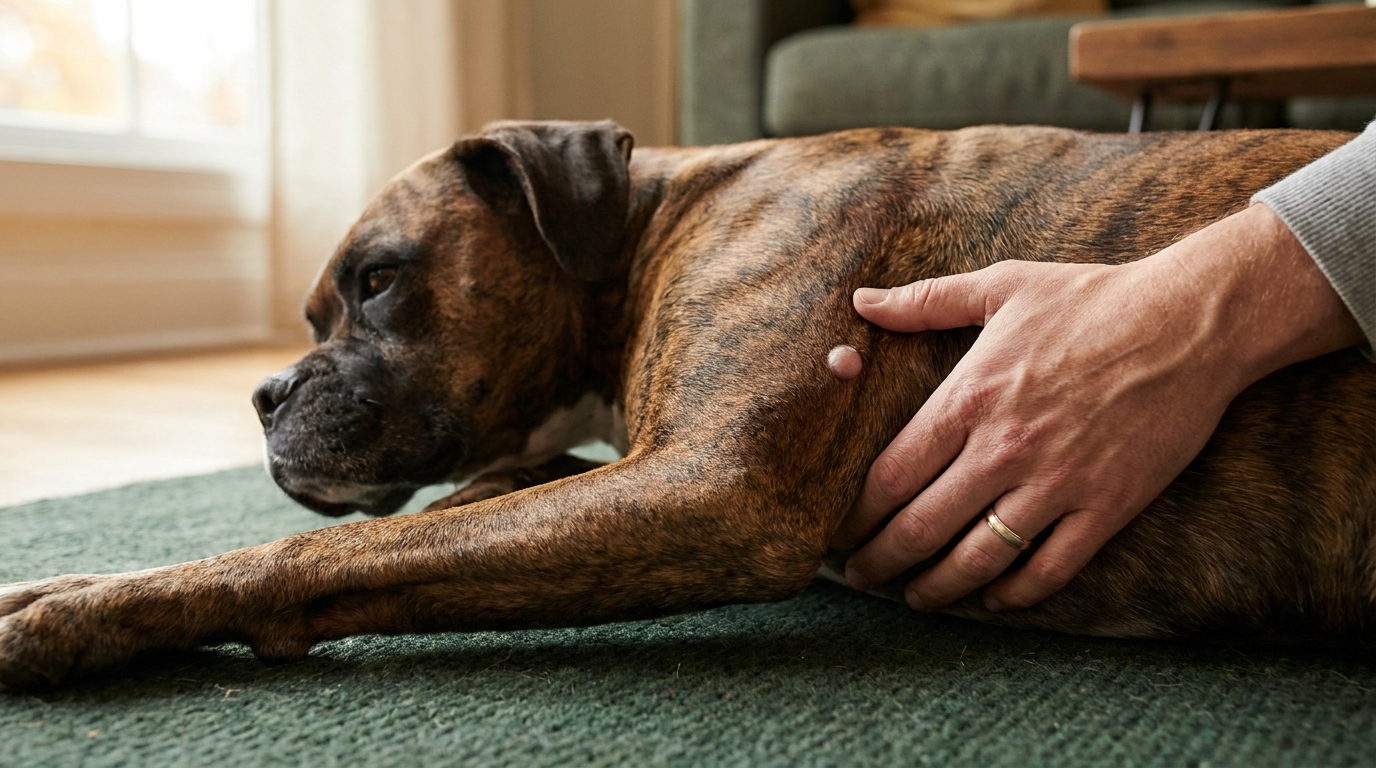
What to do when a dog's cyst pops, drains or grows, why never to squeeze it, and which signs need a vet the same day.
Quick answer: A sebaceous cyst on a dog is usually a benign sac of oily, cheesy material, but only a needle sample or biopsy can tell it from a tumor. Never squeeze it. A cyst that is open or oozing, smells, is hot, red or painful, bled (even if it stopped) or grows fast needs a vet in person the same day; a new intact one needs a needle sample within days.
This article is general information, not a diagnosis. If you think your pet is in danger, go to the nearest emergency animal hospital.
Is a sebaceous cyst on a dog an emergency?
A sebaceous cyst on a dog is usually not an emergency; go to an emergency vet now if blood is still flowing freely after several minutes of steady pressure, or the dog also collapses, is very weak, has pale gums, a swollen belly or trouble breathing. Vomiting blood, bruises elsewhere or tiny purple spots on the skin or gums also mean an emergency vet now.
See a vet in person the same day for a cyst that burst and is open or oozing anything, or a lump that smells bad, is hot, red, swollen or painful, bled (even if it stopped), grows fast, or comes with not eating, lethargy, vomiting or black tarry stool. Go in person now if your dog also has a fever or is very quiet. If your clinic is closed or short-staffed, as many are over a holiday weekend, go to an urgent care or emergency hospital.
| What you see | Next step |
|---|---|
| Still bleeding after several minutes of steady pressure | Emergency vet now |
| Lump plus collapse, very weak, pale gums or hard breathing | Emergency vet now |
| Lump plus a swollen belly or vomiting blood | Emergency vet now |
| Burst, open or oozing anything | In person same day |
| Smells bad, or hot, red, swollen or painful | In person same day |
| Bled (even if it stopped) or grows fast | In person same day |
| Squeezed at home, now red or sore | In person same day |
| Lump plus not eating, vomiting or black tarry stool | In person same day |
| New raised, firm or fixed lump | Needle sample within days |
| Swells and shrinks, or red after touch | Needle sample within days; never squeeze |
| Dark or black bump | Exam within days |
| Pea-sized or bigger, there a month | Needle sample now; stop waiting |
| Sampled cyst, not changing | Photo with ruler monthly |
What does a sebaceous cyst look like on a dog?
VCA Animal Hospitals describes a sebaceous cyst as a single raised bump, white or slightly blue, usually on the head, neck, torso or upper legs, that oozes grayish-white, brownish or cottage-cheese-like material if it bursts. VCA says that material is sebum, the oily, waxy substance made by the glands attached to hair follicles.
The Merck Veterinary Manual says the most common keratin-filled skin cyst is the follicular (epidermoid) cyst, wrongly called a sebaceous cyst: usually single and movable, 2 mm to more than 5 cm, with gray, brown or yellowish cheesy keratin.
A bad smell can mean infection: VCA says sebaceous cysts are prone to secondary bacterial infection. A dark, black or bluish bump needs an exam within days, but a bruise-like "blood blister" lump needs a vet in person the same day: Cornell University's Riney Canine Health Center says a skin hemangiosarcoma can look like a bruise or a blood blister. Rule out an engorged tick, which can look like a gray-blue bump, and on the belly, a nipple; never squeeze either. A "cyst" between the toes is usually an infected hair follicle (see interdigital cyst between the toes).
Sebaceous cyst, lipoma or tumor: how can you tell?
You cannot tell a sebaceous cyst on a dog from a tumor by looking or feeling; only a vet's needle sample (or a biopsy) can tell them apart. Veterinary oncologist Dr. Sue Ettinger writes in Today's Veterinary Practice that even an experienced cancer specialist cannot look at or feel a mass and know what it is, and AKC Chief Veterinary Officer Dr. Jerry Klein says the only way to prove a lump is a cyst is to remove all or part of it for lab testing.
Cheesy material does not settle it: the Merck Veterinary Manual says some hair-follicle tumors (trichoepitheliomas) can release yellow, cheesy keratin, and a malignant form exists. Look-alikes include:
- A lipoma, a soft fatty lump that usually moves and grows slowly (see lipomas in dogs).
- A histiocytoma, a red button-like bump that VCA says shows up mostly in dogs under 3 years old (see histiocytoma in dogs).
- A sebaceous adenoma, a wart-like oil-gland growth the Merck Veterinary Manual calls very common in older dogs (see warts on dogs).
- A mast cell tumor, which VCA says may seem to grow and shrink, even daily, and should not be handled, because pressure easily makes it react. Welts or a puffy face with normal breathing after handling need an in-person vet within 1 hour; go to an emergency vet now if they come with vomiting, pale gums, weakness, hard breathing or swelling toward the throat or tongue, or if a flat-faced dog such as a Boxer or bulldog has any face swelling.
| Bump | Clues | Next step |
|---|---|---|
| Sebaceous cyst | Round, oily or cheesy | Test in days |
| Follicular cyst | Bluish, dark cheesy core | Test in days |
| Lipoma | Soft, moves, not growing | Test in weeks |
| Red button bump | Young dog, smooth, pink | Test in days |
| Oil-gland adenoma | Wart-like, older dog | Exam in days |
| Mast cell tumor | Swells and shrinks | Test in days; no squeeze |
| Infected cyst | Hot, red, pus or smell | Vet same day |
My dog's cyst popped: what should I do right now?
If a dog's cyst pops, do not squeeze out the rest: press clean gauze on it with steady pressure if it bleeds, keep it clean and dry, stop your dog licking it, take a photo next to a ruler, and have a vet see it in person the same day, because an open, oozing or bleeding cyst is a same-day sign.
VCA Animal Hospitals says licking, scratching, rubbing or biting a cyst can cause inflammation, infection and bleeding, and that a vet may recommend a cone. VCA adds that an open cyst may need a protective bandage until it heals; the vet decides, so do not wrap it yourself. Take the photo without pressing the lump, and put nothing on it.
If your clinic is closed, go to an urgent care or emergency hospital; if the cyst still bleeds freely after several minutes of steady pressure, go to an emergency vet now.
| Do | Do not |
|---|---|
| Press clean gauze if it bleeds | Squeeze or pop it |
| Keep it clean and dry | Lance, drain or prick it |
| Stop licking with a cone | Put creams or oils on it |
| Photo next to a ruler | Give human pills |
| Write down size and date | Wrap or tape it |
| Book a vet visit | Use heat or soaks |
Why does my dog's cyst keep draining or filling back up?
A dog's cyst can keep draining or filling back up because its lining (the sac) is still under the skin, and VCA Animal Hospitals says complete removal or destruction of that lining may be necessary to stop a true cyst coming back.
The lining makes secretions, so after a cyst bursts or is drained, the sac can fill again. Draining it at home does not cure it and adds the risk of infection. A refilling cyst that opens, oozes, smells or hurts needs a vet in person the same day; a calm one that no vet has tested still needs an in-person needle sample within days.
My dog's cyst is getting bigger: when should I worry?
A cyst on a dog that grows fast needs a vet in person the same day, a new firm, fixed or raised lump needs an in-person needle sample within days, and veterinary oncologist Dr. Sue Ettinger's See Something, Do Something campaign says any lump pea-sized (about 1 cm) or larger that has been there a month needs a needle sample, with a biopsy if that gives no answer.
The rule is an outer limit, a deadline, not a reason to wait. Dr. Ettinger also writes that masses should not be allowed to grow past 1 cm without investigation. At any size, a lump on the belly or next to a nipple, a firm swelling under the jaw or in the neck, armpit, groin or behind a knee, a growth on the lip, in the mouth or at a nail bed (or a swollen toe or lost nail), an eyelid bump on a comfortable eye, or several new lumps at once need an exam within days. An eyelid bump needs a vet in person the same day if the dog squints, paws at the eye or has discharge, and an emergency vet now if the eye turns cloudy, hazy or bluish, bulges or stays shut.
Photograph the lump next to a ruler monthly, or sooner if it changes, with the date and size in centimeters, without squeezing it. A sampled cyst that slowly changes needs a new needle sample within days.
Why should you never squeeze, pop or lance a cyst at home?
Never squeeze, pop or lance a cyst on a dog at home: the Merck Veterinary Manual warns that vigorous squeezing often sets off a severe inflammatory reaction because keratin is released into the surrounding tissue, and VCA Animal Hospitals says a follicular cyst that ruptures inside the skin causes inflammation and pain.
AKC's Dr. Jerry Klein also calls sebaceous cysts one of the easiest types to become infected. Never drain, cut or tie one off, even after a vet confirms a cyst. A lump that was squeezed and is now red, swollen or sore needs a vet in person the same day.
Which dogs get cysts, and why do some keep getting them?
Any dog can get a skin cyst, and VCA Animal Hospitals says Boxers, Shih Tzus, Schnauzers and Basset Hounds are genetically prone to follicular cysts, though they can occur in any breed. VCA also says mast cell tumors are particularly common in Boxers and Schnauzers, so never assume a new lump on these breeds is a cyst; like any new raised lump, it needs an in-person needle sample within days.
VCA adds that multiple and recurrent follicular cysts may develop on the heads of young dogs, and that a pet with recurrent or multiple cysts may need tests to find the underlying cause. VCA says sebaceous cysts are unusual in cats, so any lump on a cat needs a vet exam (see lump on a cat).
How does a vet treat a sebaceous cyst?
A sebaceous cyst on a dog that a vet has confirmed and that is small, not infected and not painful may simply be monitored, while one that keeps coming back, grows or bothers the dog is often removed surgically, sac and all.
That monitoring advice comes from the AKC, which adds that infected or ulcerated cysts may first be managed without surgery, while ones that are very painful or growing large may need surgery; a vet decides after an in-person exam. The Merck Veterinary Manual calls surgical removal (excision) the treatment of choice. RexVet's guides to the mass removal cost in Florida, mass removal cost in New York and mass removal cost in Virginia show example price ranges.
When a video visit helps, and when it does not
For a dog located in Florida, New York or Virginia that is eating and acting normally and has a lump that looks like a sebaceous cyst and is intact, or has closed without bleeding, with no redness, heat, pain, smell or fast growth, RexVet, a nonprofit online vet service, offers a $64.99 live video visit with a veterinarian licensed in the dog's state, about 8 AM to 11 PM Eastern, to say how soon the lump needs an in-person needle sample. RexVet serves pets located in Florida, New York and Virginia by video visit, and your dog must be in one of those states during the visit.
A video visit fits a dog that is eating, drinking and acting normally and has:
- A new, round, intact bump, to learn how soon it needs an in-person needle sample.
- A cyst that burst days ago, drained without bleeding and has closed, with no redness, heat, smell or pain.
- A sampled cyst that has slowly changed size or look, to plan a new in-person needle sample.
- Cysts that keep coming back, to plan tests or removal.
Have clear photos ready, taken next to a ruler without pressing the lump, plus the date you first noticed it and any past sample report. The veterinarian tells you how soon the lump needs an in-person needle sample, whether it needs hands-on care today, or whether a lump already confirmed by a needle sample or biopsy can be watched. A video visit cannot feel, sample, drain or remove a cyst, or tell a cyst from a tumor.
Book a live video visit for cases like these. There are no overnight visits, and holiday hours are not confirmed, so check open slots when you book.
Skin trouble was the top reason pet owners booked a RexVet video visit: 27% of visits named skin problems, itching, allergies or hair loss. That finding covers skin concerns in general, not cysts. About 1 in 8 RexVet video visits (12.5%) ended with a prescription; the rest ended with the veterinarian's advice and care plan. No prescription is promised, and a lump cannot be sampled on camera, so the visit is about how soon it needs an in-person test.
A video visit is not the right first step for a lump that is open or oozing anything, smells, is hot, red or painful, bled (even if it stopped) or is growing fast, or for a dog that is not eating, is lethargic, is vomiting or has black tarry stool: see a vet in person the same day, at an urgent care or emergency hospital if your regular clinic is closed or short-staffed.
Go to an emergency vet now, not a video call, if blood is still flowing freely after several minutes of steady pressure, or your dog collapses, is very weak, has pale gums, a swollen belly, trouble breathing or is vomiting blood.
Need an Expert Opinion on This Topic?
Book a video visit with a licensed vet, evenings and weekends included
See open timesFrequently Asked Questions
Will a sebaceous cyst on my dog go away on its own?
Do not count on it: while a cyst's lining is still under the skin, the sac can fill again, even after it bursts. A new raised bump needs an in-person needle sample within days, because only a test shows it is a cyst. Once a vet confirms it, the AKC says a cyst that is not too large, infected or painful may simply be monitored.
Can I pop my dog's sebaceous cyst?
No: never squeeze, pop, lance or drain a cyst on your dog at home, even one a vet has already confirmed. The Merck Veterinary Manual warns that vigorous squeezing often sets off a severe inflammatory reaction. If you already squeezed a lump and it is now red, swollen or sore, see a vet in person the same day.
What is the white cheesy stuff coming out of my dog's bump?
It is often oily sebum or keratin from a burst cyst, but cheesy material alone does not prove the bump is harmless. The Merck Veterinary Manual says some hair-follicle tumors release similar cheesy keratin. An open or oozing bump needs a vet in person the same day; do not squeeze out the rest.
Is a sebaceous cyst on my dog cancer?
Often not, but only a needle sample or a biopsy can tell a cyst from a tumor. A new raised bump needs an in-person needle sample within days. Dr. Sue Ettinger's See Something, Do Something campaign says any lump pea-sized (about 1 cm) or larger that has been there a month needs a needle sample.
Should I cover a popped cyst on my dog?
Do not wrap or tape it yourself: keep it clean and dry, use a cone to stop licking, and let a vet decide. VCA Animal Hospitals says an open cyst may need a protective bandage until it heals. A popped cyst that is still open or oozing needs a vet in person the same day, at an urgent care or emergency hospital if your clinic is closed. If it bleeds, press clean gauze on it with steady pressure, and go to an emergency vet now if blood is still flowing freely after several minutes.
Can an online vet look at my dog's cyst in Florida, New York or Virginia?
Yes, for an intact lump, or one that closed without bleeding, on a dog located in Florida, New York or Virginia that is acting normally. A licensed RexVet vet can look at the bump, your dated ruler photos and any past sample report, and say how soon it needs an in-person needle sample. The veterinarian cannot feel or sample the lump, or tell a cyst from a tumor, on camera. A lump that is open or oozing, smells, is hot, red or painful, bled (even if it stopped) or grows fast needs a vet in person the same day, not a video visit. No prescription is promised. If medicine comes up for another problem, Florida limits a video-only prescription to FDA-approved animal drugs used as labeled, for up to 14 days (1 month for products labeled only for fleas and ticks), with no renewal without an in-person exam, and human-labeled, controlled and compounded anti-infective drugs need an in-person exam first. Federal rules require an in-person exam for extralabel or human-drug use, Virginia allows an electronic exam, and New York's rules are unsettled. A pharmacy transfer fee applies when RexVet sends a prescription to an outside pharmacy, because RexVet is not a pharmacy.
FAQs
Will a sebaceous cyst on my dog go away on its own?
Do not count on it: while a cyst's lining is still under the skin, the sac can fill again, even after it bursts. A new raised bump needs an in-person needle sample within days, because only a test shows it is a cyst. Once a vet confirms it, the AKC says a cyst that is not too large, infected or painful may simply be monitored.
Can I pop my dog's sebaceous cyst?
No: never squeeze, pop, lance or drain a cyst on your dog at home, even one a vet has already confirmed. The Merck Veterinary Manual warns that vigorous squeezing often sets off a severe inflammatory reaction. If you already squeezed a lump and it is now red, swollen or sore, see a vet in person the same day.
What is the white cheesy stuff coming out of my dog's bump?
It is often oily sebum or keratin from a burst cyst, but cheesy material alone does not prove the bump is harmless. The Merck Veterinary Manual says some hair-follicle tumors release similar cheesy keratin. An open or oozing bump needs a vet in person the same day; do not squeeze out the rest.
Is a sebaceous cyst on my dog cancer?
Often not, but only a needle sample or a biopsy can tell a cyst from a tumor. A new raised bump needs an in-person needle sample within days. Dr. Sue Ettinger's See Something, Do Something campaign says any lump pea-sized (about 1 cm) or larger that has been there a month needs a needle sample.
Should I cover a popped cyst on my dog?
Do not wrap or tape it yourself: keep it clean and dry, use a cone to stop licking, and let a vet decide. VCA Animal Hospitals says an open cyst may need a protective bandage until it heals. A popped cyst that is still open or oozing needs a vet in person the same day, at an urgent care or emergency hospital if your clinic is closed. If it bleeds, press clean gauze on it with steady pressure, and go to an emergency vet now if blood is still flowing freely after several minutes.
Can an online vet look at my dog's cyst in Florida, New York or Virginia?
Yes, for an intact lump, or one that closed without bleeding, on a dog located in Florida, New York or Virginia that is acting normally. A licensed RexVet vet can look at the bump, your dated ruler photos and any past sample report, and say how soon it needs an in-person needle sample. The veterinarian cannot feel or sample the lump, or tell a cyst from a tumor, on camera. A lump that is open or oozing, smells, is hot, red or painful, bled (even if it stopped) or grows fast needs a vet in person the same day, not a video visit. No prescription is promised. If medicine comes up for another problem, Florida limits a video-only prescription to FDA-approved animal drugs used as labeled, for up to 14 days (1 month for products labeled only for fleas and ticks), with no renewal without an in-person exam, and human-labeled, controlled and compounded anti-infective drugs need an in-person exam first. Federal rules require an in-person exam for extralabel or human-drug use, Virginia allows an electronic exam, and New York's rules are unsettled. A pharmacy transfer fee applies when RexVet sends a prescription to an outside pharmacy, because RexVet is not a pharmacy.
Medically Reviewed
Reviewed by Dr. Tiffany Delacruz, DVM — licensed veterinarian and CEO of RexVet. Last reviewed November 27, 2026.
Content is for informational purposes and does not replace professional veterinary advice.
Chief Executive Officer · Licensed Veterinarian
Dr. Delacruz is a licensed Doctor of Veterinary Medicine specializing in preventive care and veterinary telehealth. She reviews all health content on RexVet to ensure accuracy and clinical relevance. RexVet video visits are for pets in Florida, New York and Virginia, with a veterinarian licensed in the pet's state.
Sources & References
- · American Veterinary Medical Association — Telehealth Guidelines
- · AVMA — Pet Care Resources
- · U.S. FDA — Animal & Veterinary