
Lipomas in Dogs: When a Fatty Lump Needs a Vet Check
By RexVet Team | Reviewed by Dr. Tiffany Delacruz, DVM
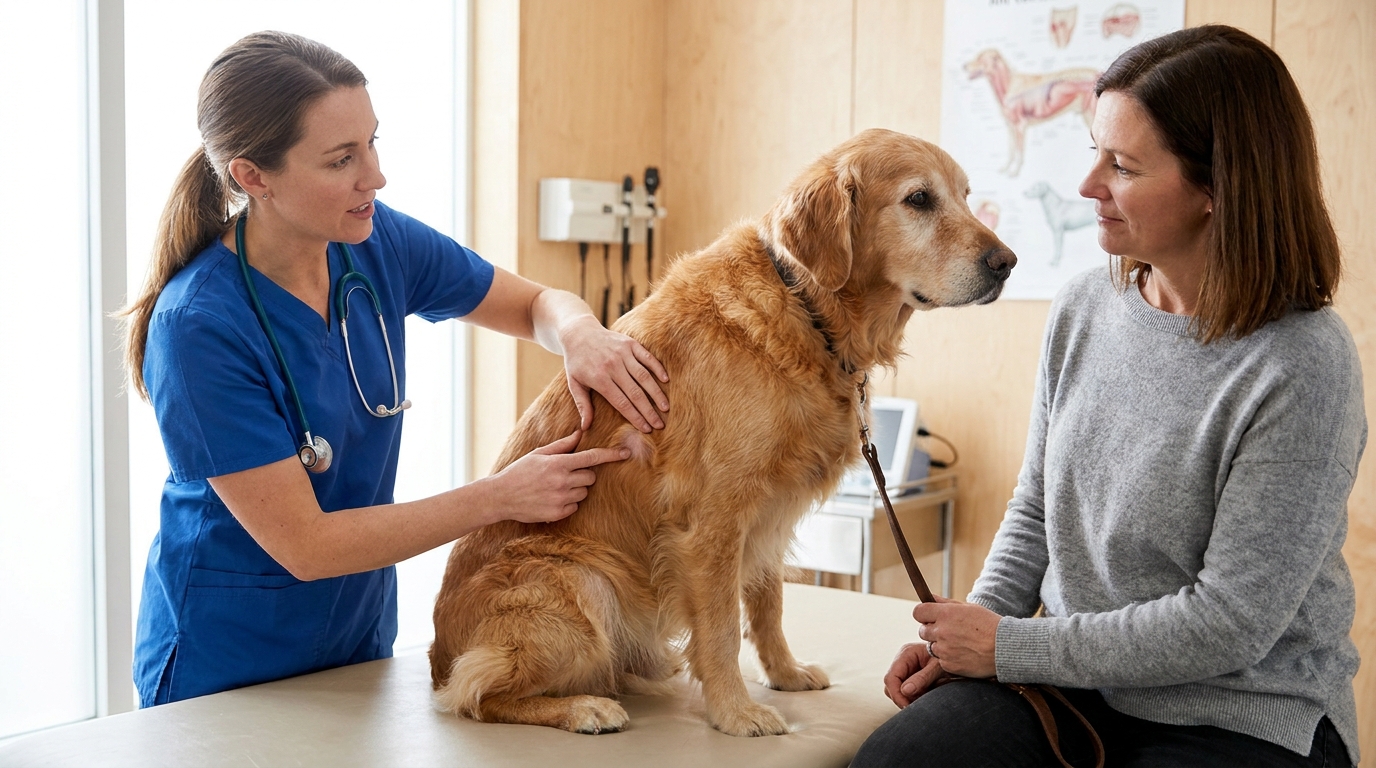
Why feel alone cannot tell a fatty lump from cancer, which lumps on dogs need a vet today, and when a lipoma should come off.
Quick answer: Many soft, movable lumps on dogs are benign lipomas, but mast cell tumors can mimic them (Merck Veterinary Manual), so touch cannot tell them apart. Any lump pea-sized (about 1 cm) or larger for a month needs a needle sample at the latest. Firm, fixed or raised lumps need an in-person exam within days; one that bled or grows fast, same day; nonstop bleeding, collapse, pale gums, swollen belly or trouble breathing: emergency vet now.
This article is general information, not a diagnosis. If you think your pet is in danger, go to the nearest emergency animal hospital.
What does a lipoma on a dog look and feel like?
A lipoma on a dog usually feels like a soft, rounded lump just under the skin that often slides when gently touched, most often on the trunk and the tops of the legs. Cornell's Riney Canine Health Center calls lipomas one of the most common benign (non-cancerous) tumors in dogs. The Merck Veterinary Manual says most move freely, but many merge with the healthy fat next to them, so their edges are difficult to find. A dog can have one or several, Cornell adds, and some grow between muscles.
Gently feel it once to see whether it slides under the skin; do not squeeze, massage or keep pressing it. Rule out an engorged tick, and on the belly, a nipple. A lump along the belly or next to a nipple, especially in an unspayed or late-spayed female dog, needs an in-person exam within days, not weeks, at any size: the Merck Veterinary Manual says approximately 45% of canine mammary tumors are malignant.
Not every soft swelling is fat. VCA Animal Hospitals says lymph nodes in the neck, chest, armpits, groin and behind the knees are often the easiest to see, and the Merck Veterinary Manual says early lymphoma causes rapid, nonpainful node swelling, so a firm swelling at those spots needs a vet within days. Cornell says a hemangiosarcoma on the skin can look like a bruise or a "blood blister", so have one seen in person the same day. Bruises in several places, or tiny purple-red spots on the skin or gums, can mean a clotting problem such as rat poison: emergency vet now. For raised growths on the skin surface, see the guide to warts and wart-like bumps on dogs.
When is a lump on a dog an emergency?
A lump on a dog is an emergency when blood is still flowing freely after several minutes of steady pressure, or when the dog also collapses, is very weak, has pale gums, a swollen belly or trouble breathing. Cornell's Riney Canine Health Center lists collapse or severe weakness, pale gums, and rapid or difficult breathing as emergency signs when a tumor ruptures, and the WSAVA Oncology Committee lists a swollen belly. Act on the most urgent row that fits.
| What you see | What to do |
|---|---|
| Still bleeding after several minutes of steady pressure | Emergency vet now |
| Lump plus collapse, weakness, pale gums or trouble breathing | Emergency vet now |
| Lump plus vomiting blood or a swollen belly | Emergency vet now |
| Lump plus bruises elsewhere or tiny purple spots | Emergency vet now |
| Lump that bled (even if it stopped), grows fast, or is open or oozing | In person same day |
| Hot, painful or quickly growing swelling after a bite | Same day; go now if fever, very quiet or not eating |
| Lump plus vomiting, black tarry stool or not eating | In person same day |
| Firm, fixed or raised lump | Needle sample within days |
| Swells and shrinks, or red and itchy after touching | Needle sample within days; never squeeze |
| Lump on the belly or near a nipple, any size | Exam within days, not weeks |
| Firm swelling in the neck, armpit, groin or behind a knee | Vet within days |
| Several new lumps at once | Vet within days |
| Known lipoma that grows, firms up or feels different | New sample within days |
| New soft, movable lump, not growing, not on the belly | Needle sample within weeks; measure monthly |
| Any lump pea-sized (about 1 cm) or larger for a month | Needle sample now; stop waiting |
The pea-sized row is Dr. Sue Ettinger's rule. A lump with a limp, or an armpit lump that gets in the way of walking, also needs a vet within days. Itchy welts that pop up suddenly all over are more likely hives, which need an in-person vet within the hour, or an emergency vet now with vomiting, diarrhea, pale gums, weakness, collapse, breathing trouble or swelling toward the throat or tongue, or if they start within 1 hour of a shot, sting or new medicine; see the guide to dog hives and sudden bumps all over.
Can you tell a lipoma from cancer by feel?
No: the Merck Veterinary Manual says mast cell tumors can mimic lipomas, so visual signs alone cannot establish a diagnosis, and a soft, movable lump on a dog can still be cancer. Veterinary oncologist Dr. Sue Ettinger writes in Today's Veterinary Practice that even an experienced cancer specialist cannot look at or feel a mass and know what it is.
Merck calls mast cell tumors the most common malignant tumor seen in dogs; they appear most often at 8 to 10 years old, usually as a raised lump that may be soft to solid. VCA Animal Hospitals says one may seem to grow or shrink, even daily, and that handling it can make it swell. In the table, "invasive lipoma" means an infiltrative lipoma, which grows into muscle.
| Lump | Usually feels | Risk |
|---|---|---|
| Lipoma | Soft, often moves | Benign; some grow |
| Invasive lipoma | Soft, lumpy, can go deep | Invades muscle; rarely spreads |
| Liposarcoma | Lumpy, soft or firm | Cancer, rare; often recurs |
| Mast cell tumor | Raised, soft or firm; may swell and shrink | Malignant |
| Mammary tumor | Lump by a nipple | About 45% are cancer |
| Swollen lymph node | Firm; neck, armpit, groin or behind knee | Can be lymphoma |
| Abscess | Hot, painful | Infection |
Sources: the Merck Veterinary Manual, VCA Animal Hospitals and Cornell; the abscess row is RexVet's own triage advice.
What is the pea-and-a-month rule for lumps on dogs?
Veterinary oncologist Dr. Sue Ettinger's See Something, Do Something campaign says any lump pea-sized (about 1 cm) or larger that has been there a month needs a needle sample, with a biopsy if that gives no answer. The rule is an outer limit, a deadline, not a reason to wait: a firm, growing, bleeding or belly lump follows the sooner rows in the table above. Ettinger also warns that letting a tumor grow can turn a simple removal into a much more complicated one.
A dog that already has lipomas still needs each new lump sampled. Ettinger describes a dog whose records already showed needle samples of many lipomas. A new lump on his flank was assumed to be one more lipoma and sampled late; it turned out to be a low-grade soft tissue sarcoma that needed removal with wide margins.
How does a vet confirm a lipoma?
A vet checks a lump on a dog with a fine-needle aspirate, a quick test that draws cells through a thin needle and often needs no sedation; a sample of only fat fits a lipoma but cannot rule out an infiltrative lipoma. Veterinary clinical pathologist Dr. Anne Barger wrote in Today's Veterinary Practice that, under the microscope, a lipoma cannot be distinguished from the normal fat under the skin.
A deep, fixed or growing lump needs more testing chosen by the vet, such as a biopsy or a CT scan. Cornell says a CT scan may be recommended to help plan surgery for an infiltrative lipoma. Even a biopsy does not always settle it: a 2018 veterinary case report says an infiltrative lipoma cannot be diagnosed accurately with either a needle sample or a core needle biopsy.
Does a fatty lump on a dog need to be removed?
Not always: a small lipoma on a dog that a needle sample has checked, and that is not growing or bothering the dog, is often measured and watched, but Cornell and VCA say one in the armpit or one that keeps growing is better removed while still small. Cornell says an armpit lipoma can interfere with leg movement and that earlier removal can prevent a fluid pocket (a seroma) after surgery.
The Merck Veterinary Manual says "Surgical removal is the cure," but also that skipping treatment for a benign lump that is not ulcerated or getting in the dog's way "may be the most prudent option, especially in aged dogs." Cornell says simple lipomas rarely come back after complete removal, though new ones can form elsewhere.
| Situation | Usual plan |
|---|---|
| Small, sampled, not growing | Measure and photo monthly |
| In the armpit | Ask about early removal |
| Growing, firm or fixed | More tests or removal |
| Needle sample gave no answer | Biopsy |
| Sampled lipoma that changed | New sample |
| Older dog, sampled lump, no trouble | Watching may be fine |
If age is the worry, the guide to whether a senior dog or cat is too old for anesthesia or surgery lists the tests to ask about before a planned removal.
What are infiltrative lipomas and liposarcomas?
An infiltrative lipoma is a rare fatty tumor that grows into muscle and connective tissue, and a liposarcoma is a rare cancer of fat cells; both need wider surgery than a simple lipoma. Cornell calls infiltrative lipomas benign but invasive, while the Merck Veterinary Manual calls them sarcomas of partial malignancy; both say they need wide surgery.
Merck says infiltrative lipomas are most common in middle-aged females, on the chest and legs, and rarely spread to other sites; Cornell says they invade muscle, bone and nerves, grow faster and come back more often than simple lipomas. Surgery removes the tumor with a margin of normal tissue, which Merck says can mean amputation; Cornell says radiation is sometimes added.
Merck says liposarcomas are found mostly in older male dogs, usually on the chest and legs, with Shetland Sheepdogs and Beagles most at risk. They are malignant but have a low potential to spread; wide surgery is most often recommended, and because they often come back, follow-up radiation may be needed.
Which dogs get lipomas?
Lipomas are most common in older, overweight dogs, and the Merck Veterinary Manual names Doberman Pinschers, Labrador Retrievers, Miniature Schnauzers and mixed-breed dogs as most at risk. Cornell agrees on older, overweight dogs and Labrador Retrievers, and Merck says lipomas generally occur in older, obese females. Those are patterns, not rules: any dog of any age or sex can grow a lump that needs a needle sample, and Merck says liposarcomas are found mostly in older males.
From RexVet's visit data, across all visit reasons: 41% of RexVet video visits were for pets aged 7 or older.
How do I track a lump on my dog at home?
Each month, or sooner if it changes, photograph a lump on your dog next to a ruler or tape measure in the same light, and write down the date, where it is and its size in centimeters. For several lumps, sketch a simple body map, number each lump and note its needle-sample result.
Never squeeze, pop, drain, cut or tie off a lump, and put no creams, oils or home remedies on it; keep your dog from licking or chewing it. Cornell says a lipoma that is not removed should be watched for changes in size, firmness or discomfort. Any such change means a new needle sample within days. Tracking never replaces the needle sample: it shows how a lump is changing, not what it is.
When does a video visit help with a lump, and when does it not?
A video visit can help a dog owner decide how soon a lump needs an in-person needle sample, but no vet can take a sample, remove a lump or tell a lipoma from cancer on camera. RexVet, a nonprofit online vet service, serves pets located in Florida, New York and Virginia by video visit. If your dog is in one of those states during the visit, a $64.99 live video visit with a licensed RexVet vet (slots about 8 AM to 11 PM ET) can help you plan the next step.
The veterinarian can look at the lump on camera and watch as you gently nudge it once to show whether it moves. Never squeeze it: VCA Animal Hospitals warns that handling a mast cell tumor can make it swell. They can also review dated photos, measurements and any past needle-sample or biopsy report, and help you prepare questions for the clinic before and after a removal. Whether and when a lump comes off is decided in person.
A video visit is not the right first step for some lumps. Go to an emergency vet now for bleeding that is still flowing freely after several minutes of steady pressure, collapse, severe weakness, pale gums, vomiting blood, a swollen belly or trouble breathing. Go in person the same day for a lump that bled (even if it stopped), grows fast, is open or oozing, or is hot and painful after a bite. Book an in-person needle sample within days for a firm, fixed or raised lump, one that swells and shrinks, or any lump on the belly or near a nipple.
For a dog you will recheck through the year, the one-time $120 Family Plan covers 4 visits over 12 months for every pet in the home and never auto-renews. Book a video visit.
Need an Expert Opinion on This Topic?
Book a video visit with a licensed vet, evenings and weekends included
See open timesFrequently Asked Questions
Is a lipoma painful for my dog?
Often not, but a lump that does not hurt is not proof it is harmless: the Merck Veterinary Manual says early lymphoma causes rapid, nonpainful lymph node swelling. Any lump that hurts needs an in-person check within days, or the same day if it is hot, swelling fast or appeared after a bite.
Can a lipoma on my dog go away or shrink if my dog loses weight?
Do not count on it: the Merck Veterinary Manual says lipomas should not be ignored, because some grow. Weight loss does not prove a lump is harmless. Merck says a weight-loss diet started several weeks before surgery may help the surgeon find the tumor's edges, but that is the surgeon's plan, not a home treatment. Any lump pea-sized (about 1 cm) or larger that has been there a month still needs a needle sample.
My dog already has lipomas. Does every new lump need a needle test?
Yes: each new lump on a dog needs its own needle sample, even when the dog already has several known lipomas. Veterinary oncologist Dr. Sue Ettinger describes one such dog whose new lump, assumed to be another lipoma, was a low-grade sarcoma. A known lipoma that grows, firms up or feels different needs a new sample within days.
How fast do lipomas grow on dogs?
Usually slowly, but a lump on a dog that grows fast needs a vet in person the same day. Cornell calls lipomas typically slow-growing, and VCA says growth rates vary greatly. Dr. Sue Ettinger's rule is that any lump pea-sized (about 1 cm) or larger that has been there a month needs a needle sample.
Can a lipoma on my dog turn into cancer?
Treat any change as a new lump: the Merck Veterinary Manual says a lipoma may be indistinguishable from an infiltrative lipoma or a liposarcoma, a rare fat-cell cancer. A known lipoma that grows, firms up or feels different needs a new needle sample within days.
Can cats get fatty lumps too?
Yes, cats can get lipomas, but a cat's skin lump is more likely to be cancer than a dog's. Any lump on a cat's belly or near a nipple needs a vet within days. The same pea-sized, one-month deadline applies, and a hot, painful lump needs a vet the same day. The guide to lumps on cats covers which cat lumps need an ER and the separate rule for lumps where a vaccine was given.
Can an online vet look at my dog's lump in Florida, New York or Virginia?
Partly: for a dog located in Florida, New York or Virginia, a video visit helps decide how soon a lump needs a needle sample. A licensed RexVet vet can look at the lump on camera and review your dated photos and past reports, but feeling whether a lump is fixed, the needle sample, a biopsy and surgery need an in-person visit, because no vet can tell a lipoma from cancer by looking. No prescription is promised: if medicine comes up for another problem, Florida limits a video-only prescription to FDA-approved animal drugs used as labeled for up to 14 days (1 month for products labeled only for fleas and ticks) with no renewal without an in-person exam, federal rules require an in-person exam for extralabel or human-drug use, Virginia allows an electronic exam, and New York's rules are unsettled. A pharmacy transfer fee applies when RexVet sends a prescription to an outside pharmacy, because RexVet is not a pharmacy.
FAQs
Is a lipoma painful for my dog?
Often not, but a lump that does not hurt is not proof it is harmless: the Merck Veterinary Manual says early lymphoma causes rapid, nonpainful lymph node swelling. Any lump that hurts needs an in-person check within days, or the same day if it is hot, swelling fast or appeared after a bite.
Can a lipoma on my dog go away or shrink if my dog loses weight?
Do not count on it: the Merck Veterinary Manual says lipomas should not be ignored, because some grow. Weight loss does not prove a lump is harmless. Merck says a weight-loss diet started several weeks before surgery may help the surgeon find the tumor's edges, but that is the surgeon's plan, not a home treatment. Any lump pea-sized (about 1 cm) or larger that has been there a month still needs a needle sample.
My dog already has lipomas. Does every new lump need a needle test?
Yes: each new lump on a dog needs its own needle sample, even when the dog already has several known lipomas. Veterinary oncologist Dr. Sue Ettinger describes one such dog whose new lump, assumed to be another lipoma, was a low-grade sarcoma. A known lipoma that grows, firms up or feels different needs a new sample within days.
How fast do lipomas grow on dogs?
Usually slowly, but a lump on a dog that grows fast needs a vet in person the same day. Cornell calls lipomas typically slow-growing, and VCA says growth rates vary greatly. Dr. Sue Ettinger's rule is that any lump pea-sized (about 1 cm) or larger that has been there a month needs a needle sample.
Can a lipoma on my dog turn into cancer?
Treat any change as a new lump: the Merck Veterinary Manual says a lipoma may be indistinguishable from an infiltrative lipoma or a liposarcoma, a rare fat-cell cancer. A known lipoma that grows, firms up or feels different needs a new needle sample within days.
Can cats get fatty lumps too?
Yes, cats can get lipomas, but a cat's skin lump is more likely to be cancer than a dog's. Any lump on a cat's belly or near a nipple needs a vet within days. The same pea-sized, one-month deadline applies, and a hot, painful lump needs a vet the same day. The guide to lumps on cats covers which cat lumps need an ER and the separate rule for lumps where a vaccine was given.
Can an online vet look at my dog's lump in Florida, New York or Virginia?
Partly: for a dog located in Florida, New York or Virginia, a video visit helps decide how soon a lump needs a needle sample. A licensed RexVet vet can look at the lump on camera and review your dated photos and past reports, but feeling whether a lump is fixed, the needle sample, a biopsy and surgery need an in-person visit, because no vet can tell a lipoma from cancer by looking. No prescription is promised: if medicine comes up for another problem, Florida limits a video-only prescription to FDA-approved animal drugs used as labeled for up to 14 days (1 month for products labeled only for fleas and ticks) with no renewal without an in-person exam, federal rules require an in-person exam for extralabel or human-drug use, Virginia allows an electronic exam, and New York's rules are unsettled. A pharmacy transfer fee applies when RexVet sends a prescription to an outside pharmacy, because RexVet is not a pharmacy.
Medically Reviewed
Reviewed by Dr. Tiffany Delacruz, DVM — licensed veterinarian and CEO of RexVet. Last reviewed November 15, 2026.
Content is for informational purposes and does not replace professional veterinary advice.
Chief Executive Officer · Licensed Veterinarian
Dr. Delacruz is a licensed Doctor of Veterinary Medicine specializing in preventive care and veterinary telehealth. She reviews all health content on RexVet to ensure accuracy and clinical relevance.
Sources & References
- · American Veterinary Medical Association — Telehealth Guidelines
- · AVMA — Pet Care Resources
- · U.S. FDA — Animal & Veterinary