
Lump on a Cat: What It Could Be and When to Worry
By RexVet Team | Reviewed by Dr. Tiffany Delacruz, DVM
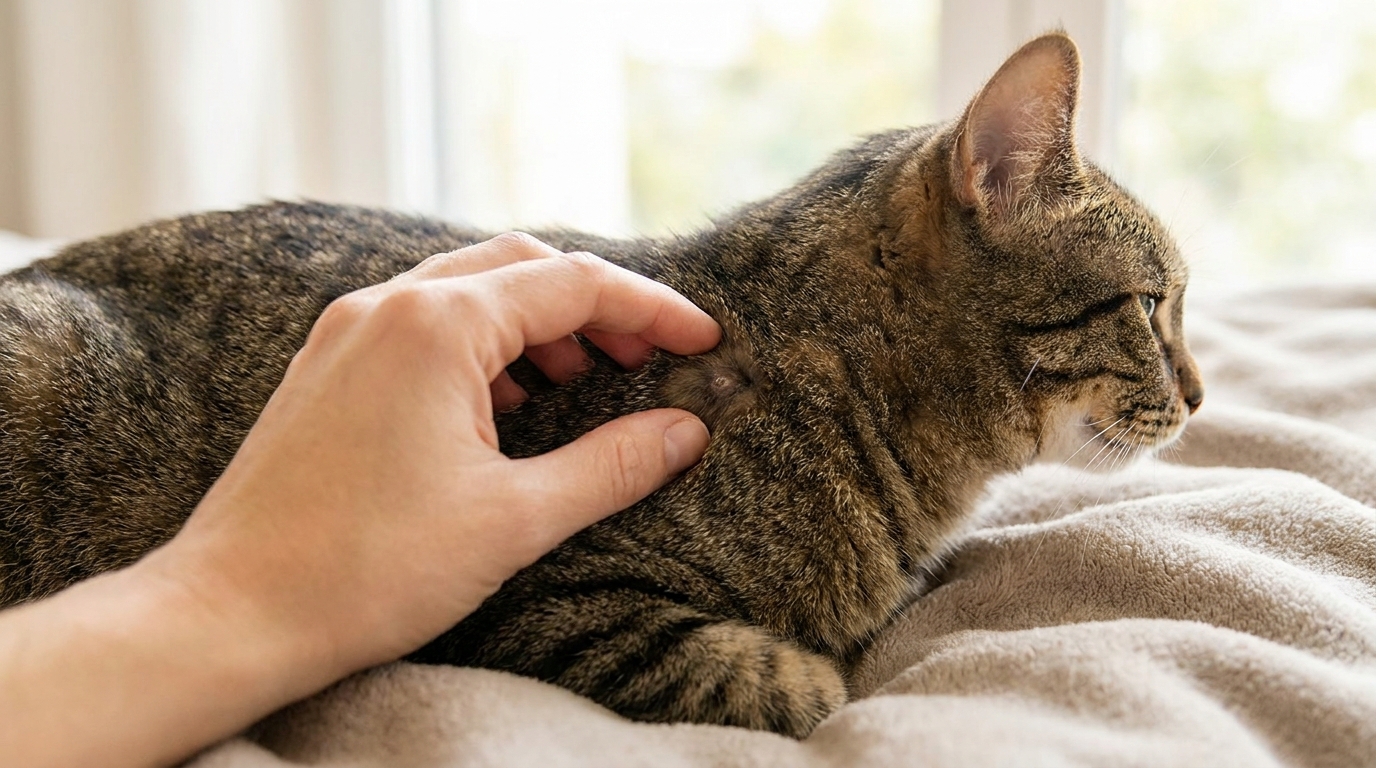
Which lumps on cats need an ER, which need a vet within days, and why a pea-sized lump that lasts a month needs a needle sample.
Quick answer: A cat's skin lump is more likely to be cancer than a dog's, so have any new lump checked. A lump pea-sized (about 1 cm) or larger that lasts a month needs a needle sample; vaccine-site lumps follow the 3-2-1 rule. Go within days if it is growing or near a nipple, and the same day if it is hot and painful or your cat is hiding or not eating.
This article is general information, not a diagnosis. If you think your pet is in danger, go to the nearest emergency animal hospital.
Is a lump on my cat an emergency?
Start with how your cat is acting, then the lump. Act on the most urgent row that fits. If your cat is also hiding, very quiet or not eating, see a vet at least the same day, whatever the lump looks like.
| What you see | What it may mean | When to act |
|---|---|---|
| Hot, painful or quickly growing swelling after a fight or outdoors | Bite abscess | Vet the same day; go now if feverish, hiding or off food |
| Lump burst and draining pus | Ruptured abscess | Vet within 24 hours; never squeeze it |
| Bleeding that won't stop with pressure, or bruises in several places | Bleeding mass, or clotting problem such as rat bait | ER now |
| Face swelling, hives, vomiting, collapse or breathing trouble after a shot or sting | Allergic reaction | ER now |
| Belly, groin or spay-scar bulge that turns firm, painful or dark, or comes with vomiting | Trapped hernia | ER now |
| Lump along the belly or nipples, any size | Possible mammary tumor | Exam within days, not weeks |
| Lump where a shot was given | Vaccine reaction or sarcoma | Use the 3-2-1 rule |
| Pea-sized swelling with a tiny breathing hole | Bot fly larva | Vet within days; never squeeze it |
| Firm swellings under the jaw, on the neck or behind the knees | Lymph nodes or thyroid | Vet within days |
| Crusty sore on white ear tips or nose, not healed in 2 weeks | Sun-related skin cancer | Vet within days |
| Soft, movable, painless lump, not growing, not on the belly | Lipoma, cyst or tumor | Needle sample within weeks; measure monthly |
| Small chin bumps with blackheads | Cat acne | Routine visit |
Beyond the ER rows above, go to an ER now for:
- Labored or open-mouth breathing with any swelling, or a crackling feel of air under the skin.
- Any bite or puncture on the chest or belly, even a tiny one. The Merck Veterinary Manual notes that the main damage from a bite is often beneath the surface.
- A swelling with a breathing hole plus circling, blindness or seizures.
For other lumps, veterinary oncologist Dr. Sue Ettinger's See Something, Do Something campaign sets an outer limit: any lump pea-sized (about 1 cm) or larger that has been there a month needs a needle sample, with a biopsy if that gives no answer. That is a deadline, not a reason to wait. Belly, growing, open, mouth and toe lumps need a vet within days, as do several lumps at once or a lump plus weight loss, vomiting or poor appetite.
The most common causes of lumps on cats
A lump under a cat's skin can be an infection, a shot reaction, a benign growth or a tumor.
Bite abscess. A bite from another animal is a common cause of a sudden, painful lump, says VCA Animal Hospitals, and cats that fight or go outdoors are at higher risk. The UK charity PDSA says an abscess often takes 2 to 4 days to form, so low appetite, low energy or fever can come first.
Fatty lump (lipoma). Merck says lipomas turn up only occasionally in cats, most often on the belly, and older neutered male Siamese cats are more prone. Lipomas are benign but tend to grow. Never assume a belly lump, especially near a nipple, is fat.
Cyst. Some lumps are keratin-filled cysts. Merck warns that squeezing one releases material that causes severe inflammation.
Mammary (breast) tumor. Merck estimates that 80% to 90% of mammary tumors in cats are malignant. They are most common in older unspayed females, at an average age of 11, and often spread to the lungs. A benign overgrowth (mammary hyperplasia) can look the same.
Mast cell tumor. Merck lists these as the second most common skin tumor in cats, usually a single hairless bump on the head or neck in a cat older than 4. They are usually benign in cats, but about 30% come back after surgery and some spread.
Basal cell tumor. Among the most common cat skin lumps, these are usually benign but keep enlarging. Many are dark, so they can look like other tumors, and some grow fast and break open.
Squamous cell carcinoma. This sun-linked cancer appears on the ear tips, nose, eyelids or lips of white-skinned cats, often as a crusty or scaly patch first. Merck says it usually invades nearby tissue and bone. It can also grow in the mouth: a mouth or jaw lump, drooling, mouth bleeding or trouble eating needs a vet within days.
Lymph nodes or thyroid. Firm swellings under the jaw or behind the knees may be lymph nodes reacting to infection, or lymphoma. A neck swelling can be an enlarged thyroid.
Bot fly larva. Merck describes a swelling about 1 cm across with a small breathing hole, usually on the head, neck or trunk. Do not squeeze it: the larva can rupture and cause infection or, rarely, a severe allergic reaction. A vet removes it.
Where the lump is tells you a lot
Location is not a diagnosis, but a lump on a cat's belly or neck calls for faster action than a soft lump on a cat's side.
| Location | Common causes | Why it matters |
|---|---|---|
| Neck and shoulders | Past injection site, abscess, bot fly | Rare sarcoma risk; 3-2-1 rule |
| Legs and tail | Current vaccine sites | 3-2-1 rule applies |
| Back and sides | Abscess, cyst, skin tumor, shot site | Needs a sample |
| Belly and nipples | Mammary tumor, lipoma, hernia | Most mammary lumps are cancer |
| Head and ears | Mast cell tumor, squamous cell on white ears | Needs a sample |
| Chin, jaw and throat | Acne, tooth abscess, mouth tumor, lymph node, thyroid | Check teeth and nodes |
| Toes and nail beds | Infection, tumor spread from lungs | May need chest x-rays |
Any shot-site lump follows the 3-2-1 rule, wherever it is. Not every lump between the shoulder blades is a sarcoma: many injections and fluids are given there.
Soft or hard, movable or fixed: what touch can and cannot tell you
A soft lump that moves under the skin is not proof of fat, and a hard lump on a cat is not proof of cancer. A veterinary oncologist writing in Today's Veterinary Practice says even a cancer specialist cannot look at or feel a mass and know what it is, because cancer is a diagnosis made from cells.
Touch tells you urgency, not identity: heat and pain after a fight suggest an abscess, and growth or a belly location means a vet visit within days.
Why lumps on cats are not the same as lumps on dogs
Most skin tumors in dogs are benign. In cats, a review in Today's Veterinary Practice says studies find about 70% to 80% of skin tumors are cancerous once benign basal cell tumors are left out, a higher share than in dogs. Four types make up about 70% of cat skin tumors: basal cell tumors, mast cell tumors, squamous cell carcinomas and fibrosarcomas, which Merck calls the most common soft tissue tumors in cats.
Most mammary lumps are cancer, fatty lumps are uncommon and a sarcoma can form at an injection site, so "wait and see" is the wrong default for a cat. Get a sample instead of watching a lump for months.
The 3-2-1 rule for a lump after a vaccine or injection
A small, firm swelling where a shot was given is common and usually goes away. The 2020 AAHA/AAFP Feline Vaccination Guidelines list it as a normal reaction, along with a few days of lethargy, poor appetite or fever. A cat that will not eat at all, is hiding or is getting worse still needs a vet the same day. The same guidelines say to biopsy a vaccine-site lump if:
- 3: it is still there 3 months after the vaccine, or
- 2: it is larger than 2 cm across, or
- 1: it is still growing 1 month after the vaccine.
Any one is enough. The guidelines recommend an incisional biopsy (a small tissue sample), because a needle sample may not give an answer. Ask for a biopsy before any removal surgery: simply cutting the lump out rarely gets the wide margins a sarcoma needs.
Injection-site sarcoma is rare, about 1 in 10,000 vaccine doses by one estimate. Merck links it to chronic inflammation after some vaccines, including rabies and feline leukemia vaccines, and other injections such as long-acting steroids. It often appears between the shoulder blades, on the hind legs or on the back, and often comes back after surgery. The 2020 guidelines now favor the lower legs for shots, where wide surgery is possible; some clinics use the tail. Write down which leg each shot went into.
Do not skip shots. Vaccine protection outweighs this small risk, and rabies shots are required by law in many states.
How to measure and track a lump at home
Tracking does not replace a vet visit. Each month, or sooner if it changes, photograph the lump next to a ruler or coin in the same light, and write down the date and its size in centimeters. Note whether it feels warm or sore and whether your cat is eating normally.
Never squeeze, pop, lance or drain a lump. Squeezing can inflame a cyst or rupture a bot fly larva. If an abscess has burst, clean it only as your vet directs and see a vet within 24 hours, or the same day if your cat is hiding or off food. Warm ears or paws do not reliably mean a fever; a thermometer reading at the vet does.
Give no human pain relievers. VCA Animal Hospitals warns that acetaminophen should never be given to a cat; even a small amount can be deadly.
What the vet will do
Needle sample (fine-needle aspirate). A thin needle draws cells for a microscope. Merck says this can spare many pets surgery for benign lumps, but it can come back without an answer, and a biopsy is generally needed for a final diagnosis.
Biopsy. A lab examines a piece of the lump, or the whole lump.
Abscess care. The vet drains and flushes the pus or removes it surgically. Merck says bite wounds need hands-on care, plus medicine if the vet decides. Ask about FIV and FeLV testing, since bites can spread FIV.
Mammary staging. Merck describes chest imaging (x-rays or CT), an abdominal ultrasound and needle samples of nearby lymph nodes, even normal-looking ones. Surgery is the treatment of choice; removing the full mammary chain, or both, is linked to less regrowth and spread. Tumors over about 3 cm carry a worse outlook.
What a RexVet video visit can and cannot do for a lump
A video call is not for emergencies. Go to an ER or a clinic now for bleeding that will not stop; trouble breathing; a bite or puncture on the chest or belly; a belly bulge that turns firm, painful or dark; facial swelling, vomiting or collapse after a vaccine; a hot, painful swelling; or any swelling in a cat that is hiding, has low energy or will not eat.
If the lump is not hot, bleeding or draining and your cat is eating and acting normally, a $64.99 live video visit with Dr. Tiffany Delacruz, DVM, can help you plan the next step. Your cat must be located in Florida, New York or Virginia, and live video slots run about 8 AM-11 PM ET. During the live call, Dr. Delacruz can look at the lump on camera along with your dated photos and measurements, check vaccine dates and red flags, and tell you how soon your cat needs a local clinic for a needle sample or a biopsy.
On camera she cannot feel how firm the lump is or whether it is attached underneath, or tell you whether it is cancer. A draining abscess usually needs hands-on care, and no prescription is promised. RexVet is a 501(c)(3) non-profit; the one-time $120 Family Plan covers 4 visits over 12 months for every pet in the home and never auto-renews. Book a live video visit with Dr. Delacruz.
Need an Expert Opinion on This Topic?
Book a video visit with a licensed vet, evenings and weekends included
See open timesFrequently Asked Questions
When should I worry about a lump on my cat?
Sooner than with a dog, because more cat skin lumps are cancer, so have any new lump checked. Any lump pea-sized (about 1 cm) or larger that lasts a month needs a needle sample at the latest. Go within days for a belly, growing or open lump, the same day if it is hot and painful or your cat is hiding or not eating, and to an ER for bleeding that will not stop, trouble breathing, or face swelling after a shot or sting.
What does a cancerous lump on a cat feel like?
No feel gives it away. Cancerous lumps can be soft or hard, movable or fixed, painless or sore, and even a cancer specialist cannot tell by touch. Only a needle sample or a biopsy can answer that.
Are fatty lumps common in cats?
No. The Merck Veterinary Manual says lipomas are only occasional in cats, most often on the belly. Mammary tumors also grow on the belly, and most are cancer, so never assume a belly lump is fat.
Can a lump on a cat go away on its own?
Some do: a small swelling at a vaccine site usually fades. Most tumors do not go away, and an abscess usually needs a vet to drain it. Do not wait for a belly, growing or open lump to fade: get it checked within days, or the same day if it is hot and painful. Any other lump that lasts a month or keeps coming back needs a vet.
Is a lump after my cat's vaccine normal?
A small, firm swelling at the shot site is common and usually goes away. Under the AAHA/AAFP 3-2-1 rule, have it biopsied if it is still there 3 months later, is bigger than 2 cm, or is still growing after 1 month. Face swelling, hives, vomiting, trouble breathing or collapse soon after a shot is an emergency: go to an ER.
Should I pop or drain a lump on my cat?
No. Do not squeeze, pop, lance or drain any lump: cysts can inflame badly, bot fly larvae can rupture, and an abscess needs a vet. Never give a cat acetaminophen (Tylenol) or any human pain reliever; even a small amount can be deadly. If your cat swallowed some, call ASPCA Animal Poison Control at (888) 426-4435 (a consultation fee may apply) or Pet Poison Helpline at (855) 764-7661 (a per-incident fee applies), or go to an ER.
Can spayed or male cats get mammary lumps?
Yes. Spayed cats and, rarely, males can still get them, especially after progestin hormone treatment. Spaying young lowers the risk most: in a 2005 study by Overley and colleagues, cats spayed before 6 months had a 91% lower risk of mammary cancer, and those spayed before 1 year an 86% lower risk. After about age 2, spaying no longer lowers that risk, though it has other health benefits. Any belly or nipple lump needs a vet within days.
Can an online vet look at my cat's lump on video in Florida, New York or Virginia?
Partly. If your cat is located in Florida, New York or Virginia, the vet can look at the lump and your dated photos on a live video visit and tell you how soon your cat needs to be seen in person. Photos add to the live exam; they do not replace it. Video cannot feel the lump, take a needle sample or biopsy, drain an abscess, take a temperature or tell you whether it is cancer. No prescription is promised. If medicine comes up: in Florida, a prescription after a video-only visit is limited to FDA-approved animal drugs used as labeled, for up to 14 days (1 month for products labeled only for fleas and ticks), with no renewal without an in-person exam. Human-labeled, controlled and compounded anti-infective drugs need an in-person exam first. Federal rules require an in-person relationship before a vet uses a drug off-label or a human drug in a pet. Virginia allows the exam to be done electronically. New York's rules for veterinary telehealth are still unsettled. RexVet is not a pharmacy; if a prescription is sent to an outside pharmacy, a pharmacy transfer fee applies.
FAQs
When should I worry about a lump on my cat?
Sooner than with a dog, because more cat skin lumps are cancer, so have any new lump checked. Any lump pea-sized (about 1 cm) or larger that lasts a month needs a needle sample at the latest. Go within days for a belly, growing or open lump, the same day if it is hot and painful or your cat is hiding or not eating, and to an ER for bleeding that will not stop, trouble breathing, or face swelling after a shot or sting.
What does a cancerous lump on a cat feel like?
No feel gives it away. Cancerous lumps can be soft or hard, movable or fixed, painless or sore, and even a cancer specialist cannot tell by touch. Only a needle sample or a biopsy can answer that.
Are fatty lumps common in cats?
No. The Merck Veterinary Manual says lipomas are only occasional in cats, most often on the belly. Mammary tumors also grow on the belly, and most are cancer, so never assume a belly lump is fat.
Can a lump on a cat go away on its own?
Some do: a small swelling at a vaccine site usually fades. Most tumors do not go away, and an abscess usually needs a vet to drain it. Do not wait for a belly, growing or open lump to fade: get it checked within days, or the same day if it is hot and painful. Any other lump that lasts a month or keeps coming back needs a vet.
Is a lump after my cat's vaccine normal?
A small, firm swelling at the shot site is common and usually goes away. Under the AAHA/AAFP 3-2-1 rule, have it biopsied if it is still there 3 months later, is bigger than 2 cm, or is still growing after 1 month. Face swelling, hives, vomiting, trouble breathing or collapse soon after a shot is an emergency: go to an ER.
Should I pop or drain a lump on my cat?
No. Do not squeeze, pop, lance or drain any lump: cysts can inflame badly, bot fly larvae can rupture, and an abscess needs a vet. Never give a cat acetaminophen (Tylenol) or any human pain reliever; even a small amount can be deadly. If your cat swallowed some, call ASPCA Animal Poison Control at (888) 426-4435 (a consultation fee may apply) or Pet Poison Helpline at (855) 764-7661 (a per-incident fee applies), or go to an ER.
Can spayed or male cats get mammary lumps?
Yes. Spayed cats and, rarely, males can still get them, especially after progestin hormone treatment. Spaying young lowers the risk most: in a 2005 study by Overley and colleagues, cats spayed before 6 months had a 91% lower risk of mammary cancer, and those spayed before 1 year an 86% lower risk. After about age 2, spaying no longer lowers that risk, though it has other health benefits. Any belly or nipple lump needs a vet within days.
Can an online vet look at my cat's lump on video in Florida, New York or Virginia?
Partly. If your cat is located in Florida, New York or Virginia, the vet can look at the lump and your dated photos on a live video visit and tell you how soon your cat needs to be seen in person. Photos add to the live exam; they do not replace it. Video cannot feel the lump, take a needle sample or biopsy, drain an abscess, take a temperature or tell you whether it is cancer. No prescription is promised. If medicine comes up: in Florida, a prescription after a video-only visit is limited to FDA-approved animal drugs used as labeled, for up to 14 days (1 month for products labeled only for fleas and ticks), with no renewal without an in-person exam. Human-labeled, controlled and compounded anti-infective drugs need an in-person exam first. Federal rules require an in-person relationship before a vet uses a drug off-label or a human drug in a pet. Virginia allows the exam to be done electronically. New York's rules for veterinary telehealth are still unsettled. RexVet is not a pharmacy; if a prescription is sent to an outside pharmacy, a pharmacy transfer fee applies.
Medically Reviewed
Reviewed by Dr. Tiffany Delacruz, DVM — licensed veterinarian and CEO of RexVet. Last reviewed October 30, 2026.
Content is for informational purposes and does not replace professional veterinary advice.
Chief Executive Officer · Licensed Veterinarian
Dr. Delacruz is a licensed Doctor of Veterinary Medicine specializing in preventive care and veterinary telehealth. She reviews all health content on RexVet to ensure accuracy and clinical relevance.
Sources & References
- · American Veterinary Medical Association — Telehealth Guidelines
- · AVMA — Pet Care Resources
- · U.S. FDA — Animal & Veterinary