
Interdigital Cyst in Dogs: Bump Between Toes, When to Worry
By RexVet Team | Reviewed by Dr. Tiffany Delacruz, DVM
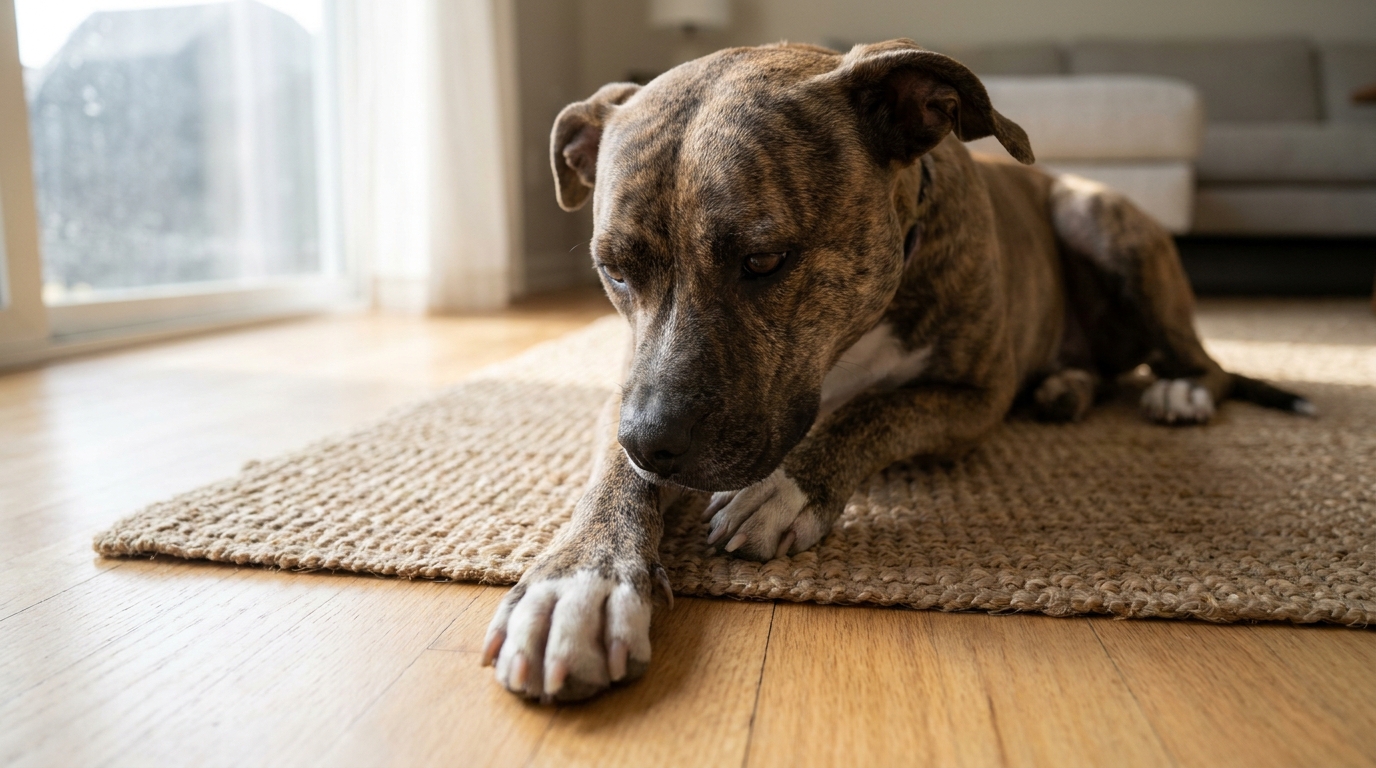
A red bump between your dog's toes is usually an infected hair follicle. What it looks like, what causes it, and which signs need a vet today.
Quick answer: A red bump between a dog's toes, called an interdigital cyst, is usually a deep infected hair follicle, set off mainly by allergies or short hairs forced into the skin. Don't squeeze it. If your dog walks normally, see a vet within a few days; if it hurts, oozes, smells or makes your dog limp, see a vet in person today; no weight on the foot means an ER now.
This article is general information, not a diagnosis. If you think your pet is in danger, go to the nearest emergency animal hospital.
When is a bump between a dog's toes an emergency?
Go to an emergency vet now if a dog won't put any weight at all on the foot, the swelling spreads fast up the leg, the face or neck swells, hives appear anywhere, breathing is hard or noisy, the dog vomits, wobbles or collapses after a sting, a snakebite is possible, the leg looks bent or bone shows, or a bump is still bleeding freely after 5 to 10 minutes of steady pressure. Pain far worse than the bump looks, skin that turns black or peels, and weakness or pale gums are emergencies too; a shiny red-purple bump on its own is the typical look, not an emergency sign.
See a vet in person today if the bump hurts or makes your dog limp, oozes pus or blood, smells or drains, comes with fever, low energy or not eating, or burst and bled but stopped with pressure. Many regular clinics close over Thanksgiving; if yours is closed, call an urgent care or emergency hospital instead of waiting (see what to do when your vet is closed for the holiday). A small new bump in a dog that walks, eats and acts normally needs a vet check within a few days, and sooner if it grows, opens or smells, or your dog starts limping.
Bump between toes: next step
| Sign | Next step |
|---|---|
| No weight on the foot | Emergency vet now |
| Swelling spreads up leg | Emergency vet now |
| Face swells or hives | Emergency vet now |
| Hard or noisy breathing | Emergency vet now |
| Severe pain, fast swelling | Emergency vet now |
| Skin black or peeling | Emergency vet now |
| Weak or pale gums | Emergency vet now |
| Still bleeds after 5-10 min of pressure | Emergency vet now |
| Pus, blood, smell or drains | In-person vet today |
| Limps, fever, low energy, not eating | In-person vet today |
| Small bump, walks fine | Vet within days |
What does an interdigital cyst look like?
Most interdigital cysts are raised red or reddish-purple bumps in the webbing between a dog's toes, most often on the top of a front paw, that may burst and leak clear or blood-tinged fluid. The Merck Veterinary Manual says early redness and small bumps in the webbing, left untreated, rapidly turn into shiny reddish-purple boils about 0.4 to 0.8 inches (1 to 2 cm) across that are usually painful. VCA Animal Hospitals adds licking, discolored paws, blood spots on the floor and limping as clues.
Is an interdigital cyst really a cyst?
An interdigital cyst is usually not a true cyst: the Merck Veterinary Manual says these bumps are often incorrectly called interdigital cysts and are almost never cystic, because most are deep infections of a hair follicle, similar to a severely infected pimple or boil. Vets call them interdigital furuncles. True cysts and comedones (clogged hair follicles) also form in the webbing, and Merck says telling them apart takes a biopsy. A furuncle is a deep skin infection, so the warning signs in our guide to skin infections in dogs apply here too.
What causes bumps between a dog's toes?
VCA Animal Hospitals says allergy-induced paw inflammation is the most common cause of bumps between a dog's toes, and the Merck Veterinary Manual adds short, bristly webbing hairs forced back into the follicles; splinters, burrs and grass awns are a less common cause. VCA lists pollen, mites, molds, fleas and food proteins as allergy triggers and says licking keeps the cycle going. VCA adds that large, short-coated or overweight dogs, rough ground or cage floors, and large, webbed paws raise the risk.
Merck lists Chinese Shar-Peis, Labrador Retrievers and English Bulldogs as prone breeds, and VCA adds pit bull terriers, bulldogs and German shepherds. RexVet's visit data found: "Pit bull-type dogs and German Shepherds stood out for skin trouble: 41% of their RexVet visits named skin, itching, allergies or hair loss, compared with 30% of all dog visits." The figure covers all skin concerns, not toe bumps alone; see pit bull skin allergies and bumps.
Cyst, foreign body or growth: how do vets tell?
An owner can't tell a furuncle from a buried foreign body or a growth by looking; a vet can often recognize a typical furuncle on exam, but the Merck Veterinary Manual says unusual or recurring bumps should be removed and examined, and a single bump may need surgical exploration to find a grass awn. Merck says foreign-object bumps are usually single and often on a front foot, and calls tumors a rare look-alike. VCA Animal Hospitals says a vet may recommend a skin biopsy to rule out cancer or immune-mediated skin disease.
A swollen toe is different: Merck says some skin cancers start in the nail bed and show up as a swollen toe, often with loss of the nail, so a swollen toe with a loose, misshapen or lost nail and no known injury, especially in an older dog, needs an in-person exam with X-rays this week, today if your dog limps. For a nail you saw catch or tear, see our broken nail and torn dewclaw guide.
What the bump may be
| Bump | Clues | Next step |
|---|---|---|
| Furuncle | Red, sore, may ooze | Vet exam |
| Foreign body | Usually one bump | Vet exam |
| True cyst | Drains, thick skin | Biopsy |
| Growth | Unusual or recurs | Needle test or biopsy |
| Torn nail | Known injury | Vet same day or next morning |
| Toe swelling | Nail loose or lost | Vet X-ray |
| Sting | Sudden swelling | ER if hives, vomits, face swells or it spreads |
Should I pop or squeeze my dog's toe bump?
No: never squeeze, pop, lance or drain a bump between a dog's toes at home; a Texas A&M veterinary school Pet Talk column calls opening or draining these cysts at home the most common mistake owners make, one that can lead to dangerous infections. The Merck Veterinary Manual says a vet may lance a furuncle to remove a foreign object, which is a clinic procedure.
If a bump has burst and is bleeding, press clean gauze or a small towel on it; VCA Animal Hospitals says paw bleeding should stop in 5 to 10 minutes of constant pressure. If it is still bleeding freely after that, go to an emergency vet now. Once it stops, keep it clean and dry, use a cone, put no powder or cream on it, and see a vet in person today. Bleeding from the gums, nose, urine or stool, new bruises, or possible rat or mouse bait also mean an emergency vet now; on the way, call ASPCA Animal Poison Control at (888) 426-4435 (a consultation fee may apply) or Pet Poison Helpline at (855) 764-7661 (a per-incident fee applies).
What can I do at home before the vet visit?
Before the vet visit, keep a dog's sore foot clean and dry, stop the licking with a cone, take photos of the top, bottom and webbing of the paw, and give no human medicines or creams. Leave any soak to the vet. Pet Poison Helpline warns that even a lick of some prescription human skin creams can be highly toxic to a pet; if your dog licked or ate any human cream, ointment or medicine, call ASPCA Animal Poison Control at (888) 426-4435 (a consultation fee may apply) or Pet Poison Helpline at (855) 764-7661 (a per-incident fee applies). The Merck Veterinary Manual says electric clipper blades can drive hair shafts into the skin, so don't shave the paw, and don't wrap it tightly.
A sore paw can make even a gentle dog bite: use a helper, and stop if your dog pulls away, growls or stiffens. Never muzzle a short-nosed breed or a dog that is vomiting or struggling to breathe, and never leave a muzzled dog alone.
Home care before the vet
| Do | Do not |
|---|---|
| Keep it clean and dry | Squeeze or pop it |
| Use a cone | Cut, lance or drain it |
| Take photos | Use human creams |
| Use a helper | Give human pills |
| Book a vet soon | Wrap it tight |
| Check it daily | Shave with clippers |
Will an interdigital cyst go away on its own?
Don't count on an interdigital cyst going away on its own: it often keeps coming back until its trigger, such as an allergy, demodex mites or a buried splinter, is found and treated, and PetMD says recovery and management can take months. VCA Animal Hospitals warns of cellulitis and scarring if a bump is not treated quickly. A Texas A&M veterinary school Pet Talk column advises booking a vet as soon as a possible cyst is spotted.
How do vets treat interdigital cysts?
Vets treat an interdigital cyst by targeting its cause: VCA Animal Hospitals lists skin tests for demodex mites, bacteria and yeast, a culture, and tests for allergies and hormone disease, and the Merck Veterinary Manual adds removing any foreign body and, in stubborn cases, surgery. Merck says diagnosis is often based on signs alone, and a culture helps choose an antibiotic.
Merck's guidance for vets says a single localized bump may be treated with a medicine on the skin that the vet chooses, while dogs with several bumps may need a long course of medicine chosen by the vet. VCA says protective boots and controlling the surfaces your dog walks on can help. Merck says not finishing the entire prescription can lead to repeat bumps, so follow the veterinarian's plan and ask them before changing anything.
Why do interdigital cysts keep coming back?
The Merck Veterinary Manual says atopy (environmental allergy) and demodex mites are the most common causes of repeat bumps between a dog's toes. Merck also links repeats to a medicine course that was too short or did not match the bacteria, long-term steroid use, and underlying disease such as hypothyroidism, and says dogs kept on wire or concrete are likely to get them again unless moved off those surfaces. A dog that also itches elsewhere may need the itch worked up; see dog itching but no fleas. A bump that keeps reopening in the same spot needs an in-person workup, and you should never stop or change a medicine on your own.
Can a video vet visit help with a bump between the toes?
For a dog in Florida, New York or Virginia with a new bump between the toes that is still walking normally, RexVet, a nonprofit online vet service, offers a $64.99 live video visit with a veterinarian licensed in the dog's state, about 8 AM to 11 PM Eastern, to decide whether it can wait, needs an exam this week, or needs to be seen in person today. RexVet serves pets located in Florida, New York and Virginia by video visit.
A video visit fits when your dog is bearing weight and eating normally and the bump is small, new or not yet identified, or keeps coming back and you need a plan for in-person tests. A licensed RexVet vet watches your dog walk, may ask you to gently spread the toes on camera without pressing the bump (stop if your dog pulls away, growls or stiffens), looks at clear photos of the paw you show on camera during the live visit, and asks about allergies, walks, sandspurs and floors. The veterinarian then tells you the next step, what to do in the meantime, and what an in-person exam will likely need. You can book a live video visit with RexVet.
A video visit is not the right first step for every bump. Go to an emergency vet now, not a video call, if the dog won't put any weight at all on the foot, the swelling spreads fast up the leg, the face or neck swells, hives appear anywhere, breathing is hard or noisy, the dog vomits, wobbles or collapses after a sting, a snake may have bitten the dog, the leg looks bent or bone shows, the pain is far worse than the bump looks, the skin turns black or peels, the dog is weak or has pale gums, or the bump is still bleeding freely after 5 to 10 minutes of steady pressure with clean gauze or a towel. Pain, pus, blood, a smell, limping, fever, low energy or not eating mean an in-person vet today; if your clinic is closed for Thanksgiving, call an urgent care or emergency hospital. Lancing, cultures, cytology, removing a splinter or grass awn, biopsies and X-rays all need hands-on care.
A video visit is for deciding the next step, and no prescription is promised. From RexVet's visit data: "Of the main concern groups, visits for vomiting, diarrhea or digestive problems were among the most likely to end with a prescription (21%), while only 5% of skin and itching visits did." If the veterinarian decides medication is appropriate, they can prescribe only where state rules allow.
Under Florida law, a prescription based only on a video exam covers up to 14 days of an FDA-approved animal drug used as labeled, cannot be renewed without an in-person exam, and cannot be a human-labeled, controlled or compounded anti-infective drug. Because the Merck Veterinary Manual says antibiotics are frequently prescribed for an initial course lasting 4 to 6 weeks, a Florida dog that needs a course longer than 14 days will need an in-person exam. In every state, federal rules (21 CFR 530.3) require an in-person exam or premises visit before a veterinarian uses a human-labeled drug or an animal drug off-label. Virginia allows the exam to be electronic, and New York's telehealth prescribing rules are still unsettled. RexVet is not a pharmacy; a pharmacy transfer fee applies when RexVet sends a prescription to an outside pharmacy.
Need an Expert Opinion on This Topic?
Book a video visit with a licensed vet, evenings and weekends included
See open timesFrequently Asked Questions
Should I pop my dog's interdigital cyst?
No, never squeeze, pop, lance or drain a bump between your dog's toes at home. A Texas A&M veterinary school Pet Talk column calls home draining the most common mistake owners make, one that can lead to dangerous infections. Keep the foot clean and dry, use a cone, and book a vet.
My dog's toe bump popped and is bleeding. What should I do?
Press clean gauze on the paw; if it still bleeds freely after 5 to 10 minutes of steady pressure, go to an emergency vet now. Once it stops, keep the foot clean and dry, use a cone, and see a vet in person today. Bleeding from the gums, nose, urine or stool, new bruises, or possible rat or mouse bait mean an emergency vet now and, on the way, a call to ASPCA Animal Poison Control at (888) 426-4435 (a consultation fee may apply) or Pet Poison Helpline at (855) 764-7661 (a per-incident fee applies).
How long does an interdigital cyst take to heal?
It varies: PetMD says recovery and management can take months, and a bump tends to return until its trigger is found and treated. Book an in-person recheck if a bump is not improving or keeps reopening.
Is a lump between my dog's toes cancer?
Rarely: the Merck Veterinary Manual calls tumors a rare cause of bumps between the toes, but says unusual or recurring bumps should be removed and examined, so a bump like that needs an in-person exam; only a needle sample or biopsy can tell. Merck also says some skin cancers start in the nail bed, so a swollen toe with a loose, misshapen or lost nail and no known injury, especially in an older dog, needs an in-person exam with X-rays this week, today if your dog limps.
Why does my dog keep getting cysts between his toes?
A trigger is usually still there: the Merck Veterinary Manual says environmental allergy (atopy) and demodex mites are the most common causes of repeat bumps. Merck also links repeats to an unfinished or mismatched antibiotic course and to wire or concrete floors. Repeat bumps need in-person tests such as skin scrapings and a culture.
Can an online vet look at my dog's toe bump in Florida, New York or Virginia?
Yes, if your dog walks normally with no emergency signs: a veterinarian licensed in your pet's state can look at the bump by live video. The veterinarian can watch your dog walk, look while you gently spread the toes without pressing the bump, and tell you whether it can wait, needs an exam this week, or needs to be seen in person today. Cultures, biopsies, X-rays and removing a splinter need an in-person clinic. No prescription is promised: in Florida, a prescription based only on a video exam is limited to an FDA-approved animal drug used as labeled, for up to 14 days; federal rules require an in-person exam before human-labeled or off-label drugs in any state; Virginia allows an electronic exam; and New York's rules are still unsettled. Go to an emergency vet now, not a video call, if your dog won't put any weight on the foot, the swelling spreads up the leg, the face swells, hives appear, breathing is hard, or a bump is still bleeding freely after 5 to 10 minutes of steady pressure.
FAQs
Should I pop my dog's interdigital cyst?
No, never squeeze, pop, lance or drain a bump between your dog's toes at home. A Texas A&M veterinary school Pet Talk column calls home draining the most common mistake owners make, one that can lead to dangerous infections. Keep the foot clean and dry, use a cone, and book a vet.
My dog's toe bump popped and is bleeding. What should I do?
Press clean gauze on the paw; if it still bleeds freely after 5 to 10 minutes of steady pressure, go to an emergency vet now. Once it stops, keep the foot clean and dry, use a cone, and see a vet in person today. Bleeding from the gums, nose, urine or stool, new bruises, or possible rat or mouse bait mean an emergency vet now and, on the way, a call to ASPCA Animal Poison Control at (888) 426-4435 (a consultation fee may apply) or Pet Poison Helpline at (855) 764-7661 (a per-incident fee applies).
How long does an interdigital cyst take to heal?
It varies: PetMD says recovery and management can take months, and a bump tends to return until its trigger is found and treated. Book an in-person recheck if a bump is not improving or keeps reopening.
Is a lump between my dog's toes cancer?
Rarely: the Merck Veterinary Manual calls tumors a rare cause of bumps between the toes, but says unusual or recurring bumps should be removed and examined, so a bump like that needs an in-person exam; only a needle sample or biopsy can tell. Merck also says some skin cancers start in the nail bed, so a swollen toe with a loose, misshapen or lost nail and no known injury, especially in an older dog, needs an in-person exam with X-rays this week, today if your dog limps.
Why does my dog keep getting cysts between his toes?
A trigger is usually still there: the Merck Veterinary Manual says environmental allergy (atopy) and demodex mites are the most common causes of repeat bumps. Merck also links repeats to an unfinished or mismatched antibiotic course and to wire or concrete floors. Repeat bumps need in-person tests such as skin scrapings and a culture.
Can an online vet look at my dog's toe bump in Florida, New York or Virginia?
Yes, if your dog walks normally with no emergency signs: a veterinarian licensed in your pet's state can look at the bump by live video. The veterinarian can watch your dog walk, look while you gently spread the toes without pressing the bump, and tell you whether it can wait, needs an exam this week, or needs to be seen in person today. Cultures, biopsies, X-rays and removing a splinter need an in-person clinic. No prescription is promised: in Florida, a prescription based only on a video exam is limited to an FDA-approved animal drug used as labeled, for up to 14 days; federal rules require an in-person exam before human-labeled or off-label drugs in any state; Virginia allows an electronic exam; and New York's rules are still unsettled. Go to an emergency vet now, not a video call, if your dog won't put any weight on the foot, the swelling spreads up the leg, the face swells, hives appear, breathing is hard, or a bump is still bleeding freely after 5 to 10 minutes of steady pressure.
Medically Reviewed
Reviewed by Dr. Tiffany Delacruz, DVM — licensed veterinarian and CEO of RexVet. Last reviewed November 23, 2026.
Content is for informational purposes and does not replace professional veterinary advice.
Chief Executive Officer · Licensed Veterinarian
Dr. Delacruz is a licensed Doctor of Veterinary Medicine specializing in preventive care and veterinary telehealth. She reviews all health content on RexVet to ensure accuracy and clinical relevance.
Sources & References
- · American Veterinary Medical Association — Telehealth Guidelines
- · AVMA — Pet Care Resources
- · U.S. FDA — Animal & Veterinary