
My Cat Ate a Mouse: Poison, Worms and What to Watch For
By RexVet Team | Reviewed by Dr. Tiffany Delacruz, DVM
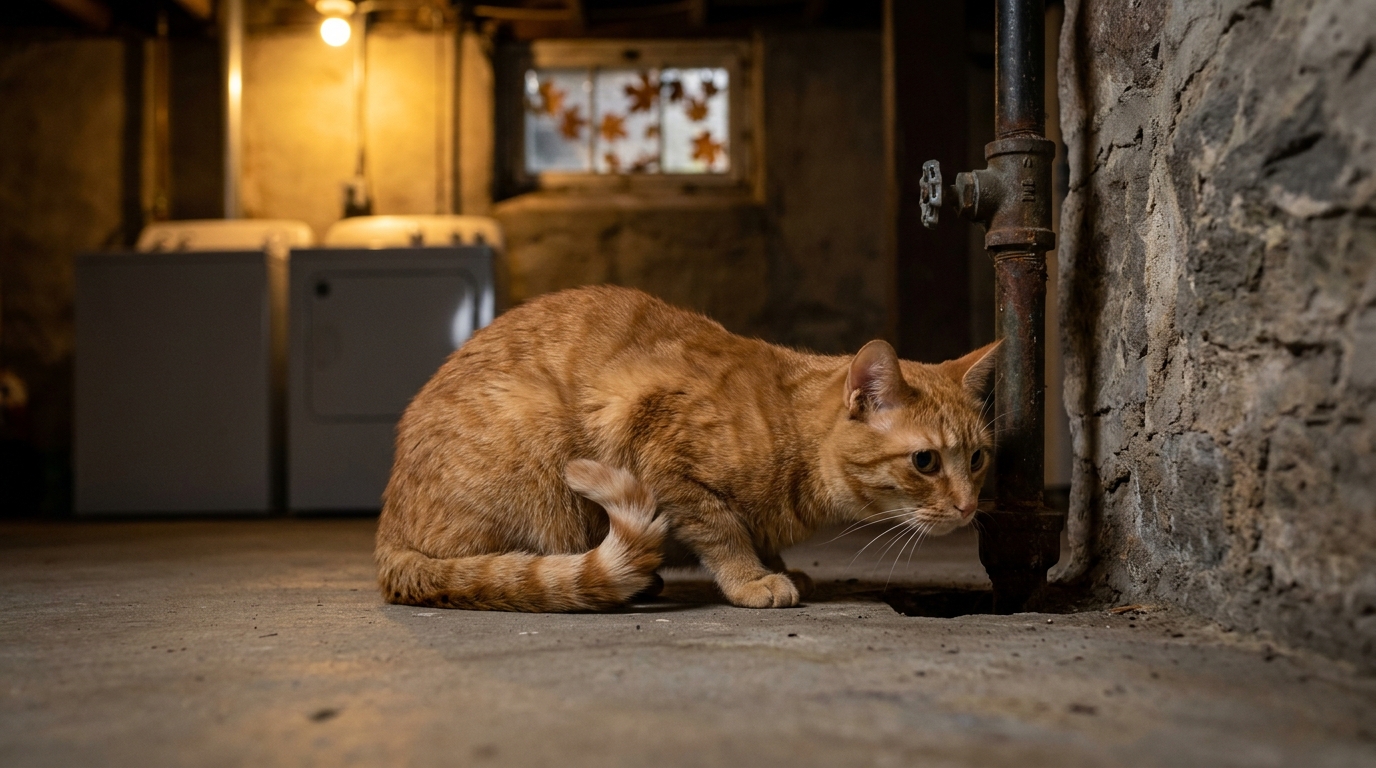
My cat ate a mouse? Relay poisoning is rare, but check for bait nearby, watch for weakness or bleeding, and plan a worm check.
Call a pet poison line and get to an emergency vet now if your cat ate mouse bait or a mouse you know was poisoned, or has pale gums, bleeding from the mouth, nose or ears, bloody or dark tarry stool, trouble breathing, a swollen belly, wobbling or back-leg weakness, tremors or seizures, keeps vomiting, or collapses.
My cat ate a mouse: what usually happens next
Hunting is normal cat behavior, and mice often come looking for a way inside as the weather cools.
If no bait could be involved and your cat brings up fur and bones once, then eats and acts normal, you can watch at home; if bait could be involved, call a poison line now, and if the vomiting keeps coming back, call a poison line and go to an emergency vet now.
If you are thinking "my cat ate a mouse, now what?" three questions matter tonight:
- Could the mouse have eaten bait?
- Is your cat acting like itself: eating, normal energy, gums their usual color?
- What parasites can a mouse pass on?
Bait comes first because, as the Merck Veterinary Manual puts it, "Pets may be poisoned directly from baits or indirectly by eating poisoned rodents."
If your cat caught a bird instead, read our guide on what to do after a cat eats a dead bird.
Emergency signs: call a poison line and go to an ER, not a video call
Call a poison line and head to an emergency vet now if your cat ate bait or a mouse you know was poisoned, or if you see any of the signs below. VCA Animal Hospitals lists several of these as signs of internal bleeding in cats and adds: "In some cases, bleeding may be visible from the mouth, nose, or ears."
- Pale gums
- Bleeding from the mouth, nose or ears
- Bloody or dark tarry stool
- Bruising
- Trouble breathing
- A swollen belly
- Weakness, wobbling or back legs giving way
- Tremors or seizures
- Vomiting that keeps coming back
- Collapse
Bromethalin is another kind of mouse bait, and VCA warns: "Cats are more sensitive to bromethalin and develop toxicity at lower doses than dogs." One sign VCA lists for it is "Pelvic limb weakness that progresses to paralysis."
ASPCA Animal Poison Control (888) 426-4435 and Pet Poison Helpline (855) 764-7661 both answer 24/7; a fee may apply.
VCA warns: "There are no safe ways to induce vomiting in cats at home." Do not give your cat any human medicine or anything else by mouth; call a poison line instead.
Could the mouse have been poisoned?
Relay poisoning, also called secondary poisoning, is when a cat is poisoned by eating a rodent that ate bait. For anticoagulant bait, the kind that uses up the body's clotting factors, VCA Animal Hospitals says: "However, secondary poisoning is rare because a cat would need to eat many rodents that died from the poison."
VCA adds who is more exposed: "Outdoor cats and cats that live around farms, stables, or vineyards that use rodenticides are at higher risk for secondary poisoning, especially if they continually consume a diet of rodents."
For bromethalin, VCA's page says: "Relay toxicity, in which poisoning occurs when an animal ingests rodents that died from bromethalin, has been anecdotally reported in cats." Since cats are also more sensitive to bromethalin than dogs, do not read the "rare" line as covering every kind of bait.
Tonight, ask your landlord, building super, HOA, neighbor or pest-control company whether bait is down and which kind, and photograph the package or bait-station label. If the answer is yes, call a poison line now, before any signs; if your cat ate the bait itself or a mouse you know was poisoned, call a poison line and get to an emergency vet now. The Merck Veterinary Manual notes: "Early veterinary intervention in cases of ingestion provides the best chance for successful treatment."
If your dog got to a mouse too, here is what to do if your dog ate a dead mouse.
The days after: why signs can show up late
If bait was nearby, a cat that seems fine the next morning is not in the clear yet. For anticoagulant bait, VCA explains: "After ingesting this type of bait, it takes one to two days for clotting factors in the body to be used up. Next, it takes three to seven days before signs of poisoning occur due to blood loss."
For bromethalin, VCA notes: "Clinical signs can develop as soon as a few hours after exposure and as long as five to seven days after exposure."
If bait could be involved at all and your cat goes off food or seems flat, call a poison line now rather than waiting; Merck notes that "Depression and loss of appetite are seen in all species even before bleeding occurs."
If no bait could be involved, keep a calm eye on appetite, energy, gum color, breathing, walking and the litter box over the next several days. Keep your cat indoors so you can see the litter box. Do not give any human medicine, and do not try to make your cat vomit. Any sign on the emergency list still means an ER now.
Worms and other parasites a mouse can pass on
According to the Merck Veterinary Manual, "Infections with Toxocara cati are most likely to be acquired by ingestion of eggs passed in the feces of infected animals and by eating prey such as mice that carry the parasites." Toxocara cati is a roundworm of cats, and Merck notes that it "will infect people."
Merck explains that the common tapeworm of cats is picked up from eating fleas, and adds: "Much less frequently, cats with access to infected house (or outdoor) mice and rats can acquire other types of tapeworm infections from these sources."
Merck notes that adult tapeworms "rarely cause serious disease," and "Often, there are no signs." Merck explains: "Diagnosis is based on finding tapeworm segments or eggs in the feces."
The practical step is a stool check and a parasite plan with your vet. As Merck puts it, "An accurate diagnosis will enable your veterinarian to provide effective advice on treating the infection and preventing reinfection." Let your vet choose the plan instead of picking a product yourself.
Toxoplasma: what it means for your cat and your family
On how cats pick up Toxoplasma gondii, the Cornell Feline Health Center explains: "When a cat ingests infected prey or raw meat, the parasite is released from cysts into the cat's digestive tract, where it reproduces and produces oocysts."
Cornell says: "Most cats infected with T. gondii show no signs of disease." It also notes: "The most common symptoms of toxoplasmosis include fever, loss of appetite, and lethargy." Those signs are worth a vet exam, and if bait could be involved, loss of appetite or low energy means a poison-line call now.
For your household, Cornell's litter-box advice: "Since it takes a minimum of 24 hours for T. gondii oocysts in cat feces to sporulate and become infective, frequent removal of feces from the litter box, while wearing gloves and washing hands afterward, minimizes the possibility of infection."
If anyone at home is pregnant or has a weakened immune system, ask your doctor. Cornell: "For answers to specific questions regarding toxoplasmosis infection in people, please consult with your health care professional."
What a RexVet online vet can and cannot do after your cat ate a mouse
A video visit fits the uncertain middle when no bait could be involved and no emergency sign is present: your cat is eating and acting normal, or you have worm questions. RexVet's veterinarians are licensed in Florida, New York and Virginia, and a vet can:
- Go over the catch with you
- Look at your cat's gums, breathing, walking and any vomit or stool on camera
- Help you decide between a vet exam soon and watching at home when no emergency sign is present
- Tell you what to watch for over the next several days and help you plan a stool check
A video visit can't run bloodwork or clotting tests, give fluids or transfusions, or treat a poisoning. For anticoagulant bait, VCA notes: "Bloodwork is often performed to assess for abnormalities." Anything on the emergency list means a poison line and an ER instead. If you are not sure whether a sign on the emergency list is present, go to an emergency vet now instead of waiting for a video visit.
If the veterinarian decides medication is appropriate, they can prescribe where state rules allow. In Florida, a veterinarian who has seen your pet only by video may prescribe only FDA-approved animal drugs used as labeled, for up to 14 days (1 month for flea-and-tick-only products), and cannot renew without an in-person exam.
A video visit cannot replace an emergency clinic, but if no bait could be involved and your cat is acting normal after a catch, you can book a RexVet video visit for $64.99, 24/7 including nights and weekends, for pet parents in Florida, New York and Virginia only.
Keeping mice and your cat apart this fall
Among the Cornell Feline Health Center's steps to minimize Toxoplasma infection are "Do not allow cats to hunt or roam unsupervised" and "Control populations of rodents and other intermediate hosts." At home, that can look like this:
- Seal gaps around pipes and doors where mice can get in.
- Store pet food and bird seed in closed containers.
- Tell anyone setting bait or traps that you have a cat, and ask that bait and traps be kept where pets can't reach them.
Even with bait out of reach, your cat can still catch a mouse that ate it, so keeping your cat from hunting matters too. If your cat gets stuck on a glue trap, see our guide on how to get a pet off a glue trap safely.
Play with wand toys and other chase games can give your cat's hunting drive an indoor outlet.
When to see a vet in person in Florida, New York or Virginia
Go to an ER now, with a poison-line call on the way, for known bait or a mouse you know was poisoned (even if your cat seems fine), bleeding signs, pale gums, trouble breathing, a swollen belly, wobbling or weakness, tremors or seizures, vomiting that keeps coming back, or collapse.
Not eating or low energy: if bait could be involved, call a poison line now, because Merck notes that appetite loss can come before any bleeding. If no bait could be involved and your cat is otherwise bright, book a vet exam soon.
Tapeworm segments in the stool: book a vet exam soon for a stool check.
In Florida, state law (Fla. Stat. 474.2021) requires a vet whose first evaluation of your pet is by telehealth to give you "the contact information for at least one physical veterinary clinic in the vicinity of the patient's location."
If no bait could be involved, your cat is bright and eating, and you want a vet to talk through the catch or a stool-check plan, you can book a RexVet video visit for $64.99, 24/7, for pet parents in Florida, New York and Virginia only.
Frequently Asked Questions
Is it normal for my cat to throw up after eating a mouse?
A cat may bring up fur and bones after eating a mouse. If no bait could be involved, a cat that then eats and acts normal can be watched at home or talked through on a video visit. If your cat ate bait or a mouse you know was poisoned, call a poison line and go to an emergency vet now, even if your cat seems fine, and do the same for vomiting that keeps coming back, any bleeding, pale gums, trouble breathing, a swollen belly, weakness or wobbling, tremors or seizures, or collapse. If bait is down nearby, or bait could be involved and your cat stops eating or seems flat, call a poison line now.
How long after eating a mouse would a cat show signs of poisoning?
For anticoagulant bait, VCA explains: "After ingesting this type of bait, it takes one to two days for clotting factors in the body to be used up. Next, it takes three to seven days before signs of poisoning occur due to blood loss." For bromethalin, VCA says signs "can develop as soon as a few hours after exposure and as long as five to seven days after exposure." Merck notes that "Depression and loss of appetite are seen in all species even before bleeding occurs," so call a poison line now if bait could be involved; if your cat ate bait or a mouse you know was poisoned, even if it seems fine, or if it has pale gums, bleeding, bloody or dark tarry stool, trouble breathing, a swollen belly, wobbling or back-leg weakness, tremors or seizures, keeps vomiting, or collapses, call a poison line and go to an emergency vet now.
Does my cat need worm treatment after eating a mouse?
Ask your vet about a stool check. According to the Merck Veterinary Manual, cats can pick up roundworms by eating prey such as mice that carry the parasites. Cats that eat infected mice and rats can also, much less often than through fleas, pick up other types of tapeworm. A stool check helps your vet decide whether treatment is needed and choose the plan.
Can I catch anything from my cat after it ate a mouse?
Possibly. Cats can pick up Toxoplasma from prey, and Cornell advises that "frequent removal of feces from the litter box, while wearing gloves and washing hands afterward, minimizes the possibility of infection." The Merck Veterinary Manual also notes that Toxocara cati, a roundworm cats can get from eating mice, "will infect people." If you have questions about your own health, or anyone at home is pregnant or has a weakened immune system, ask your doctor.
Should I stop my cat from hunting mice?
If you can, yes. Cornell's steps to minimize Toxoplasma infection include "Do not allow cats to hunt or roam unsupervised" and "Control populations of rodents and other intermediate hosts." VCA notes that outdoor cats and cats living around farms, stables or vineyards that use rodenticides are at higher risk for secondary poisoning, "especially if they continually consume a diet of rodents."
FAQs
Is it normal for my cat to throw up after eating a mouse?
A cat may bring up fur and bones after eating a mouse. If no bait could be involved, a cat that then eats and acts normal can be watched at home or talked through on a video visit. If your cat ate bait or a mouse you know was poisoned, call a poison line and go to an emergency vet now, even if your cat seems fine, and do the same for vomiting that keeps coming back, any bleeding, pale gums, trouble breathing, a swollen belly, weakness or wobbling, tremors or seizures, or collapse. If bait is down nearby, or bait could be involved and your cat stops eating or seems flat, call a poison line now.
How long after eating a mouse would a cat show signs of poisoning?
For anticoagulant bait, VCA explains: "After ingesting this type of bait, it takes one to two days for clotting factors in the body to be used up. Next, it takes three to seven days before signs of poisoning occur due to blood loss." For bromethalin, VCA says signs "can develop as soon as a few hours after exposure and as long as five to seven days after exposure." Merck notes that "Depression and loss of appetite are seen in all species even before bleeding occurs," so call a poison line now if bait could be involved; if your cat ate bait or a mouse you know was poisoned, even if it seems fine, or if it has pale gums, bleeding, bloody or dark tarry stool, trouble breathing, a swollen belly, wobbling or back-leg weakness, tremors or seizures, keeps vomiting, or collapses, call a poison line and go to an emergency vet now.
Does my cat need worm treatment after eating a mouse?
Ask your vet about a stool check. According to the Merck Veterinary Manual, cats can pick up roundworms by eating prey such as mice that carry the parasites. Cats that eat infected mice and rats can also, much less often than through fleas, pick up other types of tapeworm. A stool check helps your vet decide whether treatment is needed and choose the plan.
Can I catch anything from my cat after it ate a mouse?
Possibly. Cats can pick up Toxoplasma from prey, and Cornell advises that "frequent removal of feces from the litter box, while wearing gloves and washing hands afterward, minimizes the possibility of infection." The Merck Veterinary Manual also notes that Toxocara cati, a roundworm cats can get from eating mice, "will infect people." If you have questions about your own health, or anyone at home is pregnant or has a weakened immune system, ask your doctor.
Should I stop my cat from hunting mice?
If you can, yes. Cornell's steps to minimize Toxoplasma infection include "Do not allow cats to hunt or roam unsupervised" and "Control populations of rodents and other intermediate hosts." VCA notes that outdoor cats and cats living around farms, stables or vineyards that use rodenticides are at higher risk for secondary poisoning, "especially if they continually consume a diet of rodents."
Medically Reviewed
Reviewed by Dr. Tiffany Delacruz, DVM — licensed veterinarian and CEO of RexVet. Last reviewed September 30, 2026.
Content is for informational purposes and does not replace professional veterinary advice.
Chief Executive Officer · Licensed Veterinarian
Dr. Delacruz is a licensed Doctor of Veterinary Medicine specializing in preventive care and veterinary telehealth. She reviews all health content on RexVet to ensure accuracy and clinical relevance.
Sources & References
- · American Veterinary Medical Association — Telehealth Guidelines
- · AVMA — Pet Care Resources
- · U.S. FDA — Animal & Veterinary
Need an Expert Opinion on This Topic?
Connect with a certified vet via video call in minutes
Talk to Vet Now