
Dog Wheezing: Causes, What It Sounds Like and When It Is an Emergency
By RexVet Team | Reviewed by Dr. Tiffany Delacruz, DVM
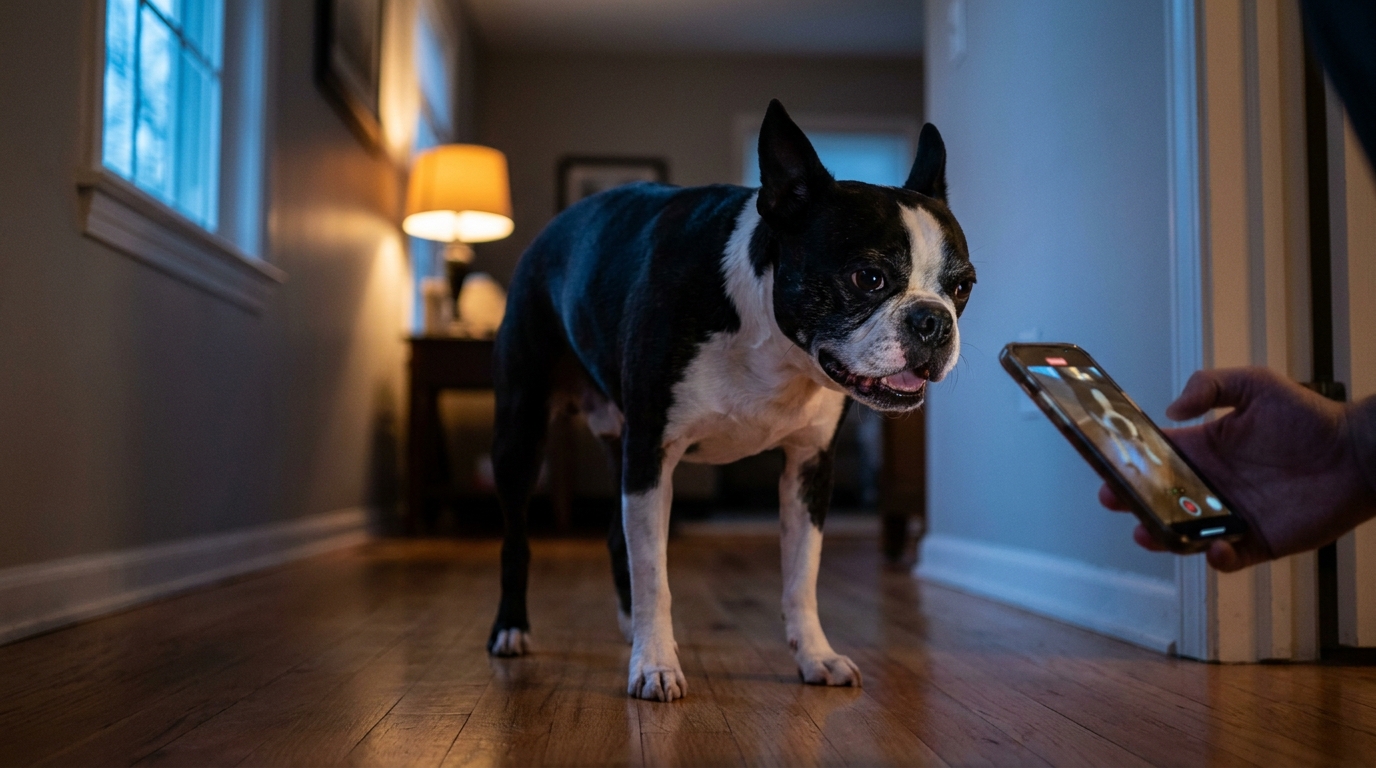
Whistle, honk, snort or rasp: what your dog's noisy breathing usually means, which sounds need an emergency vet now and what can wait for a visit.
Quick answer: Brief wheezing that stops within about a minute, in a dog who is normal before and after, is often a reverse sneeze or airway irritation. Wheezing that keeps coming back needs a vet exam. Go to an emergency vet now if your dog struggles to breathe or breathes open-mouthed at rest, stretches its neck out, collapses or has a swollen face; don't wait for gums to turn gray or blue.
This article is general information, not a diagnosis. If you think your pet is in danger, go to the nearest emergency animal hospital.
What Dog Wheezing Sounds Like (and What It Is Not)
Many noises owners call wheezing come from the throat or windpipe, and only a hands-on exam with a stethoscope can tell where a sound starts. Any noise with visible effort at rest is an emergency, whatever it sounds like.
| Sound you hear | Where it usually comes from | What to do |
|---|---|---|
| Whistling, mostly on the out-breath (wheeze) | Narrowed airways inside the chest | Vet exam soon; ER if it won't stop at rest, or breathing is fast or hard |
| Harsh, high-pitched noise on the in-breath (stridor) | Voice box or windpipe in the neck | New, loud or with effort: emergency vet now |
| Low snore or snort, even when awake (stertor) | Throat and soft palate; common in flat-faced breeds | Not normal: vet exam; ER if gasping or collapse |
| Rapid, loud snorting in-breaths for a few seconds to about a minute (reverse sneeze) | Irritation at the back of the nose | Normal before and after: usually OK; vet if more frequent or with nasal discharge |
| Dry "goose-honk" cough | Windpipe: tracheal collapse or kennel cough | Vet visit; ER if fainting, blue tongue or struggling |
| Gag or retch, nothing comes up | A cough ending in a gag, nausea or something stuck (see gagging without vomiting) | Repeated retching or pawing at the mouth: ER now |
Whether the noise comes on the in-breath or out-breath is a useful clue to where it starts. The Merck Veterinary Manual's emergency triage chapter explains that narrowing outside the chest (the nose, throat, voice box or the windpipe in the neck) makes noise on the in-breath, while narrowing inside the chest makes noise on the out-breath. In general medicine, the Merck Manual defines a wheeze as a high-pitched whistle from air squeezing through narrowed small airways, more common when breathing out.
Wheezing vs. reverse sneezing
VCA describes a reverse sneeze as rapid, long, snorting in-breaths while the dog stands still with its head and neck stretched out. It lasts several seconds to a minute, and the dog is completely normal before and after. A true wheeze tends to come with the out-breath.
Reverse sneezing is not always harmless. A 2022 study (Talavera and colleagues) said it should always be checked, since frequent or severe episodes can signal disease at the back of the nose. Book a prompt in-person visit if episodes get more frequent or longer, or come with pawing at the face or discharge from one nostril. A nosebleed or coughing up blood needs an in-person vet the same day, and an emergency vet now if the bleeding is heavy or won't stop, or comes with weakness, pale gums or labored breathing. A dog that is not back to normal right after an episode needs an emergency vet.
Go to an In-Person Emergency Vet Now If...
Merck's triage chapter says breathing gets faster and harder first, then its pattern and the dog's posture change; open-mouth breathing and gum color changes come last. Go now if you see any of these:
- Working hard to breathe, or breathing faster than usual, while resting or asleep: a belly push on each out-breath, or a dog that can't settle or won't lie down.
- Neck stretched out with elbows held wide, or open-mouth breathing at rest.
- A new, loud or harsh noise on the in-breath, or noisy breathing that doesn't stop once your dog is calm and cool.
- Fainting or collapse, including during a coughing fit or excitement (Cornell, ACVS).
- Choking: noise that starts suddenly during play or eating, pawing at the mouth, little air moving, panic. No blind finger sweeps.
- Face or throat swelling, vomiting, diarrhea, drooling, pale gums, weakness or collapse after a sting, vaccine or new medicine, even with no wheeze (VCA calls anaphylaxis a medical emergency).
- Noisy breathing while overheating, or a flat-faced dog that gasps or pauses its breathing in sleep, which University of Cambridge researchers call life-threatening.
- Breathing in smoke from a fire, even if your dog seems fine. VCA warns that carbon monoxide can turn gums cherry red, so pink gums don't rule it out, and lung damage can worsen for 48-72 hours.
- Sudden labored breathing with pale gums and dark or coffee-colored urine (heartworm caval syndrome, per the American Heartworm Society).
- Fast or labored breathing after a walk through tall grass; inhaled grass awns can migrate and cause air or pus around the lungs (Flisi and colleagues, 2018).
- Blue, gray or pale gums or tongue (check the tongue if the gums are dark). This is a late sign, so don't wait for it.
On the way, keep your dog calm and cool, take the collar off, run the air conditioning and let your dog choose its own position. Don't hold your dog down; ACVS notes that dogs in breathing distress may not want to be touched or restrained.
Common Causes, Matched to the Pattern You See
Wheezing and coughing often go together, because the same narrowed airway can make both sounds. Find the row closest to what you see.
| Pattern you notice | Common causes | How fast to act |
|---|---|---|
| Toy or small breed honks when excited, picked up or tugging on the collar | Tracheal collapse | Vet visit; ER if fainting, blue tongue or struggling |
| Dry honking cough starting 5-10 days after boarding, daycare or a dog park | Kennel cough | Often mild; in person today: puppy, senior, flat-faced, heart or airway disease, or signs below; ER if labored |
| Older dog coughs at rest or asleep, restless at night, tires on walks | Heart disease or chronic bronchitis (often both) | Vet same day; ER if breathing is fast or hard at rest |
| Older large breed (often a Labrador): raspy breathing, hoarse bark, struggles in heat | Laryngeal paralysis | Vet soon; ER if overheating, or breathing worsens with excitement or exercise |
| That same dog now has fever, lethargy, a cough or won't eat | Possible aspiration pneumonia | See a vet immediately |
| Flat-faced breed snores, snorts, or is noisy when excited or eating | BOAS (a narrowed airway from the short face) | Not normal: vet exam; ER if gasping, sleep pauses, collapse or overheating |
| Seasonal, or after smoke, vaping, candles or sprays | Airway irritation, bronchitis, allergy | Remove the trigger; vet if it persists; fire smoke: ER |
| Not on heartworm prevention, mild lasting cough, tires easily | Heartworm | Regular vet for a blood test soon; ER if sudden hard breathing, pale gums or dark urine |
| Sudden violent sneezing or coughing after tall grass | Inhaled grass awn | Same-day in-person vet; ER if breathing is fast or labored |
Kennel cough warning signs: fever, lethargy, not eating, discolored nasal discharge or a wet cough can mean the infection has moved into the lungs (Merck), so any of these means an in-person vet today, whatever day of the illness it is.
Heart or airway? ACVIM (the American College of Veterinary Internal Medicine) notes that dogs with heart-valve disease often have airway disease too, and Merck says cough is much more often caused by airway or lung disease than by heart fluid. The sound alone can't tell them apart; an exam and chest X-rays usually can.
Wheezing at Night or While Sleeping
What night-time wheezing or coughing means depends on the dog. In an older dog, coughing at rest or in sleep, restlessness and faster sleeping breaths can be signs of heart disease, though cough alone more often comes from the airways. In flat-faced breeds, snoring and snorting in sleep are signs of a narrowed airway, and gasping or pauses in breathing during sleep are an emergency.
To check whether your dog's sleeping breathing is too fast, see how to count sleeping breaths and what is normal. If your dog has a heart diagnosis and its sleeping counts are creeping up while it still breathes easily and settles, call the vet or cardiologist who manages the heart that day. If the faster breathing comes with coughing, weakness, sitting up to breathe, restlessness or visible effort at rest, go to an emergency vet now, especially at night when your own vet can't be reached.
Wheezing in Senior Dogs, Small Breeds and Flat-Faced Breeds
Old dog wheezing
Merck's guide for dog owners notes that tracheal collapse is more common in dogs with heart disease or chronic bronchitis, so a senior small dog can have both at once. Laryngeal paralysis is common in middle-aged to older large dogs (Merck), and ACVS lists harsher panting, panting while cool and calm, and a hoarse bark as its early signs.
Small and toy breeds
Cornell describes tracheal collapse in Yorkshire Terriers, Pomeranians, Toy Poodles and similar breeds, usually middle-aged or older, with a dry honk that can progress to a wheeze on the in-breath. Cornell advises a harness and avoiding smoke and hot, humid places; Merck calls weight loss critical for overweight dogs.
Flat-faced breeds
Cambridge's BOAS group says dogs with a normal upper airway breathe quietly and that snoring and snorting are signs of airway obstruction, so noisy breathing in Bulldogs, French Bulldogs and Pugs is not normal; some dogs are noisy only when excited, eating or stressed. ACVS says heat, humidity, excitement and obesity make it worse.
What You Can Safely Do at Home (and What Not to Give)
Home remedies do not treat wheezing. If you are wondering what to give your dog for wheezing, the safe answer is nothing from your medicine cabinet; treatment depends on the cause. What you can do:
- Keep your dog calm and cool; skip hot, humid outings and hard exercise.
- Use a harness instead of a neck collar (Cornell).
- Remove smoke, vape aerosols, scented candles and sprays.
- Film 30 seconds of the sound plus the chest and belly, and note what set it off. Never delay the ER to film.
- During a reverse sneeze in a dog that is otherwise breathing easily, VCA suggests gently stroking the neck or offering something to lick or drink. Never offer food or water to a dog that is choking, gasping or struggling to breathe.
Do not give or use:
- Human cough, cold, allergy or decongestant products, including cough drops and syrups. Pet Poison Helpline warns that decongestants such as pseudoephedrine and phenylephrine (often a "-D" on the label) can cause dangerously high blood pressure in pets, and VCA warns that many cough products can contain xylitol, which is highly toxic to dogs.
- Your own inhaler or nebulizer medicine, essential oils or menthol vapor.
- Never cover your dog's nostrils or sweep its mouth blindly with a finger.
If your dog has swallowed a human cold, cough, allergy or decongestant product, call ASPCA Animal Poison Control at (888) 426-4435 (a consultation fee may apply) or Pet Poison Helpline at (855) 764-7661 (per-incident fee), or go to an emergency vet.
How a Vet Finds the Cause
Wheezing that keeps coming back usually needs at least one in-person exam, because the tests that find the cause need hands or equipment:
- A stethoscope. True wheezes are heard this way (Merck), and the International Society for Companion Animal Infectious Diseases (ISCAID) counts chest crackles or wheezes in a coughing dog as possible signs of pneumonia.
- Chest X-rays, the test Merck says heart-failure diagnosis relies on.
- A heartworm blood test, which the American Heartworm Society recommends for every dog every year.
- Fluoroscopy or bronchoscopy for tracheal collapse, which plain X-rays can miss (Cornell).
- Laryngoscopy under light anesthesia for laryngeal paralysis (Merck).
- An airway scope to take samples or remove inhaled grass awns.
Where a RexVet Video Visit Fits
The best fit: your dog had a brief wheezing or noisy-breathing episode but is now breathing calmly and easily at rest, with pink gums (check the tongue if the gums are dark), and is eating and acting normally, yet the episodes keep coming back, with no nosebleed, coughing up blood, one-sided nasal discharge or pawing at the face. In that case, a $64.99 live video visit with Dr. Tiffany Delacruz, DVM, RexVet's one vet, can help for dogs located in Florida, New York or Virginia at the time of the visit. Live slots run about 8 AM to 11 PM ET, and a same-day slot is not guaranteed. She can watch your phone video of the episode, help sort out whether it looks more like a reverse sneeze or a tracheal, allergy or kennel-cough pattern, and tell you whether your dog needs an in-person exam with chest X-rays, and how soon.
A video visit is not for a dog that is working hard to breathe, breathing with its mouth open at rest, standing with its neck stretched out and elbows held wide, has blue, gray or pale gums or tongue, has fainted or collapsed, has a swollen face or hives, is overheating while breathing noisily, or has breathed smoke from a fire. That dog needs an emergency vet now, not a video call. Don't wait for the gums to change color; that is a late sign.
A video visit cannot listen to the lungs, take X-rays or measure oxygen, and it may not end with medication. In Florida, a prescription after a video-only visit is limited to FDA-approved animal drugs used as labeled, for up to 14 days, with no renewal without an in-person exam. Human-labeled and controlled drugs, which include many cough and airway medicines, need an in-person exam first. In every state, federal rules require an in-person exam before a drug is used off-label or a human drug is used. Virginia lets the exam be done electronically, but that federal rule still applies, and New York's rules for vet telehealth are not settled yet. RexVet is not a pharmacy; a pharmacy transfer fee applies when RexVet sends a prescription to an outside pharmacy.
RexVet is a non-profit. If your dog fits the first case above, you can book a live video visit.
Need an Expert Opinion on This Topic?
Book a video visit with a licensed vet, evenings and weekends included
See open timesFrequently Asked Questions
Is it normal for dogs to wheeze?
No. Cambridge's BOAS researchers note that a normal upper airway is quiet, even in flat-faced breeds. A single episode lasting a few seconds to about a minute, in a dog who is normal before and after, is often a reverse sneeze. Wheezing that keeps coming back needs a vet exam; noisy breathing with visible effort at rest needs an emergency vet now.
Does dog wheezing sound like whistling?
Often, yes. In general medicine, a wheeze is a high-pitched whistle from narrowed small airways, more common on the out-breath (Merck Manual). A harsh noise on the in-breath is stridor, which usually comes from the voice box or windpipe and is urgent when it is new, loud or comes with effort. Vets confirm true wheezes with a stethoscope.
Why is my dog wheezing but acting normal?
Common reasons include a reverse sneeze, irritation from smoke, vaping, candles or sprays, allergy-related airway inflammation, early tracheal collapse in small breeds, or kennel cough after time with other dogs. See a vet if episodes get more frequent or come with nasal discharge, bleeding or pawing at the face. If your dog is not back to normal right after an episode, treat it as breathing distress and go to an emergency vet.
Is wheezing a sign of heart failure in dogs?
Not on its own. More telling signs are faster or harder breathing at rest or asleep, restlessness at night, coughing at rest and tiring on walks. Merck notes cough is much more often caused by airway or lung disease, and many dogs with heart-valve disease have both, so only an exam and chest X-rays can tell them apart. Labored breathing means an emergency vet now.
Can allergies make a dog wheeze?
Allergies and airborne irritants can inflame a dog's airways; Merck lists smoke and chemical fumes among the causes of tracheobronchitis. Wheezing that keeps coming back needs a vet exam, often with chest X-rays. A swollen face or hives with any breathing change is an emergency, not a routine allergy flare.
Can I give my dog Benadryl for wheezing?
Do not give Benadryl or any human allergy, cold or cough medicine unless a vet who has examined your dog tells you to. Many of these products contain a decongestant (look for "-D" on the label) or xylitol, both dangerous to dogs. A swollen face or hives with any breathing change means an emergency vet now; don't give a pill and wait.
Can an online vet prescribe something for wheezing?
It depends, and a video visit may not end with medication. ISCAID notes a wheeze or crackle heard through a stethoscope can point to pneumonia, which video cannot check. For dogs located in Florida, a video-only prescription is limited to FDA-approved animal drugs used as labeled, for up to 14 days, with no renewal without an in-person exam; human-labeled and controlled drugs, including many cough medicines, need an in-person exam first. Federal rules require an in-person relationship for off-label or human-drug use in every state. Virginia allows an electronic exam, but that federal rule still applies, and New York's rules are not settled.
FAQs
Is it normal for dogs to wheeze?
No. Cambridge's BOAS researchers note that a normal upper airway is quiet, even in flat-faced breeds. A single episode lasting a few seconds to about a minute, in a dog who is normal before and after, is often a reverse sneeze. Wheezing that keeps coming back needs a vet exam; noisy breathing with visible effort at rest needs an emergency vet now.
Does dog wheezing sound like whistling?
Often, yes. In general medicine, a wheeze is a high-pitched whistle from narrowed small airways, more common on the out-breath (Merck Manual). A harsh noise on the in-breath is stridor, which usually comes from the voice box or windpipe and is urgent when it is new, loud or comes with effort. Vets confirm true wheezes with a stethoscope.
Why is my dog wheezing but acting normal?
Common reasons include a reverse sneeze, irritation from smoke, vaping, candles or sprays, allergy-related airway inflammation, early tracheal collapse in small breeds, or kennel cough after time with other dogs. See a vet if episodes get more frequent or come with nasal discharge, bleeding or pawing at the face. If your dog is not back to normal right after an episode, treat it as breathing distress and go to an emergency vet.
Is wheezing a sign of heart failure in dogs?
Not on its own. More telling signs are faster or harder breathing at rest or asleep, restlessness at night, coughing at rest and tiring on walks. Merck notes cough is much more often caused by airway or lung disease, and many dogs with heart-valve disease have both, so only an exam and chest X-rays can tell them apart. Labored breathing means an emergency vet now.
Can allergies make a dog wheeze?
Allergies and airborne irritants can inflame a dog's airways; Merck lists smoke and chemical fumes among the causes of tracheobronchitis. Wheezing that keeps coming back needs a vet exam, often with chest X-rays. A swollen face or hives with any breathing change is an emergency, not a routine allergy flare.
Can I give my dog Benadryl for wheezing?
Do not give Benadryl or any human allergy, cold or cough medicine unless a vet who has examined your dog tells you to. Many of these products contain a decongestant (look for "-D" on the label) or xylitol, both dangerous to dogs. A swollen face or hives with any breathing change means an emergency vet now; don't give a pill and wait.
Can an online vet prescribe something for wheezing?
It depends, and a video visit may not end with medication. ISCAID notes a wheeze or crackle heard through a stethoscope can point to pneumonia, which video cannot check. For dogs located in Florida, a video-only prescription is limited to FDA-approved animal drugs used as labeled, for up to 14 days, with no renewal without an in-person exam; human-labeled and controlled drugs, including many cough medicines, need an in-person exam first. Federal rules require an in-person relationship for off-label or human-drug use in every state. Virginia allows an electronic exam, but that federal rule still applies, and New York's rules are not settled.
Medically Reviewed
Reviewed by Dr. Tiffany Delacruz, DVM — licensed veterinarian and CEO of RexVet. Last reviewed October 22, 2026.
Content is for informational purposes and does not replace professional veterinary advice.
Chief Executive Officer · Licensed Veterinarian
Dr. Delacruz is a licensed Doctor of Veterinary Medicine specializing in preventive care and veterinary telehealth. She reviews all health content on RexVet to ensure accuracy and clinical relevance.
Sources & References
- · American Veterinary Medical Association — Telehealth Guidelines
- · AVMA — Pet Care Resources
- · U.S. FDA — Animal & Veterinary