
Dog Leaking Urine While Lying Down: Causes and Help
By RexVet Team | Reviewed by Dr. Tiffany Delacruz, DVM
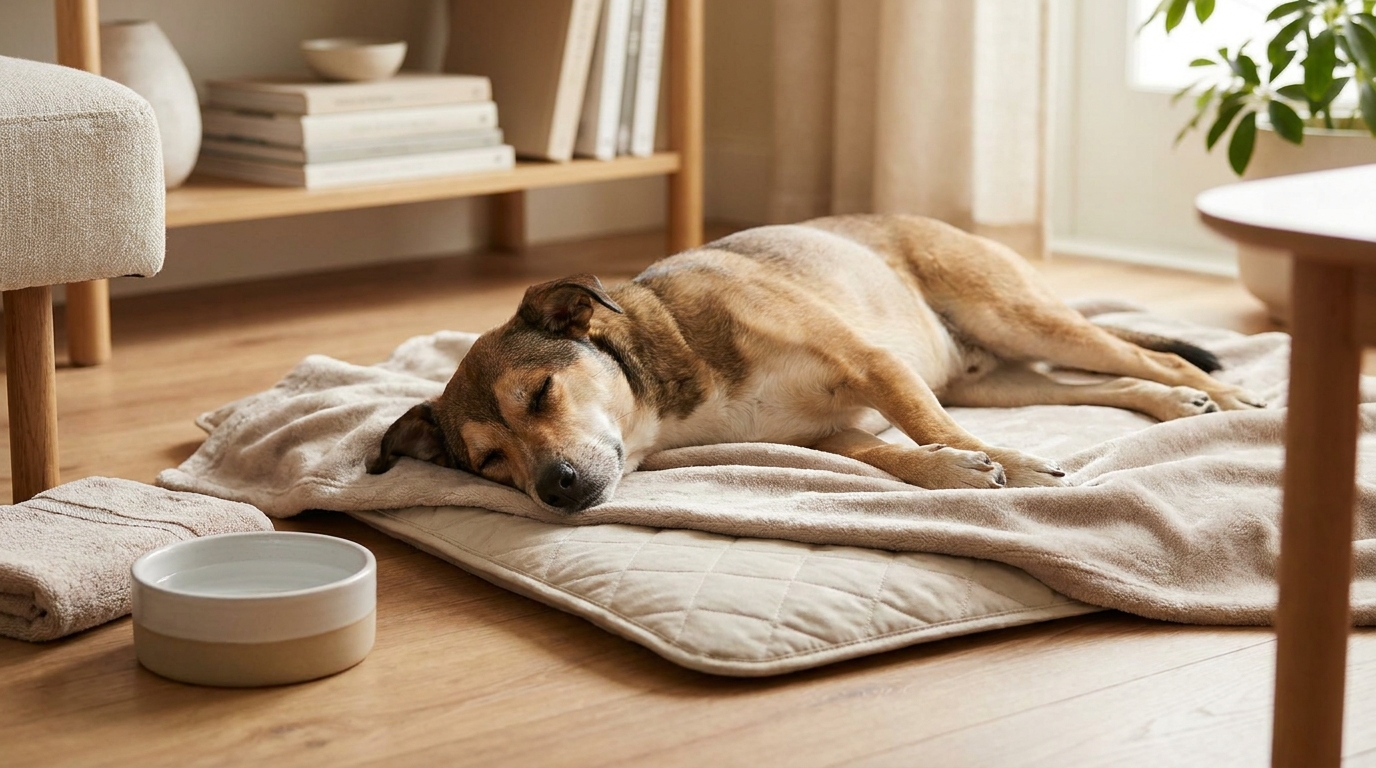
Why dogs leak urine in their sleep, how to tell leaking from accidents, which signs are urgent, and what the vet will test first.
Quick answer: A dog that leaks urine while lying down or asleep, without noticing, most often has a weak bladder sphincter (spay incontinence), common in spayed females and larger dogs and usually treatable. See a vet within days; a urine test comes first. Go the same day for blood in the urine or a dribbling male, and to an ER now for straining with little or no urine or sudden back-leg weakness.
This article is general information, not a diagnosis. If you think your pet is in danger, go to the nearest emergency animal hospital.
When leaking urine is an emergency
Go to an emergency vet now for:
- Straining and passing only drops or no urine, or a swollen, tight or painful belly, including a male who keeps dribbling and can't seem to empty his bladder. The Merck Veterinary Manual notes that a partly blocked urethra can cause overflow leaking.
- Sudden back-leg weakness, wobbling, knuckling or not being able to walk, especially with back pain or crying when picked up. This can be a disc or spinal problem, as can leaking that starts after a fall, a car accident or a tail injury.
- Blood in the urine in a dog who seems unwell: lethargic, vomiting or not eating.
- Much heavier drinking along with repeated vomiting or not eating, which can be diabetic ketoacidosis, a diabetes complication the Merck Veterinary Manual describes as life-threatening.
- An unspayed female with vaginal discharge that looks like a leak, heavy drinking, a swollen belly, lethargy, vomiting or poor appetite in the weeks or months after a heat (VCA says it can occur 2 to 16 weeks after). VCA Animal Hospitals says a very ill, unspayed female who is drinking more should be suspected of pyometra, a serious uterine infection.
- Sudden dribbling with wobbliness, sleepiness or a dazed look, which Merck and Pet Poison Helpline list as signs of THC poisoning. If your dog may have eaten a weed edible or THC gummy, go to an ER or call ASPCA Animal Poison Control at (888) 426-4435 (a consultation fee may apply) or Pet Poison Helpline at (855) 764-7661 (per-incident fee).
- Seizures, collapse or sudden trouble walking in a dog on incontinence medicine, or a dog who got into the tablets (or call one of the poison lines above).
See a vet the same day for blood in the urine, frequent small pees, or straining or pain while peeing, even in a dog who acts normal; any male who dribbles or strains; leaking with back pain, a limp tail or stool accidents; or much heavier drinking with weight loss, vomiting or lethargy.
Leaking or peeing in the house? How to tell
Leaking is involuntary; peeing in the house means your dog is awake and pees in the normal posture. Signs that point to leaking:
- A wet spot or small pool of urine where your dog was lying or sleeping (Merck Veterinary Manual).
- Your dog doesn't seem to notice, and may wake up in a damp bed.
- Damp fur, urine staining or a urine smell around the genitals or back legs.
- Normal pees on walks.
A bladder infection or drinking more can cause leaking or peeing in the house.
Leaking while lying down or asleep, with normal peeing on walks, is the classic pattern. Then watch your dog pee on a walk: is it a normal-sized pee in a steady stream? Straining, only drops, or a swollen, tight belly is not spay incontinence. Go to an ER. Even the classic pattern needs a urine test, because infection and drinking more can look the same.
Common causes of urine leaking in dogs
| Cause | Typical clue | How soon |
|---|---|---|
| Weak sphincter (spayed female) | Wet bed, normal pees on walks | Within days |
| Bladder infection (UTI) | Frequent small pees, licking, odor | Same day |
| Drinking more (kidney, diabetes, Cushing's) | Big puddles, very thirsty | Within days; same day if ill |
| Bladder stones | Straining, blood in urine | Same day; ER if no urine |
| Spine or nerve problem | Weak back legs, back pain | Same day; ER if sudden |
| Prostate problem (male) | Dribbling, straining | Same day; ER if no urine |
| Ectopic ureter (birth defect) | Young dog, damp even when awake | Within 1-2 weeks |
| Brain changes (senior) | Accidents while awake, confused | Within 1-2 weeks |
| THC exposure | Sudden dribbling, wobbly | ER or poison line now |
Brain changes in older dogs usually cause accidents while awake, which is peeing indoors rather than true leaking.
Spayed female dogs: why leaking is common
The most common cause of leaking during sleep is urethral sphincter mechanism incompetence (USMI), often called spay incontinence. The muscle at the bladder outlet doesn't close as firmly as it should, so urine can slip out when your dog relaxes or sleeps. The Merck Veterinary Manual notes that low sex-hormone levels after neutering, especially in females, can cause it.
A 2024 consensus statement from the American College of Veterinary Internal Medicine (ACVIM) says studies report that about 3% to 20% of spayed female dogs develop urinary incontinence. Spay incontinence is more common in larger dogs, especially those over about 45 to 55 pounds. Breeds ACVIM lists at higher risk include the German Shepherd, Rottweiler, Doberman, Giant Schnauzer, Old English Sheepdog, Boxer, English Springer Spaniel, Weimaraner, Irish Setter and Soft-coated Wheaten Terrier. It can start weeks to years after the spay, often around 2 to 4 years later.
If your puppy is already leaking before her spay, or she is a breed at higher risk, ask your vet about timing. Specialists recommend waiting until after the first heat for those dogs.
Proin and Proin ER (phenylpropanolamine) are FDA-approved for dogs, and Incurin (estriol) is FDA-approved for spayed female dogs. All are prescription-only; when the FDA approved Proin ER, it noted that a vet has to diagnose the cause first.
Reported side effects of phenylpropanolamine include restlessness, irritability or aggression, a fast heart rate, decreased appetite, trouble sleeping, increased thirst, vomiting, diarrhea and difficulty urinating. Vets ideally check blood pressure before starting phenylpropanolamine and recheck it during treatment, because it can occasionally raise blood pressure. Incurin can cause loss of appetite, vomiting, drinking more and a swollen vulva, and ACVIM adds that it can make a spayed female attractive to male dogs. Side effects usually ease when your vet adjusts or stops the medicine. Don't change the dose yourself. Seizures, collapse or sudden trouble walking on this medicine is an emergency: don't give another dose, and go to an ER.
Treatment is usually long-term and can take weeks to judge. VCA Animal Hospitals says blood pressure should be checked often when phenylpropanolamine is first started and then at least twice a year, and ACVIM recommends regular rechecks for every incontinent dog.
Old dogs leaking urine
Leaking is common in older dogs, but don't write it off as old age. Several problems look the same on the bed:
- A weaker sphincter. Merck notes it may show up more in middle-aged and older dogs.
- Drinking more. ACVIM notes that drinking and peeing more can make leaking worse. Kidney disease, diabetes and Cushing's disease are the main causes to rule out in a dog drinking more than usual, especially one who is also losing weight but still eating.
- Joints, spine and nerves. Arthritis, disc disease or lumbosacral stenosis (a narrowing in the lower spine) can make it hard to squat or lift a leg, so urine is held and leaks out later. Stool accidents, back pain or an odd gait call for a full neuro exam.
Puppies and young dogs
A young dog, usually a female, who leaks often, including while awake and walking around, may have an ectopic ureter. This birth defect means a tube that carries urine from a kidney opens past the bladder's control point. VCA Animal Hospitals reports that females are affected 4 to 20 times more often than males, but males get it too. The leaking can be constant or come and go, some dogs aren't diagnosed until adulthood, and many lick the genital area. ACVIM lists Siberian Huskies, Labradors, Golden Retrievers, miniature and toy Poodles, Bulldogs and Doodle mixes among breeds at higher risk.
Medicine can't fix an ectopic ureter, according to Merck. Treatment reroutes where the ureter opens, with surgery or with a laser during cystoscopy, a camera passed into the bladder. About half or more of these females also have a weak sphincter, so some still leak after the repair.
Excitement or greeting peeing in puppies is behavior, not sleep leaking, and scolding tends to make it worse. True leaking is involuntary, so don't scold or punish either.
Male dogs dripping or dribbling urine
ACVIM says a partial blockage or a bladder that doesn't empty properly is likely more common than a weak sphincter in males and must be ruled out first, so vets check how much urine is left after peeing. Benign prostate disease is most common in unneutered males, but prostate tumors can happen in neutered dogs too. Incurin is labeled only for spayed females, so it is not an approved option for males. Any male who dribbles needs an in-person exam the same day, because the bladder-emptying check and rectal exam can't be done on video. A male who strains and can't pass urine needs an ER now.
What to do at home while you wait
- Don't cut back water to stop the leaks; tell the vet if your dog is drinking more than usual.
- Use washable bedding and a waterproof cover, and offer a walk right before bed and first thing in the morning.
- Urine left on the skin can cause urine scald, a red, sore rash around the genitals, so check the skin under any diaper or belly band.
- Never give a human decongestant, cold medicine or bladder medicine for leaking; use only medicine a vet prescribes for your dog. Pet Poison Helpline warns that human decongestants can cause dangerous high blood pressure and stroke in pets.
- If the leaking or extra thirst started after a new medicine, call the vet who prescribed it, and don't stop the medicine on your own.
Keep a 48-hour log: when and where each wet spot appears, how big it is, whether your dog was asleep, how much your dog drinks, and whether pees on walks look normal. A short phone video of your dog peeing outside helps.
Fresh is best for a urine sample: get it to the clinic within about 30 minutes. If you can't, put it in a clean sealed container in the fridge and bring it within 24 hours, and tell the clinic it was chilled. Call first, since many clinics prefer to collect the sample themselves. A home sample works for a first urinalysis, but infection guidelines from ISCAID, an international veterinary society, say a urine culture is best done on a sample the clinic takes straight from the bladder, usually with a fine needle. Ask the clinic before your visit whether they want your dog to come in with a full bladder.
What the vet will check
ACVIM recommends a urinalysis and urine culture for every dog with incontinence.
| Test | What it looks for |
|---|---|
| Urinalysis | Infection, dilute urine, crystals |
| Urine culture (clinic sample) | Which bacteria, if any |
| Bloodwork | Kidneys, diabetes, Cushing's screen |
| Blood pressure | Baseline before some leak meds |
| X-ray or ultrasound | Stones, prostate, bladder shape |
| Pee check + bladder scan | Urine left behind (males) |
| Neuro and rectal exam | Spine, nerves, prostate |
All of these happen at an in-person clinic; a video visit can help you decide which ones to ask for and how soon.
If an infection turns up, treatment follows the culture, and the vet rechecks whether the leaking improves. Repeated infections in a leaking dog call for a fuller workup, including imaging.
When a video visit helps
Go to an emergency vet now if your dog strains and passes little or no urine, has blood in the urine and seems unwell, or suddenly has weak back legs. Don't wait for a video visit.
If your dog leaks urine but is otherwise well (eating, walking normally, no blood, no straining, and not a male who dribbles, since he needs a same-day in-person exam), a $64.99 live video visit with Dr. Tiffany Delacruz, DVM, through RexVet, a 501(c)(3) non-profit, can help. Your dog must be located in Florida, New York or Virginia, and visits run about 8 AM-11 PM ET. She can go over when and where the wet spots happen, look at your dog's posture, skin and walk on camera, help work out whether the pattern looks more like spay incontinence or another cause, such as a bladder infection, a drinking problem or a behavior issue, and tell you which urine tests to ask a clinic for (a urinalysis, and a urine culture from a sample the clinic collects) and how soon.
A video visit cannot run a urinalysis, and no prescription is promised. FDA-approved incontinence medicines for dogs are prescription-only and are started after a diagnosis, usually a urine test; phenylpropanolamine ideally comes with blood-pressure checks before and during treatment, which happen in person. In Florida, telehealth-only prescriptions are limited to on-label FDA-approved animal drugs for at most 14 days, with no renewal without an in-person exam, so long-term treatment runs through an in-person vet. RexVet is not a pharmacy; if a prescription is sent to an outside pharmacy, a pharmacy transfer fee applies.
Need an Expert Opinion on This Topic?
Book a video visit with a licensed vet, evenings and weekends included
See open timesFrequently Asked Questions
Why is my dog leaking urine while sleeping?
The most common reason is a weak urethral sphincter, the muscle that holds urine in. When it is weak, urine can slip out while your dog sleeps, without your dog noticing. It is most common in spayed females and larger dogs. If your dog also strains or passes only drops on walks, go to an ER. Even the classic sleep-leaking pattern needs a urine test, because a bladder infection or drinking more can look the same.
Is spay incontinence permanent?
It is usually managed long-term, not fixed with a single treatment. Many dogs improve on prescription medicine, such as Proin (phenylpropanolamine) or Incurin (estriol), both FDA-approved for dogs, but they need regular rechecks, including urine tests and, for phenylpropanolamine, blood-pressure checks. If side effects happen, your vet can adjust the plan. Don't change the dose yourself.
Can a UTI make my dog leak urine?
Yes. A bladder infection can cause leaking or a sudden urge to go, and dogs that leak are also more likely to get infections. That's why the vet tests the urine, including a culture from a sample the clinic collects, before choosing a treatment. Blood in the urine or straining needs a vet the same day; straining with little or no urine needs an ER now.
Is it normal for old dogs to leak urine?
It is common, but don't write it off as old age. In seniors, leaking can come from a weaker sphincter, drinking more because of kidney disease, diabetes or Cushing's, or arthritis or spine problems that make it hard to squat. A vet exam with a urine test, and often bloodwork, sorts these out. Go the same day if your dog is drinking much more along with weight loss, vomiting or lethargy, and to an ER now if the vomiting is repeated or your dog won't eat.
Can I treat dog incontinence without a vet?
No. Never give a human bladder medicine, decongestant or cold medicine, including allergy products with a "-D" in the name; some can cause dangerous high blood pressure and stroke in pets. Dog incontinence medicines are prescription-only and start after the cause is found, usually with a urine test.
Do dog diapers or belly bands cause problems?
They help keep your home dry, but they don't treat the cause. Urine held against the skin can cause urine scald, a red, sore rash around the genitals, so replace a diaper or band when it is wet, check the skin under it often, and see a vet if the skin looks red or raw.
Can an online vet help with dog incontinence in Florida, New York or Virginia?
Yes, for a first assessment, if your dog is located in one of those states during the visit. On video, the vet can go over when and where the leaking happens, watch your dog walk, look at the skin and bedding, tell you whether it sounds like a sphincter leak, a bladder problem or a behavior issue, and say which tests come next. The urinalysis, a urine culture from a clinic sample, a bladder-emptying check (especially in males), bloodwork, blood pressure, imaging and a rectal and neuro exam need an in-person visit. If medicine comes up: in Florida, a video-only prescription is limited to FDA-approved animal drugs used as labeled, for up to 14 days, with no renewal without an in-person exam. Virginia allows the exam to be done electronically, but prescribing is still the vet's call. In every state, federal rules require an in-person exam before a vet uses a human drug or an animal drug off-label. New York's veterinary telehealth rules are unsettled and may be more limited. Incontinence medicine takes weeks to judge and needs rechecks, so ongoing treatment usually runs through an in-person vet. A prescription is never guaranteed.
FAQs
Why is my dog leaking urine while sleeping?
The most common reason is a weak urethral sphincter, the muscle that holds urine in. When it is weak, urine can slip out while your dog sleeps, without your dog noticing. It is most common in spayed females and larger dogs. If your dog also strains or passes only drops on walks, go to an ER. Even the classic sleep-leaking pattern needs a urine test, because a bladder infection or drinking more can look the same.
Is spay incontinence permanent?
It is usually managed long-term, not fixed with a single treatment. Many dogs improve on prescription medicine, such as Proin (phenylpropanolamine) or Incurin (estriol), both FDA-approved for dogs, but they need regular rechecks, including urine tests and, for phenylpropanolamine, blood-pressure checks. If side effects happen, your vet can adjust the plan. Don't change the dose yourself.
Can a UTI make my dog leak urine?
Yes. A bladder infection can cause leaking or a sudden urge to go, and dogs that leak are also more likely to get infections. That's why the vet tests the urine, including a culture from a sample the clinic collects, before choosing a treatment. Blood in the urine or straining needs a vet the same day; straining with little or no urine needs an ER now.
Is it normal for old dogs to leak urine?
It is common, but don't write it off as old age. In seniors, leaking can come from a weaker sphincter, drinking more because of kidney disease, diabetes or Cushing's, or arthritis or spine problems that make it hard to squat. A vet exam with a urine test, and often bloodwork, sorts these out. Go the same day if your dog is drinking much more along with weight loss, vomiting or lethargy, and to an ER now if the vomiting is repeated or your dog won't eat.
Can I treat dog incontinence without a vet?
No. Never give a human bladder medicine, decongestant or cold medicine, including allergy products with a "-D" in the name; some can cause dangerous high blood pressure and stroke in pets. Dog incontinence medicines are prescription-only and start after the cause is found, usually with a urine test.
Do dog diapers or belly bands cause problems?
They help keep your home dry, but they don't treat the cause. Urine held against the skin can cause urine scald, a red, sore rash around the genitals, so replace a diaper or band when it is wet, check the skin under it often, and see a vet if the skin looks red or raw.
Can an online vet help with dog incontinence in Florida, New York or Virginia?
Yes, for a first assessment, if your dog is located in one of those states during the visit. On video, the vet can go over when and where the leaking happens, watch your dog walk, look at the skin and bedding, tell you whether it sounds like a sphincter leak, a bladder problem or a behavior issue, and say which tests come next. The urinalysis, a urine culture from a clinic sample, a bladder-emptying check (especially in males), bloodwork, blood pressure, imaging and a rectal and neuro exam need an in-person visit. If medicine comes up: in Florida, a video-only prescription is limited to FDA-approved animal drugs used as labeled, for up to 14 days, with no renewal without an in-person exam. Virginia allows the exam to be done electronically, but prescribing is still the vet's call. In every state, federal rules require an in-person exam before a vet uses a human drug or an animal drug off-label. New York's veterinary telehealth rules are unsettled and may be more limited. Incontinence medicine takes weeks to judge and needs rechecks, so ongoing treatment usually runs through an in-person vet. A prescription is never guaranteed.
Medically Reviewed
Reviewed by Dr. Tiffany Delacruz, DVM — licensed veterinarian and CEO of RexVet. Last reviewed October 30, 2026.
Content is for informational purposes and does not replace professional veterinary advice.
Chief Executive Officer · Licensed Veterinarian
Dr. Delacruz is a licensed Doctor of Veterinary Medicine specializing in preventive care and veterinary telehealth. She reviews all health content on RexVet to ensure accuracy and clinical relevance.
Sources & References
- · American Veterinary Medical Association — Telehealth Guidelines
- · AVMA — Pet Care Resources
- · U.S. FDA — Animal & Veterinary