
Dog Ear Wax Color: Brown, Black or Yellow and What It Means
By RexVet Team | Reviewed by Dr. Tiffany Delacruz, DVM
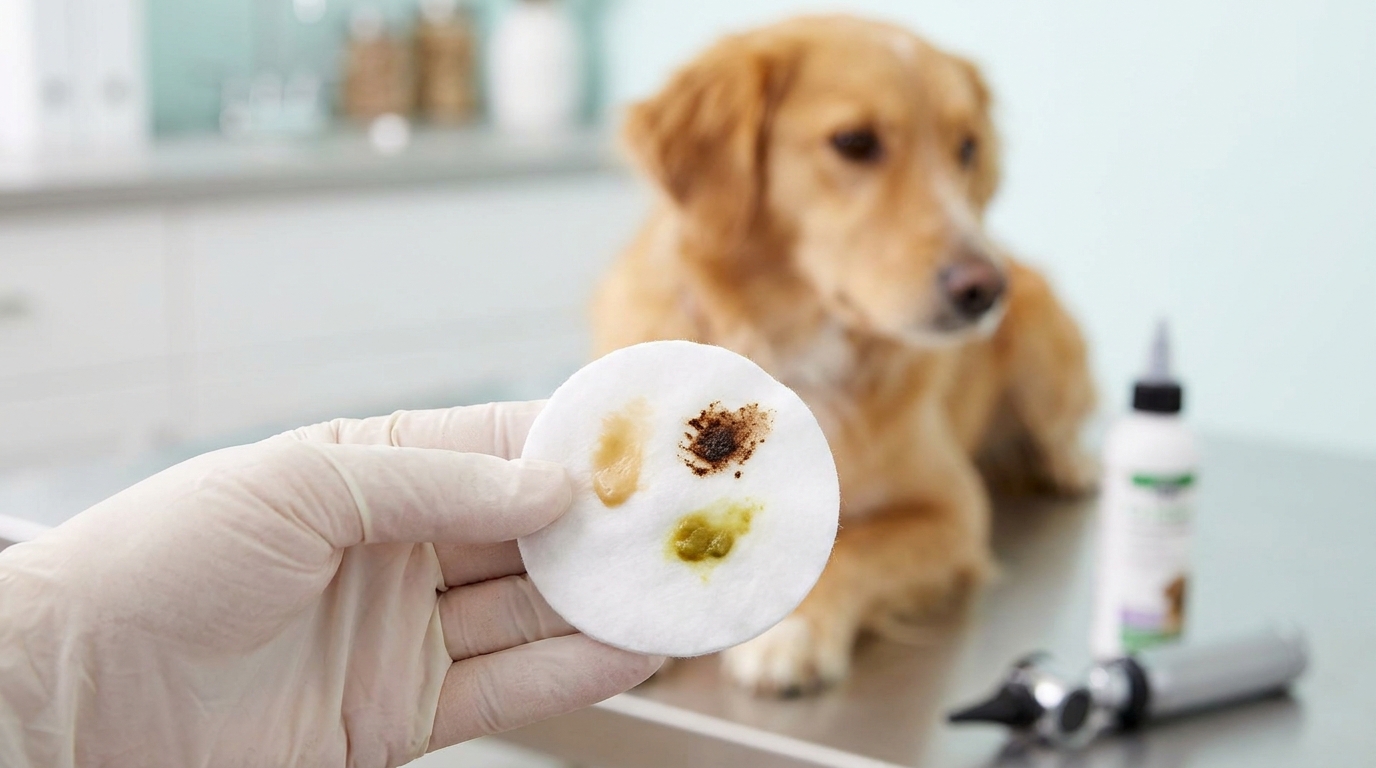
Dark brown, black, yellow or bloody discharge in a dog's ear points to different problems. Here is what each color can mean and how soon to act.
Quick answer: A healthy dog ear has a light, shiny coat of wax over skin that is not red. Dark brown or black debris often means yeast or mites, and yellow or green pus suggests bacteria. Smell, itch or redness needs a vet soon; pus or pain when chewing, the same day; a sudden head tilt, loss of balance, severe ear pain or bleeding from the ear canal, an emergency vet now.
This article is general information, not a diagnosis. If you think your pet is in danger, go to the nearest emergency animal hospital.
What color should dog ear wax be?
A healthy dog ear has a light, shiny coating of wax over smooth skin that is not red, and the ear clears that wax by itself, Clinician's Brief explains. The article's author, Louis N. Gotthelf, DVM, notes that skin cells move outward and carry old wax with them.
Color by itself is not the test: a vet also judges the amount of wax, the smell, the skin and whether the dog is itchy or sore. Clinician's Brief adds that using ear cleaners to remove mild wax from normal ears is not recommended, so a light film with no smell, itch, redness or discharge is best left alone. What matters most is change: more wax than usual, darker wax, a new smell, head shaking, scratching, or one ear that looks very different from the other.
What does each ear wax color mean?
Ear wax color in a dog is only a clue, not a diagnosis: Clinician's Brief says dark brown waxy or dry debris often points to yeast, creamy tan discharge to staph bacteria, and yellow, green or wet black pus to bacteria such as Pseudomonas. Clinician's Brief calls these clues only a presumptive guess, and the Merck Veterinary Manual says a dark discharge often means yeast or parasites but can also appear with bacterial infections.
| What you see | May mean | Next step |
|---|---|---|
| Light, shiny film | Normal | Leave alone |
| Dark brown, waxy | Yeast | Clinic soon |
| Black, dry crumbs | Yeast, mites | Clinic soon |
| Yellow or green pus | Bacteria | Same day |
| Black, wet, pus-like | Bacteria | Same day |
| Stringy mucus | Middle ear | Same day |
| Red skin | Inflamed | Clinic soon |
| Blood from canal | Ulcer, mass | ER now |
| Yellow scales, flap edge | Seborrhea | Routine vet |
Color is a clue, not an answer: only a microscope check of an ear sample (cytology) tells yeast, bacteria and mites apart.
- Creamy, tan, moist discharge: Clinician's Brief links it to Staphylococcus-type bacteria. See a vet soon, or the same day if it drains like pus.
- Stringy mucus: Clinician's Brief says mucus should never be in the outer ear canal and can come from the middle ear through a hole in the eardrum. Put nothing in that ear; see a vet the same day.
- Blood: Clinician's Brief says blood-tinged discharge can come from an ulcer or an ulcerated tumor in the canal. Bleeding from the ear canal means an emergency vet now.
Ear wax plus smell, shaking or pain: when to see a vet
A dog with ear wax plus head shaking, a new smell, itch or redness needs a vet visit soon; pus, pain when chewing, or sudden, violent head shaking after time in grass or brush needs a vet the same day; and a sudden head tilt, loss of balance, severe ear pain or bleeding from the ear canal means an emergency vet now. The Merck Veterinary Manual says an inner-ear infection typically causes a head tilt, severe coordination problems and uncontrollable eye movements.
| Sign | How soon | Where |
|---|---|---|
| Head tilt, falling | Now | ER |
| Severe pain, fever | Now | ER |
| Blood from canal | Now | ER |
| Tilt after drops | Now | ER |
| Pus from canal | Same day | Vet |
| Pain when chewing | Same day | Vet |
| Sudden shaking, grass | Same day | Vet |
| Hot, leaking flap | Same day | Vet |
| Balloon flap, eating | 24-48 hours | Clinic |
| New smell, itch, wax | Soon | Clinic |
| One ear, lump | Soon | Clinic |
| Light wax, no itch | No rush | Leave alone |
Same day means your vet today, or an emergency clinic if no clinic can see your dog today.
Go to the nearest emergency vet now for a sudden head tilt, loss of balance, circling or falling to one side; flicking or darting eyes, especially with vomiting; sudden hearing loss, a drooping face or an eye that cannot blink; severe ear pain (the dog cries or will not let anyone touch the ear), fever with ear pain, or bleeding from the ear canal. Pain when opening the mouth or chewing, or refusing food or extreme lethargy along with ear pain, needs a vet the same day.
A balloon-like ear flap is usually an aural hematoma, a fluid-filled swelling the Merck Veterinary Manual links to head shaking or scratching. It needs a clinic within 24 to 48 hours if the dog is eating and acting normally, or the same day if the flap is hot, splitting or leaking pus, or if the dog is off food or lethargic.
If an ear gets redder or more painful after prescribed drops start, call the vet who prescribed them; if a head tilt or loss of balance appears, go to an emergency vet now.
Is it ear mites?
Dark brown or black, dry debris with itching can mean ear mites, especially in puppies or dogs living with cats, but in adult dogs it more often means yeast, so a vet should confirm mites under a microscope before any pet is treated. Owners often say the debris looks like coffee grounds, but in a dog that look alone does not confirm mites.
VCA notes that ear mites are more common in puppies and kittens, that adult dogs occasionally catch them from puppies or cats, and that ear infections cause the same black discharge, scratching and head shaking. The Merck Veterinary Manual says that with ear mites a dog shakes its head and scratches its ears, the itching varies and may be intense, and severe cases can produce pus and tear the eardrum.
If a vet finds mites, the Merck Veterinary Manual says animals in contact with an infested dog should also be treated under the vet's plan; the vet then picks a product suited to each pet's species. Never put a dog's ear medicine in a cat's ears: the labels of several FDA-approved dog ear medicines say they are not approved for use in cats. For yeast or bacteria that keep coming back, see why some dogs keep getting ear infections.
Why does my dog have so much ear wax?
Extra ear wax in a dog usually means the ear canal is inflamed, often from an allergy and sometimes from low thyroid, a skin-oil disorder, mites or an infection, Clinician's Brief and the Merck Veterinary Manual explain. Inflammation itself makes the ear produce more wax.
The Merck Veterinary Manual also lists floppy ears, hairy ears and extra hair in the canal as risk factors; heavy, hairy flaps keep the canal warm and damp and trap wax, which is part of why Goldendoodles get so many ear infections. Cocker Spaniels have more wax-gland tissue in the canal, Clinician's Brief adds.
Skin and ear trouble often go together. From RexVet's visit study: "Skin was the top concern in RexVet dog visits (18%), followed by itching, ear problems and allergies." An itchy dog with extra wax may need an allergy plan too; see how a food allergy elimination diet works.
Wax can also harden into a plug against the eardrum that causes temporary hearing loss, Clinician's Brief notes; a vet removes it, often under anesthesia, so never dig at wax with a swab, tweezers or anything else. Dogs can also get tumors of the ear's wax glands, so a lump at the canal opening, or a problem in just one ear, needs a clinic visit soon. When extra wax keeps returning with infections, the cause needs treatment; this guide to repeat ear infections explains how a vet finds it.
Should I clean my dog's ear wax?
Clean a dog's ears only if a vet advises it, using a vet-recommended dog ear cleaner and never cotton swabs, because VCA notes that some dogs with healthy ears never need cleaning and a red or painful ear may hide an infection or a ruptured eardrum. If your vet has asked you to clean, the usual steps are:
- Fill the ear canal with the vet-recommended cleaner.
- Gently massage the base of the ear.
- Let your dog shake.
- Wipe the outer ear with cotton or gauze, no deeper than a finger reaches. The Merck Veterinary Manual says never to use cotton swabs.
How often to clean a dog's ears is the vet's call. The Merck Veterinary Manual says vets usually start with frequent cleaning during treatment and taper to once or twice a week for maintenance, and that overcleaning itself can inflame ears.
Do not clean the ear right before a vet visit: the Merck Veterinary Manual says ear samples should be taken before any cleaning. Take clear photos of both ears instead.
Keep home remedies out of the ear: no vinegar, oils, hydrogen peroxide, rubbing alcohol, essential oils or homemade mixes, and no leftover drops, another pet's drops or human ear products. The Merck Veterinary Manual says vinegar mixtures can worsen swelling and that even products safe in healthy ears can irritate inflamed ones. If a dog gets a head tilt, loses balance or seems suddenly deaf after ear drops or a cleaning, stop putting anything in the ear and go to an emergency vet now.
Why a first ear problem needs an in-person exam
A camera cannot see a dog's eardrum, and many FDA-approved dog ear medicines are labeled for use only after a vet confirms the eardrum is intact, so a first infection, a new flare or a sore ear needs an otoscope exam and often ear cytology at a clinic. Clinician's Brief explains that the dog ear canal is L-shaped, running down and then inward, so the eardrum cannot be seen without an otoscope.
The Merck Veterinary Manual says diagnosis rests on the history, an otoscope exam and cytology, and that discharge often hides the eardrum until the ear is cleaned or flushed. A painful ear may need sedation for the exam, VCA notes, and some dog ear medicines are labeled to be put in the ear by veterinary staff. For ears that keep flaring, the guide to repeat ear infections covers the next tests.
When a video visit helps
A video visit can help decide how soon a change in a dog's ear wax needs a clinic and can review an ear problem a clinic has already diagnosed, but a first ear infection, a new flare or a sore ear needs an in-person exam. RexVet, a nonprofit online vet service, serves pets located in Florida, New York and Virginia by video visit, and your dog must be in one of those states during the visit.
Counting visits for all pets, not only dogs, RexVet's visit study found: "Ear and eye problems came second, named in 22% of RexVet video visits."
You can book a $64.99 live video visit with a licensed RexVet vet, a veterinarian licensed in your pet's state; live slots run about 8 AM to 11 PM ET, including evenings and weekends, and there are no overnight visits.
On a video visit, the veterinarian can look at the ear flap and the opening of the canal on camera and in your photos, judge whether the wax looks normal, review your cleaning routine, ask whether other pets are scratching too, and tell you how soon the ear needs a clinic. For a dog whose ear problem was diagnosed in person before, they can also review past ear test results and the drops used before, and set a long-term plan.
An in-person ear exam uses an otoscope and often cytology, because a camera cannot see the eardrum; a new flare means a new smell, discharge or itch. Pus from the canal, pain when chewing, or sudden, violent head shaking after time in grass or brush (a possible grass seed) needs a vet the same day.
No prescription is promised; any medicine is the veterinarian's decision after the visit. Many FDA-approved dog ear medicines are labeled for use only after a vet confirms the eardrum is intact, so ear medicine after a video visit depends on a recent in-person ear exam. Florida s.474.2021 limits telehealth-only prescribing to FDA-approved animal drugs used on-label, for up to 14 days (1 month for products labeled solely for fleas and ticks), with no renewal without an in-person exam and no human-labeled, controlled or compounded anti-infective drugs. Virginia allows the exam to be electronic; New York's telehealth prescribing rules are not settled. A pharmacy transfer fee applies if a prescription is sent to an outside pharmacy.
Not a fit for video: a sudden head tilt, loss of balance, circling or falling to one side; flicking or darting eyes, especially with vomiting; sudden hearing loss, a drooping face or an eye that cannot blink; severe ear pain, fever with ear pain, or bleeding from the ear canal. Go to the nearest emergency vet now. The same applies to a head tilt, loss of balance or sudden deafness that starts after ear drops or a cleaning: put nothing more in the ear and go.
Need an Expert Opinion on This Topic?
Book a video visit with a licensed vet, evenings and weekends included
See open timesFrequently Asked Questions
Is dark brown or black ear wax normal for dogs?
Usually not: black or dark brown debris in a dog's ear often means yeast or ear mites, so a vet should check it soon. Clinician's Brief notes that wet, pus-like black discharge can come from bacteria such as Pseudomonas, and that needs a vet the same day. Only a microscope check of an ear sample tells yeast, mites and bacteria apart, so do not clean the ear right before the visit.
Can I use olive oil or vinegar to clean my dog's ears?
No. Use only an ear cleaner your vet recommends, and never put vinegar, oils, hydrogen peroxide, rubbing alcohol or a homemade mix in a dog's ear. The Merck Veterinary Manual says vinegar mixtures can worsen swelling, and VCA notes that cleaners with hydrogen peroxide or alcohol can irritate the ear canal.
Can my cat give my dog ear mites?
Yes, sometimes: VCA notes that adult dogs occasionally catch ear mites from cats or puppies. A vet should confirm mites under a microscope first, because in adult dogs dark ear debris is often yeast. Each pet then needs a product the vet picks for its species; never put a dog's ear medicine in a cat's ears or share drops between pets.
Why does my dog's ear wax smell bad?
A bad smell from a dog's ear usually means yeast or bacteria are overgrowing, so see a vet soon. The Merck Veterinary Manual lists foul odor among the signs of outer-ear inflammation and notes that some bacterial infections smell especially pungent. Smell cannot tell yeast from bacteria; only cytology can. If the smell comes with pus or pain when chewing, see a vet the same day.
Why does my dog have yellow crusty wax on the edges of the ears?
Yellow or gray waxy scales on the edge of a dog's ear flap can be ear-margin seborrhea, a skin condition, not ear-canal wax. The Merck Veterinary Manual describes these scales stuck to the hair along the flap edge as common in Dachshunds and some other floppy-eared breeds. If the flap edge is very itchy, or the canal itself smells, itches or has discharge, see a vet soon, or the same day if pus drains from it.
Can an online vet look at my dog's ear wax in Florida, New York or Virginia?
Partly: a licensed RexVet vet can look at the outer ear and wax on video, but a camera cannot see the eardrum. For a dog located in Florida, New York or Virginia during the visit, the veterinarian can judge the wax, review past ear tests and drops, and decide how soon the ear needs a clinic. A first infection, a new flare or a sore ear needs an in-person otoscope exam, and a sudden head tilt or loss of balance needs an emergency vet now. Any medicine is the veterinarian's decision and is never guaranteed. Florida limits telehealth-only prescriptions to FDA-approved animal drugs used as labeled, for up to 14 days (1 month for products labeled solely for fleas and ticks), with no renewal without an in-person exam and no human-labeled, controlled or compounded anti-infective drugs, and federal rules (21 CFR 530.3) require an in-person vet relationship for off-label drug use. Virginia allows the exam to be electronic, and New York's telehealth prescribing rules are not settled.
FAQs
Is dark brown or black ear wax normal for dogs?
Usually not: black or dark brown debris in a dog's ear often means yeast or ear mites, so a vet should check it soon. Clinician's Brief notes that wet, pus-like black discharge can come from bacteria such as Pseudomonas, and that needs a vet the same day. Only a microscope check of an ear sample tells yeast, mites and bacteria apart, so do not clean the ear right before the visit.
Can I use olive oil or vinegar to clean my dog's ears?
No. Use only an ear cleaner your vet recommends, and never put vinegar, oils, hydrogen peroxide, rubbing alcohol or a homemade mix in a dog's ear. The Merck Veterinary Manual says vinegar mixtures can worsen swelling, and VCA notes that cleaners with hydrogen peroxide or alcohol can irritate the ear canal.
Can my cat give my dog ear mites?
Yes, sometimes: VCA notes that adult dogs occasionally catch ear mites from cats or puppies. A vet should confirm mites under a microscope first, because in adult dogs dark ear debris is often yeast. Each pet then needs a product the vet picks for its species; never put a dog's ear medicine in a cat's ears or share drops between pets.
Why does my dog's ear wax smell bad?
A bad smell from a dog's ear usually means yeast or bacteria are overgrowing, so see a vet soon. The Merck Veterinary Manual lists foul odor among the signs of outer-ear inflammation and notes that some bacterial infections smell especially pungent. Smell cannot tell yeast from bacteria; only cytology can. If the smell comes with pus or pain when chewing, see a vet the same day.
Why does my dog have yellow crusty wax on the edges of the ears?
Yellow or gray waxy scales on the edge of a dog's ear flap can be ear-margin seborrhea, a skin condition, not ear-canal wax. The Merck Veterinary Manual describes these scales stuck to the hair along the flap edge as common in Dachshunds and some other floppy-eared breeds. If the flap edge is very itchy, or the canal itself smells, itches or has discharge, see a vet soon, or the same day if pus drains from it.
Can an online vet look at my dog's ear wax in Florida, New York or Virginia?
Partly: a licensed RexVet vet can look at the outer ear and wax on video, but a camera cannot see the eardrum. For a dog located in Florida, New York or Virginia during the visit, the veterinarian can judge the wax, review past ear tests and drops, and decide how soon the ear needs a clinic. A first infection, a new flare or a sore ear needs an in-person otoscope exam, and a sudden head tilt or loss of balance needs an emergency vet now. Any medicine is the veterinarian's decision and is never guaranteed. Florida limits telehealth-only prescriptions to FDA-approved animal drugs used as labeled, for up to 14 days (1 month for products labeled solely for fleas and ticks), with no renewal without an in-person exam and no human-labeled, controlled or compounded anti-infective drugs, and federal rules (21 CFR 530.3) require an in-person vet relationship for off-label drug use. Virginia allows the exam to be electronic, and New York's telehealth prescribing rules are not settled.
Medically Reviewed
Reviewed by Dr. Tiffany Delacruz, DVM — licensed veterinarian and CEO of RexVet. Last reviewed November 5, 2026.
Content is for informational purposes and does not replace professional veterinary advice.
Chief Executive Officer · Licensed Veterinarian
Dr. Delacruz is a licensed Doctor of Veterinary Medicine specializing in preventive care and veterinary telehealth. She reviews all health content on RexVet to ensure accuracy and clinical relevance.
Sources & References
- · American Veterinary Medical Association — Telehealth Guidelines
- · AVMA — Pet Care Resources
- · U.S. FDA — Animal & Veterinary