
Dog Cut Its Paw Pad? Stitches Tonight or Wait Until Morning
By RexVet Team | Reviewed by Dr. Tiffany Delacruz, DVM
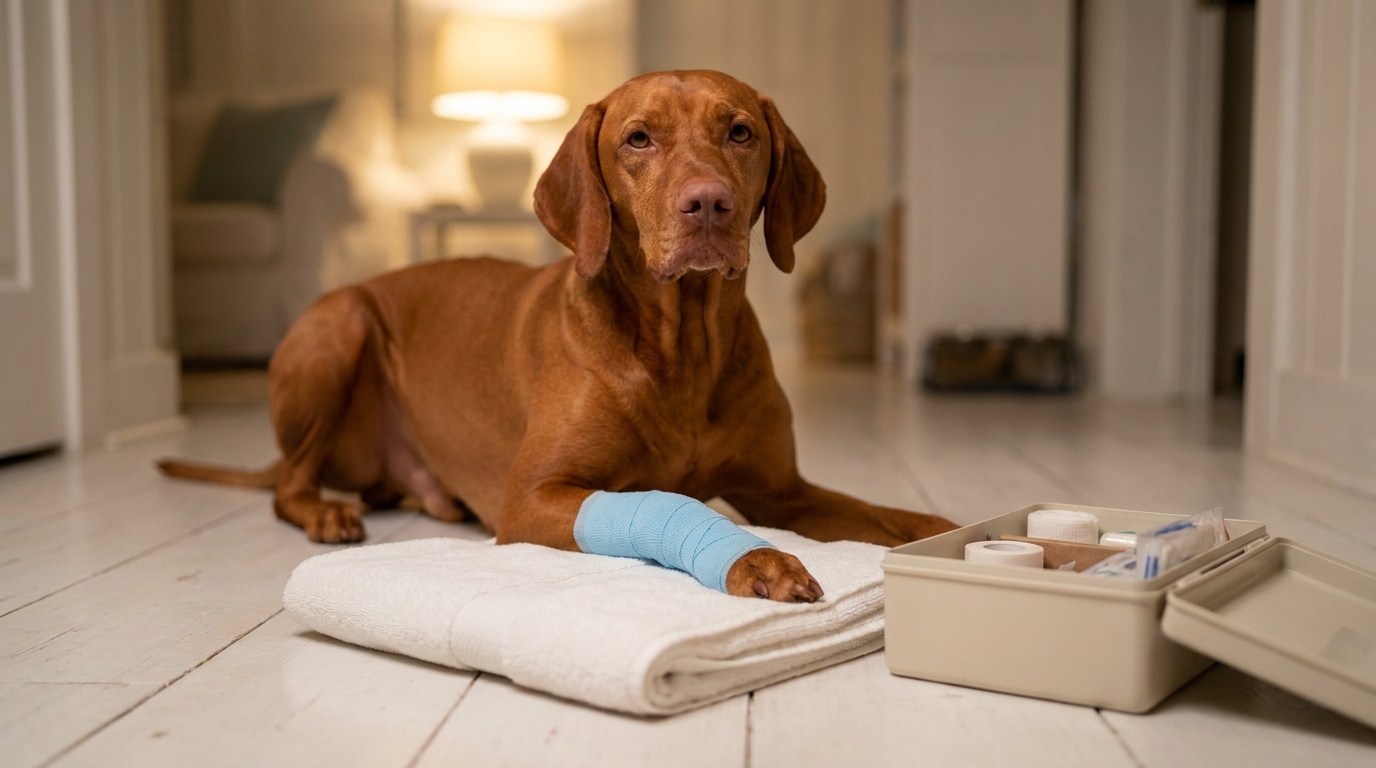
Dog cut its paw pad? Press a clean towel on it firmly. If it still bleeds after 10–15 minutes, go to an emergency vet now.
Go to an emergency vet now if the pad is still bleeding after 10–15 minutes of firm pressure, blood spurts or pulses, the cut gapes wide open or a flap of pad hangs loose, glass or another object is stuck deep in the pad, you can see bone or tendon, your dog won't put any weight at all on the leg, the leg may be broken or your dog can't move it, or your dog has pale or white gums, fast breathing, weakness or collapse.
Dog cut its paw pad: why pad cuts are tricky
The pads are the thick cushions your dog walks on, so every step presses on the cut. VCA Animal Hospitals' guide to torn or injured foot pads notes that "A torn foot pad does not hold stitches well, so cuts and punctures take longer to heal." VCA adds that "Walking on the injured foot often opens the wound and further delays healing."
October culprits include broken glass and metal on sidewalks and in parking lots, sharp shells and storm debris on Florida beaches late in hurricane season, sharp rock on fall hikes in New York and Virginia, and broken Halloween decorations.
Signs include limping, licking at one foot and bloody paw prints. In VCA's words, "Even minor foot pad injuries can be stubborn, so it is recommended that you take your dog to a veterinarian."
Emergency signs: go to an ER now, not a video call
Go to an emergency vet now, not a video call, if:
- the pad is still bleeding after 10–15 minutes of firm pressure
- blood spurts or pulses
- the cut gapes wide open, or a flap of pad hangs loose
- glass or another object is stuck deep in the pad
- you can see bone or tendon
- your dog won't put any weight at all on the leg
- the leg may be broken, or your dog can't move it
- your dog has pale or white gums, fast breathing, weakness or collapse
VCA Animal Hospitals puts it plainly: "If you cannot stop the bleeding within 10–15 minutes, this is an emergency, take your dog to the emergency veterinary clinic."
VCA explains that heavy bleeding can cause shock, and a dog in shock "may have pale or white gums and breathe rapidly." As VCA puts it, "Minutes matter."
The Merck Veterinary Manual lists "Severe or uncontrolled bleeding" and "Suspected broken bones or a limb that can't move" among emergencies that need immediate veterinary care.
If you can't tell whether one of these signs is there, go to an emergency vet now. On the way, keep firm pressure on the paw with a clean towel, without pressing on or pulling at anything stuck in the pad.
Stop the bleeding first
The Merck Veterinary Manual says, "Any injured or painful animal might bite or scratch, so protect yourself first."
If you need a muzzle, Merck says to use one only when safe: "Never muzzle a dog with chest injuries or a short-nosed breed (like a pug or a bulldog)." It also advises not to leave a muzzled dog alone. If your dog is breathing fast, skip the muzzle and go to an emergency vet now.
Then press. VCA's first aid advice for bleeding in dogs is to "Wrap the paw in gauze or a small towel and apply constant pressure to the paw." The Merck Veterinary Manual advises, "For bleeding, press firmly on the wound with your palm or fingers and then apply a firm (but not overly tight) bandage."
If it soaks through, Merck says: "If the bandage becomes soaked with blood, do not remove it. Place more material on top, and keep pressure on it."
VCA warns that "bleeding may reoccur when the dog walks on the foot," so keep your dog still and carry a small dog if you can. If the paw is still bleeding after 10–15 minutes of firm pressure, go to an emergency vet now.
Look closely once the bleeding stops
Use good light and an extra pair of hands. VCA advises, "Look for debris or foreign objects such as glass or metal shards that may be lodged in the pad."
For a gentle rinse, VCA says: "You can help dislodge tiny particles by swishing the paw in cool water or holding it under gently running water." If you can easily grasp an object with tweezers, VCA says you can gently remove it.
VCA's advice is "If the debris is lodged deeply, leave it alone," and it adds that "Deep-seated foreign bodies need to be extracted by your veterinarian." If glass or another object is stuck deep in the pad, go to an emergency vet now, keeping a clean towel around the paw without pressing on or pulling at the object.
Then check the cut while your dog lies still: are the edges together or gaping, is there a flap, how deep does it look, is anything still in it? Do not make your dog walk to test it.
If the edges gape wide open, a flap of pad hangs loose or you can see bone or tendon, keep firm pressure on the paw with a clean towel and go to an emergency vet now. If you can't tell, go now.
Do not put any human cream, ointment, spray or medicine on the cut. For a small cut whose edges sit together and that has stopped bleeding, take a clear photo for the vet.
If burs or spines are stuck in the paw rather than a cut, see our guide to sandspurs in a dog's paw and when to worry.
Wrap it and stop the licking until a vet sees it
The Merck Veterinary Manual says, "The first steps are to apply pressure to stop bleeding and to provide basic bandaging."
VCA's bandage points for a foot pad:
- Pad the bottom of the foot: "Use non-adherent gauze pads to cushion the bottom of the foot and absorb blood."
- Cover the whole paw: "It is important to cover the paw from the toes up to and including the ankle (tarsus) or wrist (carpus)."
- Keep it loose enough: "Make sure the bandage is not too tight. You should be able to insert two fingers between the bandage and the leg."
- Change the bandage daily.
- Keep it dry: "Keep the bandage dry by taping a plastic bag over it when the dog walks on wet grass."
As VCA explains, "It is natural for dogs to lick their wounds, but this can seriously delay healing and result in infection or injury." With a cone, VCA says to "always ensure that you can fit two fingers comfortably between the collar and the dog's neck."
Keep walks to short, leashed potty trips on clean, dry ground until a vet has seen the paw.
If the bandage soaks through, do not remove it; add more material on top and keep pressing. If the paw is still bleeding after 10–15 minutes of firm pressure, go to an emergency vet now.
If the paw swells after the cut, read what to check when a dog's paw is swollen.
Does a cut paw pad need stitches? How a vet decides
The Merck Veterinary Manual's page on wound management says, "After cleaning the wound, the vet will decide whether to close it with sutures, surgical staples, or surgical glue, or leave it open."
Merck explains that "Simple lacerations (tears) without deep tissue damage are usually closed completely, unless they are contaminated or infected." Deeper injuries need more work first: "Deep tissue damage must be evaluated and treated before the wound is closed." Not every wound is closed at all, since "Open wounds are managed with repeated bandage changes and wound care."
As VCA points out, pad tissue does not hold stitches well, so only the vet who examines the paw can decide how it is managed. Sedation for cleaning or closure, and removal of deep debris, need an in-person visit.
What a RexVet online vet can and cannot do for a dog that cut its paw pad
A video visit is only for a pad cut that has stopped bleeding with pressure and shows none of the emergency signs above. In that case, a RexVet veterinarian can:
- look at the pad on camera in good light
- confirm the edges sit together
- coach you through cleaning, wrapping and cone fit
- help you decide between an emergency vet tonight, a hands-on exam soon, or home care and follow-up re-checks until your dog can see a veterinarian in person
They cannot stitch or glue the cut, sedate your dog, remove deep debris or take x-rays. If the veterinarian decides medication is appropriate, they can prescribe where state rules allow. In Florida, a veterinarian who has seen your pet only by video may prescribe only FDA-approved animal drugs used as labeled, for up to 14 days (1 month for flea-and-tick-only products), and cannot renew without an in-person exam.
RexVet's veterinarians are licensed in Florida, New York and Virginia, and a video visit is $64.99, available 24/7. RexVet is a 501(c)(3) non-profit. If your dog cut its paw pad and the bleeding has stopped with pressure and none of the emergency signs is present, you can book a RexVet video visit.
Healing, warning signs and when to see a vet in person
As VCA notes, pad cuts take longer to heal, and "The collar must be worn until the wound has fully healed."
At each bandage change, VCA advises, "If the toes become swollen or if you note a foul odor or moist discharge, consult your veterinarian." It explains that "These signs may indicate compromised circulation or infection that can result in permanent damage to the foot." If the toes swell, check that two fingers still fit under the bandage and have a veterinarian look at the paw.
If none of the emergency signs above is present, a cut that is not closing, keeps reopening, or a dog that keeps limping needs a hands-on exam soon. If any of those signs appears, go to an emergency vet now.
A wound that reopens every time a dog moves is not unique to paws; read about a tail tip that keeps splitting from wagging.
To prevent the next cut, VCA advises surveying the area where your dog plays and walks: "Remove any broken glass, sharp objects, or pieces of metal."
Under Florida law (Fla. Stat. 474.2021), a telehealth vet must give you "the contact information for at least one physical veterinary clinic in the vicinity of the patient's location."
If the cut has stopped bleeding with pressure and none of the emergency signs above is present, RexVet's veterinarians are licensed in Florida, New York and Virginia and can see your dog by video 24/7 for $64.99. You can book a video visit now.
Frequently Asked Questions
Does my dog's cut paw pad need stitches?
Only a veterinarian can decide after cleaning the wound; the Merck Veterinary Manual says the vet will choose between stitches, staples, glue or leaving it open. Go to an emergency vet now if the pad is still bleeding after 10–15 minutes of firm pressure, blood spurts or pulses, the cut gapes wide open or a flap hangs loose, glass or another object is stuck deep in the pad, you can see bone or tendon, your dog won't put any weight at all on the leg, the leg may be broken or your dog can't move it, or your dog has pale or white gums, fast breathing, weakness or collapse. If the cut is small, the edges sit together and the bleeding has stopped, clean it, wrap it and have a vet check it.
How long should a cut paw pad bleed?
VCA says, "Minor tears will stop bleeding in a matter of minutes, but deeper wounds take longer to stabilize." Keep firm pressure on the paw with a clean towel. Go to an emergency vet now if it is still bleeding after 10–15 minutes of firm pressure, if blood spurts or pulses, or if your dog has pale or white gums, fast breathing, weakness or collapse.
Can I wait until morning if my dog cut its paw pad?
Not if any emergency sign is present: go to an emergency vet now if the pad is still bleeding after 10–15 minutes of firm pressure, blood spurts or pulses, the cut gapes wide open or a flap hangs loose, glass or another object is stuck deep in the pad, you can see bone or tendon, your dog won't put any weight at all on the leg, the leg may be broken or your dog can't move it, or your dog has pale or white gums, fast breathing, weakness or collapse. If you are unsure whether one of these signs is there, go to an emergency vet now. If none of them is present, clean and wrap the paw, put on a cone, keep your dog resting and have a vet look at it; a video vet can do that tonight.
Should I let my dog lick its cut paw?
No. As VCA explains, "It is natural for dogs to lick their wounds, but this can seriously delay healing and result in infection or injury." Use a cone, and make sure you can fit two fingers comfortably between the collar and your dog's neck.
Can I put something on my dog's cut paw pad tonight?
Use clean water and a clean wrap only, and do not use human creams, ointments or medicines; if the veterinarian decides medication is appropriate, they can prescribe where state rules allow. Do not try to treat it at home if the pad is still bleeding after 10–15 minutes of firm pressure, blood spurts or pulses, the cut gapes wide open or a flap hangs loose, glass or another object is stuck deep in the pad, you can see bone or tendon, your dog won't put any weight at all on the leg, the leg may be broken or your dog can't move it, or your dog has pale or white gums, fast breathing, weakness or collapse. In that case, keep firm pressure on the paw with a clean towel, without pressing on or pulling at anything stuck in the pad, and go to an emergency vet now.
FAQs
Does my dog's cut paw pad need stitches?
Only a veterinarian can decide after cleaning the wound; the Merck Veterinary Manual says the vet will choose between stitches, staples, glue or leaving it open. Go to an emergency vet now if the pad is still bleeding after 10–15 minutes of firm pressure, blood spurts or pulses, the cut gapes wide open or a flap hangs loose, glass or another object is stuck deep in the pad, you can see bone or tendon, your dog won't put any weight at all on the leg, the leg may be broken or your dog can't move it, or your dog has pale or white gums, fast breathing, weakness or collapse. If the cut is small, the edges sit together and the bleeding has stopped, clean it, wrap it and have a vet check it.
How long should a cut paw pad bleed?
VCA says, "Minor tears will stop bleeding in a matter of minutes, but deeper wounds take longer to stabilize." Keep firm pressure on the paw with a clean towel. Go to an emergency vet now if it is still bleeding after 10–15 minutes of firm pressure, if blood spurts or pulses, or if your dog has pale or white gums, fast breathing, weakness or collapse.
Can I wait until morning if my dog cut its paw pad?
Not if any emergency sign is present: go to an emergency vet now if the pad is still bleeding after 10–15 minutes of firm pressure, blood spurts or pulses, the cut gapes wide open or a flap hangs loose, glass or another object is stuck deep in the pad, you can see bone or tendon, your dog won't put any weight at all on the leg, the leg may be broken or your dog can't move it, or your dog has pale or white gums, fast breathing, weakness or collapse. If you are unsure whether one of these signs is there, go to an emergency vet now. If none of them is present, clean and wrap the paw, put on a cone, keep your dog resting and have a vet look at it; a video vet can do that tonight.
Should I let my dog lick its cut paw?
No. As VCA explains, "It is natural for dogs to lick their wounds, but this can seriously delay healing and result in infection or injury." Use a cone, and make sure you can fit two fingers comfortably between the collar and your dog's neck.
Can I put something on my dog's cut paw pad tonight?
Use clean water and a clean wrap only, and do not use human creams, ointments or medicines; if the veterinarian decides medication is appropriate, they can prescribe where state rules allow. Do not try to treat it at home if the pad is still bleeding after 10–15 minutes of firm pressure, blood spurts or pulses, the cut gapes wide open or a flap hangs loose, glass or another object is stuck deep in the pad, you can see bone or tendon, your dog won't put any weight at all on the leg, the leg may be broken or your dog can't move it, or your dog has pale or white gums, fast breathing, weakness or collapse. In that case, keep firm pressure on the paw with a clean towel, without pressing on or pulling at anything stuck in the pad, and go to an emergency vet now.
Medically Reviewed
Reviewed by Dr. Tiffany Delacruz, DVM — licensed veterinarian and CEO of RexVet. Last reviewed October 2, 2026.
Content is for informational purposes and does not replace professional veterinary advice.
Chief Executive Officer · Licensed Veterinarian
Dr. Delacruz is a licensed Doctor of Veterinary Medicine specializing in preventive care and veterinary telehealth. She reviews all health content on RexVet to ensure accuracy and clinical relevance.
Sources & References
- · American Veterinary Medical Association — Telehealth Guidelines
- · AVMA — Pet Care Resources
- · U.S. FDA — Animal & Veterinary
Need an Expert Opinion on This Topic?
Connect with a certified vet via video call in minutes
Talk to Vet Now