
Dog Happy Tail Bleeding Everywhere? What to Do Tonight
By RexVet Team | Reviewed by Dr. Tiffany Delacruz, DVM
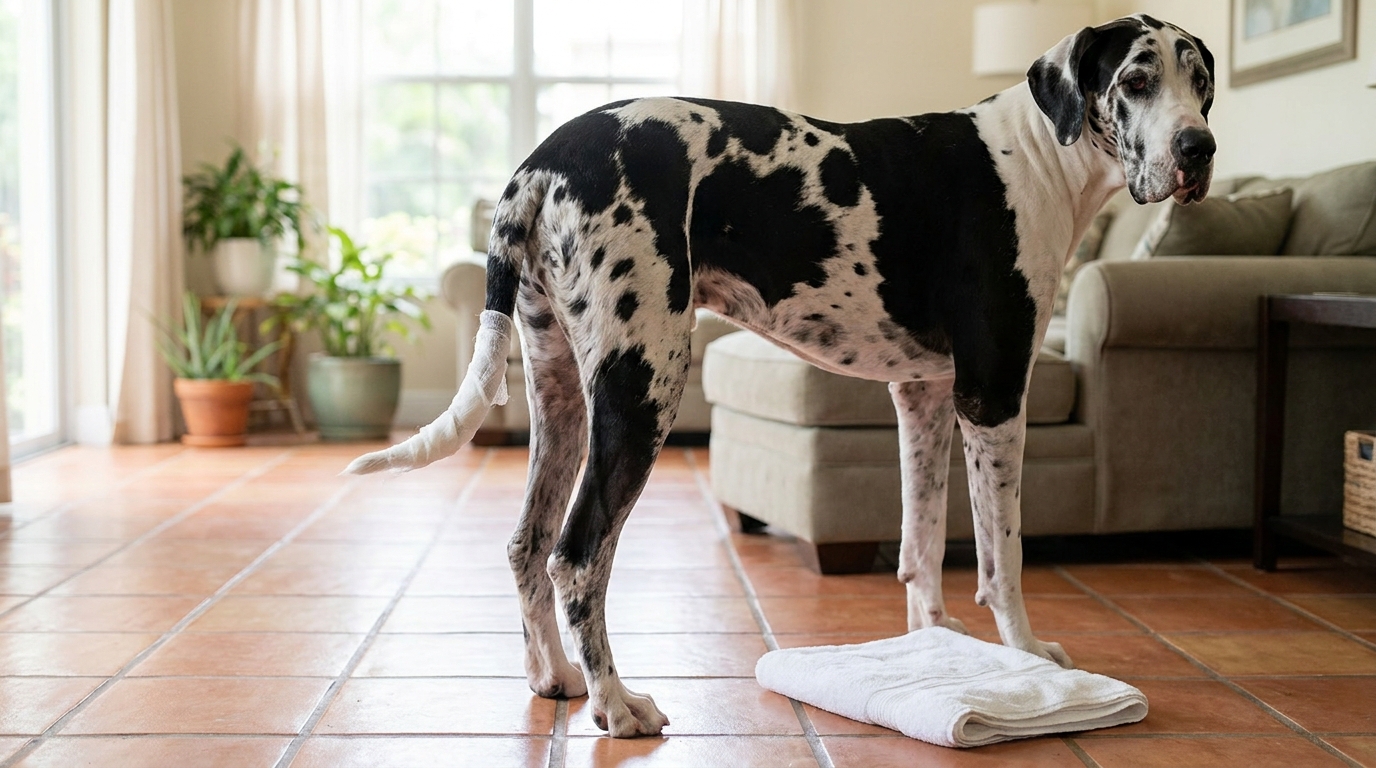
Dog happy tail bleeding? Wagging split the tail tip. Hold a clean cloth on it, calm the wagging, and have a vet check it soon.
Go to an emergency vet now if the tail keeps bleeding through steady, gentle pressure, the cut is deep or gaping, the tip has turned dark, or your dog seems weak, wobbly or has pale gums.
Finding red spots on the wall, the crate and the sofa, with a big dog wagging away in the middle of it all, is scary late at night. Start with the emergency signs below, then use the steps that follow to slow the bleeding without making it worse.
Dog happy tail bleeding: what is going on
This problem is called happy tail, or happy tail syndrome in dogs. VCA Animal Hospitals describes it this way: "Certain dog breeds wag their tails constantly (a 'happy tail') and injure themselves by hitting the tail repeatedly against solid objects like coffee tables, trees, or walls."
PetMD explains what that does to the skin: "The tip of the dog's tail becomes dried and cracked and starts bleeding because of the repetitive striking of the tail on surfaces."
Here is why a small split can leave so much blood around the house. Each wag flings blood from the split and knocks the tip again, so it keeps reopening. The mess can look worse than the wound, but do not use the mess to judge how serious it is. Check the emergency signs below first.
Often the blood is the first clue. PetMD notes, "Many times, pet parents will notice a few drops of blood in their home and then search the dog for a wound."
As for which dogs get it, PetMD says, "Vets often see this condition in Pit Bulls, Shepherds, Great Danes, and Greyhounds, but any breed can develop happy tail."
A tail that hangs limp is a different problem. If your dog's tail droops from the base instead of bleeding at the tip, read our guide to a dog tail that suddenly goes limp.
Emergency signs: go to an ER now, not a video call
Go to an emergency vet now if any of these are true:
- The tail keeps bleeding through steady, gentle pressure, or blood soaks through the cloth you are holding.
- The cut is deep or gaping.
- The tip has turned dark or changed color.
- Your dog seems weak or wobbly, or has pale gums.
- The tail looks bent or crushed after it was caught in a door or after a fall.
For the trip, VCA advises: "Wrap the tail in a towel to control bleeding while you take your dog to the veterinary emergency clinic." Keep that towel loose and hold it in place rather than taping it on. A tight wrap can cause its own harm, as the home-care section below explains.
VCA also says, "If excessive bleeding or swelling occurs or if the tissue changes color, take your dog to your veterinarian." If you are not sure whether one of these signs applies, treat it as an emergency and go.
For the wider list of signs that need a clinic tonight, keep our practical pet emergency checklist handy.
Is happy tail an emergency?
Usually not, but it still needs a vet. VCA says, "Happy tail injuries are usually not emergencies but require treatment to heal properly. If you notice a raw spot on your dog's tail, call your veterinarian."
The wagging itself is the reason it needs treatment. VCA explains, "Happy tails often develop bleeding ulcers that will not heal because the source of the problem (wagging) will not stop." It adds, "These injuries expose delicate nerves that cause pain, so veterinary intervention is advised."
PetMD points out that leaving it alone has a cost too: "In the long term, this condition can lead to infection and nerve damage."
There is some reassurance about the rest of your dog. PetMD says, "Dogs otherwise behave normally, eating, drinking, urinating, and defecating as usual." That also tells you what to watch for. A dog who is not acting normally, or who seems weak, wobbly or has pale gums, goes back to the emergency list above.
What to do tonight to stop the bleeding
If none of the emergency signs are present, these steps help calm things down until your dog can be seen:
- Keep your voice low and skip the big greetings. Excitement means more wagging, and every wag knocks the tip again.
- Press a clean cloth, gauze pad or small towel gently over the tip and hold it there with steady, gentle pressure.
- Move your dog to an open room, away from walls, crate bars and furniture edges, so a wag has nothing to hit.
- If your dog already has a cone (e-collar), putting it on can stop licking and chewing at the tip. PetMD notes an e-collar can keep a dog from "continuing to lick or bite at the tail tip." There is no need to go out and buy one tonight.
- Put no creams, powders, sprays or human products on the tip.
- Once the bleeding slows, take a clear photo of the tip in good light so your vet can see how it looked tonight.
Do not tape on a wrap. PetMD warns, "Because there is minimal tissue on the tail, bandages can easily cut off circulation and cause harm, so it is best to leave bandaging to your veterinary staff." VCA gives the same caution: "To avoid restricting blood flow, do not wrap the bandage too tightly." At home, the only cover you need is a loose towel held over the tip for the car ride.
If the bleeding soaks through the cloth while you hold steady, gentle pressure, stop here. Wrap the tail loosely in a towel and go to an emergency vet now.
For more on which small wounds can wait and which need a clinic, see our guide to minor pet wounds and when to go in.
How vets treat a happy tail that keeps splitting
At the clinic, the first job is to protect the tip. PetMD describes it: "They will apply a bandage to the tail to stop the bleeding and provide a layer of padding to the tail tip." A padded tail bandage is hands-on work, which is why it belongs at the clinic and not on the kitchen floor.
The bandage is only half of the plan. PetMD says, "The other main component to the healing process, and to hopefully prevent the need for amputation, is to stop the dog from vigorously wagging its tail." Your vet can talk with you about keeping your dog calm and giving the tail space while it heals.
Your vet may also want to check your dog's blood. According to PetMD, "your vet may want to do some routine bloodwork to make sure there are no signs of anemia or low platelets, or do specialized testing for clotting."
Surgery comes up only for stubborn cases. PetMD notes that "your veterinarian may try other therapies before recommending amputation," starting with the padded bandage and stopping the wagging. VCA says, "In severe, chronic cases where the wagging will not stop and the injury will not heal, the best solution is surgical shortening of the tail."
If it does come to that, PetMD notes that "dogs do very well after a tail amputation."
What a RexVet online vet can and cannot do for happy tail
One rule first: bleeding that will not stop, a deep cut, a color change or weakness means the ER, not a video call.
Once the bleeding has slowed and none of those signs are present, a video visit can help you plan the next step. A RexVet veterinarian can:
- look at the tail tip on camera or in your photos and judge how deep and raw it is
- check how your dog carries and wags the tail
- coach you on a loose cover for the car ride and a wag-proof room for tonight
- help you sort out whether this means the ER tonight, a clinic visit soon for a padded bandage, or home care for now
A video vet cannot place or change a padded tail bandage, run bloodwork, close a deep cut, or do tail surgery. Those need an in-person clinic, and the vet will tell you when that is the next step.
RexVet's veterinarians are licensed in Florida, New York and Virginia, and they are available 24/7, including nights, weekends and holidays. If the veterinarian decides medication is appropriate, they can prescribe where state rules allow. In Florida, a veterinarian who has seen your pet only by video may prescribe only FDA-approved animal drugs used as labeled, for up to 14 days (1 month for flea-and-tick-only products), and cannot renew without an in-person exam.
If your dog's tail has stopped bleeding and you want a vet to look at it tonight, you can book a RexVet video visit for $64.99, 24/7, if you are in Florida, New York or Virginia.
Stopping the next split
Space is the big fix. PetMD lists happy tail showing up "following a stay at a boarding facility or another tight space where they can easily bang their tail."
That can be good news. PetMD says, "In some cases, a dog may only have one incident of Happy Tail, especially if it occurred while in a tighter space such as a boarding facility or kennel situation."
At home, give your dog room to wag:
- Use a crate big enough that the tail does not hit the bars.
- Clear boxes, bags and furniture out of narrow hallways.
- Greet your dog in open space, like the yard or the middle of a room, rather than in a tight entryway.
- Keep your dog out of cramped corners while the tip heals.
Be careful with homemade padding. PetMD warns that "many dogs will want to chew off the items, which can lead to the bigger issue of a foreign body stuck in the intestines." Ask your vet before you attach anything to the tail.
When to be seen in person in Florida, New York or Virginia
Any of the emergency signs above means go now. For the problems below, book an in-person visit with your veterinarian soon, even if tonight feels calm:
- a raw spot that keeps reopening
- bleeding that restarts every day
- swelling around the tip
- a smell or discharge from the wound
- a tail that hangs limp or looks kinked
A tip that has turned dark or changed color belongs on the emergency list, not this one.
If you start with a video visit in Florida, state law requires the telehealth vet to give you "the contact information for at least one physical veterinary clinic in the vicinity of the patient's location."
Happy tail can turn a quiet evening upside down, but a clean cloth, a calm voice and a room with space to wag are a solid start. If the bleeding has stopped and you want a vet to look at the tip and help you plan the next step, you can book a RexVet video visit for $64.99. RexVet's veterinarians are licensed in Florida, New York and Virginia and are available 24/7, including nights, weekends and holidays.
Frequently Asked Questions
Is happy tail an emergency?
Usually not, but it still needs a vet. VCA says happy tail injuries are usually not emergencies but require treatment to heal properly. It becomes an emergency if the tail keeps bleeding through steady, gentle pressure, the cut is deep or gaping, the tip has turned dark, or your dog seems weak, wobbly or has pale gums. If you see any of these signs, or you are not sure, go to an emergency vet now.
Will happy tail heal on its own?
Not while the wagging keeps hitting the tip. VCA notes that happy tails often develop bleeding ulcers that will not heal because the source of the problem, the wagging, will not stop. PetMD adds that some dogs have only one episode, especially after time in a tight space such as a boarding facility or kennel. Either way, a raw spot on the tail is worth a call to your veterinarian.
Should I bandage my dog's tail at home?
No. PetMD warns that because there is minimal tissue on the tail, bandages can easily cut off circulation, so it is best to leave bandaging to your veterinary staff. VCA also cautions against wrapping a tail too tightly. At home, hold a clean cloth on the tip, and use only a loose towel over it for the car ride.
Why is there so much blood from a small cut?
Each wag flings blood from the split tip across the room and knocks the tip again, so a small cut can leave a big mess. PetMD notes that pet parents often notice a few drops of blood in their home first and then search the dog for a wound. Check the emergency signs before you decide the cut is small.
Does happy tail mean my dog's tail has to be amputated?
Not necessarily. VCA reserves surgical shortening of the tail for severe, chronic cases where the wagging will not stop and the injury will not heal. PetMD says vets may try other therapies first, such as a padded bandage and stopping the vigorous wagging. If surgery is needed, PetMD notes that dogs do very well after a tail amputation.
FAQs
Is happy tail an emergency?
Usually not, but it still needs a vet. VCA says happy tail injuries are usually not emergencies but require treatment to heal properly. It becomes an emergency if the tail keeps bleeding through steady, gentle pressure, the cut is deep or gaping, the tip has turned dark, or your dog seems weak, wobbly or has pale gums. If you see any of these signs, or you are not sure, go to an emergency vet now.
Will happy tail heal on its own?
Not while the wagging keeps hitting the tip. VCA notes that happy tails often develop bleeding ulcers that will not heal because the source of the problem, the wagging, will not stop. PetMD adds that some dogs have only one episode, especially after time in a tight space such as a boarding facility or kennel. Either way, a raw spot on the tail is worth a call to your veterinarian.
Should I bandage my dog's tail at home?
No. PetMD warns that because there is minimal tissue on the tail, bandages can easily cut off circulation, so it is best to leave bandaging to your veterinary staff. VCA also cautions against wrapping a tail too tightly. At home, hold a clean cloth on the tip, and use only a loose towel over it for the car ride.
Why is there so much blood from a small cut?
Each wag flings blood from the split tip across the room and knocks the tip again, so a small cut can leave a big mess. PetMD notes that pet parents often notice a few drops of blood in their home first and then search the dog for a wound. Check the emergency signs before you decide the cut is small.
Does happy tail mean my dog's tail has to be amputated?
Not necessarily. VCA reserves surgical shortening of the tail for severe, chronic cases where the wagging will not stop and the injury will not heal. PetMD says vets may try other therapies first, such as a padded bandage and stopping the vigorous wagging. If surgery is needed, PetMD notes that dogs do very well after a tail amputation.
Medically Reviewed
Reviewed by Dr. Tiffany Delacruz, DVM — licensed veterinarian and CEO of RexVet. Last reviewed September 29, 2026.
Content is for informational purposes and does not replace professional veterinary advice.
Chief Executive Officer · Licensed Veterinarian
Dr. Delacruz is a licensed Doctor of Veterinary Medicine specializing in preventive care and veterinary telehealth. She reviews all health content on RexVet to ensure accuracy and clinical relevance.
Sources & References
- · American Veterinary Medical Association — Telehealth Guidelines
- · AVMA — Pet Care Resources
- · U.S. FDA — Animal & Veterinary
Need an Expert Opinion on This Topic?
Connect with a certified vet via video call in minutes
Talk to Vet Now