
Dog Chewed an Electrical Cord or Lights: What to Do Now
By RexVet Team | Reviewed by Dr. Tiffany Delacruz, DVM
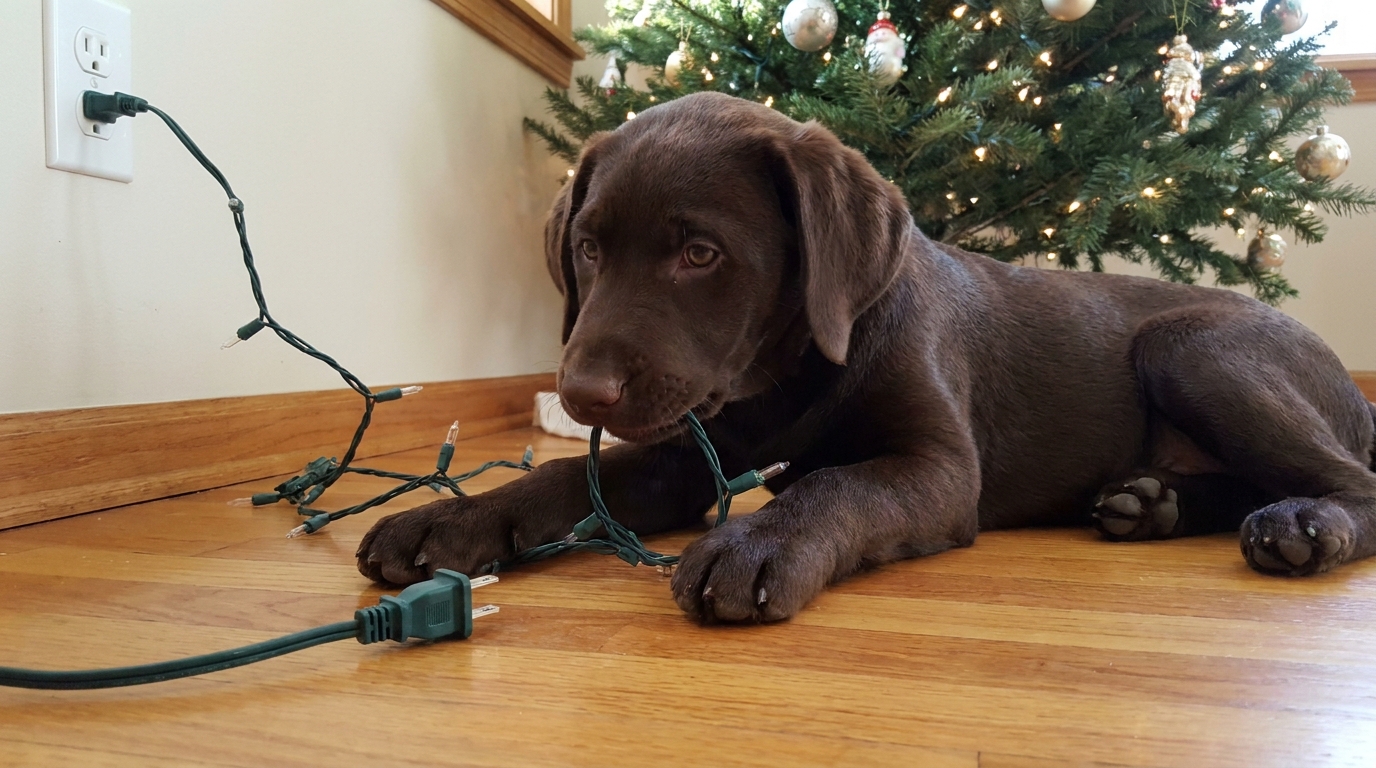
A bitten live cord means power off, then an emergency vet now, even if your dog seems fine. Burn signs, timeline and cord-proofing.
Quick answer: If your dog bit a plugged-in electrical cord or string of lights, switch off the power before touching your dog, then go to an emergency vet now, even if your dog seems fine. MSPCA-Angell says fluid in the lungs "can be delayed up to 12-36 hours," so for several days afterward, go back now for coughing, white or pink foam, labored breathing, blue or gray gums, weakness or collapse.
This article is general information, not a diagnosis. If you think your pet is in danger, go to the nearest emergency animal hospital.
For cats, see why cats chew plastic bags and cords.
What should I do right now if my dog bit a live cord?
Switch off the power at the plug or the breaker before you touch a dog that bit a live cord, then go to an emergency vet now, even if the dog acts normal.
- Hands off. PDSA says not to approach a pet that is still being shocked until the power is off. Stand on a dry floor and don't touch your dog, the cord (other than the plug) or anything wet.
- Cut the power. Pull the plug only if you can reach it without touching your dog, the chewed part or anything wet; otherwise switch off the breaker.
- Never pull your dog off by hand or use anything metal. PDSA says that only if the power truly can't be cut should you separate the pet with a dry, non-conducting pole such as a wooden broom handle.
- Check the nose and mouth. Wipe foam or mucus from the outside with a cloth. Don't put your fingers deep in the mouth, and don't muzzle a dog that is foaming, vomiting or struggling to breathe; a shocked dog may bite. If your dog isn't breathing and has no heartbeat, PetMD says to do CPR and, if it works, go to an emergency vet immediately; PDSA says to call your vet as soon as you start, so have someone call the emergency vet or drive while you do it.
- Go now. MSPCA-Angell says to get veterinary care immediately, regardless of how your dog is acting. Keep your dog warm with a blanket on the way (PDSA), never wait for an unconscious dog to wake up, and tell the vet which cord was chewed.
- Retire the cord. AAHA says chewed cords can cause a shock or a fire, so replace the cord and never plug it back in.
My dog seems fine after chewing a cord. Does it still need the ER?
Yes: a dog that bit a plugged-in cord needs an emergency vet now even if it seems fine, because MSPCA-Angell says fluid in the lungs can show up as late as 12 to 36 hours after the bite. PetMD gives the same 12 to 36 hours and says repeat chest X-rays may be needed. The Merck Veterinary Manual calls electrical injury a true emergency and says complications can develop later, even when the injury looks mild.
If you are not sure the cord was unplugged, use the first row; switched off is not the same as unplugged.
| What happened | Main risk | What to do |
|---|---|---|
| Bit a plugged-in cord | Shock, lung fluid | Power off, ER now |
| Still touching live cord | Active shock | Cut power, then ER |
| Ate coating, cord unplugged | Blockage | Vet in person now |
| Ate wire, sharp bits or unsure | Gut cuts, blockage | ER now |
| Bit a battery or bulb | Burns, cuts | ER now; don't make it vomit |
| Unplugged, nothing missing | Low | Check mouth; watch closely |
What does an electrical burn in a dog's mouth look like?
Electrical burns from a cord bite usually show on a dog's lips, gums or tongue, and MSPCA-Angell says they can look pale yellow, tan or gray. Any burn you can see means the cord was live, so go to an emergency vet now.
- The Merck Veterinary Manual says a burned pet drools heavily, hesitates to eat or drink and resents having its mouth or face touched, and the full damage may take several days to show.
- Lort Smith Animal Hospital lists singed or misshapen whiskers and facial swelling, and Merck says facial swelling can cause breathing distress, so either one means an emergency vet now.
Don't put anything on or in a burned mouth at home; the vet who examines your dog decides on care. PetMD says mouth burns may take 10 to 14 days or longer to heal. Merck also says teeth may later discolor or break, and some cord chewers develop an opening that lets food or water come out of the nose; both mean a vet visit, and so does new sneezing while eating or drinking.
What are the signs of electrocution and lung fluid in a dog?
Coughing, white or pink foam from the nose or mouth, labored breathing and blue or gray gums are the lung-fluid signs MSPCA-Angell lists after a cord bite, and any one of them means an emergency vet now.
Other signs of electrocution that mean an emergency vet now:
- Agitation, not settling, weakness, collapse, or pale or gray gums (MSPCA-Angell's heart-rhythm signs, which need an EKG)
- A rapid breathing rate, muscle spasms or rigidity (Lort Smith Animal Hospital)
- Seizures, unconsciousness, vomiting or belly pain (MSPCA-Angell)
- New wobbliness, weak legs, trouble seeing or dullness
After a cord bite, any faster or harder breathing means an emergency vet now, not a count at home. For ordinary days, see how to count your dog's breathing at rest.
Your dog goes to an emergency vet now first; this table is what to watch for after that visit.
| When | Watch for | Action |
|---|---|---|
| Up to 12-36 hours | Cough, white or pink foam | Go back now |
| Several days | Fast or hard breathing | Go back now |
| Any time | Pale gums, weak, collapse | Go back now |
| Next few days | Mouth looks worse | Call vet today |
| About 2 weeks | Mouth healing | Soft food only |
| Weeks later | Food from nose | Vet visit |
What if my dog chewed an unplugged cord or swallowed wire?
A cord that was unplugged from the wall and not attached to a battery cannot shock a dog, but swallowed pieces can still block or cut the gut, so plastic coating alone means a vet in person now for X-rays and bare wire or a sharp piece means an emergency vet now.
- Not sure it was unplugged? Treat it as plugged in and go to an emergency vet now. A device switched off but still plugged into the wall counts as live.
- Plastic coating only, cord unplugged the whole time, dog acting normally: X-rays now, at your own vet if they can see your dog right away, otherwise an emergency vet.
- Bare wire, a sharp piece, a plug prong, or you can't tell what is missing: emergency vet now.
- Any vomiting, not eating, belly pain, pale gums or weakness after a possible swallow: emergency vet now.
- Unplugged the whole time and no piece is missing: check the lips, gums and tongue and watch closely. Any burn, drooling or trouble eating means the cord may have been live: emergency vet now.
Never make your dog vomit at home after chewing a cord. For the signs to watch after a swallow, see intestinal blockage in dogs.
Christmas lights, light-up toys and batteries
A dog that chewed a plugged-in string of Christmas lights has bitten a live cord: switch off the power first, then go to an emergency vet now, even if your dog seems fine. A bitten bulb or swallowed bulb glass also means an emergency vet now; don't make your dog vomit.
Pet Poison Helpline says a dog that ate a battery needs immediate veterinary care, so a dog that bit or swallowed a battery from lights, a light-up toy, a remote, a phone or a power bank needs an emergency vet now, even if it seems fine; mouth ulcers may not show for hours. For the full steps, see what to do if your dog ate a battery.
For the rest of the tree, see whether Christmas trees are toxic to dogs, and if your dog swallowed ribbon or decoration string, see what to do after a dog eats string, tinsel or ribbon.
What will the emergency vet do?
A dog that bit a live cord can expect a mouth and chest exam at the emergency vet, and MSPCA-Angell says the tests recommended include chest X-rays, full bloodwork and an EKG. X-rays look for lung fluid and the EKG checks heart rhythm; PetMD also lists urine testing and blood pressure.
MSPCA-Angell says treatment ranges from outpatient care to a hospital stay with oxygen, IV fluids and intensive monitoring, and PetMD says a dog may stay in the hospital two to three days while the vet watches for lung fluid or rhythm problems. MSPCA-Angell says animals with only mouth burns or mild signs have a good outcome, while survival is between 40% and 85% for those that develop lung fluid. For dogs under treatment, PetMD says a dog that survives the first 24 to 48 hours is likely to survive without permanent effects, but keep watching at home. Merck adds that nerve signs can last days, weeks or for good.
After discharge, MSPCA-Angell advises soft food, treats and toys only for 2 weeks, close watching and restricted activity for 2-3 days, a recheck with repeat chest X-rays if your vet advises one, and seeing a vet immediately if your dog declines or shows new signs.
Why do puppies chew cords, and how do I cord-proof the house?
MSPCA-Angell says young dogs and cats aged 8 weeks to 2 years are more commonly affected by cord injuries because they treat cords as chew toys, so unplug, cover or lift every cord a puppy can reach. The Merck Veterinary Manual says chewing electrical cords is the most common cause of electrical injury in small animals, and VCA says teething dogs are 3 to 6 months old. MSPCA-Angell and PetMD name phone chargers, Christmas lights, fans, TVs and computers among risky cords, and Merck says there may be a seasonal pattern tied to holiday lights.
- Unplug chargers, appliances and electronics that aren't in use, and wrap and tuck cords out of reach (PetMD).
- Hide cords in commercial cord protectors, run them behind or under furniture, and close off rooms with pet gates (AAHA).
- When you can't supervise, keep your puppy in its bed, crate or a room with appealing chew and feeding toys (VCA).
- Put a bitter anti-chew spray on cords as a taste deterrent (VCA).
When a video visit helps and when to go in person
A dog that bit a plugged-in or possibly live cord needs an emergency vet now, even if the dog seems fine, not a video visit: switch off the power first (at the breaker if you can't reach the plug safely), then go.
RexVet, a nonprofit online vet service, serves pets located in Florida, New York and Virginia by video visit. A $64.99 live video visit with a licensed RexVet vet (a veterinarian licensed in your pet's state) can fit when a slot is open (usually about 8 AM to 11 PM ET; holiday hours may differ). Video fits in three cases:
- The cord was unplugged from the wall the whole time and not attached to a battery, no piece of it is missing, and your dog is eating, breathing and acting normally. If you are not sure it was unplugged, treat it as live and go to the ER now.
- After an ER discharge, for questions about eating, soft food and how the mouth looks while it heals. Your ER or regular vet stays the first call for the recheck, and recheck chest X-rays happen in person.
- A puppy that keeps chewing cords and needs a chewing and cord-proofing plan.
On camera, the veterinarian can look at the lips, gums and tongue and watch breathing and energy, and they will tell you if your dog needs an in-person exam or X-rays. A video visit can't X-ray, run an EKG or bloodwork, give oxygen or treat a cord burn, so it can't rule out a burn, lung fluid or a swallowed piece. Any new or worse sign after discharge (coughing, foam, faster or harder breathing, a change in gum color, weakness, not eating or drinking) means back to the emergency vet now, not a video visit.
Go to an emergency vet now instead, even if your dog seems fine, for any bite on a plugged-in or possibly live cord; any mouth burn (pale yellow, tan or gray patches), drooling, trouble eating or refusing food after chewing a cord, even days later; coughing, white or pink foam, fast or labored breathing, or blue, gray or pale gums; weakness, restlessness or not settling, muscle spasms, collapse, seizure or unconsciousness; any vomiting; or swallowed bare wire, a sharp piece, a battery or bulb glass. Never make your dog vomit. Outside those hours, when no slot is open, or if your dog gets worse while you wait, go to an emergency vet.
A dog with a cord burn needs an in-person exam first, and the vet who examines your dog decides on any treatment. No prescription is promised; the veterinarian decides whether any medicine is appropriate. Florida limits video-only prescriptions to FDA-approved animal drugs used as labeled, for up to 14 days (1 month for products labeled only for fleas and ticks), with no renewal without an in-person exam; human-labeled drugs, controlled drugs and compounded anti-infectives need an in-person exam first. Federal rules require a recent in-person exam for any off-label or human-drug use. Virginia allows the veterinarian's exam to be electronic; New York's rules for video-only prescribing are still unsettled. RexVet is not a pharmacy; if a prescription is sent to an outside pharmacy, a pharmacy transfer fee applies.
Need an Expert Opinion on This Topic?
Book a video visit with a licensed vet, evenings and weekends included
See open timesFrequently Asked Questions
Can a dog survive chewing an electrical cord?
Yes, often: MSPCA-Angell says dogs with only mouth burns or other mild signs have a good outcome. Survival falls to between 40% and 85% in dogs that develop fluid in the lungs, and most dogs that go into cardiac arrest or lose consciousness do not survive, so any bite on a plugged-in cord means an emergency vet now.
How long after a dog chews a cord do symptoms show up?
Collapse or seizures can start at once, but MSPCA-Angell and PetMD both say lung fluid can take 12 to 36 hours to develop. The Merck Veterinary Manual says mouth burn damage can take several days to fully show, so go to an emergency vet now, then watch breathing closely for several days.
Can a phone charger shock my dog?
Yes, a plugged-in phone charger is a live cord, and MSPCA-Angell and PetMD both list phone chargers among the cords that put pets at risk. Switch off the power and go to an emergency vet now, even if your dog seems fine. A chewed-open phone or power bank is also a battery emergency: ER now, and don't make your dog vomit.
My dog chewed a cord but I didn't see a shock. Is it still an emergency?
Yes, if the cord was plugged in or you are not sure, go to an emergency vet now. PetMD says electrocution can be hard to spot unless you saw it, and the Merck Veterinary Manual says young pets with unexplained labored breathing should be checked for mouth burns from chewing cords.
Do cats get the same injury from chewing electrical cords?
Yes: MSPCA-Angell says young dogs and cats aged 8 weeks to 2 years are more commonly affected. A cat that bit a plugged-in cord needs the same steps: power off, then an emergency vet now, even if the cat seems fine. The guide to why cats chew plastic bags and cords covers cat signs and cord-proofing.
When should I take my dog back to the vet after the ER visit for a cord bite?
Go back to the emergency vet now for any new or worse sign during the several days MSPCA-Angell says to watch breathing closely. That means coughing, white or pink foam, fast or labored breathing, blue, gray or pale gums, weakness or collapse. Keep any recheck your ER advises, including repeat chest X-rays.
Can an online vet help after my dog chewed a cord in Florida, New York or Virginia?
Not for a plugged-in or possibly live cord: go to an emergency vet now. For a dog located in Florida, New York or Virginia, a licensed RexVet vet can check lips, gums, tongue and breathing on camera after an unplugged-cord chew with no piece missing, or after ER discharge. X-rays, an EKG and burn care need an in-person visit, and a cord burn needs an in-person exam before any medicine; state and federal rules limit video-only prescriptions.
FAQs
Can a dog survive chewing an electrical cord?
Yes, often: MSPCA-Angell says dogs with only mouth burns or other mild signs have a good outcome. Survival falls to between 40% and 85% in dogs that develop fluid in the lungs, and most dogs that go into cardiac arrest or lose consciousness do not survive, so any bite on a plugged-in cord means an emergency vet now.
How long after a dog chews a cord do symptoms show up?
Collapse or seizures can start at once, but MSPCA-Angell and PetMD both say lung fluid can take 12 to 36 hours to develop. The Merck Veterinary Manual says mouth burn damage can take several days to fully show, so go to an emergency vet now, then watch breathing closely for several days.
Can a phone charger shock my dog?
Yes, a plugged-in phone charger is a live cord, and MSPCA-Angell and PetMD both list phone chargers among the cords that put pets at risk. Switch off the power and go to an emergency vet now, even if your dog seems fine. A chewed-open phone or power bank is also a battery emergency: ER now, and don't make your dog vomit.
My dog chewed a cord but I didn't see a shock. Is it still an emergency?
Yes, if the cord was plugged in or you are not sure, go to an emergency vet now. PetMD says electrocution can be hard to spot unless you saw it, and the Merck Veterinary Manual says young pets with unexplained labored breathing should be checked for mouth burns from chewing cords.
Do cats get the same injury from chewing electrical cords?
Yes: MSPCA-Angell says young dogs and cats aged 8 weeks to 2 years are more commonly affected. A cat that bit a plugged-in cord needs the same steps: power off, then an emergency vet now, even if the cat seems fine. The guide to why cats chew plastic bags and cords covers cat signs and cord-proofing.
When should I take my dog back to the vet after the ER visit for a cord bite?
Go back to the emergency vet now for any new or worse sign during the several days MSPCA-Angell says to watch breathing closely. That means coughing, white or pink foam, fast or labored breathing, blue, gray or pale gums, weakness or collapse. Keep any recheck your ER advises, including repeat chest X-rays.
Can an online vet help after my dog chewed a cord in Florida, New York or Virginia?
Not for a plugged-in or possibly live cord: go to an emergency vet now. For a dog located in Florida, New York or Virginia, a licensed RexVet vet can check lips, gums, tongue and breathing on camera after an unplugged-cord chew with no piece missing, or after ER discharge. X-rays, an EKG and burn care need an in-person visit, and a cord burn needs an in-person exam before any medicine; state and federal rules limit video-only prescriptions.
Medically Reviewed
Reviewed by Dr. Tiffany Delacruz, DVM — licensed veterinarian and CEO of RexVet. Last reviewed November 5, 2026.
Content is for informational purposes and does not replace professional veterinary advice.
Chief Executive Officer · Licensed Veterinarian
Dr. Delacruz is a licensed Doctor of Veterinary Medicine specializing in preventive care and veterinary telehealth. She reviews all health content on RexVet to ensure accuracy and clinical relevance.
Sources & References
- · American Veterinary Medical Association — Telehealth Guidelines
- · AVMA — Pet Care Resources
- · U.S. FDA — Animal & Veterinary