
Dog Ate a Battery? AA, Button or Coin Cell: What to Do
By RexVet Team | Reviewed by Dr. Tiffany Delacruz, DVM
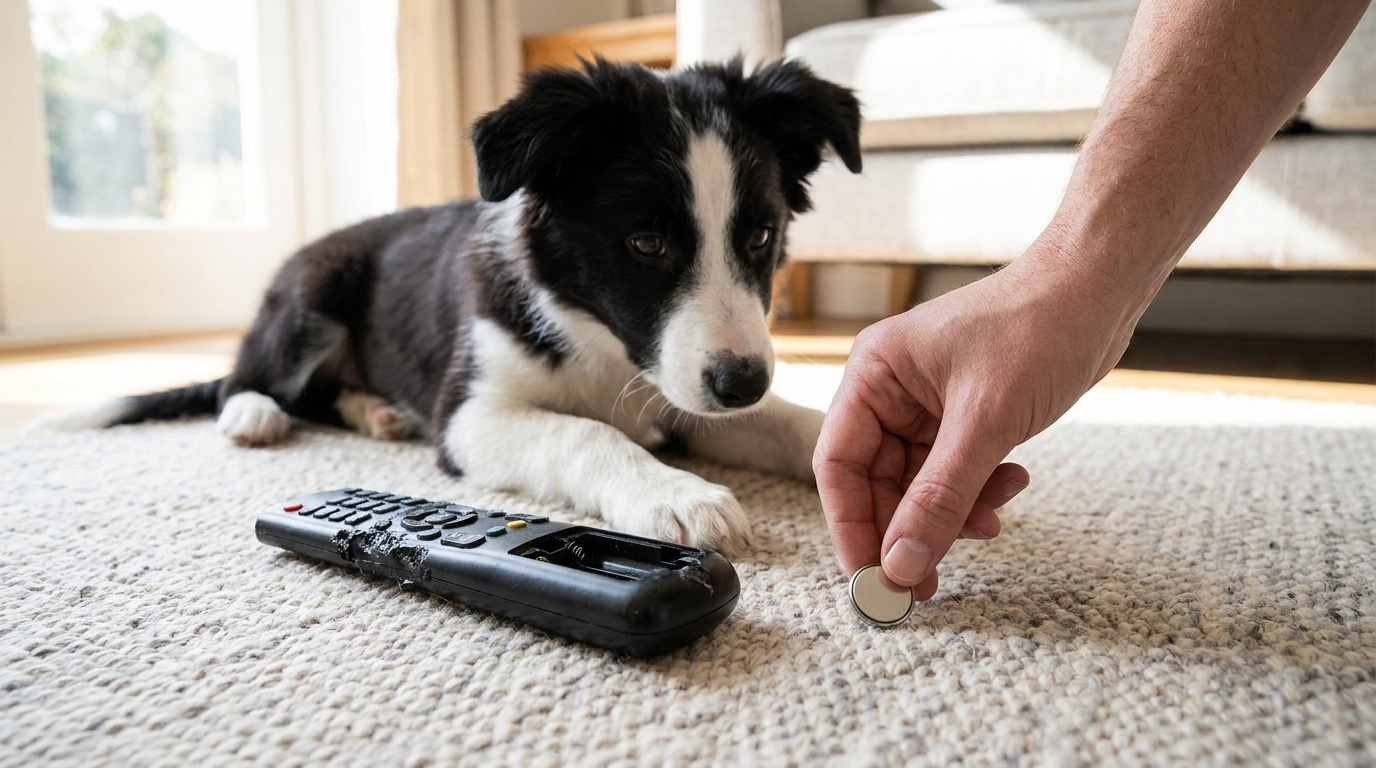
Any chewed, swallowed or missing battery means an emergency vet now. Which types are worst, the signs, and what never to do at home.
Quick answer: A dog that chewed, swallowed or may have swallowed a battery needs an emergency vet now, even with no signs; call a poison line on the way, not instead of going, and never make your dog vomit. Pet Poison Helpline says a 3-volt lithium button battery can severely burn the food pipe within 15 to 30 minutes, and the ASPCA says the full injury may not show for 24 hours.
This article is general information, not a diagnosis. If you think your pet is in danger, go to the nearest emergency animal hospital.
What should I do right now if my dog ate a battery?
A dog that chewed, swallowed or may have swallowed a battery needs an emergency vet now, even if it seems fine: move the other batteries and the device out of reach, leave right away, and call a poison line on the way, never instead of going.
- Move the other batteries and the device out of reach, which is the ASPCA's first step.
- No fingers down the throat and no blind finger sweeps.
- Do not make your dog vomit, and give no food, treats, honey, charcoal or medicine; rinse or offer water or milk only as described below or as the poison line says.
- Grab the device or packaging on the way out so the vet can tell a lithium coin cell from an alkaline cell; photograph a chewed phone, power bank or vape instead; never delay leaving to find it.
- Count the batteries against the compartment, and note the type, size, chewed or whole, and the time.
- Have a passenger call while you drive. If you are alone, keep any call short and never wait at home for a callback.
On the way to the emergency vet, call ASPCA Animal Poison Control at (888) 426-4435 (a consultation fee may apply) or Pet Poison Helpline at (855) 764-7661 (a per-incident fee applies).
Which batteries are most dangerous: AA, button or coin cell?
Button and coin-cell batteries are the most dangerous for dogs, because Pet Poison Helpline says one stuck in the food pipe burns tissue by an electrochemical effect even when it is not leaking, while chewed AA, AAA, C, D and 9-volt batteries mainly burn by leaking caustic fluid and can also block the gut.
| Battery type | Main harm | What to do |
|---|---|---|
| AA, AAA, C, D | Leak burns, blockage | ER now |
| 9-volt | Leak burns | ER now |
| Button or coin cell | Lodges, burns | ER now, even intact |
| Hearing aid cell | Lodges, burns | ER now |
| Phone, power bank | Burns, fire | Make safe; ER now |
| Vape pen | Burns, nicotine | ER now; tell poison line |
Most household batteries are alkaline dry cells, which Pet Poison Helpline says contain potassium or sodium hydroxide; the ASPCA says a chewed one leaks a caustic substance that can burn the mouth, esophagus or stomach, and a swallowed one can block the intestines.
The ASPCA says button-sized batteries can lodge in the esophagus and burn even when intact, and the Merck Veterinary Manual says a lodged disc battery creates an electrical current that leaves circular ulcers, which can perforate. Pet Poison Helpline says one 3-volt lithium button battery can cause severe tissue death within 15 to 30 minutes of contact, and treats any size of disc battery as suspect in pets.
For a chewed phone, power bank or vape pack, NFPA says damaged lithium-ion batteries are more likely to overheat, catch fire or explode. New York State's Division of Homeland Security and Emergency Services advises, only if it is safe, using tongs or gloves to move a failing pack away from anything that can burn, and calling 911 from outside if it is smoking.
My dog bit or swallowed a battery and seems fine. Is that OK?
No, a dog that bit, chewed or swallowed a battery needs an emergency vet now even if it seems fine, because Pet Poison Helpline says mouth ulcers may not show for hours.
A dvm360 toxicology case notes the food pipe can be ulcerated when the mouth has no ulcers, and Pet Poison Helpline says vets X-ray to find any unattached battery pieces.
| Situation | Risk | Action |
|---|---|---|
| Bit it, spat it out | Mouth burns | ER now |
| Swallowed whole | Lodges, burns | ER now |
| Battery missing | Unknown | ER for X-ray |
| Fluid on fur or skin | Skin, mouth burns | Rinse; ER now |
| Black powder in mouth | Leaked cell | Rinse; ER now |
| Coughing or gagging | Stuck, inhaled | ER now |
Rinse only when fluid or black powder is visible in the mouth or on fur or skin, which a dog will lick; skip rinsing the mouth of a dog that is coughing, gagging, retching or struggling to breathe, and just go. Use plain lukewarm water, never vinegar, lemon juice or baking soda, and keep the head tilted down so the water runs out and not down the throat; never let rinsing delay leaving. Pet Poison Helpline says immediate veterinary attention is required after that first flush. For fluid in or near the eyes, rinse with lukewarm water and see a vet now.
Should I make my dog throw up after eating a battery?
No, never make a dog vomit at home after any battery, because Pet Poison Helpline says the corrosive contents can damage the food pipe further; only a vet who has taken X-rays can decide how a battery comes out.
That covers hydrogen peroxide, salt, fingers and every other home method. The guide on when making a dog throw up helps and when it harms lists any battery as a "no, ER now" case.
Can I give my dog milk, water or honey?
After eating a battery, a dog should get no honey, food, treats or home remedies; call a poison line on the way to the emergency vet and follow what it says about rinsing the mouth or offering water or milk.
The ASPCA says that if a pet has no symptoms yet and the exposure just happened, you can offer a small drink of milk or water; if you do, offer it as you leave for the emergency vet, never force it, never give it to a dog that is drooling, gagging or retching, and call the poison line on the way.
Honey advice you may see online comes from the National Capital Poison Center's guidance for children; pet battery guidance from the ASPCA and Pet Poison Helpline does not include it, so do not give honey to a pet. Activated charcoal does not help either, ASPCA Poison Control's guidance for veterinarians says, because alkalis are not absorbed.
What are the signs of battery burns in dogs?
The main signs of battery burns in a dog are drooling, pawing at the mouth, refusing food, bad breath, gray or bright red mouth sores, vomiting, belly pain and fever, but a dog that ate a battery needs an emergency vet now, before any sign appears.
The ASPCA describes belly pain as a hunched back or a dog that cannot lie down and get comfortable. Pet Poison Helpline adds trouble swallowing, red gums, grayish-black material on the teeth, coughing and gagging, then later noisy breathing, vomit like coffee grounds and blood in the stool.
| Sign | May mean | Action |
|---|---|---|
| Drooling, pawing at mouth | Mouth burn | ER now |
| Not eating, hard to swallow | Food pipe burn | ER now |
| Coughing, noisy breathing | Stuck, inhaled | ER now |
| Vomiting, diarrhea, belly pain | Gut burn, blockage | ER now |
| Vomit like coffee grounds, black stool | Gut bleeding | ER now |
| Fever, weakness | Leak or tear | ER now |
| Weeks later: food comes back up | Narrowed pipe | In person today |
Can a dog pass a battery on its own?
A dog should never be left to pass a battery at home unless an emergency vet has taken X-rays and set the plan; a battery stuck in the food pipe has to come out right away.
A vet follows the battery with repeat X-rays and removes it by endoscope or surgery if it is in the food pipe, leaking, or stops moving. Pet Poison Helpline says most swallowed batteries pass without incident, but that is the vet's call after X-rays, never a reason to wait at home. A swallowed battery can also cause an intestinal blockage in dogs.
A dvm360 toxicology case notes zinc or lead may be released if a battery's casing breaks down in the stomach. Never feed bread, pumpkin or fiber to push a battery through; change the diet only if your vet advises it after X-rays.
What will the emergency vet do?
At the emergency vet, a dog that ate a battery usually gets a mouth exam and X-rays of the neck, chest and belly, and a battery that is stuck in the food pipe or leaking is removed by endoscope or surgery.
ASPCA Poison Control's guidance for veterinarians says any battery that cannot be accounted for should be X-rayed, with the neck and chest included for disc batteries. An endoscope is a camera tube passed through the mouth. The ASPCA says cases are much easier to treat when caught early.
Never give a human pain reliever at home after a battery, because ASPCA Poison Control's guidance warns some pain relievers can make battery ulcers worse.
Where do dogs find batteries during the holidays?
During the holidays, dogs find batteries in new toys, remotes, keys, watches, hearing aids, greeting cards and light-up decorations, and Pet Poison Helpline says the holiday season brings more battery exposures in pets.
The ASPCA lists all of these except decorations. Pet Poison Helpline says visitors often leave hearing-aid batteries loose on tables or bedside stands, and that dogs tend to mouth and chew batteries. Flameless candles, kitchen scales and tracker tags use coin cells too.
- Tape shut the battery doors on toys, remotes and decorations.
- Count batteries when you load a device, so a missing one is noticed.
- Keep spare and used batteries in a closed container, up high.
- Ask guests to keep hearing aids and spare cells in a closed case at night.
For tinsel, cords and glass, see Christmas tree dangers for dogs, from needles to ornaments.
My cat bit a battery. Is it the same?
Yes, a cat that bit or swallowed a battery needs an emergency vet now, just like a dog, and a cat should never be made to vomit at home.
The ASPCA says cats seem less interested in batteries than dogs, but for cats that do get into them the concerns, problems and recommendations are the same. Pet Poison Helpline notes that cats are more likely to bat batteries around in play. A missing coin cell in a home with a cat still means the ER for an X-ray. If your cat chews cords or plastic, see why cats chew plastic bags and cords, and when to worry.
When a video visit helps and when it does not
A dog or cat that chewed, swallowed or may have swallowed a battery, including one that has gone missing, needs an emergency vet now, not a video visit, because only an in-person vet can X-ray, find a lodged battery, remove it and check the food pipe for burns; call ASPCA Animal Poison Control at (888) 426-4435 (a consultation fee may apply) or Pet Poison Helpline at (855) 764-7661 (a per-incident fee applies) on the way, never instead of going.
In the weeks after a battery, any drooling, pawing at the mouth, eating less or refusing food or water, trouble swallowing, repeated swallowing or bringing food back up, vomiting (especially vomit that looks like coffee grounds), diarrhea, black or bloody stool, belly pain, fever, breathing trouble, weakness or low energy, or weight loss means calling the ER that treated your pet and going back in person, not booking a video visit. ASPCA Poison Control's guidance for veterinarians says a tear in the gut is a risk 3 to 14 days after exposure and narrowing of the food pipe can take up to 4 to 6 weeks to show, though both are uncommon.
RexVet, a nonprofit online vet service, serves pets located in Florida, New York and Virginia by video visit with a veterinarian licensed in your pet's state. After the ER has examined your pet and sent you home, a live video visit with a licensed RexVet vet can help with later questions: the veterinarian can explain the ER's discharge instructions, help you list questions for the ER, and help you battery-proof the house for the holidays. Follow the ER's feeding instructions and keep every recheck it books in person; a video visit does not replace them. No prescription is promised: any medicine is the veterinarian's decision under your state's rules, and if the ER sent your pet home with medicine, ask the ER or your regular vet about refills. RexVet is not a pharmacy; a pharmacy transfer fee applies when RexVet sends a prescription to an outside pharmacy. Live slots run about 8 AM to 11 PM ET, and a visit is $64.99: book a video visit for after-ER questions.
Need an Expert Opinion on This Topic?
Book a video visit with a licensed vet, evenings and weekends included
See open timesFrequently Asked Questions
Can a dog survive eating a battery?
Yes, the ASPCA says battery ingestion is treatable and much easier to treat when caught early, so go to an emergency vet now. A small experimental 1998 study in Veterinary and Human Toxicology, in which 3-volt lithium coin cells were held in the food pipe of five dogs, found deep tissue damage after 15 minutes.
How long does it take for a dog to pass a battery?
No home timeline is safe: only an emergency vet with X-rays can tell where a swallowed battery is and whether it is moving. The vet removes it by endoscope or surgery if it is in the food pipe, leaking or stops moving.
Is battery acid poisonous to dogs?
Yes. Pet Poison Helpline says most household batteries are alkaline dry cells, so the leaking fluid is usually a strong alkali rather than acid, and it causes corrosive burns; a chewed battery means the ER now. A dvm360 toxicology case notes alkaline burns cause little or no pain at first, so a calm dog is not a safe dog. Car and motorcycle batteries hold real acid and lead.
My dog chewed a lithium-ion battery from a phone, power bank or vape. What should I do?
Make the area safe, then take your dog to an emergency vet now and tell the poison line about any vape. Only if it is safe, use tongs or gloves to move the pack away from anything that can burn, and do not charge or use it; if it is smoking, get everyone outside and call 911. NFPA says damaged lithium-ion batteries are more likely to overheat, catch fire or explode. Pet Poison Helpline calls nicotine a rapidly acting toxin with a narrow safety margin for pets.
My dog chewed the remote or a toy and a battery is missing. Do I still need to go to the vet?
Yes. A battery missing from a chewed remote or toy means an emergency vet visit for X-rays, even if your dog seems fine, because ASPCA Poison Control's guidance for veterinarians says any battery that cannot be accounted for should be X-rayed. Take the device, skip searching the house, and never make your dog vomit to check.
How soon do battery burns show up in a dog?
Never wait for burns to show: a dog that chewed or swallowed a battery needs an emergency vet now. Pet Poison Helpline says a 3-volt lithium button battery can severely burn the food pipe within 15 to 30 minutes and mouth ulcers may not be visible for hours, while the ASPCA says the full injury may not show for 24 hours. After discharge, any new sign means going back to the ER.
Can an online vet help if my dog ate a battery and we live in Florida, New York or Virginia?
No: a dog or cat that chewed or swallowed a battery needs an emergency vet now in all three states. A video visit cannot X-ray, find or remove a battery. For a pet located in Florida, New York or Virginia, a video visit fits only after the ER has sent your pet home, to go over discharge instructions and battery-proofing; any new sign means back to the ER. No prescription is promised. In Florida, a prescription based only on a video visit must be an FDA-approved animal drug used as labeled, for up to 14 days (up to 1 month for products labeled only for flea and tick control), with no renewal without an in-person exam, and human-labeled, controlled and compounded anti-infective drugs need an in-person exam. Federal rules (21 CFR 530.3) require a vet who has examined the pet for extralabel use, including human drugs. Virginia allows an electronic exam, but that does not make a battery a video-visit case. New York's telehealth prescribing rules are not settled, so the veterinarian decides.
FAQs
Can a dog survive eating a battery?
Yes, the ASPCA says battery ingestion is treatable and much easier to treat when caught early, so go to an emergency vet now. A small experimental 1998 study in Veterinary and Human Toxicology, in which 3-volt lithium coin cells were held in the food pipe of five dogs, found deep tissue damage after 15 minutes.
How long does it take for a dog to pass a battery?
No home timeline is safe: only an emergency vet with X-rays can tell where a swallowed battery is and whether it is moving. The vet removes it by endoscope or surgery if it is in the food pipe, leaking or stops moving.
Is battery acid poisonous to dogs?
Yes. Pet Poison Helpline says most household batteries are alkaline dry cells, so the leaking fluid is usually a strong alkali rather than acid, and it causes corrosive burns; a chewed battery means the ER now. A dvm360 toxicology case notes alkaline burns cause little or no pain at first, so a calm dog is not a safe dog. Car and motorcycle batteries hold real acid and lead.
My dog chewed a lithium-ion battery from a phone, power bank or vape. What should I do?
Make the area safe, then take your dog to an emergency vet now and tell the poison line about any vape. Only if it is safe, use tongs or gloves to move the pack away from anything that can burn, and do not charge or use it; if it is smoking, get everyone outside and call 911. NFPA says damaged lithium-ion batteries are more likely to overheat, catch fire or explode. Pet Poison Helpline calls nicotine a rapidly acting toxin with a narrow safety margin for pets.
My dog chewed the remote or a toy and a battery is missing. Do I still need to go to the vet?
Yes. A battery missing from a chewed remote or toy means an emergency vet visit for X-rays, even if your dog seems fine, because ASPCA Poison Control's guidance for veterinarians says any battery that cannot be accounted for should be X-rayed. Take the device, skip searching the house, and never make your dog vomit to check.
How soon do battery burns show up in a dog?
Never wait for burns to show: a dog that chewed or swallowed a battery needs an emergency vet now. Pet Poison Helpline says a 3-volt lithium button battery can severely burn the food pipe within 15 to 30 minutes and mouth ulcers may not be visible for hours, while the ASPCA says the full injury may not show for 24 hours. After discharge, any new sign means going back to the ER.
Can an online vet help if my dog ate a battery and we live in Florida, New York or Virginia?
No: a dog or cat that chewed or swallowed a battery needs an emergency vet now in all three states. A video visit cannot X-ray, find or remove a battery. For a pet located in Florida, New York or Virginia, a video visit fits only after the ER has sent your pet home, to go over discharge instructions and battery-proofing; any new sign means back to the ER. No prescription is promised. In Florida, a prescription based only on a video visit must be an FDA-approved animal drug used as labeled, for up to 14 days (up to 1 month for products labeled only for flea and tick control), with no renewal without an in-person exam, and human-labeled, controlled and compounded anti-infective drugs need an in-person exam. Federal rules (21 CFR 530.3) require a vet who has examined the pet for extralabel use, including human drugs. Virginia allows an electronic exam, but that does not make a battery a video-visit case. New York's telehealth prescribing rules are not settled, so the veterinarian decides.
Medically Reviewed
Reviewed by Dr. Tiffany Delacruz, DVM — licensed veterinarian and CEO of RexVet. Last reviewed November 5, 2026.
Content is for informational purposes and does not replace professional veterinary advice.
Chief Executive Officer · Licensed Veterinarian
Dr. Delacruz is a licensed Doctor of Veterinary Medicine specializing in preventive care and veterinary telehealth. She reviews all health content on RexVet to ensure accuracy and clinical relevance.
Sources & References
- · American Veterinary Medical Association — Telehealth Guidelines
- · AVMA — Pet Care Resources
- · U.S. FDA — Animal & Veterinary