
Dog Ate a Whole Bag of Dog Food? What to Watch Tonight
By RexVet Team | Reviewed by Dr. Tiffany Delacruz, DVM
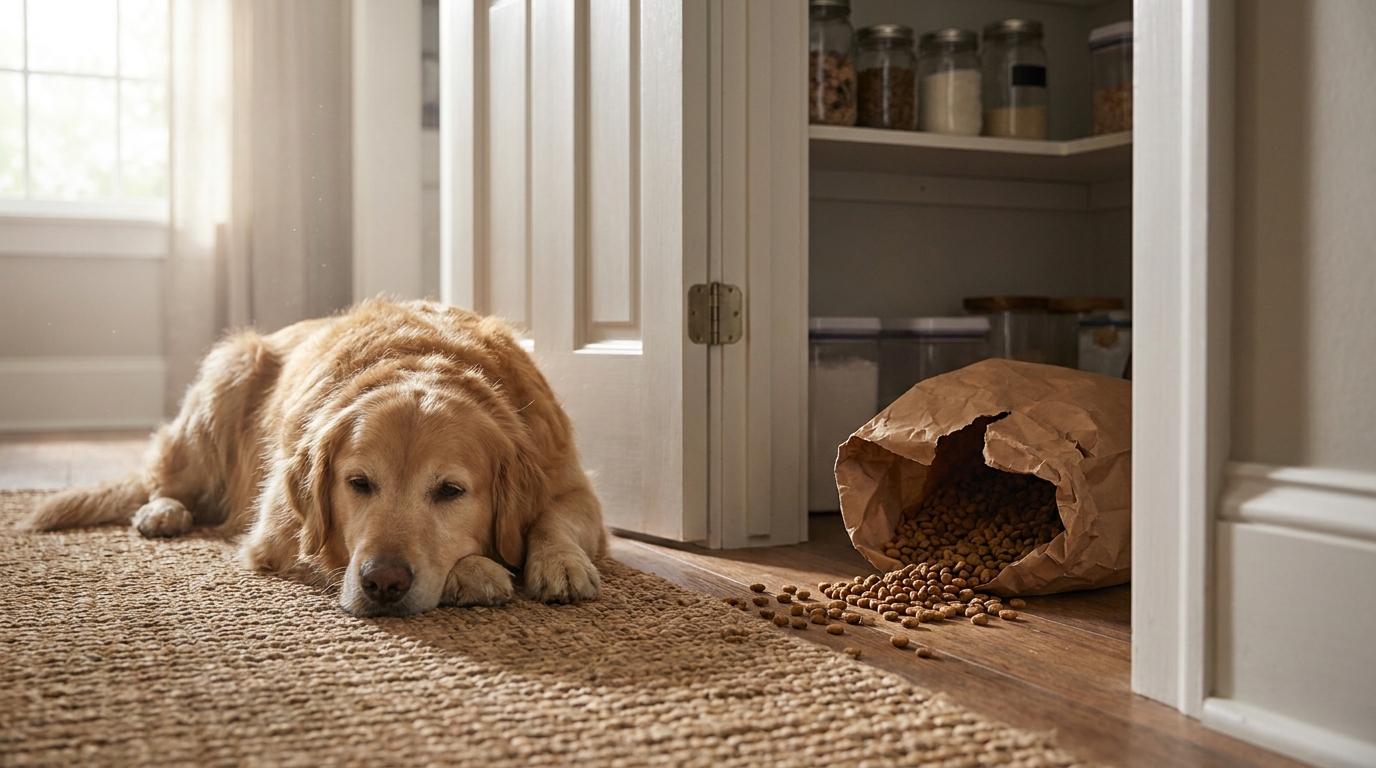
Dog ate a whole bag of dog food? Keep them calm and watch the belly. Dry retching, pacing or a hard, growing belly means an ER now.
Go to an emergency vet now if your dog retches or tries to vomit with nothing coming up, has a belly that is tight, hard, painful or getting bigger, paces and can't settle, drools heavily, has pale gums, breathes hard, is weak or collapses, or also swallowed chocolate, grapes, medications or the bag itself.
Dog ate a whole bag of dog food: why a stuffed stomach is a worry
A stomach this full can stretch, and the real danger is a stretched stomach twisting, a condition called gastric dilatation-volvulus, or GDV.
On its page about GDV, the American College of Veterinary Surgeons (ACVS) writes: "The condition is multifactorial but is commonly associated with rapid ingestion of large meals." The same page explains that "The presence of food and gas causes the stomach to significantly dilate and expand," which, the page says, may have several severe consequences.
A stretched stomach does not always twist. VCA Animal Hospitals notes in its article on bloat and GDV in dogs: "Sometimes, the condition progresses no further than a bloat." That means the stomach fills and stretches (gastric dilatation) without twisting, and you cannot tell which is happening by looking.
On timing, VCA adds: "The condition has been reported to most commonly occur shortly after eating a large meal, although bloat and GDV can occur at any time."
Cornell notes that "Large, deep-chested dogs are most at risk." VCA adds: "However, any dog can bloat, even dachshunds and chihuahuas."
The hours after the raid are the ones to watch, and the rest of this guide tells you what to look for. You can also read more about the signs of a bloated stomach in dogs.
Emergency signs: go to an ER now, not a video call
Cornell's Riney Canine Health Center puts it plainly in its guide to when to go to the ER: "A swollen belly paired with retching but no vomit may mean bloat (gastric dilatation-volvulus or GDV), which can be a life-threatening emergency."
Go to an emergency vet now, not a video call, if you see any of these:
- Dry retching, or trying to vomit with nothing coming up
- A belly that is tight, hard, painful or getting bigger
- Pacing, or being unable to lie down and settle
- Heavy drooling
- Pale gums
- Hard or fast breathing
- Weakness or collapse
- The "praying" stance, with the front legs stretched forward and the chest low to the ground
- Chocolate, grapes, medications or anything else toxic swallowed too, or pieces of the bag itself missing
Cornell's GDV page lists signs including "Pale gums," "Restlessness, pacing" and "Weakness or collapse," and VCA's list includes dogs that "Retch without producing anything" or "Collapse or be unable to stand."
The Merck Veterinary Manual advises: "Immediately seek veterinary care if your dog exhibits signs of bloat; doing so can improve its chance of survival." ACVS adds: "Stabilization and surgery are best when performed early in the course of the disease since death (mortality) rates increase with the severity of disease."
Food bloat or a twisted stomach? Why nobody can tell by looking
According to VCA, "GD and GDV often look identical on physical examination." VCA also says: "X-rays and other diagnostic tests are necessary to determine if the stomach has twisted."
The Merck Veterinary Manual's guide to stomach and intestine disorders in dogs describes the classic picture: "Dogs with bloat commonly have eaten a large meal followed by exercise and repeated, unsuccessful attempts to vomit." It adds: "Signs of bloat may include restlessness, apparent discomfort, rapid breathing, abdominal pain and swelling, repeated dry retching, and excessive drooling."
Since nobody can tell the two apart at home, use one line to decide what to do tonight:
- Watch closely at home, and a vet can look by video, if the belly looks full but feels soft, your dog lies down and settles, the gums are pink, there is no retching, pacing, drooling, hard breathing, weakness, collapse or "praying" stance, and you are sure nothing toxic and no bag pieces were swallowed.
- Go to an emergency vet now if the belly is tight, hard, painful or getting bigger, if your dog can't settle, retches, drools, has pale gums, breathes hard, is weak or collapses, or takes the "praying" stance, or if anything toxic or bag pieces may have been swallowed.
If you are not sure which one you are looking at, go to an emergency vet now. A calm, settled dog is not a guarantee, which is why you keep watching through the night.
What to do in the next few hours
- Pick up the rest of the food and close the bin or the pantry door.
- Keep your dog calm and quiet: no running, fetch or rough play. Merck advises that "Excessive exercise should be avoided, especially after eating, to decrease the likelihood of bloat," and Cornell says to "Limit activity after meals."
- Keep potty trips short and calm, on a leash.
- Don't let your dog gulp a huge bowl of water all at once. VCA notes that "Exercise after eating a large meal or drinking large amounts of water may increase risk." Ask a veterinarian how to offer water.
- Don't feed another meal until a vet has told you when and how much.
- Don't try to make your dog vomit, and don't give any human medicine or gas remedy.
- Check on your dog every so often. Look at the belly from above and from the side, feel gently whether it is soft or tight, check the gums in good light, and watch whether your dog lies down and settles. If you see anything from the emergency list, go to an emergency vet now.
- Take a short video of your dog breathing, walking and lying down, and a photo of the torn bag with its label.
Check what else was in the bag
Treat bags, a pantry raid or a trash raid can hide other hazards, so check what else your dog got into. Cornell notes: "If your dog has eaten something toxic (such as chocolate, grapes, or medications) or something that could cause a blockage (like a toy or sock), you often need to act quickly."
If chocolate, grapes, raisins, xylitol, medications or anything else toxic may be involved, call ASPCA Animal Poison Control at (888) 426-4435 or Pet Poison Helpline at (855) 764-7661 (both 24/7; a fee may apply), or go straight to an emergency vet now.
If chunks of the plastic or paper bag are missing, treat it as a possible blockage and go to an emergency vet now. You can read more later about whether swallowed wrappers can cause a blockage.
If the bag held rich treats or fatty food, VCA notes that pancreatitis "may be triggered in some cases by a fatty meal," with signs including "nausea, vomiting, fever, lethargy, abdominal pain, diarrhea, and decreased appetite." A painful belly, repeated vomiting or diarrhea, heavy drooling, weakness or collapse means an emergency vet now. See a vet in person soon if your dog stays off food but is otherwise bright and has no emergency signs. Our guide explains when to worry about pancreatitis after a fatty snack.
What a RexVet online vet can and cannot do when your dog ate a whole bag of dog food
A video visit fits only the dog on the watch-at-home side of the line above, with none of the emergency signs. RexVet's veterinarians are licensed in Florida, New York and Virginia and are available 24/7.
On a video visit, a veterinarian can:
- Look at the belly from above and the side, plus breathing, gum color and posture
- Watch your dog walk and try to lie down
- Guide you through gently feeling whether the belly is soft or tight
- Go over what was in the bag, how much is missing and when it happened
- Tell you right away if anything they see points to the ER
- If nothing does, give you a clear plan for the night: what to watch for, water, rest and when to feed again
A video visit cannot take x-rays, pass a stomach tube, empty the stomach or operate, and it cannot rule out a twisted stomach. A belly that is tight, hard, painful or getting bigger, or any other emergency sign, skips the video call and goes to the ER.
If the veterinarian decides medication is appropriate, they can prescribe where state rules allow. In Florida, a veterinarian who has seen your pet only by video may prescribe only FDA-approved animal drugs used as labeled, for up to 14 days (1 month for flea-and-tick-only products), and cannot renew without an in-person exam.
If your dog is lying down and settling, the belly looks full but feels soft, the gums are pink, there is no retching, pacing, drooling, hard breathing, weakness, collapse or "praying" stance, and you are sure nothing toxic and no bag pieces were swallowed, you can book a RexVet video visit tonight. A visit is $64.99, vets are available 24/7, and visits are for pet parents in Florida, New York and Virginia.
The next day: what to keep watching for
Cornell's ER guide notes that "repeated episodes of vomiting or diarrhea in a 24-hour period, especially with signs like blood, lethargy, or refusal to eat, can signal more serious issues." If you see repeated vomiting or diarrhea, go to an emergency vet now.
Keep watching for the pancreatitis signs VCA lists above. A painful belly, heavy drooling, weakness or collapse, the "praying" stance, retching with nothing coming up, or a belly that turns tight, hard or bigger, at any point, means an emergency vet now.
How to stop the next raid, and when to be seen in person in Florida, New York or Virginia
Store food in a sealed bin behind a closed door or up high, and don't leave bags on the floor. Feed measured meals.
If you have a large, deep-chested dog, ask your regular vet about bloat prevention, since Cornell names these dogs as most at risk.
Go to an emergency vet in person now for any emergency sign above, for repeated vomiting or diarrhea, and for swallowed packaging or a possible toxin. See a vet in person soon if your dog stays off food but is otherwise bright and has none of these signs.
Under Florida law (Fla. Stat. 474.2021), when a vet's first evaluation of your pet is done by telehealth, the vet must give you a statement that includes "the contact information for at least one physical veterinary clinic in the vicinity of the patient's location" along with other details.
If your dog is lying down and settling, with a belly that looks full but feels soft, pink gums and no retching, pacing, drooling, hard breathing, weakness, collapse or "praying" stance, and you are sure nothing toxic and no bag pieces were swallowed, you can book a RexVet video visit. RexVet's veterinarians are licensed in Florida, New York and Virginia and are available 24/7, and a visit is $64.99.
Frequently Asked Questions
Is my dog OK if he ate a whole bag of food but is acting normal?
Nobody can promise that at home, and if bag pieces are missing or chocolate, grapes, medications or anything else toxic may have been eaten too, go to an emergency vet now or, for a possible toxin, call a pet poison control line. If you are sure none of that was swallowed, the belly looks full but feels soft, your dog lies down and settles, the gums are pink, and there is no retching, pacing, drooling, hard breathing, weakness, collapse or "praying" stance, you can watch closely, and a vet can look by video. VCA notes that "The condition has been reported to most commonly occur shortly after eating a large meal, although bloat and GDV can occur at any time," so keep watching through the night. Go to an emergency vet now for dry retching, a tight, hard, painful or growing belly, pacing or being unable to settle, heavy drooling, pale gums, hard breathing, weakness or collapse, or the "praying" stance.
How can I tell food bloat from a twisted stomach?
You can't tell at home. According to VCA, "GD and GDV often look identical on physical examination," and x-rays and other diagnostic tests are needed to tell whether the stomach has twisted. If the belly is tight, hard, painful or getting bigger, or your dog can't settle, retches, drools, has pale gums, breathes hard, or is weak or collapses, or if you are not sure, go to an emergency vet now.
Should I make my dog throw up after he ate too much?
No, never try to make your dog vomit at home; if emptying the stomach is needed, a veterinarian decides that and does it in person. If bag pieces are missing or chocolate, grapes, medications or anything else toxic may have been eaten too, go to an emergency vet now or, for a possible toxin, call a pet poison control line. Dry retching, a tight, hard, painful or growing belly, pacing or being unable to settle, heavy drooling, pale gums, hard breathing, or weakness or collapse also means an emergency vet now.
Can my dog drink water after eating a whole bag of kibble?
Don't let him gulp a huge bowl of water all at once. The concern is bloat: VCA notes that "Exercise after eating a large meal or drinking large amounts of water may increase risk." Ask a veterinarian how to offer water. If he retches with nothing coming up, has a belly that is tight, hard, painful or getting bigger, paces or can't settle, drools heavily, has pale gums, breathes hard, or is weak or collapses, go to an emergency vet now.
When can I feed my dog again after he overate?
Not until a vet has told you when and how much, and then start small, as your vet advises. Cornell's guide to when to go to the ER notes that "repeated episodes of vomiting or diarrhea in a 24-hour period, especially with signs like blood, lethargy, or refusal to eat, can signal more serious issues," so repeated vomiting or diarrhea means an emergency vet now. At any point, dry retching, a tight, hard, painful or growing belly, pacing or being unable to settle, heavy drooling, pale gums, hard breathing, or weakness or collapse also means an emergency vet now.
FAQs
Is my dog OK if he ate a whole bag of food but is acting normal?
Nobody can promise that at home, and if bag pieces are missing or chocolate, grapes, medications or anything else toxic may have been eaten too, go to an emergency vet now or, for a possible toxin, call a pet poison control line. If you are sure none of that was swallowed, the belly looks full but feels soft, your dog lies down and settles, the gums are pink, and there is no retching, pacing, drooling, hard breathing, weakness, collapse or "praying" stance, you can watch closely, and a vet can look by video. VCA notes that "The condition has been reported to most commonly occur shortly after eating a large meal, although bloat and GDV can occur at any time," so keep watching through the night. Go to an emergency vet now for dry retching, a tight, hard, painful or growing belly, pacing or being unable to settle, heavy drooling, pale gums, hard breathing, weakness or collapse, or the "praying" stance.
How can I tell food bloat from a twisted stomach?
You can't tell at home. According to VCA, "GD and GDV often look identical on physical examination," and x-rays and other diagnostic tests are needed to tell whether the stomach has twisted. If the belly is tight, hard, painful or getting bigger, or your dog can't settle, retches, drools, has pale gums, breathes hard, or is weak or collapses, or if you are not sure, go to an emergency vet now.
Should I make my dog throw up after he ate too much?
No, never try to make your dog vomit at home; if emptying the stomach is needed, a veterinarian decides that and does it in person. If bag pieces are missing or chocolate, grapes, medications or anything else toxic may have been eaten too, go to an emergency vet now or, for a possible toxin, call a pet poison control line. Dry retching, a tight, hard, painful or growing belly, pacing or being unable to settle, heavy drooling, pale gums, hard breathing, or weakness or collapse also means an emergency vet now.
Can my dog drink water after eating a whole bag of kibble?
Don't let him gulp a huge bowl of water all at once. The concern is bloat: VCA notes that "Exercise after eating a large meal or drinking large amounts of water may increase risk." Ask a veterinarian how to offer water. If he retches with nothing coming up, has a belly that is tight, hard, painful or getting bigger, paces or can't settle, drools heavily, has pale gums, breathes hard, or is weak or collapses, go to an emergency vet now.
When can I feed my dog again after he overate?
Not until a vet has told you when and how much, and then start small, as your vet advises. Cornell's guide to when to go to the ER notes that "repeated episodes of vomiting or diarrhea in a 24-hour period, especially with signs like blood, lethargy, or refusal to eat, can signal more serious issues," so repeated vomiting or diarrhea means an emergency vet now. At any point, dry retching, a tight, hard, painful or growing belly, pacing or being unable to settle, heavy drooling, pale gums, hard breathing, or weakness or collapse also means an emergency vet now.
Medically Reviewed
Reviewed by Dr. Tiffany Delacruz, DVM — licensed veterinarian and CEO of RexVet. Last reviewed September 30, 2026.
Content is for informational purposes and does not replace professional veterinary advice.
Chief Executive Officer · Licensed Veterinarian
Dr. Delacruz is a licensed Doctor of Veterinary Medicine specializing in preventive care and veterinary telehealth. She reviews all health content on RexVet to ensure accuracy and clinical relevance.
Sources & References
- · American Veterinary Medical Association — Telehealth Guidelines
- · AVMA — Pet Care Resources
- · U.S. FDA — Animal & Veterinary
Need an Expert Opinion on This Topic?
Connect with a certified vet via video call in minutes
Talk to Vet Now