
Dog Ate Candy Wrappers: Will They Pass or Cause a Blockage?
By RexVet Team | Reviewed by Dr. Tiffany Delacruz, DVM
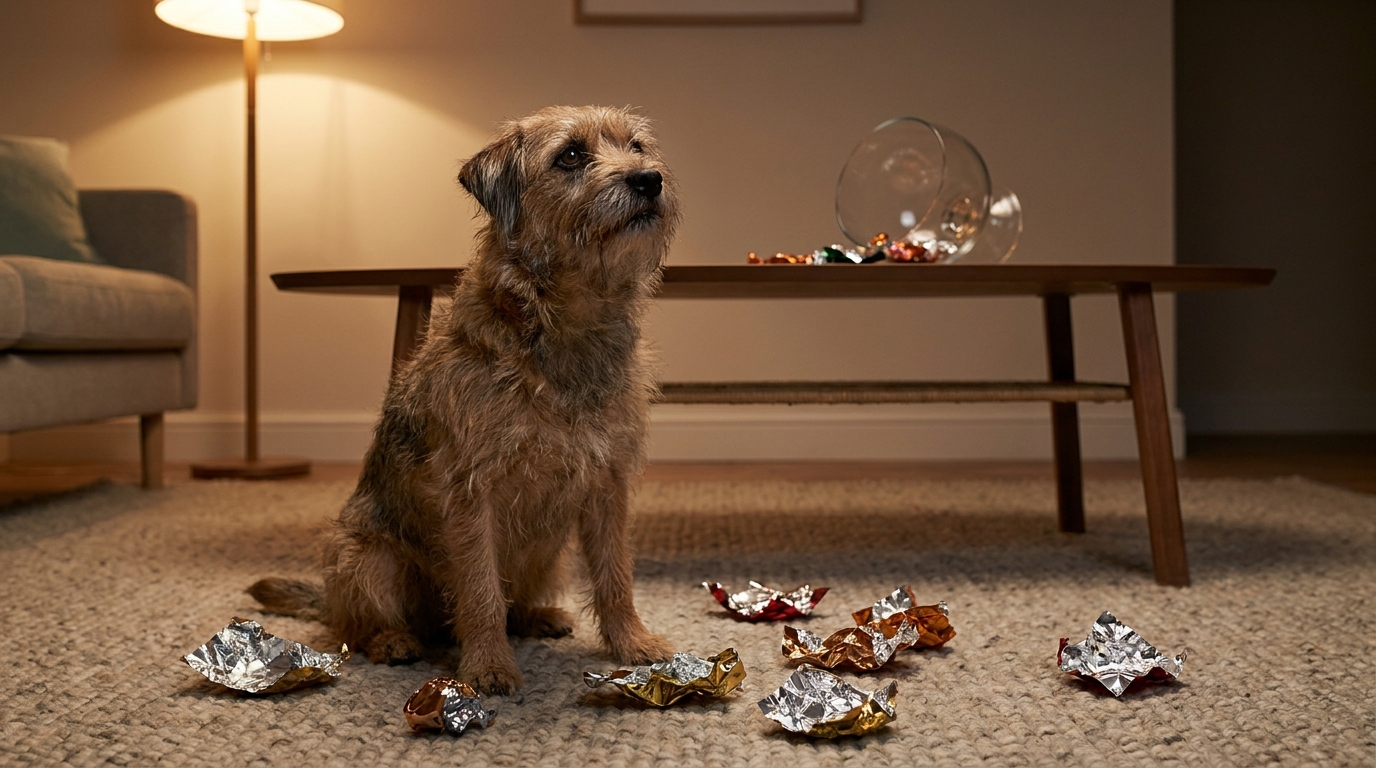
Dog ate candy wrappers? Some pass on their own, but vomiting, belly pain, chocolate, raisins or sugar-free candy means a vet now.
Go to an in-person emergency vet now if your dog is vomiting repeatedly, cannot keep water down, has a painful or swollen belly, is straining or not passing stool, or is weak, collapsing or having seizures, or if he may have eaten sugar-free candy or gum (xylitol), raisins, or chocolate, especially dark or baking chocolate. Call ASPCA Poison Control at (888) 426-4435 or Pet Poison Helpline at (855) 764-7661 on the way.
Shredded foil and cellophane on the floor after a candy-bowl raid is stressful to find. Two questions matter most: what was inside the wrappers, and how much packaging went down. How your dog is acting right now decides the rest.
What decides whether wrappers pass
Swallowed packaging is a familiar problem for vets. VCA Animal Hospitals notes that dogs "are notorious for swallowing" things like paper, tissues and food wrappers, and that "some foreign bodies pass uneventfully through the intestinal tract, not all of them do." The Merck Veterinary Manual adds that dogs are more likely than cats to swallow a foreign body and develop a gastrointestinal obstruction.
When a swallowed object does cause trouble, VCA says the outlook depends on:
- Where the foreign body is
- How long the obstruction has been going on
- The size, shape and characteristics of the foreign body
- Your dog's health before he swallowed it
Size of the dog is not a free pass. Merck notes that young large-breed dogs are more likely than older animals to develop a foreign body obstruction, so a big, young dog who raided the candy bowl still needs the same careful watch.
That is also why a vet will ask how many wrappers are missing, whether they were foil, cellophane or plastic, and whether they went down in a clump or still wrapped around candy. Those details describe the size, shape and characteristics of what he swallowed.
Pet Poison Helpline lists candy wrappers among the most common food-related Halloween hazards for pets. It notes that pets eating candy often don't bother to remove the wrappers, and warns that swallowing foil and cellophane wrappers "can cause a life-threatening bowel obstruction," which can require surgery to correct. There is no way to know from the kitchen floor which way it will go.
Right now: check the candy and count what's missing
Your first job is gathering evidence, but one check comes before everything else: was the candy eaten too, and what kind was it?
- Look for sugar-free candy or gum, chocolate and raisins. If there is any chance he ate sugar-free candy or gum (which can contain xylitol), any chocolate, or raisins, call your vet, an emergency clinic or a poison control line now while you gather the rest. Do not wait for signs.
- Count the wrappers. Compare what is left against the bag or bowl to estimate how many are missing.
- Keep the evidence. Save the torn wrappers and the original packaging so a vet can see the brand, the ingredients and whether it was foil, cellophane or plastic.
- Take photos. A picture of the mess and a short video of your dog help a vet understand what happened.
Do not try to make your dog vomit at home, and do not give oils, laxatives, extra food to "bulk up" his stool, or any human medicine. Leave treatment decisions to a veterinarian who can examine him.
Was it just the wrappers, or the candy too?
The contents can be more dangerous than the packaging. According to the ASPCA's Halloween safety tips, chocolate in all forms, especially dark or baking chocolate, can be very dangerous for dogs, and sugar-free candies containing the sugar substitute xylitol "can cause serious problems in pets." The ASPCA advises contacting your veterinarian or ASPCA Poison Control immediately if you suspect your pet ate something toxic.
Pet Poison Helpline also flags raisins, which are sometimes handed out as a healthier Halloween snack. It warns that very small amounts of raisins can cause kidney failure in dogs, so a missing box of raisins needs the same urgent call as chocolate or sugar-free candy.
For a fuller list of dangerous kitchen foods, see our toxic foods for dogs guide. The home-watch advice further down applies only when the wrappers were empty.
Blockage and emergency signs to watch for
Pet Poison Helpline's list of signs to watch after a dog eats wrappers is short: vomiting, decreased appetite, not defecating, straining to defecate, or lethargy. VCA adds diarrhea, belly tenderness or pain, and changes in behavior such as biting or growling when he is picked up or handled around the belly. The Merck Veterinary Manual says the signs of a gastrointestinal obstruction often include vomiting and loss of appetite, and that an exam may reveal belly pain.
Go straight to the nearest in-person emergency vet if you see any of these:
- Repeated vomiting, or he can't keep water down
- A swollen, bloated, tight or painful belly, crying when it is touched, or a hunched posture
- Straining to pass stool, or no stool coming out
- Marked lethargy, weakness or collapse
- Tremors or seizures
- Any chance he ate sugar-free candy or gum, raisins, or chocolate, even if he seems fine
Don't book a video visit first for any of these. Our pet emergency checklist covers other signs that can't wait.
Call a vet the same day if he:
- Vomits once
- Skips a meal or eats less than usual
- Has diarrhea
- Seems quieter or lower in energy than normal
Every one of these is on the source lists above, so none of them is something to sleep on. If a same-day sign gets worse or turns into anything on the emergency list, go in person right away.
Don't be reassured just because he isn't throwing up. The Merck Veterinary Manual notes that vomiting may be less common when the blockage is further down the intestine, so a dog that isn't vomiting can still be blocked. For more on what vomiting can mean, see our guide to why dogs vomit.
How to watch him at home (only if a vet agrees)
Watching at home is only an option when the wrappers were empty, your dog is bright and comfortable, and a veterinarian agrees it is reasonable for him and the amount he ate. It is not the same as a vet tracking the material on X-rays.
If you are watching him at home:
- Check every stool for bits of foil, cellophane or plastic.
- Make sure he eats his normal meals, drinks and has his usual energy.
- Keep him on his regular food. Don't add treats, bones or chews while you wait.
Finding a few pieces doesn't prove all of it has passed, and a quiet first evening doesn't prove it either. There is no reliable home timetable for how long wrappers take to pass. Keep watching until your dog is fully back to normal, and use the sign lists above: a same-day sign means calling a vet, and an emergency sign means going to an in-person ER.
When it must be in person: X-rays, endoscopy and surgery
A possible blockage cannot be ruled out without an exam and imaging. VCA explains that if a foreign body is suspected, abdominal X-rays will be performed, and that several views or specialized X-rays using contrast material may be needed.
Not every swallowed object shows up the same way on a plain X-ray. Merck notes that plain radiographs can help when a foreign body is radiopaque (visible on X-rays), that contrast X-rays may help detect radiolucent foreign bodies that don't show clearly, and that abdominal ultrasound can help identify foreign bodies in the gut. Your vet will choose the imaging and weigh how your dog is doing.
Depending on what the vet finds, the options may include:
- Endoscopic retrieval, if the material is still in the stomach. Merck notes that endoscopy is "typically limited to the retrieval of gastric foreign bodies."
- Hospital care with repeat X-rays, if the object may be able to pass on its own. VCA describes hospitalization for close observation, often with IV fluids, and follow-up X-rays to track the object.
- Surgery, if an obstruction is diagnosed or suspected, or his signs get worse. VCA notes that exploratory surgery is generally recommended if a foreign body obstruction is diagnosed or suspected.
The Merck Veterinary Manual also describes how vets follow an object in the clinic. When an object can be seen on X-rays and the dog is clinically stable, it can be followed with repeat X-rays, and surgery is needed if it has not passed within 36–48 hours, stops moving, or the dog's signs get worse. That is an in-clinic plan built on imaging, not a home waiting period.
For another look at how vets handle swallowed objects, see our guide on what to do if your dog ate a chicken bone.
What a RexVet video visit can and cannot do
A video visit is for a dog with no red flags. If any sign from the emergency list is present, or he may have eaten chocolate, raisins or sugar-free candy, go to an emergency clinic first.
On video, a vet can look at the leftover wrappers and candy with you, ask your dog's age, weight and how much is missing, and tell you whether to go in now or watch at home.
A video visit cannot take X-rays, run an ultrasound, feel his belly, give fluids or remove anything. If the vet thinks a blockage is possible, they will tell you to go in person.
RexVet's veterinarians are licensed in Florida, New York and Virginia and are available 24/7 for late-night questions when your dog is still acting normally. You can read more on our Florida, New York and Virginia pages.
If your dog is bright and comfortable and the wrappers were empty, you can book a RexVet video visit for $64.99, for pet parents in Florida, New York and Virginia only.
Keep the candy bowl out of reach
Once things settle down, a few habits make a repeat less likely:
- Store candy in high cabinets or containers with secure lids that a determined nose can't pry open.
- Keep trick-or-treat bags off low tables, couches and floors, and ask kids to hand their haul to an adult when they get home.
- Collect wrappers as they are unwrapped instead of leaving them on the coffee table.
- Use a lidded trash can, or keep it behind a closed door. An open trash can is an easy target.
- Store raisins the same way. Pet Poison Helpline says raisins deserve the same pet-proofing treatment as chocolate.
Frequently Asked Questions
Will my dog pass candy wrappers on his own?
Sometimes. VCA notes that some swallowed objects pass without problem, but not all of them do. Because there is no guarantee, check the candy first and ask a vet whether watching at home is reasonable.
How long does it take for a dog to pass a candy wrapper?
There is no safe home waiting period. Finding pieces in his stool doesn't prove everything has passed. Ask a veterinarian how long to watch, and go in at once if any emergency sign appears.
Should I make my dog throw up after he eats candy wrappers?
No. Don't try to make him vomit at home. Don't give any home remedies, oils, laxatives or human medicines either. A veterinarian will decide on treatment after examining him.
What are the warning signs of a bowel obstruction in dogs?
Watch for vomiting, decreased appetite, not passing stool, straining, low energy and belly pain. Repeated vomiting, a painful or bloated belly, or straining or not passing stool means the ER now.
My dog ate candy wrappers but seems fine. Can an online vet help?
Yes, if your dog has no emergency signs. If he has any red flag above, or ate chocolate, raisins or sugar-free candy, go to an emergency vet now. If he is bright, eating and comfortable, a video visit can help you decide whether home monitoring is reasonable or whether he needs to be seen in person now.
If your dog ate some candy wrappers, the candy was not chocolate, raisins or sugar-free, and he is still acting like himself, a veterinarian can help you plan the next few days. RexVet's vets are available 24/7 for pet parents in Florida, New York and Virginia only, and a visit is $64.99. When you are ready, book a video visit now.
FAQs
Will my dog pass candy wrappers on his own?
Sometimes. VCA notes that some swallowed objects pass without problem, but not all of them do. Because there is no guarantee, check the candy first and ask a vet whether watching at home is reasonable.
How long does it take for a dog to pass a candy wrapper?
There is no safe home waiting period. Finding pieces in his stool doesn't prove everything has passed. Ask a veterinarian how long to watch, and go in at once if any emergency sign appears.
Should I make my dog throw up after he eats candy wrappers?
No. Don't try to make him vomit at home. Don't give any home remedies, oils, laxatives or human medicines either. A veterinarian will decide on treatment after examining him.
What are the warning signs of a bowel obstruction in dogs?
Watch for vomiting, decreased appetite, not passing stool, straining, low energy and belly pain. Repeated vomiting, a painful or bloated belly, or straining or not passing stool means the ER now.
My dog ate candy wrappers but seems fine. Can an online vet help?
Yes, if your dog has no emergency signs. If he has any red flag above, or ate chocolate, raisins or sugar-free candy, go to an emergency vet now. If he is bright, eating and comfortable, a video visit can help you decide whether home monitoring is reasonable or whether he needs to be seen in person now.
If your dog ate some candy wrappers, the candy was not chocolate, raisins or sugar-free, and he is still acting like himself, a veterinarian can help you plan the next few days. RexVet's vets are available 24/7 for pet parents in Florida, New York and Virginia only, and a visit is $64.99. When you are ready, book a video visit now.
Medically Reviewed
Reviewed by Dr. Tiffany Delacruz, DVM — licensed veterinarian and CEO of RexVet. Last reviewed September 22, 2026.
Content is for informational purposes and does not replace professional veterinary advice.
Chief Executive Officer · Licensed Veterinarian
Dr. Delacruz is a licensed Doctor of Veterinary Medicine specializing in preventive care and veterinary telehealth. She reviews all health content on RexVet to ensure accuracy and clinical relevance.
Sources & References
- · American Veterinary Medical Association — Telehealth Guidelines
- · AVMA — Pet Care Resources
- · U.S. FDA — Animal & Veterinary
Need an Expert Opinion on This Topic?
Connect with a certified vet via video call in minutes
Talk to Vet Now