
Dog Ate a Fuzzy Caterpillar? What to Do About the Sting
By RexVet Team | Reviewed by Dr. Tiffany Delacruz, DVM
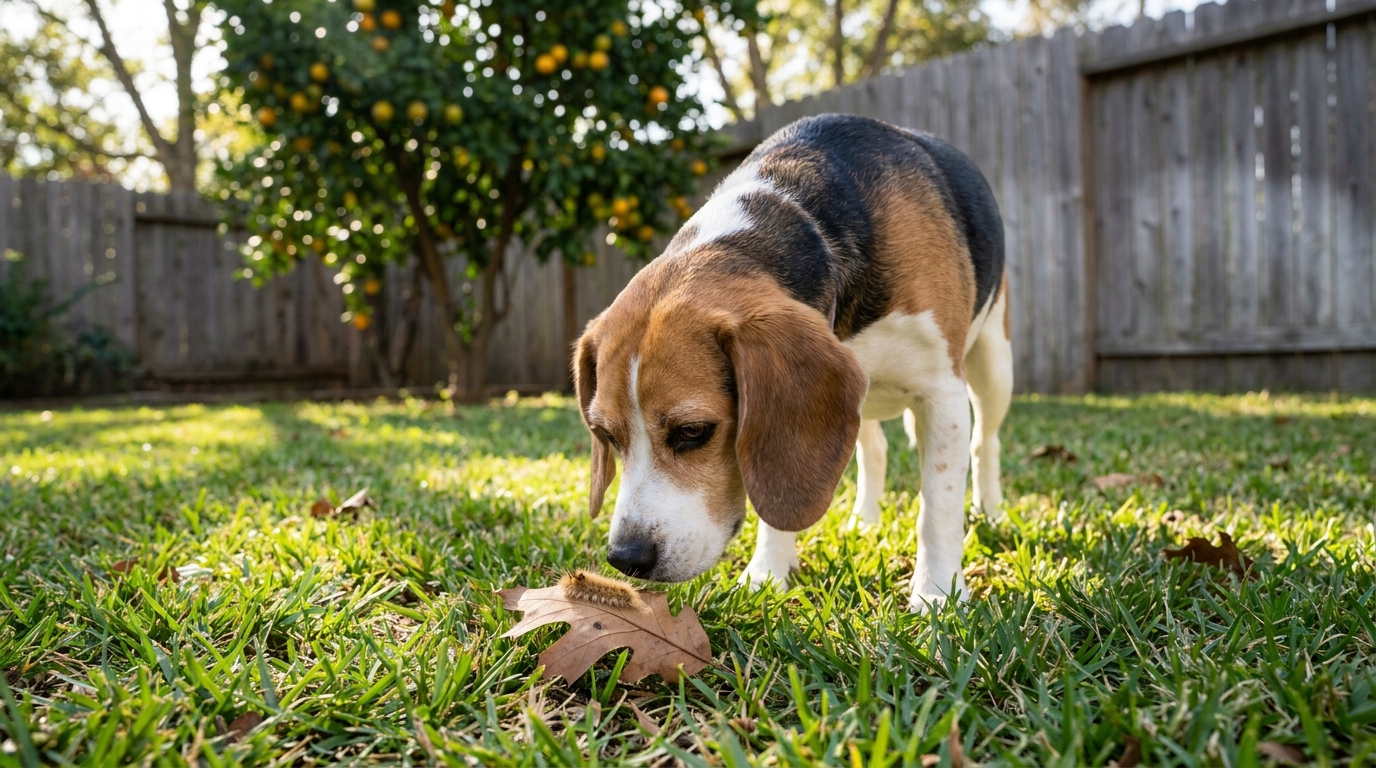
Dog ate a fuzzy caterpillar? Its hairs can sting the mouth. Rinse gently, protect your hands, and watch for swelling, drooling and trouble swallowing.
Go to an emergency vet now if your dog's face, tongue or throat is swelling, it is struggling to breathe or swallow, it collapses, or it keeps vomiting.
If your dog ate a fuzzy caterpillar, or only mouthed or licked one, the problem is the hairs. Some caterpillars carry stinging hairs, which is why a Virginia Tech insect expert quoted by PBS Nature says it is best not to touch, or to be careful about touching, any hairy caterpillar. This guide starts with the signs that mean go now, then covers first aid, then what a vet can do.
Dog Ate a Fuzzy Caterpillar: Why Some Caterpillars Sting
ASPCA Poison Control, writing on ASPCApro, explains that "caterpillars have two types of hair: urticating and stinging." Urticating hairs irritate on contact. Stinging hairs are the ones with poison.
In the same article, ASPCA Poison Control describes stinging hairs as "hollow spines with poison-secreting cells at the base that cause local or systemic effects after they enter the skin and break off." In plain words, a sting can cause trouble right where it happened, or it can affect the whole body.
The puss caterpillar is a good example. UF/IFAS explains: "Under the soft hairs are stiff spines that are attached to poison glands. When touched, these poisonous spines break off in the skin and cause severe pain."
UF/IFAS is describing what happens when a caterpillar is touched. Apply that to a curious dog: if your dog mouthed or swallowed one, those spines can break off in the lips, tongue or mouth. That is why the mouth is the place to watch.
Emergency Signs: Go to an ER Now
Check these first. If any one of them is true, stop reading and go to an emergency vet now:
- Your dog's face, tongue or throat is swelling.
- Your dog is struggling to breathe.
- Your dog is struggling to swallow.
- Your dog collapses.
- Your dog keeps vomiting.
Call the emergency clinic on the way so the team knows you are coming and what happened. If you know your dog swallowed a caterpillar, you can also call ASPCA Animal Poison Control at (888) 426-4435. The line is open 24/7, and a fee may apply.
Not sure whether what you are seeing counts as an emergency? Our practical checklist for dog and cat emergencies walks through the signs that should never wait.
What a Mouth Sting Looks Like
ASPCA Poison Control says oral exposures to caterpillars are "not common" but "definitely possible." Its list of signs, translated from the medical terms, includes:
- Drooling
- Head shaking
- Pawing at the mouth because it hurts
- Trouble swallowing
- Irritation of the tongue, lips and mouth
- Irritation of the food pipe, the stomach and the intestines
That last item means swallowed hairs can irritate more than the mouth.
What about the skin? ASPCA Poison Control notes that "because of an animal's coat, such dermal reactions are not very likely." In other words, your dog's fur usually shields the skin, so the lips, tongue and mouth are the places to check.
If swelling spreads toward the throat, your dog cannot swallow or it keeps vomiting, go to an emergency vet now. Do not wait to see if it settles.
First Aid Now
If your dog is breathing and swallowing normally and none of the emergency signs is present, you can start first aid at home. Work calmly and keep the steps simple.
- Protect your hands. Wear gloves, or put a plastic bag over your hand. Do not pick up the caterpillar with bare fingers.
- Check that rinsing is safe. Rinse only if your dog is breathing and swallowing normally and will let you. If the face, tongue or throat is swelling, skip rinsing and go to the emergency vet. A dog in mouth pain may bite, so keep your face away and stop if your dog resists.
- Rinse the mouth gently. ASPCA Poison Control lists rinsing the pet's mouth out among the treatments for caterpillar exposure. At home, tilt your dog's head down and let cool water run gently across the lips and gums and back out of the mouth. Never force a hose into the mouth. Do not rub or scrub the area.
- Use something cold. The Merck Veterinary Manual advises that you "apply a cold pack to the affected area to decrease swelling and itching." Wrap it in a thin cloth and hold it on the outside of the muzzle, never inside the mouth.
- Lift hairs off the skin and fur. ASPCA Poison Control notes: "If hairs are present in the skin, they may be removed using tape." Press a strip of tape lightly on the coat and peel it away. Use tape on skin and fur only, never inside the mouth.
- Check the eyes. If hairs got in the eyes, ASPCA Poison Control says "the first step is to thoroughly flush the pet's eyes." Flush with clean water, then call a vet.
- Skip human products. Do not use human creams, pills or ointments. Call a veterinarian before giving your dog anything.
- Take a photo. If you can, photograph the caterpillar without touching it. PBS Nature, reporting with a Virginia Tech insect expert, advises: "If possible, take a photo of the caterpillar that stung you."
Keep your dog calm and quiet afterward, and keep checking the emergency list above while you watch.
Stinging Caterpillars in Florida, Virginia and New York
Where you live changes which caterpillars you are likely to meet, and when.
Florida
UF/IFAS says the puss caterpillar is "most often found on oaks and citrus," and that "in Florida there are two generations a year, one in spring and the other in fall." If your yard has oak or citrus trees, those are the places to look before letting a curious dog nose around.
For comparison, NC State Extension, writing about the puss caterpillar farther north, reports two generations a year, "with peaks of abundance of caterpillars in July and October." That timing is for the puss caterpillar in the Extension's own report, not a rule for every stinging caterpillar.
Virginia
PBS Nature, reporting with Virginia Tech's insect experts, notes: "The puss caterpillar is native to Virginia and has been found in low numbers in the region for years and years."
The saddleback caterpillar
UF/IFAS notes the saddleback caterpillar feeds on plants such as maples, hibiscus and crape myrtle. These are common garden plants, so check them before a dog goes digging underneath.
New York
The sources in this article do not map which stinging caterpillars live in New York, so use the simplest rule there, and everywhere else too. As the PBS expert puts it, "in general, it is best to not touch or to be careful about touching any hairy caterpillars." Treat any hairy caterpillar your dog finds as a possible stinger.
Not a Bee Sting and Not a Fire-Ant Bite
A caterpillar sting comes from hairs and spines rather than a single stinger, so it is a different problem from a bee sting or an ant bite. If a bee or wasp was the cause, read what to do about a swollen face after a bee or wasp sting. For ants, see fire-ant bites on dogs in Florida. If heavy drooling is the main thing you are seeing, our guide to sudden heavy drooling in dogs can help. If you do not know what got your dog, use the emergency list above and ask a vet.
What a RexVet Online Vet Can and Cannot Do After a Caterpillar Sting
If none of the emergency signs is present, a video visit can help you decide what comes next. On a video call, a RexVet veterinarian can:
- Look at your dog's lips, gums, tongue and face on camera.
- Look at your photo of the caterpillar.
- Watch your dog swallow and breathe.
- Coach you through rinsing the mouth and lifting hairs off the coat.
- Help you decide between the ER, a clinic visit or watching at home.
A video vet cannot remove spines from inside the mouth or treat swelling in person. If that is needed, the veterinarian will tell you to go to a clinic or an ER.
Before the call, have your caterpillar photo and a short, well-lit video of your dog's face ready. Our guide on how to upload pet photos and videos for an online vet review shows how to capture what the vet needs to see.
If the veterinarian decides medication is appropriate, they can prescribe where state rules allow. In Florida, a veterinarian who has seen your pet only by video may prescribe only FDA-approved animal drugs used as labeled, for up to 14 days (1 month for flea-and-tick-only products), and cannot renew without an in-person exam.
RexVet's veterinarians are licensed in Florida, New York and Virginia and are available 24/7 by video, including nights, weekends and holidays. RexVet is a 501(c)(3) non-profit, and a video visit is $64.99. Book a RexVet video visit.
When to Be Seen in Person in Florida, New York or Virginia
Any sign on the emergency list above means go now. Any swelling of the face, lips, tongue or throat that keeps growing is also an emergency: go to an emergency vet now.
Even without an emergency sign, plan an in-person visit soon if:
- Hairs or a sting got into your dog's eye. ASPCA Poison Control notes that if signs persist after flushing, a closer eye exam may be needed.
- Pain does not settle.
An in-person vet can look inside the mouth and throat and remove spines that cannot be reached at home.
If you are in Florida and start with a video visit, state law requires the telehealth vet to give you "the contact information for at least one physical veterinary clinic in the vicinity of the patient's location" (Fla. Stat. 474.2021). That way you know where to go if your dog needs hands-on care.
To learn how online vet care works where you live, see our pages for Florida, New York and Virginia.
Frequently Asked Questions
Are puss caterpillars dangerous to dogs?
They can be. UF/IFAS says the puss caterpillar's hidden spines break off in the skin and cause severe pain, and ASPCA Poison Control notes that stinging hairs can have local or whole-body effects. The danger signs are swelling of the face, tongue or throat and any trouble breathing or swallowing. Any of those means an emergency vet now.
How do I get caterpillar hairs out of my dog's mouth or fur?
Protect your hands with gloves or a plastic bag first. If your dog is breathing and swallowing normally, rinse the mouth gently with cool water, head tilted down, and let the water run out. For hairs in the skin or fur, ASPCA Poison Control says they may be removed using tape. Never force a hose into the mouth, and do not scrub the area.
What does a puss caterpillar look like?
UF/IFAS describes it as about an inch long and covered in gray to brown hairs. The soft hairs hide stiff, venomous spines underneath. If you see one, photograph it without touching it.
Can a fuzzy caterpillar hurt my cat too?
Yes. ASPCA Poison Control's caterpillar guidance covers pets in general, and the same stinging hairs can irritate a cat's mouth. Use the same steps: protect your hands, rinse gently if your cat is swallowing normally, and watch for the same emergency signs. Call a veterinarian if you think your cat has been stung.
Can I give my dog something for the pain or swelling?
Do not give your dog any human medicine, cream or ointment; call a veterinarian before giving anything. For home care, the Merck Veterinary Manual advises that you "apply a cold pack to the affected area to decrease swelling and itching." Wrap it in a thin cloth and keep it out of the mouth. If your dog is struggling to swallow or breathe, go to an emergency vet now.
If you see any emergency sign, go in person first. For everything else, RexVet's veterinarians are licensed in Florida, New York and Virginia and are available 24/7, and a video visit is $64.99. Have your caterpillar photo ready and book a video visit now.
FAQs
Are puss caterpillars dangerous to dogs?
They can be. UF/IFAS says the puss caterpillar's hidden spines break off in the skin and cause severe pain, and ASPCA Poison Control notes that stinging hairs can have local or whole-body effects. The danger signs are swelling of the face, tongue or throat and any trouble breathing or swallowing. Any of those means an emergency vet now.
How do I get caterpillar hairs out of my dog's mouth or fur?
Protect your hands with gloves or a plastic bag first. If your dog is breathing and swallowing normally, rinse the mouth gently with cool water, head tilted down, and let the water run out. For hairs in the skin or fur, ASPCA Poison Control says they may be removed using tape. Never force a hose into the mouth, and do not scrub the area.
What does a puss caterpillar look like?
UF/IFAS describes it as about an inch long and covered in gray to brown hairs. The soft hairs hide stiff, venomous spines underneath. If you see one, photograph it without touching it.
Can a fuzzy caterpillar hurt my cat too?
Yes. ASPCA Poison Control's caterpillar guidance covers pets in general, and the same stinging hairs can irritate a cat's mouth. Use the same steps: protect your hands, rinse gently if your cat is swallowing normally, and watch for the same emergency signs. Call a veterinarian if you think your cat has been stung.
Can I give my dog something for the pain or swelling?
Do not give your dog any human medicine, cream or ointment; call a veterinarian before giving anything. For home care, the Merck Veterinary Manual advises that you "apply a cold pack to the affected area to decrease swelling and itching." Wrap it in a thin cloth and keep it out of the mouth. If your dog is struggling to swallow or breathe, go to an emergency vet now.
If you see any emergency sign, go in person first. For everything else, RexVet's veterinarians are licensed in Florida, New York and Virginia and are available 24/7, and a video visit is $64.99. Have your caterpillar photo ready and book a video visit now.
Medically Reviewed
Reviewed by Dr. Tiffany Delacruz, DVM — licensed veterinarian and CEO of RexVet. Last reviewed September 24, 2026.
Content is for informational purposes and does not replace professional veterinary advice.
Chief Executive Officer · Licensed Veterinarian
Dr. Delacruz is a licensed Doctor of Veterinary Medicine specializing in preventive care and veterinary telehealth. She reviews all health content on RexVet to ensure accuracy and clinical relevance.
Sources & References
- · American Veterinary Medical Association — Telehealth Guidelines
- · AVMA — Pet Care Resources
- · U.S. FDA — Animal & Veterinary
Need an Expert Opinion on This Topic?
Connect with a certified vet via video call in minutes
Talk to Vet Now