
Dog Ate a Cough Drop? Check the Wrapper for Xylitol Now
By RexVet Team | Reviewed by Dr. Tiffany Delacruz, DVM
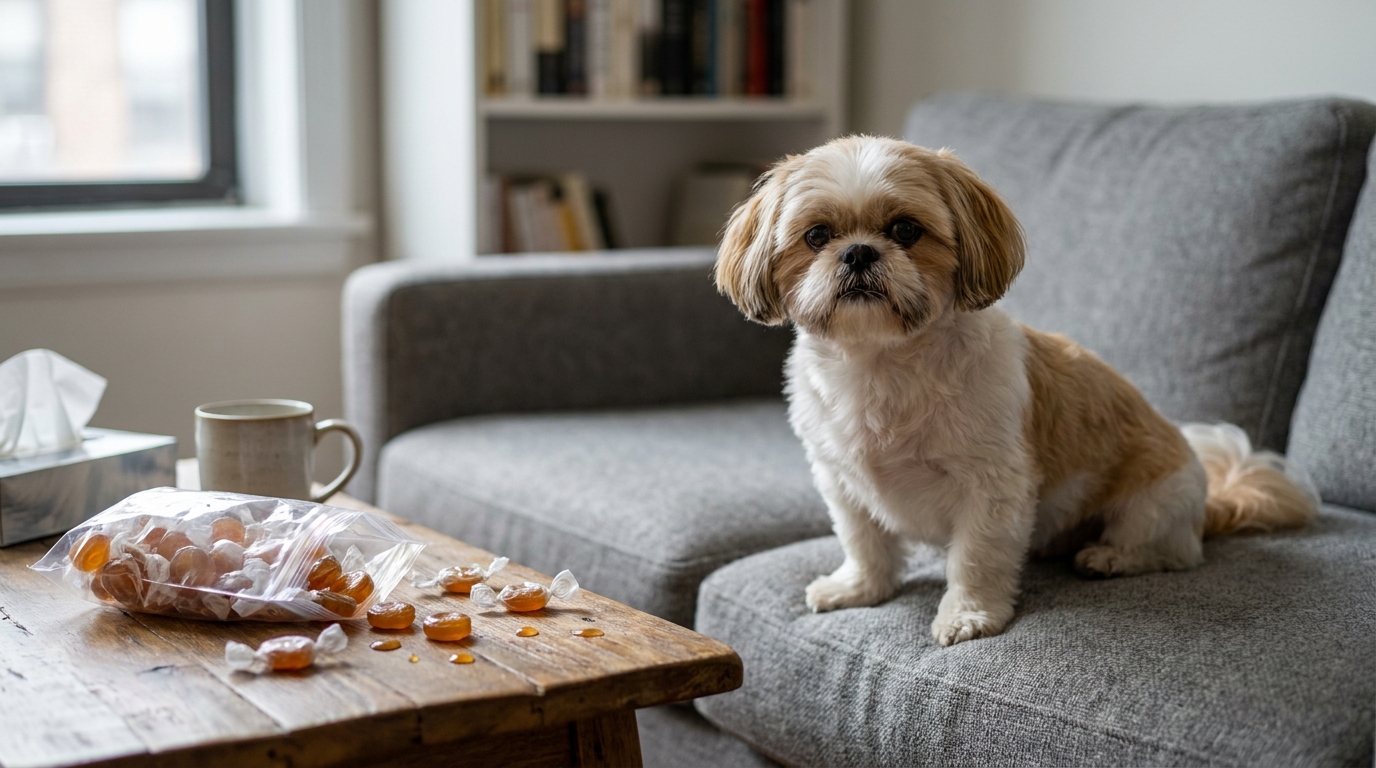
Dog ate a cough drop? Read the wrapper now: sugar and menthol usually mean an upset stomach, but xylitol or benzocaine means call a poison line.
Call a poison line and go to an emergency vet now if the drops are sugar-free, list xylitol or benzocaine, or you cannot read the label, or if your dog is weak, wobbly, trembling, having a seizure, has discolored gums, or is vomiting repeatedly.
Dog ate a cough drop: read the wrapper first
An open bag on the coffee table and a few twisted wrappers on the rug is a familiar cold-season scene. Before you do anything else, find the bag or a wrapper and turn it over. According to the ASPCA, "the first thing you should do if your pet ingests cough drops is check the ingredients list."
The ingredient list tells you which of two very different situations you are in. The ASPCA explains: "Most cough drops contain sugar, menthol, eucalyptus oil, colors and flavor—all of which can cause gastrointestinal upset." That is the milder picture: an unhappy stomach.
A few ingredients, though, can be serious. Look for these words on the panel:
- Xylitol, or the words "sugar-free." Treat a sugar-free drop as xylitol until a professional tells you otherwise.
- Benzocaine, a numbing ingredient.
If either one shows up, or the packaging is missing, torn or unreadable, follow the bold line above: call a poison line and go to an emergency vet. Whether cough drops are toxic to dogs depends on what is printed on that panel, so the label decides your next step.
Emergency signs: go now
Here is the go-now list again, because it matters more than anything else on this page. Call a poison line and head to the nearest emergency vet if any of these apply:
- The drops are sugar-free, or the label lists xylitol.
- The label lists benzocaine.
- You cannot find the packaging or cannot read the label.
- Your dog is weak, wobbly or trembling.
- Your dog is having a seizure.
- Your dog's gums look discolored.
- Your dog is vomiting repeatedly.
Call ASPCA Animal Poison Control at (888) 426-4435 or Pet Poison Helpline at (855) 764-7661. Both are open 24/7, and a fee may apply. If someone else can drive, make the call on the way so you do not lose time, and keep the wrapper in your hand so you can read the ingredients to them.
If you are unsure whether what you are seeing counts as an emergency, the pet emergency checklist walks through the signs. If your dog is shaking, stiff, paddling or not responding to you, this guide to what dog seizures look like and what to do can help, but read it on the way, not at home.
Xylitol: the ingredient that changes everything
Xylitol is a sugar substitute used in some sugar-free products. For dogs it is a real concern. The ASPCA warns that "Xylitol can cause hypoglycemia and possible liver injury"; hypoglycemia means low blood sugar.
How often is it in cough drops? The sources do not agree. The ASPCA says, "Infrequently, xylitol may be found in cough drops." ASPCApro, the ASPCA's resource site for animal professionals, says, "It's becoming more and more common for manufacturers to include xylitol in cough drops." Pet Poison Helpline says, "Manufacturers are increasingly using xylitol in cough drops."
Either way, the answer for you is the same: check the label every time. Any sugar-free or xylitol label means a poison line and an emergency vet now, not a wait-and-see.
For other foods and pantry items that can send a dog to the ER, see this guide to toxic foods for dogs and when to see an emergency vet.
Benzocaine and other numbing drops
Some lozenges contain benzocaine, an ingredient that numbs the throat. It is on the go-now list for two separate reasons.
The first is a blood problem. The ASPCA says benzocaine "is metabolized into compounds which are capable of causing methemoglobinemia at high doses." It explains that "Methemoglobinemia is a form of anemia," and the signs it lists include "discoloration of skin and mucous membranes," which can mean gums that look an unusual color.
The second is the numbing itself. ASPCApro notes that benzocaine "will numb the throat when swallowed" and adds: "This can pose a risk for aspiration, particularly in those patients that may be more susceptible to aspiration." Aspiration means something is breathed into the airway instead of being swallowed.
If the label lists benzocaine, call a poison line and go to an emergency vet now. Do not wait for signs like discolored gums or trouble breathing.
Menthol and sugar drops: what to expect
This section applies only once you have read the label and confirmed there is no xylitol, no benzocaine and no sugar-free wording.
Pet Poison Helpline says menthol "irritates the oral and digestive system tissues," and that "Symptoms of menthol poisoning often show up within an hour of consumption." After eating menthol drops, your dog may drool, vomit or have diarrhea. The ASPCA notes that the sugar, eucalyptus oil, colors and flavor in cough drops can upset the stomach too.
Stay with your dog and watch. If drooling, vomiting or diarrhea continue, call a vet. Repeated vomiting, weakness or wobbliness means go to an emergency vet now. For help reading stomach signs, see why is my dog vomiting.
Wrappers and a whole bag: blockage risk
Wrappers can go down with the drops, and a dog that finds a bag may not stop at one. Then the ingredients are not the only question. The ASPCA says "obstruction may also be a concern depending on the number of drops ingested, the size of the pet and whether or not the wrappers were also ingested."
Obstruction means a blockage in the stomach or intestines. That is different from choking, which blocks the airway. Trouble breathing always means an emergency vet now.
If your dog ate a bag of cough drops, or a small dog swallowed wrappers, plan on an in-person vet visit rather than watching at home. Check the ingredients first, because a xylitol, benzocaine, sugar-free or unreadable label makes it an emergency straight away. For more on foil and plastic, read whether candy wrappers will pass or cause a blockage.
What to do right now
- Take the bag away. Move any remaining drops and wrappers out of reach so your dog cannot eat more.
- Check the label. If it lists xylitol or benzocaine, says sugar-free, or you cannot read it, call a poison line and go to an emergency vet now. If you cannot find the packaging at all, treat it as xylitol.
- Gather the evidence. Collect the wrappers, count what is missing as best you can, photograph the ingredient panel and note the time.
- Bring a sample. Pet Poison Helpline advises: "Bring a sample of the cough drop, if possible, when you visit the vet." Take the bag or a wrapper too.
- Do not make your dog vomit. Do not try it at home. Tell the poison line or the vet what the label says and follow their instructions.
- Watch closely if the label is low risk. For a confirmed sugar-and-menthol drop, watch for drooling, vomiting or diarrhea, and call a vet if they continue.
Then prevent a repeat. Cold season in New York and Virginia puts lozenges in coat pockets, purses and nightstands, within reach of a curious dog. Keep drops in closed bags up high, and follow the ASPCA's advice to "keep your flu season supplies stored safely out of paws’ reach". A bag left on the floor counts. For other risks around the house, see this room-by-room guide to household toxins.
What a RexVet online vet can and cannot do
First, the plain rule. If the label lists xylitol or benzocaine, says sugar-free, or cannot be read, do not book a video visit. Call one of the poison lines in the emergency section above and go to an emergency vet. That is not a video-visit case. A whole bag, or wrappers swallowed by a small dog, is not a video-visit case either: plan on an in-person vet visit.
RexVet is a 501(c)(3) non-profit veterinary telehealth service, and RexVet's veterinarians are licensed in Florida, New York and Virginia. If you can read the label and it shows only sugar, menthol or eucalyptus, with no xylitol or benzocaine, a video visit can help you decide what to watch for at home. A RexVet veterinarian can:
- Read the ingredient panel with you live, on camera.
- Confirm that it is a sugar-and-menthol drop with no xylitol or benzocaine.
- Weigh the wrapper and blockage risk by your dog's size.
- Tell you what to watch for and when to go in person.
A video visit cannot check blood sugar, run liver tests, induce vomiting or give fluids; those need an in-person clinic. That is why the high-risk labels go straight to an emergency vet.
A general note on medication that applies to every visit: if the veterinarian decides medication is appropriate, they can prescribe where state rules allow. In Florida, a veterinarian who has seen your pet only by video may prescribe only FDA-approved animal drugs used as labeled, for up to 14 days (1 month for flea-and-tick-only products), and cannot renew without an in-person exam.
If the label shows only sugar and menthol, your dog did not eat a whole bag, and no wrappers went down a small dog, you can book a RexVet video visit 24/7 for $64.99 to go over it with a veterinarian, for pet parents in Florida, New York and Virginia only.
When to go in person in Florida, New York or Virginia
Go to an in-person vet, and call a poison line on the way when a toxin may be involved, if any of these apply:
- The label lists xylitol or benzocaine, or says sugar-free.
- The label is unknown or unreadable, or the packaging is gone.
- Your dog ate a whole bag.
- A small dog swallowed wrappers.
- Your dog is weak, wobbly or trembling, or has a seizure.
- Your dog is vomiting repeatedly.
- Your dog's gums look discolored, or your dog has trouble breathing.
In Florida, a telehealth vet must give you "the contact information for at least one physical veterinary clinic in the vicinity of the patient's location" (Fla. Stat. 474.2021). Wherever you live, it helps to save the number of your nearest emergency clinic in your phone before you need it.
For more on how video visits work in your state, see online vet care in Florida, New York and Virginia.
Frequently Asked Questions
Are cough drops toxic to dogs?
It depends on the label. The ASPCA says most cough drops contain sugar, menthol, eucalyptus oil, colors and flavor, which can cause gastrointestinal upset. Xylitol and benzocaine can be serious, and a whole bag or swallowed wrappers can raise a blockage concern. Check the ingredients every time.
My dog ate a sugar-free cough drop; what should I do?
Treat it as xylitol until a professional says otherwise. Sugar-free drops may contain xylitol, which the ASPCA warns can cause low blood sugar and possible liver injury. Call ASPCA Animal Poison Control at (888) 426-4435 or Pet Poison Helpline at (855) 764-7661 and go to an emergency vet now.
Is menthol bad for dogs?
Menthol is an irritant. Pet Poison Helpline says it "irritates the oral and digestive system tissues" and that signs often show up within an hour, so drooling, vomiting or diarrhea are possible. If those signs continue, call a vet. If vomiting is repeated or your dog is weak or wobbly, go to an emergency vet.
What if my dog ate the wrappers too?
Wrappers add a blockage risk. The ASPCA says obstruction may be a concern depending on the number of drops eaten, the size of the pet and whether the wrappers went down too. A whole bag, or wrappers in a small dog, means an in-person vet visit, and repeated vomiting means an emergency vet now.
Should I make my dog throw up?
No. Do not try to make your dog vomit at home. Tell the poison line or the vet what the label says and follow their instructions. If the label shows xylitol, benzocaine or sugar-free, or you cannot read it, call a poison line and go to an emergency vet, and bring the packaging with you.
Remember the order: a xylitol, benzocaine, sugar-free or unreadable label goes to a poison line and an emergency vet first, and a whole bag or wrappers in a small dog goes to an in-person vet. If you have read the label, it shows only sugar and menthol, and you would like a veterinarian to go over it with you, you can book a video visit now for $64.99. RexVet's veterinarians are available 24/7 for pet parents in Florida, New York and Virginia only.
FAQs
Are cough drops toxic to dogs?
It depends on the label. The ASPCA says most cough drops contain sugar, menthol, eucalyptus oil, colors and flavor, which can cause gastrointestinal upset. Xylitol and benzocaine can be serious, and a whole bag or swallowed wrappers can raise a blockage concern. Check the ingredients every time.
My dog ate a sugar-free cough drop; what should I do?
Treat it as xylitol until a professional says otherwise. Sugar-free drops may contain xylitol, which the ASPCA warns can cause low blood sugar and possible liver injury. Call ASPCA Animal Poison Control at (888) 426-4435 or Pet Poison Helpline at (855) 764-7661 and go to an emergency vet now.
Is menthol bad for dogs?
Menthol is an irritant. Pet Poison Helpline says it "irritates the oral and digestive system tissues" and that signs often show up within an hour, so drooling, vomiting or diarrhea are possible. If those signs continue, call a vet. If vomiting is repeated or your dog is weak or wobbly, go to an emergency vet.
What if my dog ate the wrappers too?
Wrappers add a blockage risk. The ASPCA says obstruction may be a concern depending on the number of drops eaten, the size of the pet and whether the wrappers went down too. A whole bag, or wrappers in a small dog, means an in-person vet visit, and repeated vomiting means an emergency vet now.
Should I make my dog throw up?
No. Do not try to make your dog vomit at home. Tell the poison line or the vet what the label says and follow their instructions. If the label shows xylitol, benzocaine or sugar-free, or you cannot read it, call a poison line and go to an emergency vet, and bring the packaging with you.
Remember the order: a xylitol, benzocaine, sugar-free or unreadable label goes to a poison line and an emergency vet first, and a whole bag or wrappers in a small dog goes to an in-person vet. If you have read the label, it shows only sugar and menthol, and you would like a veterinarian to go over it with you, you can book a video visit now for $64.99. RexVet's veterinarians are available 24/7 for pet parents in Florida, New York and Virginia only.
Medically Reviewed
Reviewed by Dr. Tiffany Delacruz, DVM — licensed veterinarian and CEO of RexVet. Last reviewed September 23, 2026.
Content is for informational purposes and does not replace professional veterinary advice.
Chief Executive Officer · Licensed Veterinarian
Dr. Delacruz is a licensed Doctor of Veterinary Medicine specializing in preventive care and veterinary telehealth. She reviews all health content on RexVet to ensure accuracy and clinical relevance.
Sources & References
- · American Veterinary Medical Association — Telehealth Guidelines
- · AVMA — Pet Care Resources
- · U.S. FDA — Animal & Veterinary
Need an Expert Opinion on This Topic?
Connect with a certified vet via video call in minutes
Talk to Vet Now