
Cat Scabs on Neck and Back Losing Hair? Florida Vet Guide
By RexVet Team | Reviewed by Dr. Tiffany Delacruz, DVM
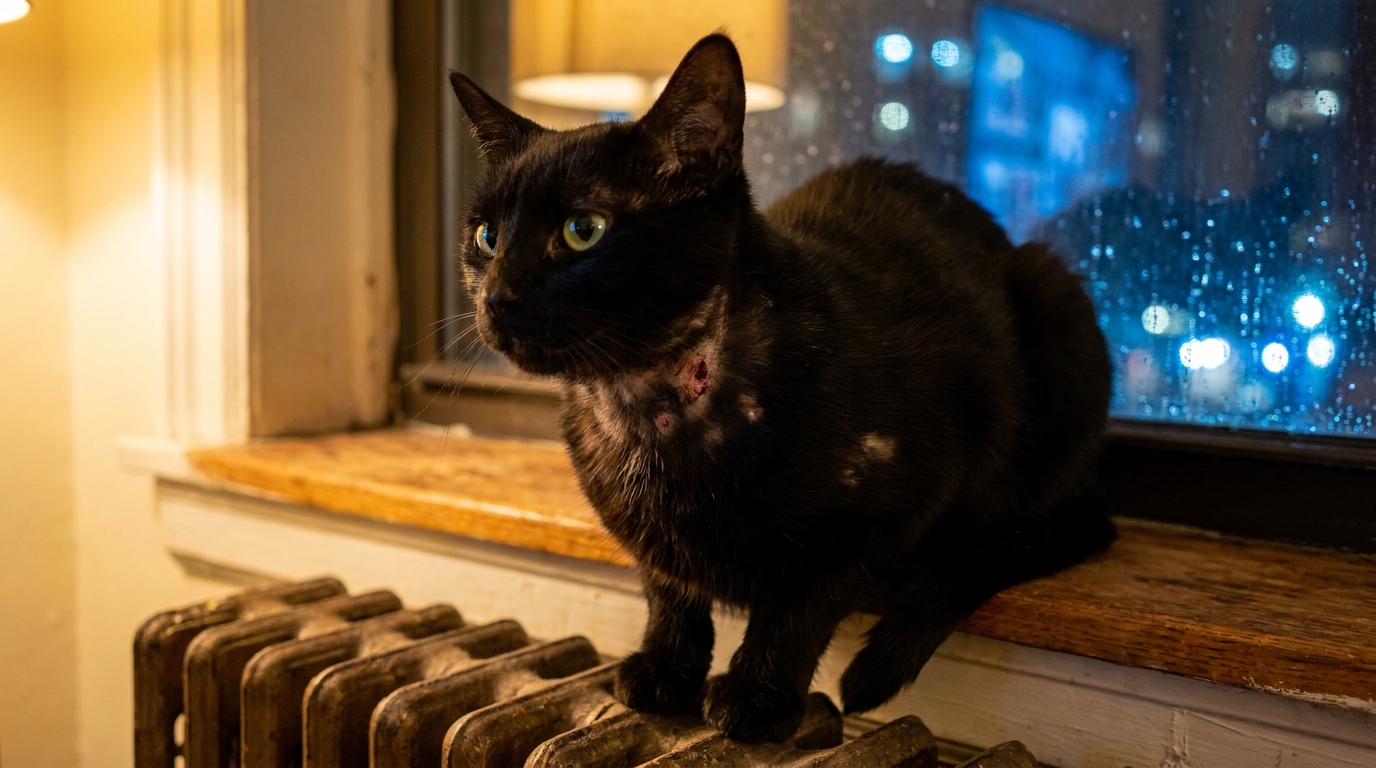
Scabs on a cat's neck and back with hair loss most often trace back to fleas, and a vet can check the pattern by video before you book a clinic trip.
Go to an in-person emergency vet now if your cat is twitching, drooling, wobbly or seizing after any flea product (especially one made for dogs), or if she has stopped eating, is lethargic, has hot, swollen or oozing skin, or is breathing hard.
If you parted the fur tonight and found gritty scabs and thin hair, take a breath: cat scabs on neck and back losing hair is a pattern veterinarians know well, and fleas are the first thing they check for. If the carrier fight is part of the dread, see low-stress vet care for cats in Florida from home.
Cat scabs on neck and back losing hair: what you are probably looking at
The Merck Veterinary Manual calls this pattern feline miliary dermatitis: with the fur parted, small, solid bumps are visible that resemble tiny, round millet seeds. They are typically spread over the back, neck and face and crust over once the cat scratches. Merck adds that flea-allergic cats can also have widespread hair loss or a "racing stripe" of skin inflammation along the back.
Merck's professional reference puts the lesions most often on the back, tailhead, back of the thighs, groin, head and neck. So part the fur and look rather than just feeling the coat: the grit is usually tiny crusted bumps, and the thin fur around them is often the cat's own grooming.
Why fleas are the first suspect even if you never see one
Merck states that many cats are allergic to flea saliva, and VCA Animal Hospitals says fleas are the most common reason for itching and skin infection in cats, so a veterinarian may recommend flea control even when no fleas are found. That is a suspicion, not a diagnosis, until a veterinarian has excluded other causes.
As for "but I never saw a flea": Merck notes that fleas may not be visible on extremely allergic cats because of grooming, and VCA says the evidence is often groomed off by your cat. The Cornell Feline Health Center adds that cats are bitten mostly on the back of the neck and the top of the tail head, and that allergic cats show reddish, crusty bumps even where they have not scratched.
The two-minute flea-comb check to do before any visit
Cornell's check: stand the cat on a large piece of white paper or a pillowcase and run a fine-toothed comb through the coat. Fleas and small black specks (their feces) get caught in the comb or fall onto the white background. Go slowly and spend extra time over the back of the neck and the base of the tail, where Cornell says cats are bitten most.
Then test the specks. Merck describes flea excrement as reddish black, cylindrical and pellet- or comma-shaped; on a damp paper towel it dissolves and produces a reddish brown color. Plain dirt does not make that reddish smear. Photograph the comb, the towel and the worst patch with the fur parted, in daylight, for the veterinarian.
Other causes that look the same: ringworm, mites, allergy, stress overgrooming
The same picture has other causes. The Merck Veterinary Manual lists these look-alikes:
- Ringworm, a fungal infection: bald, scaly, crusted patches with broken hairs, most often on the face, ear tips, tail and feet. Merck says it spreads to people; see the post on ringworm in cats, and your own doctor if anyone at home gets a rash.
- Mites and other parasites: Cheyletiella mites, chiggers, Notoedres mange and lice.
- Feline atopic skin syndrome, an allergy to something in the environment or the food.
- Secondary skin infections, bacterial or yeast, in skin already damaged by scratching.
Stress overgrooming, where an anxious cat licks the fur thin, can look similar and is another thing a veterinarian will weigh.
None of these can be confirmed or ruled out on a screen; they need a skin scrape, cytology or a fungal culture in a clinic.
Florida cats: why this rash never takes a season off
Florida's warm, humid climate gives fleas no winter break, and an indoor cat is not exempt: fleas arrive on people and other pets. VCA notes that homes with carpets and central heating provide ideal conditions for the year-round growth of fleas, and in Florida the outdoors adds to that instead of interrupting it.
So an indoor-only cat in Miami, Orlando, Tampa or Jacksonville with these scabs should still be checked for fleas first. See flea prevention for indoor cats in Florida and New York; an online vet in Florida can look at the pattern without a carrier trip.
What a RexVet video visit can and cannot do for a scabby, balding cat
On a video visit, a RexVet veterinarian can look at the skin with the fur parted, review your comb and towel photos, take the history, judge whether the picture fits flea allergy, and say whether it looks inflamed enough to need in-person testing.
The most useful thing a video veterinarian can set up is a trial. The Merck Veterinary Manual says response to flea control can itself be used as a diagnostic test: a flea preventive labeled for cats that your veterinarian recommends goes on every pet, the home is treated, and the veterinarian judges the result at follow-up. If the veterinarian decides medication is appropriate, they can prescribe where state rules allow.
In Florida, those rules come from F.S. 474.2021, the veterinary telehealth law: a prescription based only on a telehealth evaluation can run up to 1 month for products labeled solely for flea and tick control and up to 14 days for other animal drugs, cannot be renewed without an in-person examination, and cannot be a controlled substance, and the veterinarian must give you contact information for at least one physical veterinary clinic near you. See the Florida telehealth law guide.
A video visit cannot do a skin scrape, skin cytology, a fungal culture or an injection, so mites, ringworm and skin infection cannot be confirmed or ruled out over video.
RexVet's veterinarians are licensed in Florida, New York and Virginia only and are available 24/7. A video visit is $64.99; book a RexVet video visit now and have your comb photos ready.
When your cat needs to be seen in person
Some signs mean an emergency clinic, not a video call: any twitching, tremor, drooling, wobbliness or seizure after a flea product, especially one made for dogs; a cat who has stopped eating, is lethargic or is breathing hard; or skin that is hot, swollen or oozing.
Other problems are not emergencies but still need a clinic. Merck says cytological testing of the skin is how a veterinarian checks for a bacterial or Malassezia (yeast) infection on top of the allergy. For suspected ringworm, Merck says veterinarians use fungal culture, an ultraviolet lamp and direct microscopic examination of hair or skin scale, and culture can take up to 3 weeks. A video visit cannot do a skin scrape, cytology, fungal culture or injection. If none of the emergency signs above are present and you are unsure whether the clinic trip can wait, a visit through RexVet's booking page can help you decide whether it is needed tonight.
Treating the whole house: every pet, every room, for months
The plan is never just the itchy cat. Merck says long-term control means consistently using flea control in all household animals, and VCA says to continue flea control on all pets in the house for 3-6 months after an infestation, so the flea life stages still in the home mature and are killed when they jump onto a treated pet.
Merck lists the places flea eggs and larvae gather and says they should be treated: bedding, furniture, carpets, the tiny spaces in hardwood flooring, behind baseboards and within closets.
Cornell warns that some flea products are fine for dogs but can be toxic to cats, and that a cat that licks a wet dog product can be killed by it; VCA says to ensure the product is labeled for use in cats. Use only a flea preventive labeled for cats that your veterinarian recommends. VCA also notes that any cat with fleas is likely to also have a tapeworm infestation; mention the fleas to the veterinarian.
New York and Virginia cat parents: same scabs, different rules
The same rash shows up on indoor cats in a heated apartment in January; VCA's carpets-and-central-heating point applies to a northern winter too. Cornell notes that in upstate New York, at the Cornell University Hospital for Animals, the most common causes of skin disease in cats seen by dermatology specialists are allergies to airborne particles, food, or flea and mosquito bites.
RexVet's veterinarians are licensed in New York and Virginia as well as Florida, and a video visit works the same way; each state's own telehealth rules govern what can be prescribed, and no visit comes with a promised prescription. See the online vet in New York and online vet in Virginia pages.
Your cat does not need to be wrestled into a carrier tonight to get a first answer. You can book a video visit with a RexVet veterinarian for $64.99, 24/7; RexVet's veterinarians are licensed in Florida, New York and Virginia only. Bring the comb photos, and let the veterinarian say what needs a clinic.
Frequently asked questions
Why does my cat have scabs on its neck and back but no fleas?
Because an allergic cat grooms the evidence away: Merck notes that fleas may not be visible on extremely allergic cats due to grooming. Cornell says cats are bitten mostly on the back of the neck and the top of the tail head, which is why the scabs cluster there. Do the comb check and let a veterinarian weigh the other causes too.
What does flea allergy dermatitis look like on a cat?
Merck describes small, solid bumps like tiny, round millet seeds over the back, neck and face that crust over after scratching, sometimes with widespread hair loss or a "racing stripe" of inflammation along the back. Part the fur to see them.
Can an online vet in Florida tell if my cat's scabs and hair loss are from fleas?
Often enough to plan the next step. RexVet's veterinarians can look at the pattern and your comb photos on camera, judge whether it fits flea allergy and set up a flea-control trial, which Merck notes can serve as a diagnostic test. They cannot do a skin scrape, cytology or fungal culture, so if the picture does not fit or looks infected, they will send you to a clinic.
Can I put my dog's flea treatment on my cat?
No. Cornell warns that some dog flea products can be toxic to cats and that a cat that licks a wet dog product can be killed by it; VCA says to use only a product labeled for cats. If a dog product has touched your cat and she is twitching, drooling or wobbly, go to an in-person emergency vet now.
How long until my cat's scabs heal and the hair grows back after starting flea control?
Healing depends on stopping new bites, so the plan for every pet and the whole home matters. VCA says to keep every pet on flea control for 3-6 months after an infestation, and the veterinarian will say at follow-up whether the skin is settling. Hot, swollen or oozing skin, or a cat who keeps scratching, needs an in-person visit and cytology to check for infection (Merck).
Sources
- Merck Veterinary Manual: Flea Allergy Dermatitis in Dogs and Cats
- Merck Veterinary Manual: Fleas of Cats
- Cornell Feline Health Center: Fleas: A Source of Torment for your Cat
- Cornell Feline Health Center: Feline Skin Diseases
- VCA Animal Hospitals: Flea Control in Cats
- Merck Veterinary Manual: Ringworm (Dermatophytosis) in Cats
- Florida Statutes 474.2021: Veterinary Telehealth
FAQs
Why does my cat have scabs on its neck and back but no fleas?
Because an allergic cat grooms the evidence away: Merck notes that fleas may not be visible on extremely allergic cats due to grooming. Cornell says cats are bitten mostly on the back of the neck and the top of the tail head, which is why the scabs cluster there. Do the comb check and let a veterinarian weigh the other causes too.
What does flea allergy dermatitis look like on a cat?
Merck describes small, solid bumps like tiny, round millet seeds over the back, neck and face that crust over after scratching, sometimes with widespread hair loss or a "racing stripe" of inflammation along the back. Part the fur to see them.
Can an online vet in Florida tell if my cat's scabs and hair loss are from fleas?
Often enough to plan the next step. RexVet's veterinarians can look at the pattern and your comb photos on camera, judge whether it fits flea allergy and set up a flea-control trial, which Merck notes can serve as a diagnostic test. They cannot do a skin scrape, cytology or fungal culture, so if the picture does not fit or looks infected, they will send you to a clinic.
Can I put my dog's flea treatment on my cat?
No. Cornell warns that some dog flea products can be toxic to cats and that a cat that licks a wet dog product can be killed by it; VCA says to use only a product labeled for cats. If a dog product has touched your cat and she is twitching, drooling or wobbly, go to an in-person emergency vet now.
How long until my cat's scabs heal and the hair grows back after starting flea control?
Healing depends on stopping new bites, so the plan for every pet and the whole home matters. VCA says to keep every pet on flea control for 3-6 months after an infestation, and the veterinarian will say at follow-up whether the skin is settling. Hot, swollen or oozing skin, or a cat who keeps scratching, needs an in-person visit and cytology to check for infection (Merck).
Sources
- Merck Veterinary Manual: Flea Allergy Dermatitis in Dogs and Cats
- Merck Veterinary Manual: Fleas of Cats
- Cornell Feline Health Center: Fleas: A Source of Torment for your Cat
- Cornell Feline Health Center: Feline Skin Diseases
- VCA Animal Hospitals: Flea Control in Cats
- Merck Veterinary Manual: Ringworm (Dermatophytosis) in Cats
- Florida Statutes 474.2021: Veterinary Telehealth
Medically Reviewed
Reviewed by Dr. Tiffany Delacruz, DVM — licensed veterinarian and CEO of RexVet. Last reviewed September 16, 2026.
Content is for informational purposes and does not replace professional veterinary advice.
Chief Executive Officer · Licensed Veterinarian
Dr. Delacruz is a licensed Doctor of Veterinary Medicine specializing in preventive care and veterinary telehealth. She reviews all health content on RexVet to ensure accuracy and clinical relevance.
Sources & References
- · American Veterinary Medical Association — Telehealth Guidelines
- · AVMA — Pet Care Resources
- · U.S. FDA — Animal & Veterinary
Need an Expert Opinion on This Topic?
Connect with a certified vet via video call in minutes
Talk to Vet Now