
Cat Itching but No Fleas? Why It Happens and What to Check First
By RexVet Team | Reviewed by Dr. Tiffany Delacruz, DVM
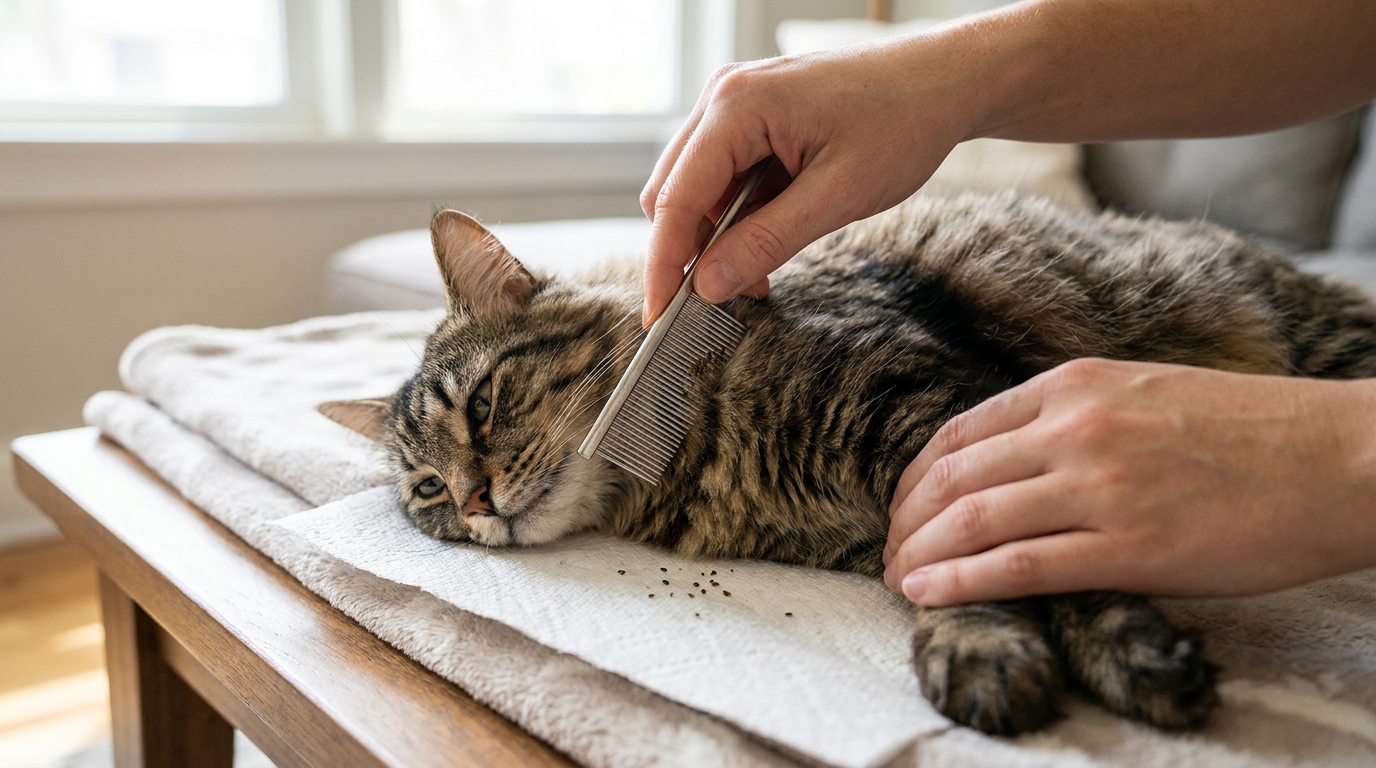
Fleas are still the first suspect when you can't find any. Use this 10-minute check, an itch map and clear ER signs to decide what to do next.
Quick answer: If your cat is itching but you see no fleas, fleas are still the first suspect: allergic cats often groom them away. Flea-comb over white paper and treat every pet with flea control labeled for its species, age and weight. No permethrin dog products near cats. Book a vet for scabs, hair loss, broken skin or several itchy pets. A swollen face, hard breathing or twitching after a flea product needs an ER now.
This article is general information, not a diagnosis. If you think your pet is in danger, go to the nearest emergency animal hospital.
Cat itching but no fleas: start with what you see
Itch in a cat is not only scratching. Licking, chewing and pulling out fur are itch too; bald patches and tiny crusts are clues. Note where your cat itches, when it started, and whether anyone else in the home, pet or person, is itchy.
Not seeing fleas does not mean there are none. In a study of 502 itchy cats seen at skin specialty clinics (Veterinary Dermatology, 2011), flea allergy was the most common single cause, at about 3 in 10. Food allergy, environmental allergy, mites and infections made up most of the rest, and they often look alike, which is why vets rule out fleas first.
Is an itchy cat an emergency?
Most itchy cats can wait for a planned visit. The top rows of this table cannot.
| Sign | What it can mean | How soon |
|---|---|---|
| Swollen face or lips, hives, vomiting, hard breathing, collapse | Allergic reaction | ER now |
| Drooling, twitching or wobbly after a flea product | Flea product poisoning | ER now; call a poison line |
| Pale gums, weak kitten or frail cat with many fleas | Blood loss from fleas | ER now |
| Belly licking, straining, little or no urine | Blocked bladder | ER now |
| Skin scratched raw, bleeding, oozing or a hot swelling | Infection or abscess | Within 24 h |
| Ear itch with a head tilt or lost balance | Middle or inner ear problem | Within 24 h |
| Itchy and not eating for a day | Illness; liver risk | Within 24 h |
| Scabs, hair loss or bald rings | Fleas, allergy, mites, ringworm | Book this week |
| Several pets itching | Fleas or contagious mites | Book this week |
| Mild itch, cat otherwise well | Assume fleas first | Flea check, treat all pets; book if no better |
For a flea-product or essential-oil exposure, call ASPCA Animal Poison Control at (888) 426-4435 (a consultation fee may apply) or Pet Poison Helpline at (855) 764-7661 (per-incident fee) on the way to the ER, and bring the box or tube. Don't bathe a trembling cat or try to make it vomit. If a dog-only flea product went on your cat, or your cat groomed, cuddled or played with a freshly treated dog, go now, even before signs: the ASPCA reports they can start within hours or up to 3 days later.
The Cornell Feline Health Center calls a blocked urethra an absolute emergency (male cats are at higher risk) and warns that cats that stop eating can develop a serious liver disease. Sudden itching with vomiting, drooling, a swollen face or hard breathing can be a severe allergic reaction: go to an ER now. If your cat is vomiting without those signs, see when a cat throwing up white foam is an emergency. If your cat started a thyroid medicine in the last few months and suddenly scratches its face raw, call the prescribing vet within 24 hours (Merck lists this as a serious side effect); if your cat is also lethargic or bruising, see a vet now. Don't stop or change the medicine on your own.
Why it can still be fleas when you never see one
The Merck Veterinary Manual notes that very allergic cats can carry almost no fleas because they groom so much, so fleas and flea dirt are hard to find. VCA Animal Hospitals adds that one or two fleas often leave no visible trace, and a single bite can cause itching for several days. That is why vets treat the response to flea control as the real test.
Indoor cats are not exempt. Merck says fleas ride in on other pets and, unnoticed, on people, and indoor flea problems can run all year. The Companion Animal Parasite Council (CAPC) advises year-round flea control for every cat, for life, with every pet in the home treated.
Tapeworm segments near the tail or in bedding are another clue: they usually mean your cat swallowed fleas while grooming (Cornell notes that fleas carry tapeworm eggs).
The 10-minute check before you call a vet
You need a fine-tooth flea comb, a sheet of white paper and a damp paper towel.
- Comb over white paper. Dr. William Miller Jr., VMD, quoted by Cornell, says cats are bitten mostly on the back of the neck and the top of the tail head, so comb there first.
- Do the wet paper towel test. Flea dirt is reddish-black and comma-shaped, and on a damp paper towel it dissolves to reddish-brown (Merck). Ordinary dirt stays dark.
- Comb every pet. Other pets can carry the fleas that bite your cat.
- Look in the ears for dark debris, redness or crusty edges.
- Write down the flea control: product type, date last given, which pets got it, and whether each is labeled for that species, age and weight.
- Take photos of the itchy spots, comb results and paper towel, and list everything your cat eats.
A clean comb does not rule fleas out.
Where your cat itches is a clue
Use this map as a clue, not a diagnosis: the same patterns show up with fleas, food allergy and environmental allergy.
| Where the itch is | Vets check first | Check at home |
|---|---|---|
| Head, face and neck | Fleas, food allergy, atopic itch, scabies | Scabs, new foods, any lump |
| Ears, head shaking | Ear mites, ear infection, scabies | Redness, hair loss, crusty ear edges |
| Back and tail base | Fleas first: flea allergy, tiny scabs | Flea comb, wet paper towel test |
| Belly, thighs, legs (more licking) | Fleas, allergy, bladder pain | Bald patches, litter box habits |
| Whole body, "walking dandruff" | Fur mites, lice, fleas, ringworm | Moving flakes, itchy bumps on people |
| One spot only | Ringworm, a lump, a wound | Bald ring, broken hairs, a lump |
Tiny crusty bumps along the neck and back, called miliary dermatitis, are a common flea-allergy reaction in cats. Cornell notes they can appear even where the cat hasn't scratched. Feline scabies often starts on the ear edges, head and neck, and it is not unusual in warm climates like Florida.
If it is not fleas: the other usual causes
If a full flea trial on every pet has not settled the itch, vets work through parasites, then infections, then allergies (Merck). More than one cause can be present.
Food allergy. A systematic review in BMC Veterinary Research found food allergy in about 12 to 21% of itchy cats, which is common enough to justify a vet-guided diet trial.
Feline atopic skin syndrome. This is the International Committee on Allergic Diseases of Animals (ICADA) name for itch usually linked to environmental allergens. It can coexist with food allergy. Its 4 patterns are miliary dermatitis, self-induced hair loss, head and neck itch, and eosinophilic granuloma complex. Vets diagnose it only after fleas, other parasites, infections and food allergy are ruled out.
Mites and lice. Merck describes several that spread between pets:
- Ear mites, a common cause of outer-ear itch, redness and hair loss.
- Cheyletiella, the "walking dandruff" mite, very contagious in multi-pet homes. Some cats carry it with no signs.
- Demodex gatoi, which causes a contagious, often itchy mange.
- Notoedres, or feline scabies: highly contagious, with intense itch.
- Lice, which spread between cats. Monthly flea control has made them uncommon in the US; they show up mostly in older long-haired cats that can't groom well.
Ringworm. This fungal skin infection can itch a lot, a little or not at all, and a negative black-light check does not rule it out. Merck describes bald, scaly, crusted patches with broken hairs, most often on the face, ear tips, tail and feet.
Bacterial or yeast infection. Scratching opens the skin to bacteria or yeast, which add their own itch.
Stress overgrooming. Stress is rarely the whole story. In a 2006 Journal of the American Veterinary Medical Association study, 16 of 21 cats referred for "psychogenic" hair loss had a medical cause of itch, most often a food reaction, and only 2 had a purely behavioral problem. Vets call it stress only after other causes are ruled out.
Less common causes. For an older cat with itching plus weight loss, a dermatologist-written table in Today's Veterinary Practice suggests checking for an overactive thyroid, an uncommon cause of itch (see cat hyperthyroidism symptoms and when to see a vet). VCA notes that skin mast cell tumors, firm lumps often on the head, neck or ears, may itch, so any new or growing lump needs a vet.
When two or more pets are itching at once
Several itchy pets point to something contagious: fleas, ear mites, Cheyletiella, scabies, Demodex gatoi or ringworm. Start flea control on every pet now, each with a product labeled for its species, age and weight. In a home with cats, avoid permethrin dog products: the ASPCA Animal Poison Control Center has seen cases where cats were poisoned after playing with a treated dog. For mites or ringworm, a vet confirms the cause and picks treatment for every animal; Merck notes that ear mites survive off the animal for some time. For ringworm, Merck says removing loose hair, vacuuming and washing bedding matter more than disinfectant alone. If your dog is scratching too, see dog scabs on the back: fleas, skin infection or allergy.
People count too. Cheyletiella, feline scabies and ringworm can cause itchy rashes in people, and Cornell notes that fleas can carry Bartonella henselae, the cause of cat-scratch disease. Anyone in the home with itchy red bumps or ring-shaped rashes should see their own doctor.
What not to put on an itchy cat
Dog flea products, especially permethrin. The ASPCA Animal Poison Control Center says concentrated permethrin spot-ons are labeled for dogs only and should never be used on cats, and it names permethrin the most common toxic cause of tremors in cats. Cats can also be poisoned by grooming or cuddling a freshly treated dog. The American Association of Feline Practitioners lists signs from restlessness and drooling to muscle spasms, seizures and death.
Essential oils, including tea tree oil. In an ASPCA Animal Poison Control Center review of 443 dogs and cats exposed to concentrated tea tree oil (JAVMA, 2014), most owners used the oil on purpose, and signs such as drooling, wobbling and tremors began within 2 to 12 hours. Pet Poison Helpline warns that even small amounts of the concentrated oil can seriously poison a cat. As itch remedies, also skip vinegar rinses and dish-soap baths, and never give garlic, which the ASPCA lists as toxic to cats.
Human creams, sprays and pills. Use none unless a vet has examined your cat in person and told you to.
How a vet works out the cause
Some steps take weeks, so don't judge one too early.
| Step | Typical length | What a result means |
|---|---|---|
| Flea control on every pet | At least 4-6 weeks; up to 3 months if the home had fleas | Itch eases: fleas were the cause |
| Skin scrape, tape test, cytology | Same clinic visit | Finds mites, yeast or bacteria |
| Fungal culture | About 2 weeks | Shows if ringworm is there |
| Vet diet trial, then old food back | At least 8 weeks, then up to 2 weeks | Itch returns on old food: food allergy |
| Atopic skin syndrome | Only after all steps above | Found by exclusion; no allergy test proves it |
A board-certified veterinary dermatologist writing in Today's Veterinary Practice advises a flea trial of at least 4 to 6 weeks with all in-contact animals treated and the home vacuumed, and Merck notes that clearing an infestation often takes up to 3 months. A cat still itchy at week 5 in a home that had fleas has not ruled fleas out. Flea control then continues year-round, for life, on every pet.
A diet trial means a vet-chosen diet and nothing else: no treats, flavored chews, table food or hunting. Ask your vet before changing any flavored medicine. A store grain-free or limited-ingredient food is not a diet trial. Never let a cat go without food.
What a video visit can and cannot do for an itchy cat
RexVet is a non-profit telehealth service with one veterinarian, Dr. Tiffany Delacruz, DVM, licensed in Florida, New York and Virginia. A video visit fits a cat that has itched for days or weeks with no fleas you can find and is otherwise well. On camera, she can see where your cat itches and review your flea-comb and paper-towel photos and diet history.
She can lay out a plan for treating every pet and the house with products labeled for each species; a prescription product for another pet means that pet needs its own visit. She can also tell you when skin scrapes or a fungal culture need a clinic nearby.
A prescription is never guaranteed. In Florida, a prescription based only on a video visit must be an FDA-approved animal drug used exactly as labeled, for 14 days at most (up to 1 month for products labeled only for flea and tick control), and it can't be renewed without an in-person exam. Human medicines, controlled drugs and compounded anti-infective drugs need an in-person exam. Federal rules require an in-person exam before any cat gets a drug off-label or a human drug, whatever the state. Virginia allows the exam itself by video, but a prescription still depends on Dr. Delacruz's judgment. New York's telehealth rules are still unsettled. Many cat itch medicines are off-label for cats or need longer courses than a video-only prescription allows. RexVet is not a pharmacy, so if Dr. Delacruz does write a prescription, a pharmacy transfer fee applies when RexVet sends it to an outside pharmacy.
If your cat is in Florida, New York or Virginia, you can book a $64.99 live video visit with Dr. Tiffany Delacruz, DVM, when a slot is open (usually about 8 AM to 11 PM ET). If no slot is open and you are worried, go to an emergency vet instead of waiting.
A video visit does not fit a swollen face, hives or hard breathing; drooling, twitching or seizures after a flea product or a freshly treated dog; deep wounds or bleeding that won't stop; a pale, weak kitten; or straining with little or no urine. Go to an emergency vet, and for a flea-product or essential-oil exposure also call ASPCA Animal Poison Control at (888) 426-4435 (a consultation fee may apply) or Pet Poison Helpline at (855) 764-7661 (per-incident fee).
Need an Expert Opinion on This Topic?
Book a video visit with a licensed vet, evenings and weekends included
See open timesFrequently Asked Questions
Why is my cat so itchy if I can't find fleas?
Fleas can still be the cause. Flea-allergic cats often groom away fleas and flea dirt, and one bite can cause days of itching. Flea allergy is the most common single cause, so vets rule it out first with flea control on every pet.
Can indoor cats get fleas?
Yes. Fleas ride in on dogs, other pets and people, and in warm places such as Florida they can carry on through the winter. The Companion Animal Parasite Council advises year-round flea control for every cat, for life.
Can food make my cat itchy, and how long is a food trial?
Yes, in about 12 to 21% of itchy cats. The test is a vet-chosen elimination diet fed for at least 8 weeks with nothing else. If the itch eases, the old food goes back: most food-allergic cats flare within a week, though your vet may watch for up to 2 weeks. If your cat refuses the new food for about a day, call your vet.
Why is my cat so itchy all of a sudden?
Fleas top the list, even for indoor cats. Mites caught from another pet and a reaction to a medicine started in the last few months are other causes. Itch with a swollen face, hives or hard breathing needs an ER now.
Why is my cat still itchy after flea treatment?
One dose is rarely enough. Fleas already in the home keep hatching, and clearing an infestation often takes up to 3 months. Treat every pet with a product labeled for its species, and vacuum and wash bedding. If the itch continues after at least 4 to 6 weeks, vets move on to skin tests, a fungal culture and a diet trial.
What can I give my cat for itching at home?
Nothing medicated until a vet has seen your cat: no human creams, sprays or pills, no dog flea products and no essential oils, including tea tree oil. You can flea-comb over white paper, put every pet on flea control labeled for its species, wash bedding and vacuum.
FAQs
Why is my cat so itchy if I can't find fleas?
Fleas can still be the cause. Flea-allergic cats often groom away fleas and flea dirt, and one bite can cause days of itching. Flea allergy is the most common single cause, so vets rule it out first with flea control on every pet.
Can indoor cats get fleas?
Yes. Fleas ride in on dogs, other pets and people, and in warm places such as Florida they can carry on through the winter. The Companion Animal Parasite Council advises year-round flea control for every cat, for life.
Can food make my cat itchy, and how long is a food trial?
Yes, in about 12 to 21% of itchy cats. The test is a vet-chosen elimination diet fed for at least 8 weeks with nothing else. If the itch eases, the old food goes back: most food-allergic cats flare within a week, though your vet may watch for up to 2 weeks. If your cat refuses the new food for about a day, call your vet.
Why is my cat so itchy all of a sudden?
Fleas top the list, even for indoor cats. Mites caught from another pet and a reaction to a medicine started in the last few months are other causes. Itch with a swollen face, hives or hard breathing needs an ER now.
Why is my cat still itchy after flea treatment?
One dose is rarely enough. Fleas already in the home keep hatching, and clearing an infestation often takes up to 3 months. Treat every pet with a product labeled for its species, and vacuum and wash bedding. If the itch continues after at least 4 to 6 weeks, vets move on to skin tests, a fungal culture and a diet trial.
What can I give my cat for itching at home?
Nothing medicated until a vet has seen your cat: no human creams, sprays or pills, no dog flea products and no essential oils, including tea tree oil. You can flea-comb over white paper, put every pet on flea control labeled for its species, wash bedding and vacuum.
Medically Reviewed
Reviewed by Dr. Tiffany Delacruz, DVM — licensed veterinarian and CEO of RexVet. Last reviewed October 24, 2026.
Content is for informational purposes and does not replace professional veterinary advice.
Chief Executive Officer · Licensed Veterinarian
Dr. Delacruz is a licensed Doctor of Veterinary Medicine specializing in preventive care and veterinary telehealth. She reviews all health content on RexVet to ensure accuracy and clinical relevance.
Sources & References
- · American Veterinary Medical Association — Telehealth Guidelines
- · AVMA — Pet Care Resources
- · U.S. FDA — Animal & Veterinary