
Cat Hissing at Other Cat After Vet Visit? What to Do Tonight
By RexVet Team | Reviewed by Dr. Tiffany Delacruz, DVM
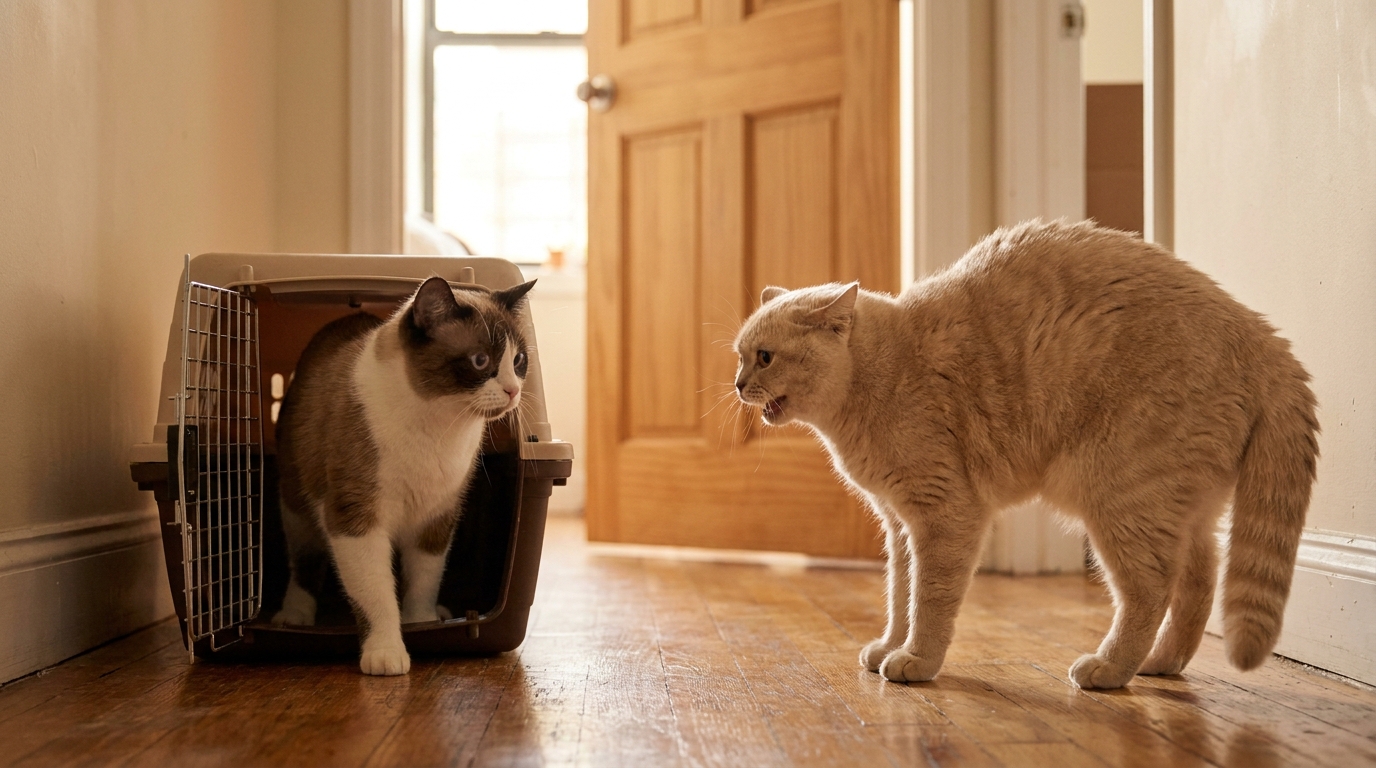
Cat hissing at other cat after vet visit? The cat at home may not recognize the clinic smell. Separate them tonight and reintroduce slowly.
Go to an emergency vet now if either cat is bleeding, breathing hard or can't walk normally after a fight, or if the cat that came home had surgery and its incision was bitten or opened.
Cat hissing at other cat after vet visit: why it happens
The reaction is driven largely by smell. International Cat Care explains that "your cat will have picked up unfamiliar scents whilst at the veterinary clinic." It adds that "these smells may cause anxiety in other cats in your home because they smell strange and/or mask your cat's natural scent, making identifying your cat as part of the group difficult."
In other words, the cat at home may not recognize the cat that came back. Behaviorists call this non-recognition aggression: one cat reacts to a familiar housemate as if it were a stranger, because the housemate no longer smells like home.
The ASPCA describes the same pattern, noting that cats can "get along just fine until something scary or unpleasant (like fireworks or the odor of the veterinary clinic) becomes associated with the other cat." Cornell's feline health center adds that "cats may even attack resident cats that were previously accepted but were away from the home, such as for a hospital stay."
Hissing can come from either cat. The one at home may not recognize the returning cat's smell, and the returning cat may be sore or still recovering from sedation. International Cat Care notes that "some cats experience temporary behavioural changes after anaesthesia which could be perceived negatively by other cats in the household."
Emergency signs: go to an ER now, not a video call
Before anything else, check both cats. Go to an emergency vet now, not a video call, if you see any of these:
- Either cat is bleeding.
- Either cat is breathing hard.
- Either cat can't walk normally after a fight.
- The cat that came home had surgery, and its incision was bitten or has opened.
Any bite puncture, even a tiny one that is not bleeding, needs a vet soon, because cat bites can abscess. A hidden bite can show up later as limping with no visible injury.
Protect yourself, too. Cornell's feline health center warns: "It is crucial that you never put your hand or any other body part between cats that are fighting, as you can be seriously injured."
Separate them tonight
The first step is space. International Cat Care advises: "Keep your cats in separate rooms for a few hours or a day or two and allow some gradual supervised contact." Here is how to set that up tonight:
- Give the returning cat its own room. Cornell says "new or returning cats should be confined to their own room with separate litter box, water, and food."
- Keep things quiet. International Cat Care says: "Don't overwhelm your returning cat with attention from people, other cats or dogs."
- Don't let them settle it. The ASPCA is clear: "Never let the cats 'fight it out.'"
- Give the upset cat space. The ASPCA also advises: "Don't try to calm or soothe your aggressive cat, just leave her alone and give her space."
- Never punish. Cornell warns that "any type of physical punishment can increase a cat's fear or anxiety and worsen aggression."
- Use a barrier. According to Cornell, "using barriers such as baby gates or panels made of cardboard, light wood, or plastic to separate aggressive cats can be very effective."
If a scuffle starts before you can separate them, slide a piece of cardboard or a similar panel between the cats rather than reaching in, then guide each cat to its own room.
Help the returning cat smell like home again
Once the cats are apart, work on the scent. International Cat Care suggests: "Wash bedding from your cat's carrier, as this will remove any smells from the veterinary clinic."
If your cats normally share beds or blankets, International Cat Care recommends that you "offer bedding from shared resting areas to your returning cat in their separate room," adding: "This will help re-establish a familiar smell." The time apart matters as well, since it "also gives your returning cat time to smell familiar again through grooming and interacting within the home."
The ASPCA suggests one more step: "Each day, have the cats switch rooms so that they both experience some variation and get access to each other's scents."
Reintroduce slowly
When the hissing through the door has quieted down, you can start bringing your cats back together. The ASPCA lays out a gradual approach:
- "Place the cats' food bowls on opposite sides of a closed door." Mealtimes then become a calm, pleasant time spent near each other.
- "After several days, if both of your cats appear relaxed, crack the door open one inch."
- If either cat hisses, growls or swats again, the ASPCA says to "separate them again and follow the gradual reintroduction instructions" it gives for a slower restart.
Rewards help. Cornell notes that "food treats are excellent positive enforcers of non-aggressive behavior," so offer a treat when both cats stay calm near each other.
Stay close during these early meetings. International Cat Care advises: "Keep a close eye on your cats when they are reintroduced to ensure all cats are comfortable."
If the hissing turns into a longer standoff, expect a slower process. Cornell says a full reintroduction "can take weeks to months, depending upon the cats involved." That describes a long standoff, not the usual course after a single vet trip, and it is a good time to involve a vet or a behaviorist.
Reading the body language
Body language tells you when to move to the next reintroduction step and when to go back a step. Cornell describes both ends:
- "Signs of aggression include dilated pupils, ears flattened backward on the head, tail held erect with hairs raised, and an arched back."
- "A relaxed cat is not swatting or hissing, has normal sized pupils, ears held upright, and normal tail posture, with the tail held upward with no flicking, twitching, or hairs on end."
If you see the signs of aggression, keep the door closed a little longer. If both cats look relaxed for several days in a row, you can move to the next step. Body language cannot tell you whether a cat is in pain or unwell, though. That question belongs to a veterinarian.
Rule out pain or illness in either cat
Sometimes hissing is a sign that one of the cats is in pain or unwell, and it could be either one. The ASPCA points out that "any sudden change in your cat's behavior could be an indication of an underlying medical condition." Cornell adds that "diseases such as hyperthyroidism, osteoarthritis, dental disease, and central nervous system problems may cause aggression."
Pain is easy to miss. International Cat Care says: "Pain can be difficult to recognise in cats. Signs include loss of appetite, hiding or being withdrawn." If you notice any of these in either cat, contact a veterinarian rather than trying to decide at home whether the cause is behavioral or medical.
If the hissing started without a recent vet trip, see the guide to sudden aggression from pain, fear or illness.
What a RexVet online vet can and cannot do
A video visit lets a veterinarian see your cats at home, without a second carrier trip. On a video call, a RexVet veterinarian can:
- Watch both cats' body language on camera in their own space.
- Look at the returning cat's incision or any scratch on camera.
- Check both cats for signs of pain.
- Build a separation and reintroduction plan with you.
- Recheck by video as you move through the steps.
A video vet cannot feel a bite wound, clean or drain it, or run tests; those need an in-person clinic. Anything on the emergency list above still goes to an emergency vet, not a video call.
If the veterinarian decides medication is appropriate, they can prescribe where state rules allow. In Florida, a veterinarian who has seen your pet only by video may prescribe only FDA-approved animal drugs used as labeled, for up to 14 days (1 month for flea-and-tick-only products), and cannot renew without an in-person exam.
If your cat just came home from a spay or neuter and is also off food, see what's normal when a cat won't eat after a spay.
RexVet's veterinarians are licensed in Florida, New York and Virginia and are available 24/7, including nights, weekends and holidays. A video visit is $64.99, and if you live in one of those three states you can book a RexVet video visit tonight.
Preventing it after the next vet visit
A little planning before the next appointment may help your cat smell more like home when you get back. International Cat Care suggests these carrier steps:
- "Put bedding your cat normally sleeps on at home in the carrier, along with an article of clothing belonging to your cat's favourite person."
- "Wipe a soft cloth around your cat's face to pick up their scent and rub it around the carrier, especially in the corners, then leave it in the carrier."
- "Take some spare bedding (smelling of home) in case your cat is sick or soils the carrier."
Set up the homecoming room before you leave, with its own litter box, water, food and a familiar bed. Then the returning cat can go straight there while the clinic smell fades.
When to get help in person in Florida, New York or Virginia
Separation and a slow reintroduction are the first steps, but some situations need a vet in person. A bitten or opened incision is an emergency, so go to an emergency vet now (see the list above). Book a prompt in-person visit with your regular vet if:
- Either cat has a bite wound, even a small one.
- The fights keep restarting.
- Either cat stops eating, hides or seems withdrawn. International Cat Care lists loss of appetite, hiding or being withdrawn as possible signs of pain.
For fights that keep coming back once any medical cause has been ruled out, the ASPCA says: "Don't hesitate to contact a Certified Applied Animal Behaviorist (CAAB or ACAAB) or a board-certified veterinary behaviorist (Dip ACVB) for guidance."
If you start with a telehealth vet in Florida, state law (Fla. Stat. 474.2021) requires that vet to give you the contact information for at least one physical veterinary clinic near you, so you know where to go for a hands-on exam.
If your cats are still hissing at each other and you want a veterinarian to watch them and help you plan the next steps, you can book a video visit now. RexVet is a 501(c)(3) non-profit, and RexVet's veterinarians are licensed in Florida, New York and Virginia and available 24/7, with video visits at $64.99.
Frequently Asked Questions
Why is my cat hissing at my other cat after the vet?
The cat that went to the clinic comes home carrying unfamiliar smells. International Cat Care explains that these smells can "mask your cat's natural scent," which makes it hard for the other cat to recognize a housemate. Pain or the after-effects of sedation can also play a part, so a vet should check any cat that seems unwell.
How long should I keep my cats apart after a vet visit?
International Cat Care suggests separate rooms "for a few hours or a day or two," followed by gradual supervised contact. If the hissing continues, keep them apart longer and follow the ASPCA's slow, door-by-door reintroduction.
Should I let my cats fight it out?
No. The ASPCA says to "never let the cats 'fight it out.'" Never put your hand between fighting cats, as Cornell warns you can be seriously injured. Slide a piece of cardboard or a similar panel between them, then keep them in separate rooms.
How can I make my cat smell like home again?
International Cat Care recommends washing the bedding from the carrier and giving the returning cat bedding from shared resting spots in its separate room. The time apart also lets your cat groom and smell familiar again.
Can I stop this from happening after the next vet visit?
Yes, you can help by making the carrier smell like home. International Cat Care suggests putting your cat's usual bedding and a piece of your clothing in the carrier, wiping a soft cloth around your cat's face and rubbing it around the carrier, and packing spare bedding for the trip home.
FAQs
Why is my cat hissing at my other cat after the vet?
The cat that went to the clinic comes home carrying unfamiliar smells. International Cat Care explains that these smells can "mask your cat's natural scent," which makes it hard for the other cat to recognize a housemate. Pain or the after-effects of sedation can also play a part, so a vet should check any cat that seems unwell.
How long should I keep my cats apart after a vet visit?
International Cat Care suggests separate rooms "for a few hours or a day or two," followed by gradual supervised contact. If the hissing continues, keep them apart longer and follow the ASPCA's slow, door-by-door reintroduction.
Should I let my cats fight it out?
No. The ASPCA says to "never let the cats 'fight it out.'" Never put your hand between fighting cats, as Cornell warns you can be seriously injured. Slide a piece of cardboard or a similar panel between them, then keep them in separate rooms.
How can I make my cat smell like home again?
International Cat Care recommends washing the bedding from the carrier and giving the returning cat bedding from shared resting spots in its separate room. The time apart also lets your cat groom and smell familiar again.
Can I stop this from happening after the next vet visit?
Yes, you can help by making the carrier smell like home. International Cat Care suggests putting your cat's usual bedding and a piece of your clothing in the carrier, wiping a soft cloth around your cat's face and rubbing it around the carrier, and packing spare bedding for the trip home.
Medically Reviewed
Reviewed by Dr. Tiffany Delacruz, DVM — licensed veterinarian and CEO of RexVet. Last reviewed September 29, 2026.
Content is for informational purposes and does not replace professional veterinary advice.
Chief Executive Officer · Licensed Veterinarian
Dr. Delacruz is a licensed Doctor of Veterinary Medicine specializing in preventive care and veterinary telehealth. She reviews all health content on RexVet to ensure accuracy and clinical relevance.
Sources & References
- · American Veterinary Medical Association — Telehealth Guidelines
- · AVMA — Pet Care Resources
- · U.S. FDA — Animal & Veterinary
Need an Expert Opinion on This Topic?
Connect with a certified vet via video call in minutes
Talk to Vet Now