
Are Antlers, Rawhide and Bones Safe for Dogs? Chew Safety
By RexVet Team | Reviewed by Dr. Tiffany Delacruz, DVM
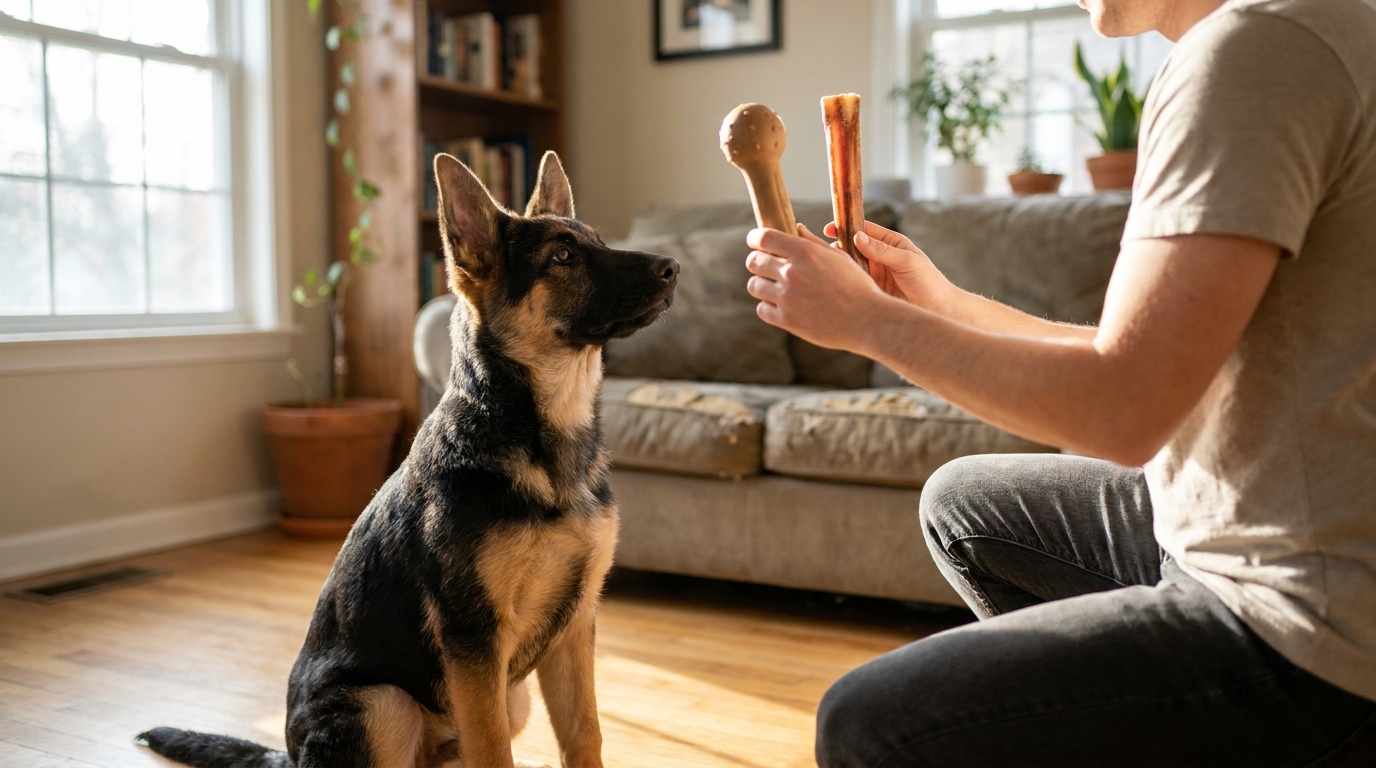
Antlers, real bones and hard nylon can break a dog's teeth, and swallowed pieces can block the gut. Use these tests to pick a safer chew.
Quick answer: Antlers, hooves, real bones and hard nylon bones commonly break dogs' teeth, and cooked or smoked bones can splinter, choke a dog or block the gut. A safer chew dents under a fingernail, bends a little and is sized for your dog. A swallowed bone, rawhide chunk or hard chew piece needs an in-person vet now; choking, retching, any vomiting or a swollen belly means an emergency vet now.
This article is general information, not a diagnosis. If you think your pet is in danger, go to the nearest emergency animal hospital.
Emergency signs after a chew or a swallowed piece
A dog that chokes, paws at its mouth, drools, gags or keeps swallowing after a chew, or retches or vomits even once after swallowing a chew piece, needs an emergency vet now. Also go now for:
- Trouble breathing, or pale or blue gums.
- Bringing food back up, even if water stays down.
- Not eating, weakness, or a swollen, hard or painful belly.
- Straining with little or nothing coming out, black tarry or bloody stool, blood in the vomit, or water that comes back up.
- A bone or chew piece wedged in the mouth or around the lower jaw; don't pull, pry or cut it out.
- A swallowed sharp bone splinter, even with no signs.
A swallowed bone or a piece of antler, hoof or hard nylon means in person now, even if your dog seems fine: your own vet if they can see your dog right away, otherwise an emergency vet. The same goes for a large chunk of rawhide or the end of a bully stick. The FDA notes that signs of a stuck bone or chew can start hours to days later, so don't wait for them (see signs of an intestinal blockage in dogs).
The Merck Veterinary Manual says an object stuck in a dog's esophagus should be removed immediately, by a vet. Never do a blind finger sweep, which can push an object deeper, and a frightened dog can bite. A dog that needed help clearing its airway still needs a vet right away (see a dog that keeps gagging). Don't make your dog vomit, don't give bread, rice, pumpkin, oil, fiber, a laxative or an enema to push a piece through, and don't wait for it to pass.
The thumbnail, bend and size tests for any dog chew
A chew is gentler on a dog's teeth if you can dent it with your fingernail and it bends a little, the thumbnail test that Cornell's Riney Canine Health Center says most veterinary dentists use. AAHA (the American Animal Hospital Association) says a chew your nail can't dent is too hard, and that a chew should be bigger than your dog's snout and slightly wider than its mouth. AAHA advises one size up only for aggressive chewers, and a bigger chew must still dent and bend. Cornell warns that larger chews are harder and may not suit a little dog.
Are antlers safe for dogs? Antlers, hooves and hard nylon
The Merck Veterinary Manual lists antlers, hooves, real bones and hard nylon toys among the objects that can break a dog's teeth, and Cornell's Riney Canine Health Center advises avoiding antlers, hooves and bones. AAHA adds yak milk chews, sticks and rocks. The Merck Veterinary Manual's dental chapter, written by a board-certified veterinary dentist, calls a break of the big upper chewing tooth that exposes the pulp (the nerve and blood supply inside) a "slab" fracture, and exposed pulp does not heal on its own.
Owners often never see the break happen, and the Merck Veterinary Manual says most dogs mask their pain. If your dog chews any of these, lift its lip regularly and check the back teeth for a chip or a pink, red or dark spot. Throw out a nylon chew once pieces break off; Merck says swallowed plastic usually can't be digested.
Are real bones safe for dogs? Cooked, smoked and raw
Real bones are risky chews for dogs whether raw, cooked or smoked: the Merck Veterinary Manual says real bones break teeth regardless of processing, and bones are the most common object stuck in a dog's esophagus.
- Cooked bones, including leftover rib, chicken, turkey and ham bones, can splinter. The FDA warns that sharp bone pieces can injure the mouth, esophagus and stomach.
- Smoked or baked bone treats are still real bones. In a 2017 consumer update, the FDA said illnesses reported in dogs after store-bought smoked or baked bone treats included choking, blockages, mouth wounds and deaths.
- Raw bones carry the same tooth and blockage risks, and the FDA warns that raw pet foods can carry Salmonella and Listeria, which can also sicken people.
For holiday table bones, see turkey skin, bones and leftovers.
Is rawhide bad for dogs?
Rawhide's main risk to a dog is choking or a blockage: the Merck Veterinary Manual says rawhide can lodge in the esophagus, and a 114-dog study in the Journal of Veterinary Emergency and Critical Care found rawhide was the second most common stuck object after bone. Most of those dogs were small, and the authors call a stuck object a medical emergency; the longer it stays, the more damage it does. AAHA also lists rawhide among chews that can damage or fracture teeth, and Cornell's Riney Center says some rawhides are safe but always need supervision.
If you give rawhide, stay with your dog while it chews, pick one bigger than its snout, take it away once it is small enough to swallow, and skip rawhide for a dog that gulps. A swallowed large chunk means an in-person vet now.
Bully sticks, pig ears and dental chews: calories and germs
Bully sticks are softer than antlers but carry calories and germs: a 2013 Canadian Veterinary Journal study found bully sticks had 9 to 22 calories per inch, and some carried bacteria, including E. coli; single sticks carried C. difficile or MRSA. The authors advise hand-washing after handling them, and say very young, elderly, pregnant and immunocompromised people should avoid raw animal-product treats. AAHA says hooves, pig ears and bully sticks may carry bacteria, including Salmonella and E. coli, that can also harm people in the home. Take a bully stick away before the end is small enough to swallow.
The Veterinary Oral Health Council (VOHC) seal means a product met VOHC standards for slowing plaque or tartar; it is not a safety rating. Even a chew with the VOHC seal can cause a blockage; VOHC says the right size for your dog's weight and supervision lower that risk.
Which chews are safest for dogs?
For most dogs, a chew that dents under a fingernail and bends a little, such as a firm rubber toy or a dental chew sized for the dog's weight, is lower-risk than antlers, hooves, hard nylon or real bones, though no chew is risk-free.
| Chew | Main risk | Verdict |
|---|---|---|
| Antler | Broken teeth | Skip |
| Hoof | Broken teeth, germs | Skip |
| Hard nylon bone | Broken teeth | Skip |
| Yak chew | Broken teeth | Skip |
| Cooked bone | Splinters, blockage | Never |
| Smoked bone treat | Choking, blockage | Avoid |
| Raw bone | Teeth, gut, germs | Avoid |
| Rawhide | Choking, teeth | Supervise |
| Bully stick | Swallowed end, germs | Supervise |
| Pig ear | Salmonella | Supervise |
| VOHC dental chew | Can still block | Right size, supervise |
| Firm rubber toy | Swallowed bits | Lower risk if it dents |
Signs a dog broke a tooth on an antler, bone or chew
A pink or red spot in a dog's broken tooth usually means the nerve is exposed: call a vet right away and plan to be seen within 1 to 2 days. The Merck Veterinary Manual says treatment that can keep a broken tooth alive works best when done as soon as possible, ideally within 24 to 48 hours. A dark or black spot can mean the nerve was exposed and has died; it is not the milder version and still needs a vet soon. Neither spot alone is an ER sign.
The Merck Veterinary Manual's signs of a broken tooth include a tooth the dog won't let you touch, a reddish-brown, purple or gray tooth, a red or black hole on the crown, facial swelling and eating less. Cornell's Riney Center adds avoiding cool water or chew toys, refusing hard treats, and leaving the food bowl without eating. Chewing on one side and dropping food also call for a vet visit; use a lift-the-lip check to look. Pawing at the mouth after a chew means an emergency vet now, and so does not eating if your dog may have swallowed a piece of the chew.
| What you see | What it may mean | When to act |
|---|---|---|
| Chip, no spot, no pain | Shallow chip | Vet check soon |
| Pink or red dot | Exposed pulp | Call now; seen in 1-2 days |
| Dark or black dot | Dead pulp | Vet soon, not ER |
| Face or under-eye swelling | Tooth root abscess | ER now |
| Heavy bleeding, mouth won't close | Mouth injury | ER now |
| Break after a car, fall or blow | Trauma | ER now |
A broken tooth is fixed in person: Cornell says treatment starts with dental X-rays with the dog sedated, and the Merck Veterinary Manual says exposed pulp is treated with either a root canal or an extraction. Antibiotics or pain medicine alone do not fix it; never give a dog human pain relievers such as acetaminophen, ibuprofen or aspirin.
Safe chew rules for aggressive chewers and holiday stockings
Before a chew goes in a dog's stocking, check that it dents under a fingernail, bends a little and is bigger than your dog's snout, and give it only while you can watch. The FDA warns against letting a dog gobble a stocking full of treats at once, because unchewed treats can get stuck in the windpipe or the gut.
- Give one chew at a time, and take it away once it is small enough to swallow.
- For an aggressive chewer, pick a firm rubber toy one size up that still dents and bends.
- Skip new chews for a dog that gulps.
- Keep gift wrap and ribbon out of reach; a swallowed ribbon means the ER now (see dog ate string, tinsel or ribbon).
Dry retching with a swollen, hard belly after a gulped chew means an emergency vet now, because it can be a blockage or bloat.
When a video visit helps with a broken tooth or chew
RexVet, a nonprofit online vet service, can help by video when a dog has chipped or cracked a tooth, is chewing on one side or needs a safer chew, but a dog that may have swallowed a chew piece needs an in-person vet now. RexVet serves pets located in Florida, New York and Virginia by video visit, and every visit is with a veterinarian licensed in your pet's state. Your pet must be in one of those states during the visit.
Book a $64.99 live video visit with a licensed RexVet vet. Live video slots run from about 8 AM to 11 PM ET; there are no overnight visits, and a same-day slot is not guaranteed.
The veterinarian looks at the tooth on camera (lift the lip in good light, and have a clear photo of the break on your phone ready to show), judges whether the break looks pink, red or dark, which point to an exposed or dead nerve, and tells you how soon your dog needs an in-person dental exam; only an in-person exam with dental X-rays can confirm it. They can also check the gums for swelling and help you choose chews that fit your dog.
A broken tooth with an exposed nerve is treated in person, usually with a root canal or an extraction under anesthesia with dental X-rays; a shallow chip may only need monitoring, but only an in-person exam can confirm that. Antibiotics or pain medicine do not fix a broken tooth.
A dog that may have swallowed a piece of bone, antler, hoof or hard nylon, a large piece of rawhide or the end of a bully stick needs to be seen in person now for X-rays, even if it is eating, pooping and acting normal; a video visit cannot rule out a blockage. Go to an emergency vet now for choking or any trouble breathing; pawing at the mouth, drooling, gagging, repeated swallowing or bringing food back up after a bone, rawhide or chew; retching or any vomiting after a swallowed piece; not eating or weakness; a swollen or painful belly; straining with little or nothing coming out; black, tarry or bloody stool; a piece wedged in the mouth or jaw (don't pull it out); or mouth bleeding that won't slow with gentle pressure, face or under-eye swelling, a mouth that won't close, or a tooth broken by a car, a fall or a hard blow. If no slot is open or signs get worse, go to an emergency vet.
No prescription is promised; any medicine is the veterinarian's decision after the visit, and the state limits are in the FAQ below.
Need an Expert Opinion on This Topic?
Book a video visit with a licensed vet, evenings and weekends included
See open timesFrequently Asked Questions
Are antlers good for dogs' teeth?
No. The Merck Veterinary Manual lists antlers among the objects that can break a dog's teeth, and Cornell's Riney Canine Health Center advises avoiding them. If your dog has chewed antlers, lift the lip and look for a chip or a pink, red or dark spot, and call a vet right away if you see one. A swallowed piece of antler means an in-person vet now.
My dog swallowed a piece of a bone or antler. What should I do?
Get your dog seen in person now for X-rays, even if it seems fine: your own vet if they can see your dog right away, otherwise an emergency vet. The same applies to a piece of hoof or hard nylon, a large chunk of rawhide or the end of a bully stick. A sharp bone splinter means the ER now. Any vomiting, retching with nothing coming up, not eating, weakness, a swollen or painful belly, or straining with little or nothing coming out means an emergency vet now. The FDA notes that signs of a stuck bone or chew can start hours to days later, so don't wait for them. Don't make your dog vomit, don't reach down its throat, and don't give bread, rice, pumpkin, oil, fiber, a laxative or an enema to push the piece through.
How long should I let my dog chew a bone?
No chewing time makes a real bone safe for a dog: the Merck Veterinary Manual says real bones break teeth whether raw, cooked or smoked. Pick a chew that dents under a fingernail and bends a little instead. Watch your dog the whole time, and take any chew away once it is small enough to swallow. Never give cooked bones, which can splinter.
Are pig ears safe for dogs?
Pig ears can carry Salmonella, so never feed a recalled one, watch your dog while it eats, and wash your hands after handling it. The CDC reported that a 2019 Salmonella outbreak linked to pig ear dog treats sickened 154 people in 34 states and put 35 in the hospital. That outbreak is over, and the CDC and FDA dropped their warning except for recalled treats. The FDA also says to keep pig ears away from small children and clean where they touched. See a vet promptly for diarrhea, fever, a poor appetite or low energy afterward; if your dog swallowed a chunk, any vomiting, not eating, a swollen or painful belly, or bloody or black stool means an emergency vet now.
Are hard nylon bones safe for dogs?
Not for a dog's teeth if you can't dent them with a fingernail. The Merck Veterinary Manual lists hard nylon toys among the objects that can fracture teeth. A safer chew dents under your fingernail and bends a little. Throw it out once pieces start breaking off, since a swallowed piece means an in-person vet now.
Can puppies have rawhide?
No veterinary rule sets a safe age for rawhide. If you give a puppy one, choose one bigger than its snout and watch the whole time. Cornell's Riney Canine Health Center notes that larger chews are harder, so the chew should be too big to swallow but still dent under a fingernail. Gagging, drooling or bringing food back up after a chew means an emergency vet now.
Can an online vet check my dog's broken tooth in Florida, New York or Virginia?
Partly: a video visit can check a chipped or broken tooth and say how urgent it is, but X-rays and treatment need an in-person vet. Your dog must be located in Florida, New York or Virginia during the visit, and the visit is with a veterinarian licensed in your pet's state. On camera, the veterinarian can look at the break and the gums, judge whether the break looks pink, red or dark, and tell you how soon your dog needs a dental exam. Any swallowed chew piece needs an in-person vet now, even if your dog seems fine, and heavy mouth bleeding, face or under-eye swelling, or a mouth that won't close means the ER now. If medicine comes up, no prescription is promised. In Florida, s.474.2021 limits telehealth-only prescriptions to FDA-approved animal drugs used on-label, for up to 14 days (1 month for products labeled only for fleas and ticks), with no renewal without an in-person exam and no human-labeled, controlled or compounded anti-infective drugs. Federal rules allow a human medicine or off-label drug use only after a vet has examined the animal in person. Virginia allows the exam to be electronic. New York's telehealth prescribing rules are not settled. RexVet is not a pharmacy; if you ask RexVet to send a prescription to an outside pharmacy, a pharmacy transfer fee applies.
FAQs
Are antlers good for dogs' teeth?
No. The Merck Veterinary Manual lists antlers among the objects that can break a dog's teeth, and Cornell's Riney Canine Health Center advises avoiding them. If your dog has chewed antlers, lift the lip and look for a chip or a pink, red or dark spot, and call a vet right away if you see one. A swallowed piece of antler means an in-person vet now.
My dog swallowed a piece of a bone or antler. What should I do?
Get your dog seen in person now for X-rays, even if it seems fine: your own vet if they can see your dog right away, otherwise an emergency vet. The same applies to a piece of hoof or hard nylon, a large chunk of rawhide or the end of a bully stick. A sharp bone splinter means the ER now. Any vomiting, retching with nothing coming up, not eating, weakness, a swollen or painful belly, or straining with little or nothing coming out means an emergency vet now. The FDA notes that signs of a stuck bone or chew can start hours to days later, so don't wait for them. Don't make your dog vomit, don't reach down its throat, and don't give bread, rice, pumpkin, oil, fiber, a laxative or an enema to push the piece through.
How long should I let my dog chew a bone?
No chewing time makes a real bone safe for a dog: the Merck Veterinary Manual says real bones break teeth whether raw, cooked or smoked. Pick a chew that dents under a fingernail and bends a little instead. Watch your dog the whole time, and take any chew away once it is small enough to swallow. Never give cooked bones, which can splinter.
Are pig ears safe for dogs?
Pig ears can carry Salmonella, so never feed a recalled one, watch your dog while it eats, and wash your hands after handling it. The CDC reported that a 2019 Salmonella outbreak linked to pig ear dog treats sickened 154 people in 34 states and put 35 in the hospital. That outbreak is over, and the CDC and FDA dropped their warning except for recalled treats. The FDA also says to keep pig ears away from small children and clean where they touched. See a vet promptly for diarrhea, fever, a poor appetite or low energy afterward; if your dog swallowed a chunk, any vomiting, not eating, a swollen or painful belly, or bloody or black stool means an emergency vet now.
Are hard nylon bones safe for dogs?
Not for a dog's teeth if you can't dent them with a fingernail. The Merck Veterinary Manual lists hard nylon toys among the objects that can fracture teeth. A safer chew dents under your fingernail and bends a little. Throw it out once pieces start breaking off, since a swallowed piece means an in-person vet now.
Can puppies have rawhide?
No veterinary rule sets a safe age for rawhide. If you give a puppy one, choose one bigger than its snout and watch the whole time. Cornell's Riney Canine Health Center notes that larger chews are harder, so the chew should be too big to swallow but still dent under a fingernail. Gagging, drooling or bringing food back up after a chew means an emergency vet now.
Can an online vet check my dog's broken tooth in Florida, New York or Virginia?
Partly: a video visit can check a chipped or broken tooth and say how urgent it is, but X-rays and treatment need an in-person vet. Your dog must be located in Florida, New York or Virginia during the visit, and the visit is with a veterinarian licensed in your pet's state. On camera, the veterinarian can look at the break and the gums, judge whether the break looks pink, red or dark, and tell you how soon your dog needs a dental exam. Any swallowed chew piece needs an in-person vet now, even if your dog seems fine, and heavy mouth bleeding, face or under-eye swelling, or a mouth that won't close means the ER now. If medicine comes up, no prescription is promised. In Florida, s.474.2021 limits telehealth-only prescriptions to FDA-approved animal drugs used on-label, for up to 14 days (1 month for products labeled only for fleas and ticks), with no renewal without an in-person exam and no human-labeled, controlled or compounded anti-infective drugs. Federal rules allow a human medicine or off-label drug use only after a vet has examined the animal in person. Virginia allows the exam to be electronic. New York's telehealth prescribing rules are not settled. RexVet is not a pharmacy; if you ask RexVet to send a prescription to an outside pharmacy, a pharmacy transfer fee applies.
Medically Reviewed
Reviewed by Dr. Tiffany Delacruz, DVM — licensed veterinarian and CEO of RexVet. Last reviewed November 4, 2026.
Content is for informational purposes and does not replace professional veterinary advice.
Chief Executive Officer · Licensed Veterinarian
Dr. Delacruz is a licensed Doctor of Veterinary Medicine specializing in preventive care and veterinary telehealth. She reviews all health content on RexVet to ensure accuracy and clinical relevance.
Sources & References
- · American Veterinary Medical Association — Telehealth Guidelines
- · AVMA — Pet Care Resources
- · U.S. FDA — Animal & Veterinary