
Senior Dog Panting and Restless at Night: When to Worry
By RexVet Team | Reviewed by Dr. Tiffany Delacruz, DVM
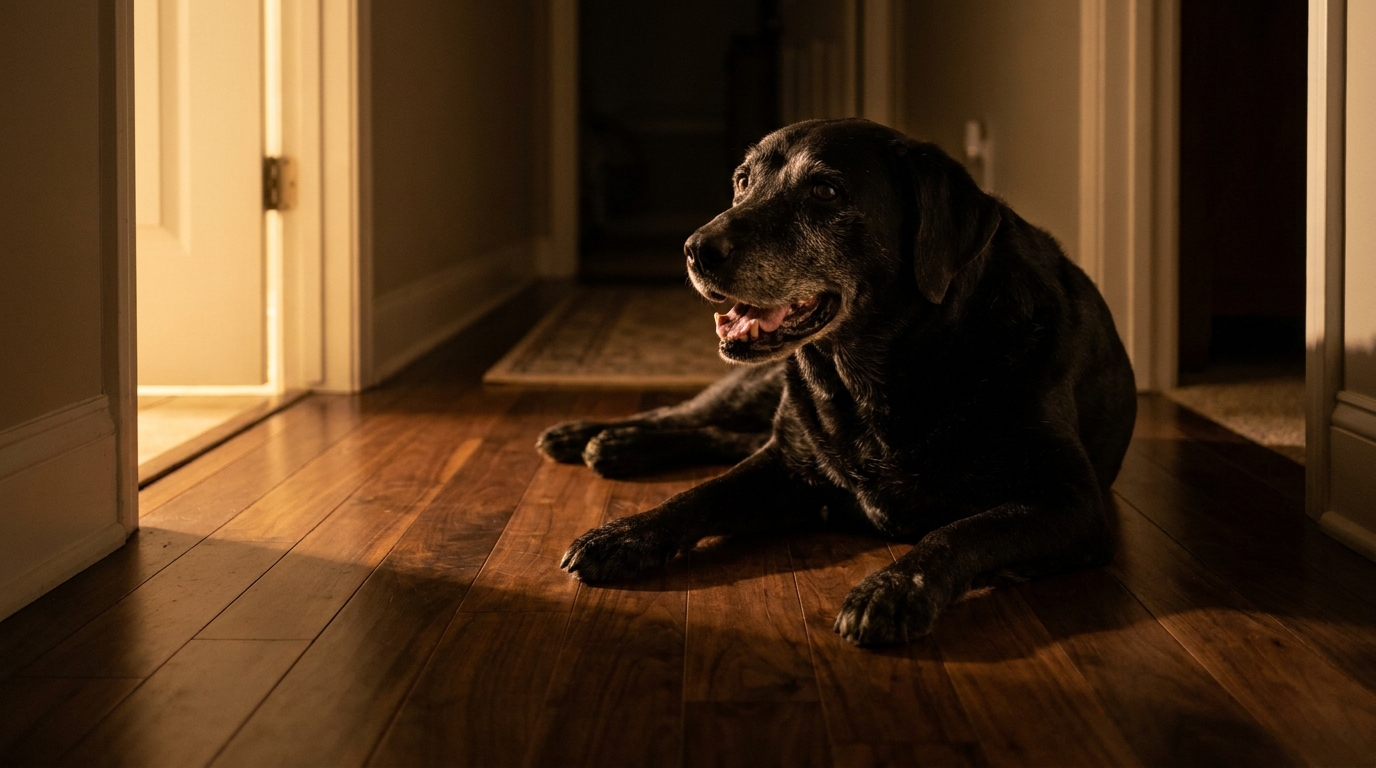
Why an older dog pants and can't settle at night, which signs mean the ER, and how to check breathing, gums and comfort at home.
Quick answer: A senior dog that pants and can't settle at night may have arthritis pain, cognitive dysfunction (dog dementia), Cushing's disease, or heart or airway trouble. Once it sleeps, count breaths: if repeat sleeping counts stay above 30 a minute, see a vet in person today. Labored breathing at rest, new panting that won't settle in a cool room, or gray, blue or pale gums mean an emergency vet now.
This article is general information, not a diagnosis. If you think your pet is in danger, go to the nearest emergency animal hospital.
Emergency signs: when to stop reading and go now
Go to an emergency vet now if your senior dog breathes with effort or keeps breathing with its mouth open at rest in a cool room, breathes fast and won't lie down, stretches its neck out to breathe, has gray, blue, pale or white gums or tongue, collapses, or has a swollen belly or retching that brings nothing up. If breathing takes effort, don't wait for the gums to change color. Also go now for:
- Belly heaving, flared nostrils or elbows held out at rest.
- Pink or frothy fluid from the nose or mouth, or new raspy or wheezing breathing at rest.
- Fainting, or being hard to wake.
- Sudden weakness with pale gums or fast breathing; Cornell's Riney Canine Health Center notes a bleeding spleen or heart tumor in an older, large-breed dog can cause this.
- A cough with fast breathing in a dog with heart disease.
- New panting that won't settle in a cool room or after heat or exercise, or panting with lethargy. Move your dog somewhere cool, wet the coat with cool, not icy, water, and go.
- In a large, deep-chested dog, restlessness with drooling, fast breathing, a tight belly or retching that brings nothing up, especially after a big meal; the Merck Veterinary Manual lists restlessness among bloat signs.
- Sudden labored breathing in a dog with Cushing's disease or on long-term steroids, which Merck links to blood clots in the lungs.
- A seizure lasting 5 minutes or more, two or more seizures in 24 hours, or a dog not back to normal after one.
- Sudden back-leg weakness or dragging, straining with little or no urine, or crying while trying to pee.
In the 4 days after a fatty holiday meal, a painful or swollen belly, hunching, weakness or collapse means the ER, and refusing food means an in-person vet today (see pancreatitis signs after a dog eats grease or fat).
For a swallowed medicine or toxin, go to the ER and call the ASPCA Animal Poison Control Center at (888) 426-4435 (a consultation fee may apply) or Pet Poison Helpline at (855) 764-7661 (a per-incident fee applies) on the way. Do not make your dog vomit unless a vet or poison line tells you to.
A sudden head tilt, circling or new confusion in a dog that breathes normally, a first-ever short seizure, or a dog that suddenly stops eating or drinking needs an in-person vet the same day, at an emergency hospital if your regular clinic is closed, including over the holidays. A dog that suddenly cannot get up or walk, or drags its back legs, needs an emergency vet now.
Why do senior dogs pant and get restless at night?
A senior dog may pant and get restless at night because of pain, age-related changes in the brain's sleep-wake cycle, or an illness that is easier to notice when the house is quiet, and the ASPCA advises a vet exam first.
The ASPCA notes that an older dog that newly paces, pants and seeks attention at night may have an undiagnosed medical problem, and it names arthritis, dental disease, hypothyroidism, cancer, vision or hearing loss, urinary tract disease and Cushing's disease as causes to rule out. VCA Hospitals lists restlessness as a heart and breathing warning sign, so count sleeping breaths before blaming age.
What the clue points to
| What you see | Points to | Next step |
|---|---|---|
| Slow to lie down, stiff after rest | Pain | Vet this week |
| Wanders, stares, stuck in corners | Dementia | Vet this week |
| Drinks and pees more, pot belly | Cushing's | Vet this week |
| Unspayed female, drinks more, ill | Pyometra | Vet now |
| Raspy breath on walks, bark change | Airway | Vet today |
| Sleeps on chest, counts over 30 | Heart or lungs | In-person vet today |
| Heart dog, cough with fast breathing | Heart | ER now |
| New panting, won't settle, cool room | Heat or illness | ER now |
| Deep-chested, restless, drooling or tight belly | Bloat | ER now |
| Labored breathing, gray or pale gums | Emergency | ER now |
If more than one row fits, follow the most urgent.
Is it pain? Signs that point to arthritis
A senior dog that is slow to lie down or get up, shifts position often, licks a sore joint, or is stiffer after rest or in cold weather may be in arthritis pain and should see a vet this week.
Cornell lists trouble getting up, stiffness and reluctance to walk as osteoarthritis signs, and the Merck Veterinary Manual lists restlessness, trouble getting comfortable, a change in breathing and licking a sore area as pain signs. Cold can add stiffness (see why dog arthritis can seem worse in cold weather).
From RexVet's visit data: Arthritis and joint concerns were named in 15% of RexVet visits for pets 11 or older, versus about 1% for pets under 7.
Never give a human pain reliever, a leftover prescription or another pet's medicine; the FDA warns that human pain relievers can cause ulcers and kidney or liver failure in pets. Call a vet first; see why human pain relievers are dangerous for dogs. Pain that a prescribed medicine no longer controls needs an in-person exam the same day.
Is it dog dementia (cognitive dysfunction)?
Dog dementia (canine cognitive dysfunction) is more likely when night restlessness comes with daytime sleeping, wandering, staring, getting stuck in corners or new house accidents, and it is diagnosed only after pain and illness are ruled out.
Cornell says dogs may start to develop it around age 9 or older, and a vet diagnoses it after an exam, with blood and urine tests to rule out pain, seizure disorders, other illness and vision or hearing loss. The 2023 AAHA Senior Care Guidelines list daytime sleeping and nighttime restlessness among the most common signs.
Restlessness with fast or effortful breathing is not a dementia sign; it means an emergency vet now.
Could it be the heart or the airway?
Heart disease, including heart failure, can make a senior dog breathe fast and get restless at night, and repeat sleeping breath counts above 30 a minute, which VCA calls abnormal, mean an in-person vet today.
Tufts HeartSmart notes that a dog with heart disease may sleep poorly, sleep on its chest instead of its side, or wake and seek fresh air near a window.
VCA puts a normal resting or sleeping rate at 15 to 30 breaths a minute; see how to count a dog's sleeping breaths.
If your dog has a heart diagnosis and its counts climb above its usual number, even under 30, call the vet or cardiologist who manages its heart care today, or an emergency vet if that clinic is closed. Never change heart medicine on your own.
Cornell says laryngeal paralysis, most common in older, large-breed dogs, causes raspy breathing, heavy panting, a bark change and poor heat tolerance. Raspy breathing that suddenly gets worse, often with excitement, stress, exercise or heat, or that comes with blue gums or tongue or collapse, means an emergency vet now. Raspy breathing with a fever, persistent cough, lethargy or no appetite can mean aspiration pneumonia and needs a vet immediately.
Could it be Cushing's disease, thirst or a full bladder?
In a senior dog, panting with heavy drinking, more peeing, a pot belly or a thinning coat points toward Cushing's disease or another hormone or kidney problem, which needs bloodwork.
The Merck Veterinary Manual says Cushing's disease tends to occur in middle-aged to older dogs and lists increased thirst and urination, a bigger appetite, heat intolerance, a pot belly, panting and hair loss.
An unspayed female that is drinking much more and seems ill needs a vet now, or the ER if the clinic is closed; VCA warns of pyometra, a uterine infection. Frequent night pee trips or blood in the urine need a vet visit, and straining with little or no urine means an emergency vet now.
Could it be medication, nausea, heat or stress?
Steroid medicines, nausea, a warm room or heated bed, holiday guests, noise, and fading hearing or sight can all keep an older dog panting at night.
- Steroids: VCA lists panting and thirst as short-term side effects. Never stop or change a steroid on your own; call the prescribing vet, and see when drinking and peeing a lot on prednisone needs a call.
- Nausea: lip licking, drooling or gulping with restlessness can mean an upset stomach; call your vet today. In a large, deep-chested dog, or after a big meal, or with a tight belly, fast breathing or retching that brings nothing up, go to the ER now.
- Heat: Cornell lists older dogs and dogs with breathing or heart disorders as higher risk for heatstroke; keep the room cool and skip the heated bed.
- Guests and noise: visitors and doorbells can unsettle an older dog; offer a quiet room.
- Hearing or sight loss: the ASPCA lists both among causes to rule out.
How to check your dog tonight
To check a senior dog tonight, look at gum color, count sleeping breaths for 30 seconds and double it, take a 30- to 60-second video, and note the time, room temperature, water and pee trips.
- Count only a dog that is breathing easily; any effort means the ER, not counting.
- Check the gums only if your dog is calm, by gently lifting the lip. Pink is normal; if your dog's gums are naturally dark, check a pink patch of gum or the tongue, and compare with its usual color. Never force the mouth open.
- Count in deep sleep in a cool room; use a full 60 seconds if the rhythm is irregular. Repeat 2 or 3 times, and film the sleep from the side.
3-night log
| Night | Sleep count (per min) | Notes |
|---|---|---|
| 1 | ___ / ___ / ___ | Panting? Pacing? Water? Pee trips? |
| 2 | ___ / ___ / ___ | Room temp? Gums pink? Cough? |
| 3 | ___ / ___ / ___ | Stiff? Confused? Usual count: ___ |
What helps a senior dog settle at night?
A cool, dimly lit room, a last bathroom trip, a supportive bed, non-slip footing, water nearby and a steady routine help many older dogs settle.
The 2023 AAHA Senior Care Guidelines suggest well-padded bedding, secure rugs or mats over slippery floors, temperature control, nightlights and sound machines. Never give a sleep aid, supplement, human medicine or leftover prescription without your veterinarian.
When a video visit fits, and when it does not
For a senior dog in Florida, New York or Virginia that pants or paces at night but settles in a cool room, breathes without effort, has pink gums and keeps sleeping breath counts under 30, RexVet, a nonprofit online vet service, offers a $64.99 live video visit with a veterinarian licensed in the dog's state, about 8 AM to 11 PM Eastern, to decide whether it needs an in-person exam and how soon.
RexVet serves pets located in Florida, New York and Virginia by video visit, and your dog must be in one of those states during the visit. Borderline counts, meaning counts creeping up toward 30 or one count above 30 that drops back on recount, also fit if your dog is comfortable. From RexVet's visit data: 28% of RexVet video visits started between 6 PM and 11 PM in the pet owner's local time.
On camera, a licensed RexVet vet can watch your dog walk, lie down and breathe, review your log and videos, and ask about drinking, peeing, coughing, appetite and confusion. A video visit cannot listen to the heart or lungs, measure blood pressure, take X-rays, run tests, feel the belly, diagnose heart failure or Cushing's disease, or start or change heart medicine.
No prescription is promised; any medicine is the veterinarian's decision under state rules. In Florida, a video-only prescription is limited to FDA-approved animal drugs used as labeled, for up to 14 days for most drugs, with no renewal without an in-person exam; human-labeled, controlled and compounded anti-infective drugs need an in-person exam, and federal rules require an in-person exam for any human or off-label drug. Virginia allows an electronic exam, and New York's rules are unsettled. RexVet is not a pharmacy, and a pharmacy transfer fee applies when RexVet sends a prescription to an outside pharmacy.
Repeat sleeping counts above 30 with no effort mean an in-person vet today, or an emergency vet if none can see your dog. A heart dog with climbing counts needs a same-day call to its heart vet, not a video visit. A sudden head tilt, first short seizure, or a sudden refusal to eat or drink needs an in-person vet the same day; a dog that suddenly cannot get up or walk needs an emergency vet now.
Labored breathing at rest, new panting that will not settle in a cool room, restlessness with fast breathing, gray, blue or pale gums, collapse, retching that brings nothing up or a swollen belly, a seizure lasting 5 minutes or more or two or more in 24 hours, or a swallowed medicine or toxin means an emergency vet now, not a video call; for a toxin, call a poison line above on the way.
There are no RexVet video visits outside about 8 AM to 11 PM Eastern, and a same-day slot is not guaranteed. Overnight, any emergency sign means an emergency vet now, while a comfortable dog with sleeping counts under 30 can wait for a daytime visit. Book a live video visit with a licensed RexVet vet.
What will a vet check?
At an in-person exam, a senior dog that pants at night usually gets heart and lung listening, a blood pressure check, bloodwork with a thyroid test, a urine test, and chest X-rays or heart tests when heart or lung disease is suspected.
The 2023 AAHA Senior Care Guidelines call a detailed blood profile with a thyroid panel, plus a urinalysis, the minimum workup for every senior pet. Bring your night log, videos and medicine list.
Need an Expert Opinion on This Topic?
Book a video visit with a licensed vet, evenings and weekends included
See open timesFrequently Asked Questions
Why is my old dog panting at night when it is not hot?
Pain, dog dementia, Cushing's disease, heart or airway disease, steroid medicines and stress are possible reasons, so a vet should look for the cause. New panting that won't settle in a cool room, or labored breathing, means an emergency vet now; once your dog sleeps, repeat counts above 30 a minute mean an in-person vet today.
Is panting at night a sign my senior dog is dying?
Not on its own. Pain and hormone problems can cause night panting and can often be managed, so book a vet check soon. Tufts HeartSmart notes that in pets with heart disease, difficulty breathing, low energy or changed sleep can mean quality of life is slipping; this quality-of-life guide can help. Labored breathing, collapse, or gray, blue or pale gums mean an emergency vet now.
Is panting a sign of pain in older dogs?
Yes, it can be. The Merck Veterinary Manual lists restlessness, trouble getting comfortable and a change in breathing among signs of pain in pets. Never give a human pain reliever or a leftover prescription; call a vet first.
Can dementia make a dog pant at night?
Possibly, but a vet must first rule out pain, heart disease and hormone problems, which also cause panting. The 2023 AAHA Senior Care Guidelines list nighttime restlessness among the most common signs of cognitive dysfunction. Restlessness with fast or labored breathing means an emergency vet now, not dementia.
Can I give my senior dog something to help it sleep at night?
Not on your own; ask your veterinarian first, and never give a human sleep aid, a supplement or a leftover prescription. Federal rules require a veterinarian who has examined your dog in person before a human medicine, or an animal drug used off its label, is given.
Can an online vet help if my senior dog pants at night in Florida, New York or Virginia?
Yes, if your dog breathes without effort, has pink gums and settles in a cool room; labored breathing or collapse needs an emergency vet now. On camera, a licensed RexVet vet can watch your dog move and breathe, review your log and videos, and say how soon an in-person exam is needed. Heart and lung listening, bloodwork and X-rays need an in-person visit, as do repeat sleeping counts above 30. No prescription is promised: Florida limits video-only prescriptions to FDA-approved animal drugs used as labeled, for up to 14 days for most drugs, with no renewal without an in-person exam; federal rules require an in-person exam for human or off-label drugs; Virginia allows an electronic exam, and New York's rules are unsettled.
FAQs
Why is my old dog panting at night when it is not hot?
Pain, dog dementia, Cushing's disease, heart or airway disease, steroid medicines and stress are possible reasons, so a vet should look for the cause. New panting that won't settle in a cool room, or labored breathing, means an emergency vet now; once your dog sleeps, repeat counts above 30 a minute mean an in-person vet today.
Is panting at night a sign my senior dog is dying?
Not on its own. Pain and hormone problems can cause night panting and can often be managed, so book a vet check soon. Tufts HeartSmart notes that in pets with heart disease, difficulty breathing, low energy or changed sleep can mean quality of life is slipping; this quality-of-life guide can help. Labored breathing, collapse, or gray, blue or pale gums mean an emergency vet now.
Is panting a sign of pain in older dogs?
Yes, it can be. The Merck Veterinary Manual lists restlessness, trouble getting comfortable and a change in breathing among signs of pain in pets. Never give a human pain reliever or a leftover prescription; call a vet first.
Can dementia make a dog pant at night?
Possibly, but a vet must first rule out pain, heart disease and hormone problems, which also cause panting. The 2023 AAHA Senior Care Guidelines list nighttime restlessness among the most common signs of cognitive dysfunction. Restlessness with fast or labored breathing means an emergency vet now, not dementia.
Can I give my senior dog something to help it sleep at night?
Not on your own; ask your veterinarian first, and never give a human sleep aid, a supplement or a leftover prescription. Federal rules require a veterinarian who has examined your dog in person before a human medicine, or an animal drug used off its label, is given.
Can an online vet help if my senior dog pants at night in Florida, New York or Virginia?
Yes, if your dog breathes without effort, has pink gums and settles in a cool room; labored breathing or collapse needs an emergency vet now. On camera, a licensed RexVet vet can watch your dog move and breathe, review your log and videos, and say how soon an in-person exam is needed. Heart and lung listening, bloodwork and X-rays need an in-person visit, as do repeat sleeping counts above 30. No prescription is promised: Florida limits video-only prescriptions to FDA-approved animal drugs used as labeled, for up to 14 days for most drugs, with no renewal without an in-person exam; federal rules require an in-person exam for human or off-label drugs; Virginia allows an electronic exam, and New York's rules are unsettled.
Medically Reviewed
Reviewed by Dr. Tiffany Delacruz, DVM — licensed veterinarian and CEO of RexVet. Last reviewed November 25, 2026.
Content is for informational purposes and does not replace professional veterinary advice.
Chief Executive Officer · Licensed Veterinarian
Dr. Delacruz is a licensed Doctor of Veterinary Medicine specializing in preventive care and veterinary telehealth. She reviews all health content on RexVet to ensure accuracy and clinical relevance. RexVet video visits are for pets in Florida, New York and Virginia, with a veterinarian licensed in the pet's state.
Sources & References
- · American Veterinary Medical Association — Telehealth Guidelines
- · AVMA — Pet Care Resources
- · U.S. FDA — Animal & Veterinary