
Sago Palm Poisoning in Dogs: What to Do Before Signs Start
By RexVet Team | Reviewed by Dr. Tiffany Delacruz, DVM
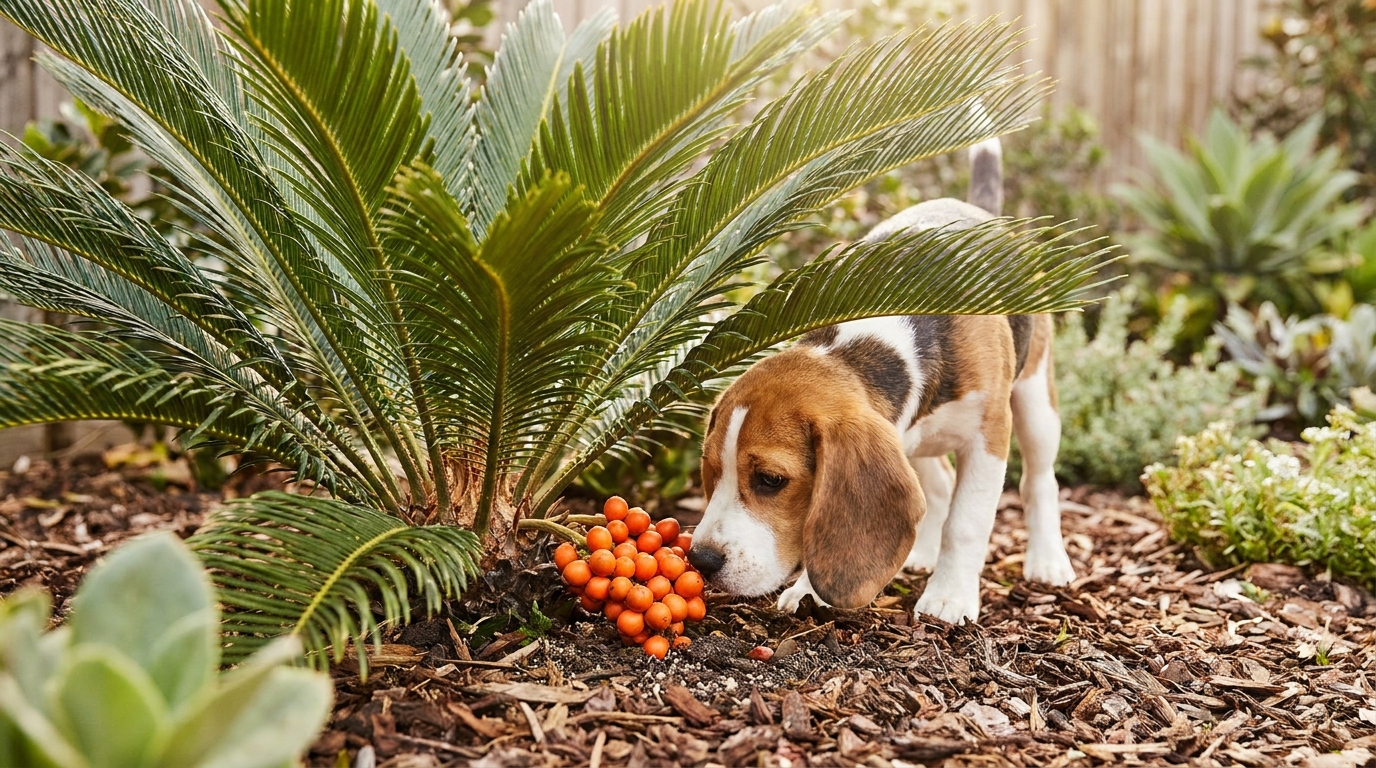
Every part of a sago palm can poison a dog, and a dog can look fine for hours. What to do in the first hour, the signs, and the survival odds.
Quick answer: If your dog chewed or swallowed any part of a sago palm, go to an emergency vet now, even without signs, and call ASPCA Animal Poison Control (888) 426-4435 or Pet Poison Helpline (855) 764-7661 on the way (ASPCA may charge a fee; Pet Poison Helpline charges one). Every part is poisonous, seeds most of all. A dog can look fine for hours, and a normal first blood test does not rule out liver damage.
This article is general information, not a diagnosis. If you think your pet is in danger, go to the nearest emergency animal hospital.
Is sago palm poisonous to dogs?
Yes: every part of a sago palm (Cycas revoluta) is poisonous to dogs, and the orange-to-red seeds carry the most cycasin, a toxin that damages the liver.
The ASPCA lists sago palm and the other cycads as toxic to dogs, cats and horses. NC State Extension rates the plant's poison severity as high and notes that pets are attracted to it. Pet Poison Helpline calls cycasin "a highly toxic plant chemical," and VCA Animal Hospitals, writing with Pet Poison Helpline toxicologists, warns that even a small amount of plant material can cause serious effects.
Every part means fronds, trunk, roots, cones and seeds, on male and female plants, in every season. Nothing shows that drying makes the plant safe, so treat dead fronds and fallen leaflets as poisonous too.
What should I do in the first hour?
In the first hour after a dog chews sago palm, move the dog away from the plant, take a piece or photo of it, and drive to an emergency vet now, calling a poison line on the way.
- Move your dog away from the plant to prevent more exposure, as the ASPCA's first-aid advice says, and keep other pets out of the area. Check the plant and the ground for chewed fronds, a torn-open cone or missing seeds; any other dog or cat that may also have chewed it needs the same emergency trip.
- Only if it is safe, remove loose plant bits from your dog's mouth.
- Bring a clear photo, or a frond or seed sealed in a bag and kept where your dog cannot reach it, plus any vomit with plant bits, and note the time and which part was eaten. VCA says no test confirms sago palm poisoning, so the hospital relies on this history.
- Drive to the nearest emergency vet now. Have a passenger call, or use a hands-free phone to call, ASPCA Animal Poison Control at (888) 426-4435 (a consultation fee may apply) or Pet Poison Helpline at (855) 764-7661 (a per-incident fee applies). Call on the way, not instead of going.
Do not make your dog vomit unless the poison line or the emergency vet tells you to, and never make a cat vomit at home. The ASPCA and VCA both warn that trying it at home can be dangerous; see when making a dog throw up helps and when it harms. Give no activated charcoal, food, milk, oil, salt or home remedy.
My dog seems fine: can I wait and watch?
No: a dog that chewed sago palm can look normal for hours, and hospital treatment works best when it starts before signs appear.
Dr. Alexia Berg, an emergency and critical care veterinarian at Tufts University, advises getting to the vet quickly so vomiting can be induced. There is no antidote, and Tufts says the sooner supportive care starts, the better the outlook generally is.
A normal first blood test does not rule out sago palm poisoning. In a review of 60 dogs from ASPCA poison center records (Albretsen and colleagues, 1998), signs showed up within a day, but lab values did not change for 24 to 48 hours. VCA says liver enzyme rises may take up to 48 to 72 hours, so the hospital repeats bloodwork.
At Louisiana State University (Ferguson and colleagues, 2011), activated charcoal given when dogs first arrived was linked with longer survival, and in a 130-dog study at two Texas referral hospitals (Lake and colleagues, 2020), activated charcoal treatment at the hospital was linked with 82% lower odds of death. Activated charcoal is the hospital's decision, never home first aid. Fast care helps but guarantees nothing: in a Houston study (Clarke and Burney, 2017), dogs kept showing signs of illness despite decontamination.
The same go-before-signs rule applies to other poisons that act late, such as rat and mouse bait.
What are the signs, and when do they show up?
The first signs of sago palm poisoning in a dog are usually vomiting, diarrhea and tiredness within 15 minutes to several hours, and liver signs such as yellow gums or dark urine can follow within about 3 days.
| When | What you see | What to do |
|---|---|---|
| Minutes to hours | Vomiting (can be bloody), diarrhea, tiredness | ER now |
| First 1 to 3 days | Black, tarry or bloody stool | ER now |
| Often by day 2 or 3, can be sooner | Yellow gums or eyes, dark urine, swollen belly, drinking more, bruises, red spots, nosebleed, any bleeding | ER now |
| Any time | Weakness, wobbling, tremors, seizures, collapse | ER now |
No signs at all still means ER now after any known or possible chewing, and plant bits in vomit, stool or the mouth after time near a cycad count as possible chewing. In the 130-dog Texas 2020 study, 82.3% of dogs had signs when they arrived, so some had none yet.
VCA says a failing liver can also cause low blood sugar and bleeding, and that weakness, a wobbly gait, tremors and seizures are less common. The 1998 ASPCA review found signs can develop over 1 to 3 days and last several days. Dark or brown urine means the ER now after possible sago palm exposure, and so do yellow gums on their own; the dog urine color chart explains other colors.
Can a dog survive sago palm poisoning?
Many dogs survive sago palm poisoning with fast hospital care, but in four published case series of dogs treated for cycad (sago) palm poisoning, between about 12% and 64% did not survive.
| Study | Dogs | Did not survive |
|---|---|---|
| ASPCA 1998 | 60 | 32.1% (reported) |
| LSU 2011 | 34 | 50% |
| Texas 2017 | 14 | 64% |
| Texas 2020 | 130 | 12.3% |
The studies are Albretsen 1998 (ASPCA poison center records), Ferguson 2011 (Louisiana State University), Clarke and Burney 2017 (Houston) and Lake 2020 (two Texas referral hospitals). The LSU and Texas 2020 counts include euthanasia, and the ASPCA paper gives its figure as a reported rate, from records that included suspected and possible cases. All four are look-back case series from referral hospitals or a poison center, which may lean toward sicker dogs, and they cover cycad palms in general.
In the Houston study, three surviving dogs had liver enzymes that stayed high, though Tufts says long-term problems are generally uncommon. VCA calls the outlook generally fair with early diagnosis and treatment. Keep every liver recheck the treating hospital schedules, and call that hospital or go to an ER now if your dog has any new vomiting, refusal to eat, lethargy, black or bloody stool, dark urine, yellow gums or eyes, bruising or bleeding, wobbliness or seizures after coming home.
Which plants count as a sago palm?
Sago palm is not a true palm but a cycad, and related cycads, including queen sago, coontie and cardboard palm, carry the same poisoning warning.
NC State Extension says the king sago (Cycas revoluta) is not a true palm and rates the whole Cycas genus, which includes queen sago (Cycas circinalis), as high for poison severity. The ASPCA lists coontie (Zamia pumila) and cardboard palm (Zamia species) as toxic to dogs, cats and horses. On a female king sago, UF/IFAS says, a nest-like cone at the top of the stem bears many orange fruits as it matures.
| Plant | Toxic? | Note |
|---|---|---|
| King sago | Yes | Seeds worst |
| Queen sago | Yes | A cycad |
| Coontie | Yes | Florida native |
| Cardboard palm | Yes | A cycad |
| Areca palm | No | ASPCA list |
| Pygmy date palm | No | ASPCA list |
| Ponytail palm | No | ASPCA list |
- The ASPCA files ponytail palm under the name bottle palm.
- The ASPCA says eating any plant may cause vomiting and stomach upset, so "No" means "not toxic," not "safe to eat."
- Male sagos carry no seeds, but every part is still poisonous, all year.
- If your dog ate orange or red seeds from a palm-like plant, or you are not sure which plant it chewed, treat it as a sago palm and go in.
- Even if you believe your dog ate an areca, pygmy date or ponytail palm, call a poison line right away with a photo of the plant. If the line cannot rule out a cycad, or you cannot reach it, go to an emergency vet now.
Where do dogs run into sago palms?
Dogs usually meet sago palms in yards and landscaping in warm parts of the United States, including Florida, and as potted houseplants anywhere; VCA reports that Pet Poison Helpline gets hundreds of sago palm calls a year.
In the 1998 ASPCA review, 89.7% of the poisoned dogs were from the southern US, and dogs that ate seeds were likely to have more serious problems. NC State Extension says the seeds ripen orange to red from September to October on female plants.
If you are taking a dog to a rental in Florida or another warm state for Thanksgiving or Christmas, walk the yard before your dog does, ask the host about sagos or other cycads, and save both poison-line numbers; the ASPCA line answers 24 hours a day, 365 days a year. Find the emergency hospital nearest where you will stay before you need it; see what to do when your vet is closed on Thanksgiving or Christmas.
Is sago palm poisonous to cats?
Yes: sago palm is poisonous to cats too, and a cat that chewed any part needs the same poison-line call and emergency vet trip as a dog.
The ASPCA, Pet Poison Helpline and VCA all list cats. Dr. Berg at Tufts reports seeing far more dogs affected than cats, but that is no reason to wait with a cat that chewed a potted sago. Never try to make a cat vomit at home: Pet Poison Helpline says there is no safe or effective way to do it.
How do I make my yard safe?
To make a yard safe for a dog, remove or fence off every sago palm and other cycad, pick up fallen seeds and fronds, and choose palms the ASPCA lists as non-toxic, such as areca, pygmy date or ponytail palm.
- Wear gloves to remove a sago: NC State Extension lists the plant as spiny and poisonous to people too. Bag the cones, seeds and leaflets where pets cannot reach them.
- Check for potted and bonsai sagos indoors.
- Pygmy date palms are not toxic, but NC State Extension notes sharp spines near the leaf base, so plant them away from where your dog plays.
- On walks, watch neighbors' yards and condo landscaping, and keep a short leash near cycads.
- Teach a strong "leave it" and reward it often.
- Give holiday plants the same check, including poinsettias, mistletoe and holly.
When a video visit fits, and when it does not
A suspected sago palm exposure is not a video-visit problem: it needs a poison line and an in-person emergency vet who can give hospital treatment and run liver bloodwork, so do not book a video call first or wait on one.
For a dog in Florida, New York or Virginia that is already home from the hospital after sago palm poisoning and is eating and acting normally, RexVet, a nonprofit online vet service, offers a $64.99 live video visit with a veterinarian licensed in the dog's state, about 8 AM to 11 PM Eastern when a slot is open, for follow-up questions, while the treating hospital stays in charge of rechecks and medicines.
RexVet serves pets located in Florida, New York and Virginia by video visit only; the pet must be in one of those states during the visit, and the veterinarian is licensed in that state. A dog traveling in any other state should see a local emergency vet.
Any dog or cat that may have chewed any part of a sago palm, queen sago, coontie, cardboard palm or other cycad, or that has vomiting, black or bloody stool, yellow gums, dark urine, bruising, weakness, wobbling or seizures after time near these plants, needs a poison line and an emergency hospital now, not a video visit.
A video visit with a licensed RexVet vet can fit when:
- Your dog is home from the hospital, eating and acting normally, and you have questions about discharge instructions or which warning signs mean going back. Keep every recheck that hospital schedules, and if you cannot make one, call that hospital the same day. Any new vomiting, refusal to eat, lethargy, black or bloody stool, dark urine, yellow gums or eyes, bruising or bleeding, wobbliness or seizures after discharge means calling that hospital or going to an ER now, not booking a video visit.
- A poison line has said the plant was a non-toxic palm (areca, pygmy date or ponytail palm) and that watching at home is fine, and your dog has had at most one vomit or one soft stool and is eating and acting normally. If you are unsure of the plant, or see orange seeds or chewed cycad parts, go in.
- Nothing has been eaten, and you want to plan a pet-safe yard, check a rental yard before a trip, or ask new-puppy safety questions.
If one of these fits, you can book a video visit for follow-up or yard-safety questions. A video visit cannot refill, continue or change medicines the hospital started; ask the treating hospital. No prescription is promised; the veterinarian decides.
Need an Expert Opinion on This Topic?
Book a video visit with a licensed vet, evenings and weekends included
See open timesFrequently Asked Questions
How much sago palm is toxic to a dog?
Any amount can be dangerous: treat any chewing of any part of a sago palm as an emergency and go to an ER now. Every part is poisonous, the seeds most of all. The ASPCA's cycad listing warns that 1-2 seeds can be fatal, but that is a worst case, not a safe limit: no amount of leaf, trunk, root or seed is safe to watch at home.
Is sago palm poisonous if my dog only licked it?
Call a poison line right away; if you see chewed leaflets, missing seeds or plant bits in the mouth, go to an emergency vet now. A lick is hard to tell from a small bite. If the line cannot rule out chewing, or you cannot reach it, go in rather than waiting for signs.
Are dried or dead sago palm leaves still toxic to dogs?
Treat them as toxic: every part of a sago palm is poisonous, so a dog that chewed dried leaves needs an emergency vet now. NC State Extension says all parts contain cycasin, and nothing shows that drying makes it safe, so do not assume dead fronds, fallen leaflets or a dried-out potted sago are safe.
Can I make my dog throw up at home after eating sago palm?
No, not unless a poison line or the emergency vet tells you to; drive to the hospital, where vomiting can be induced safely. The ASPCA and VCA warn that making a pet vomit at home can be dangerous, and Pet Poison Helpline says there is no safe way to do it in a cat. Give no charcoal or home remedy.
What will the emergency vet do for sago palm poisoning?
There is no antidote, so the emergency vet removes what they safely can and supports the liver, with repeat bloodwork over the next few days. VCA describes decontamination, liver-support medication and supportive care, and says bloodwork is essential for tracking liver enzymes. If your dog arrives early, the vet may induce vomiting, and two hospital studies linked hospital-given activated charcoal with survival.
Is coontie the same as sago palm?
No, but coontie is a related cycad the ASPCA lists as toxic to dogs and cats, so treat any chewing exactly like sago palm. Coontie (Zamia integrifolia, which the ASPCA lists as Zamia pumila) is a Florida-native plant, and UF/IFAS calls it the only cycad native to the United States. Like the king sago, it contains cycasin.
Can an online vet help if my dog ate sago palm in Florida, New York or Virginia?
No: a dog that chewed any part of a sago palm needs a poison line and an in-person emergency vet now, not a video visit. Only a hospital can do the hands-on exam, vet-induced vomiting, hospital-given activated charcoal, supportive care and liver bloodwork. On camera, a veterinarian licensed in your pet's state can answer follow-up questions once your dog is home from the hospital and eating and acting normally, or help you plan a pet-safe yard. A video visit cannot refill or change medicines the hospital started. No prescription is promised; the veterinarian decides. In Florida, a prescription based only on a video visit is limited to FDA-approved animal drugs used as labeled, for up to 14 days (1 month for products labeled only for fleas and ticks), with no renewal without an in-person exam, and human-labeled, controlled and compounded anti-infective drugs need an in-person exam. Federal rules (21 CFR 530.3) allow off-label or human-drug use only within a vet-client-patient relationship that the FDA says cannot be set up through telemedicine alone. Virginia allows the exam to be electronic, but that federal rule still applies. New York's rules are unsettled, so the veterinarian decides case by case. If the veterinarian prescribes and RexVet sends the prescription to an outside pharmacy, a pharmacy transfer fee applies; RexVet is not a pharmacy.
FAQs
How much sago palm is toxic to a dog?
Any amount can be dangerous: treat any chewing of any part of a sago palm as an emergency and go to an ER now. Every part is poisonous, the seeds most of all. The ASPCA's cycad listing warns that 1-2 seeds can be fatal, but that is a worst case, not a safe limit: no amount of leaf, trunk, root or seed is safe to watch at home.
Is sago palm poisonous if my dog only licked it?
Call a poison line right away; if you see chewed leaflets, missing seeds or plant bits in the mouth, go to an emergency vet now. A lick is hard to tell from a small bite. If the line cannot rule out chewing, or you cannot reach it, go in rather than waiting for signs.
Are dried or dead sago palm leaves still toxic to dogs?
Treat them as toxic: every part of a sago palm is poisonous, so a dog that chewed dried leaves needs an emergency vet now. NC State Extension says all parts contain cycasin, and nothing shows that drying makes it safe, so do not assume dead fronds, fallen leaflets or a dried-out potted sago are safe.
Can I make my dog throw up at home after eating sago palm?
No, not unless a poison line or the emergency vet tells you to; drive to the hospital, where vomiting can be induced safely. The ASPCA and VCA warn that making a pet vomit at home can be dangerous, and Pet Poison Helpline says there is no safe way to do it in a cat. Give no charcoal or home remedy.
What will the emergency vet do for sago palm poisoning?
There is no antidote, so the emergency vet removes what they safely can and supports the liver, with repeat bloodwork over the next few days. VCA describes decontamination, liver-support medication and supportive care, and says bloodwork is essential for tracking liver enzymes. If your dog arrives early, the vet may induce vomiting, and two hospital studies linked hospital-given activated charcoal with survival.
Is coontie the same as sago palm?
No, but coontie is a related cycad the ASPCA lists as toxic to dogs and cats, so treat any chewing exactly like sago palm. Coontie (Zamia integrifolia, which the ASPCA lists as Zamia pumila) is a Florida-native plant, and UF/IFAS calls it the only cycad native to the United States. Like the king sago, it contains cycasin.
Can an online vet help if my dog ate sago palm in Florida, New York or Virginia?
No: a dog that chewed any part of a sago palm needs a poison line and an in-person emergency vet now, not a video visit. Only a hospital can do the hands-on exam, vet-induced vomiting, hospital-given activated charcoal, supportive care and liver bloodwork. On camera, a veterinarian licensed in your pet's state can answer follow-up questions once your dog is home from the hospital and eating and acting normally, or help you plan a pet-safe yard. A video visit cannot refill or change medicines the hospital started. No prescription is promised; the veterinarian decides. In Florida, a prescription based only on a video visit is limited to FDA-approved animal drugs used as labeled, for up to 14 days (1 month for products labeled only for fleas and ticks), with no renewal without an in-person exam, and human-labeled, controlled and compounded anti-infective drugs need an in-person exam. Federal rules (21 CFR 530.3) allow off-label or human-drug use only within a vet-client-patient relationship that the FDA says cannot be set up through telemedicine alone. Virginia allows the exam to be electronic, but that federal rule still applies. New York's rules are unsettled, so the veterinarian decides case by case. If the veterinarian prescribes and RexVet sends the prescription to an outside pharmacy, a pharmacy transfer fee applies; RexVet is not a pharmacy.
Medically Reviewed
Reviewed by Dr. Tiffany Delacruz, DVM — licensed veterinarian and CEO of RexVet. Last reviewed November 18, 2026.
Content is for informational purposes and does not replace professional veterinary advice.
Chief Executive Officer · Licensed Veterinarian
Dr. Delacruz is a licensed Doctor of Veterinary Medicine specializing in preventive care and veterinary telehealth. She reviews all health content on RexVet to ensure accuracy and clinical relevance.
Sources & References
- · American Veterinary Medical Association — Telehealth Guidelines
- · AVMA — Pet Care Resources
- · U.S. FDA — Animal & Veterinary