
Older Dog Growling at New Puppy: Normal or a Problem?
By RexVet Team | Reviewed by Dr. Tiffany Delacruz, DVM
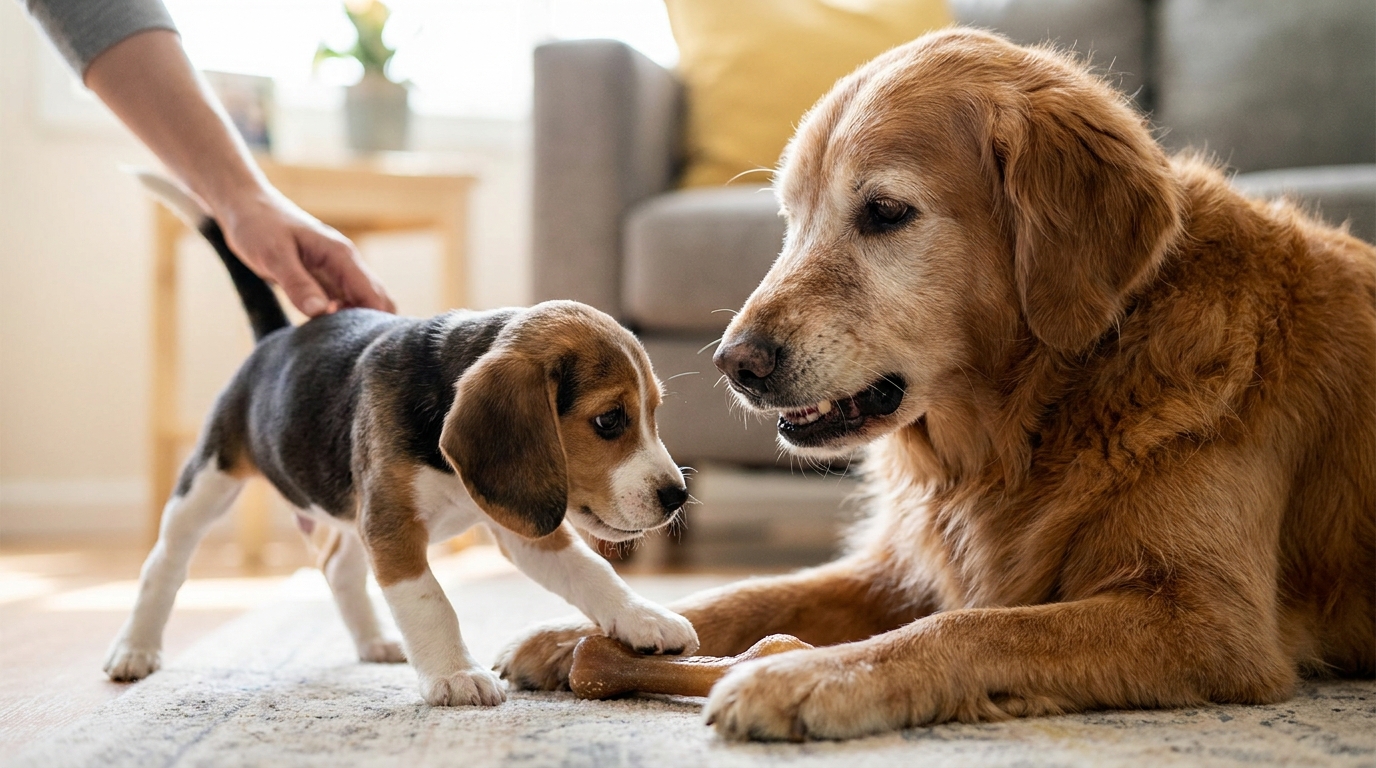
When a growl is a normal limit, when it is a bite risk, how to check a puppy after a scuffle, and why pain may be shortening an older dog's temper.
Quick answer: An older dog that growls, lifts a lip or snaps at a pushy new puppy without its teeth touching the puppy, then walks away, is usually setting a normal limit, so never punish the growl. Give the older dog puppy-free space and supervise every meeting. Teeth on the puppy, any broken skin or swelling, or an older dog that stops eating means an in-person vet today.
This article is general information, not a diagnosis. If you think your pet is in danger, go to the nearest emergency animal hospital.
Go to an emergency vet now if a bitten puppy cries, limps or was shaken, or has a deep puncture, a bite to the neck, chest or belly, bleeding that will not stop, trouble breathing, pale or blue gums, weakness or collapse.
Is it normal for an older dog to growl at a new puppy?
Yes: a growl, lip lift or snap that does not touch the puppy, followed by the older dog moving away, is normal dog communication, and the American Kennel Club says it is normal for an adult dog not to love a puppy at first.
The American Kennel Club says an older dog may move away, growl or even snap to send a pushy puppy away, and that growling should not be punished. A warning is usually a normal limit when:
- the older dog's teeth never touch the puppy;
- the puppy backs off and the older dog stops;
- the older dog then walks away instead of following;
- both dogs keep eating, and the puppy is not afraid.
When you see a warning, calmly move the puppy away and let the older dog rest.
When is it more than a warning?
An older dog has gone past a normal warning when its teeth touch the puppy, when it pins, chases or keeps going after the puppy backs off, when it guards food or beds with bites, or when the puppy becomes fearful; the American Kennel Club says teeth on a puppy are not normal and may mean it is time to consult a veterinary behaviorist.
The Merck Veterinary Manual says arguments between dogs in the same household can be caused by resource guarding, and advises getting help from a veterinarian as soon as any signs of aggression appear.
The American Veterinary Society of Animal Behavior (AVSAB) says aggression must be treated with humane, reward-based methods, and that shock, prong and choke collars, leash jerking, shouting and physical force should be avoided. The Merck Veterinary Manual adds that physical punishment can make an aggressive dog worse.
My older dog bit the puppy: what now?
Separate an older dog and a puppy calmly without putting your hands between them, check the puppy's whole body, including under the fur, and get the puppy seen by a vet in person today if the older dog's teeth closed on it, broke the skin or left swelling, because VCA Animal Hospitals says even a bite that does not break the skin can crush tissue underneath.
If a scuffle is still going on, the American Kennel Club says to keep your hands and face far from the dogs' mouths: make a loud noise, throw a blanket over them, or slide a board, baby gate or chair between them. Keep the dogs apart for several hours afterward, and get professional help before reuniting them if fights recur or cause injuries, as the ASPCA advises.
Call a vet right away after any fight, as VCA advises: small punctures close over quickly and hide in fur, and dog teeth can go through the chest wall and collapse a lung, or damage the intestines. Do not treat a bite at home; VCA warns against cleaning a bite with hydrogen peroxide unless your veterinarian says to. Handle a hurt puppy gently, because it may bite, and get medical care if you are bitten.
Go to an emergency vet now if the bitten puppy cries, limps or was shaken, has trouble breathing, or is cold, wobbly, hard to wake, or hides and will not eat after the scuffle, or for any emergency row below.
| What you see | Next step | How soon |
|---|---|---|
| Growl, then moves away | Normal limit | Watch |
| Repeated snaps, no contact | Manage, vet check | This week |
| Teeth closed on puppy | Vet in person | Today |
| Bite broke the skin | Vet in person | Today |
| Swelling where bitten | Vet in person | Today |
| Older dog stops eating | Vet in person | Today |
| Bitten puppy cries, limps | Emergency vet | Now |
| Deep puncture | Emergency vet | Now |
| Bleeding won't stop | Emergency vet | Now |
| Neck, chest or belly bite | Emergency vet | Now |
| Weak, pale gums, collapse | Emergency vet | Now |
| Older dog, no food over 24 hours | Emergency vet | Now |
If more than one row fits, follow the most urgent. If your clinic is closed, use an emergency hospital for any Today row.
Could pain or aging be making my older dog grumpy?
Pain and aging can make an older dog grumpy: arthritis, dental pain, vision or hearing loss and canine cognitive dysfunction can all shorten an older dog's patience, so new snapping in a senior that used to tolerate other dogs deserves a vet check, not just training.
The ASPCA says any illness that causes pain, discomfort or reduced mobility, including arthritis, dental disease and impaired sight or hearing, can make an older dog irritable or aggressive, and the Merck Veterinary Manual says vets must rule out physical problems, especially pain, when diagnosing behavior problems. AKC Chief Veterinarian Dr. Jerry Klein also warns that a large or relentless puppy can threaten a senior with heart problems or an arthritic back or spine.
Arthritis and joint concerns were named in 15% of RexVet visits for pets 11 or older, versus about 1% for pets under 7. Cornell's Riney Canine Health Center lists irritability and aggression among the signs of canine cognitive dysfunction, which dogs may start to develop around 9 or older; see a senior dog panting and restless at night for other signs.
A sudden head tilt, circling or new confusion, or a first-ever short seizure, needs an in-person vet the same day, at an emergency hospital if your clinic is closed; a seizure lasting 5 minutes or more, two or more seizures in 24 hours, or a dog not back to normal after one means an emergency vet now.
An older dog that will not put weight on a leg or cries out when touched needs a hands-on exam the same day; one that suddenly cannot stand or walk, drags its back feet or cannot pee needs an emergency vet now. Our guide to arthritis that gets worse in cold weather explains the signs.
How do I introduce a puppy to an older dog?
Introduce a puppy to an older dog on neutral ground with both dogs on leashes and one handler per dog, keep sessions short and positive, and give the older dog a puppy-free room or gated area from day one.
- Save the nearest emergency vet's address and phone number; many regular clinics are closed on Thanksgiving and over the winter holidays.
- If the older dog has ever fought other dogs, see a veterinary behaviorist or certified professional dog trainer first, as the ASPCA advises.
- Walk the dogs side by side, with slack leashes for the first sniff, somewhere unvaccinated or unknown dogs do not use.
- Greet, leash and feed the older dog first, as the AKC's Dr. Klein advises.
- Do not hold the puppy up to be sniffed; the ASPCA suggests standing with your feet apart so it can shelter between them.
- Keep meetings short, skip the car and small rooms at first, and never let the older dog bowl over the puppy.
- Try the AKC's consent test: let a light leash drag from the puppy, calmly lead it away every minute or two, and let the dogs restart only if both choose to.
How do I keep the peace day to day?
An older dog and a new puppy keep the peace best when they eat apart, have their own beds, bowls and crates, get time on their own, and have bones and favorite toys picked up so nothing sets off guarding.
The American Kennel Club also advises keeping more than one water bowl out and crating one or both dogs with a chew toy when you leave; the ASPCA says never to crate them together.
| Do | Do not |
|---|---|
| Give a puppy-free room | Punish the growl |
| Feed apart | Leave them alone together |
| Short, calm meetings | Force closeness |
| Reward calm | Shock or prong collars |
| Rest breaks | Shout or scold |
| Pick up chews | Share chews or toys |
| Crate apart | Crate them together |
| Barrier in a scuffle | Hands between dogs |
My older dog stopped eating or is hiding since the puppy came
Some stress is common in an older dog's first days with a new puppy, but an older dog that suddenly stops eating should see a vet in person the same day, and one that has eaten nothing for more than 24 hours, or is also vomiting, weak or in pain, needs an emergency vet now.
Use an emergency hospital if your own vet cannot see the dog right away. If the older dog still eats but hides or seems flat, book a vet check, since pain can look like moodiness, and in the meantime the American Kennel Club advises feeding the dogs separately and keeping its routine and one-on-one time the same. An older dog that pants, shakes or trembles while resting also needs an in-person vet today, even if the puppy seems to be the cause, but labored breathing at rest, new panting that will not settle in a cool room, gray, pale or blue gums or collapse means an emergency vet now; see a dog that is suddenly clingy for other medical causes of a mood change.
How long does it take an older dog to accept a puppy?
The American Kennel Club says it can take a few months for an older dog and a puppy to fully adjust, so steady progress matters more than the calendar; if tension is getting worse rather than better, or there has been any bite, ask a vet for help.
Not every senior dog will enjoy living with a puppy, the AKC notes, so keep the older dog's puppy-free space as long as it needs it.
Puppy health: shots, worms and coughs
Keep a new puppy out of dog parks, pet stores and places with dogs of unknown vaccine status until about 2 weeks after its final puppy shot or as the vet advises, keep socializing it with healthy vaccinated dogs you know, and check that the older dog is current on vaccines and parasite prevention too.
AAHA's canine vaccination guidelines give puppy core vaccines every 2 to 4 weeks until about 16 weeks of age or older; your vet sets the schedule. AVSAB calls socialization before full vaccination the standard of care, and the American Kennel Club advises testing both dogs for parasites such as heartworm, fleas and ticks and keeping both current on prevention.
A puppy under 4 months that has eaten nothing for more than 8 hours needs an in-person vet today (see a new puppy's first week), one that is weak, cold or hard to wake needs an emergency vet now, and a coughing puppy should stay away from the older dog, with no shared bowls, toys or bedding, until the vet says it is safe. A cough with fever, thick discharge, low energy or poor appetite needs an in-person vet today, and labored breathing means an emergency vet now (see puppy coughing).
When a video visit helps, and when it does not
If an older dog growls or snaps at a new puppy but its teeth have never closed on the puppy and both dogs are eating normally, a live video visit can set up a home plan and look for signs that pain may be behind the older dog's short temper.
For an older dog in Florida, New York or Virginia that keeps growling or snapping at a new puppy that has not been bitten, RexVet, a nonprofit online vet service, offers a $64.99 live video visit with a veterinarian licensed in the dog's state, about 8 AM to 11 PM Eastern, to look for signs of pain in the older dog and set up a plan for home. You can book a visit with a licensed RexVet vet. RexVet serves pets located in these three states by live video visit.
Have ready a short clip of the dogs together, filmed from a safe distance with a gate or leashes in place; a clip of the older dog getting up, lying down and walking; both dogs' ages, weights and medicines; and their vaccine records. Never provoke a growl for the camera. Clips add to the live video call and never replace it.
The veterinarian can read the dogs' body language, look for signs that stiffness, pain, vision or hearing loss, or confusion could be shortening the older dog's patience, set up a home plan, and say how soon the older dog should have an in-person exam and tests such as bloodwork, X-rays or a dental check, and whether a veterinary behaviorist could help.
VCA Animal Hospitals says any pet with a behavior change should have a physical exam. A video visit cannot feel a wound, handle the joints or run tests, and it does not replace the puppy's first in-person exam, vaccines or stool test. Any bite that broke the skin, swelling, or teeth that closed on the puppy needs an in-person vet today.
Go to an emergency vet now, not a video visit, if the puppy has a deep puncture, a bite to the neck, chest or belly, was shaken by the older dog, has bleeding that will not stop, trouble breathing, pale or blue gums, weakness, crying, limping or collapse, or if the older dog has eaten nothing for more than 24 hours or suddenly cannot stand.
No prescription is promised; any medicine is the veterinarian's decision. Many behavior and pain medicines are human-labeled or used off-label, and federal rules (21 CFR 530.3) require an in-person exam before those are prescribed, in every state; the last question below covers each state's video prescribing limits. RexVet is not a pharmacy; a pharmacy transfer fee applies if RexVet sends a prescription to an outside pharmacy.
Need an Expert Opinion on This Topic?
Book a video visit with a licensed vet, evenings and weekends included
See open timesFrequently Asked Questions
Should I let my older dog correct my new puppy?
Only a warning is normal: a growl, lip lift or air snap that never touches the puppy, then calmly move the puppy away. If teeth touch the puppy, separate them calmly and have the puppy checked by a vet in person today. The American Kennel Club calls growling normal dog communication but says teeth on a puppy are not normal.
Will my older dog ever accept the new puppy?
Many do, but the American Kennel Club says full adjustment can take a few months, and not every senior dog enjoys a puppy. Keep meetings short and ask a vet for help if tension is getting worse or there has been any bite.
Is my older dog jealous or depressed about the new puppy?
It may be stressed, but new grumpiness, hiding or low energy in an older dog deserves a vet check, since pain can look like moodiness. Keep its routine the same and give it time alone with you. An older dog that suddenly stops eating should see a vet in person the same day; one that has eaten nothing for more than 24 hours, or is also vomiting, weak or in pain, needs an emergency vet now.
Can I leave my older dog and new puppy alone together?
No, not at first: crate or gate one or both dogs whenever you cannot watch them, as the American Kennel Club advises. The ASPCA says to wait until there has been no tense or negative moment for at least one week, and some dogs need longer. Never crate them together.
Can calming supplements or medicine help my older dog get along with the puppy?
Ask a veterinarian first: whether any medicine or supplement fits is the veterinarian's decision after the older dog is checked for pain and illness. AVSAB says medicine may be needed for serious fear or aggression, alongside reward-based training. Never give a human medicine, a leftover prescription or another pet's medicine. A video visit does not promise a prescription, and many behavior and pain medicines need an in-person exam first.
Can an online vet help with my older dog and new puppy in Florida, New York or Virginia?
Yes, for a dog located in Florida, New York or Virginia, if the older dog's teeth have not closed on or hurt the puppy. A veterinarian licensed in the dog's state can watch the dogs on live video, look for signs of pain and set up a home plan; any bite, limp, sudden confusion or pain workup needs an in-person visit. No prescription is promised. In Florida, a prescription based only on a video visit is limited to FDA-approved animal drugs used as labeled, for up to 14 days (1 month for flea- or tick-only products), with no renewal without an in-person exam and no human-labeled or controlled drugs. Federal rules require an in-person exam for human-labeled or off-label drugs, including in Virginia, and New York's rules are not settled.
FAQs
Should I let my older dog correct my new puppy?
Only a warning is normal: a growl, lip lift or air snap that never touches the puppy, then calmly move the puppy away. If teeth touch the puppy, separate them calmly and have the puppy checked by a vet in person today. The American Kennel Club calls growling normal dog communication but says teeth on a puppy are not normal.
Will my older dog ever accept the new puppy?
Many do, but the American Kennel Club says full adjustment can take a few months, and not every senior dog enjoys a puppy. Keep meetings short and ask a vet for help if tension is getting worse or there has been any bite.
Is my older dog jealous or depressed about the new puppy?
It may be stressed, but new grumpiness, hiding or low energy in an older dog deserves a vet check, since pain can look like moodiness. Keep its routine the same and give it time alone with you. An older dog that suddenly stops eating should see a vet in person the same day; one that has eaten nothing for more than 24 hours, or is also vomiting, weak or in pain, needs an emergency vet now.
Can I leave my older dog and new puppy alone together?
No, not at first: crate or gate one or both dogs whenever you cannot watch them, as the American Kennel Club advises. The ASPCA says to wait until there has been no tense or negative moment for at least one week, and some dogs need longer. Never crate them together.
Can calming supplements or medicine help my older dog get along with the puppy?
Ask a veterinarian first: whether any medicine or supplement fits is the veterinarian's decision after the older dog is checked for pain and illness. AVSAB says medicine may be needed for serious fear or aggression, alongside reward-based training. Never give a human medicine, a leftover prescription or another pet's medicine. A video visit does not promise a prescription, and many behavior and pain medicines need an in-person exam first.
Can an online vet help with my older dog and new puppy in Florida, New York or Virginia?
Yes, for a dog located in Florida, New York or Virginia, if the older dog's teeth have not closed on or hurt the puppy. A veterinarian licensed in the dog's state can watch the dogs on live video, look for signs of pain and set up a home plan; any bite, limp, sudden confusion or pain workup needs an in-person visit. No prescription is promised. In Florida, a prescription based only on a video visit is limited to FDA-approved animal drugs used as labeled, for up to 14 days (1 month for flea- or tick-only products), with no renewal without an in-person exam and no human-labeled or controlled drugs. Federal rules require an in-person exam for human-labeled or off-label drugs, including in Virginia, and New York's rules are not settled.
Medically Reviewed
Reviewed by Dr. Tiffany Delacruz, DVM — licensed veterinarian and CEO of RexVet. Last reviewed November 26, 2026.
Content is for informational purposes and does not replace professional veterinary advice.
Chief Executive Officer · Licensed Veterinarian
Dr. Delacruz is a licensed Doctor of Veterinary Medicine specializing in preventive care and veterinary telehealth. She reviews all health content on RexVet to ensure accuracy and clinical relevance. RexVet video visits are for pets in Florida, New York and Virginia, with a veterinarian licensed in the pet's state.
Sources & References
- · American Veterinary Medical Association — Telehealth Guidelines
- · AVMA — Pet Care Resources
- · U.S. FDA — Animal & Veterinary