
Old Cat Back Legs Suddenly Wobbly: Emergency or Not?
By RexVet Team | Reviewed by Dr. Tiffany Delacruz, DVM
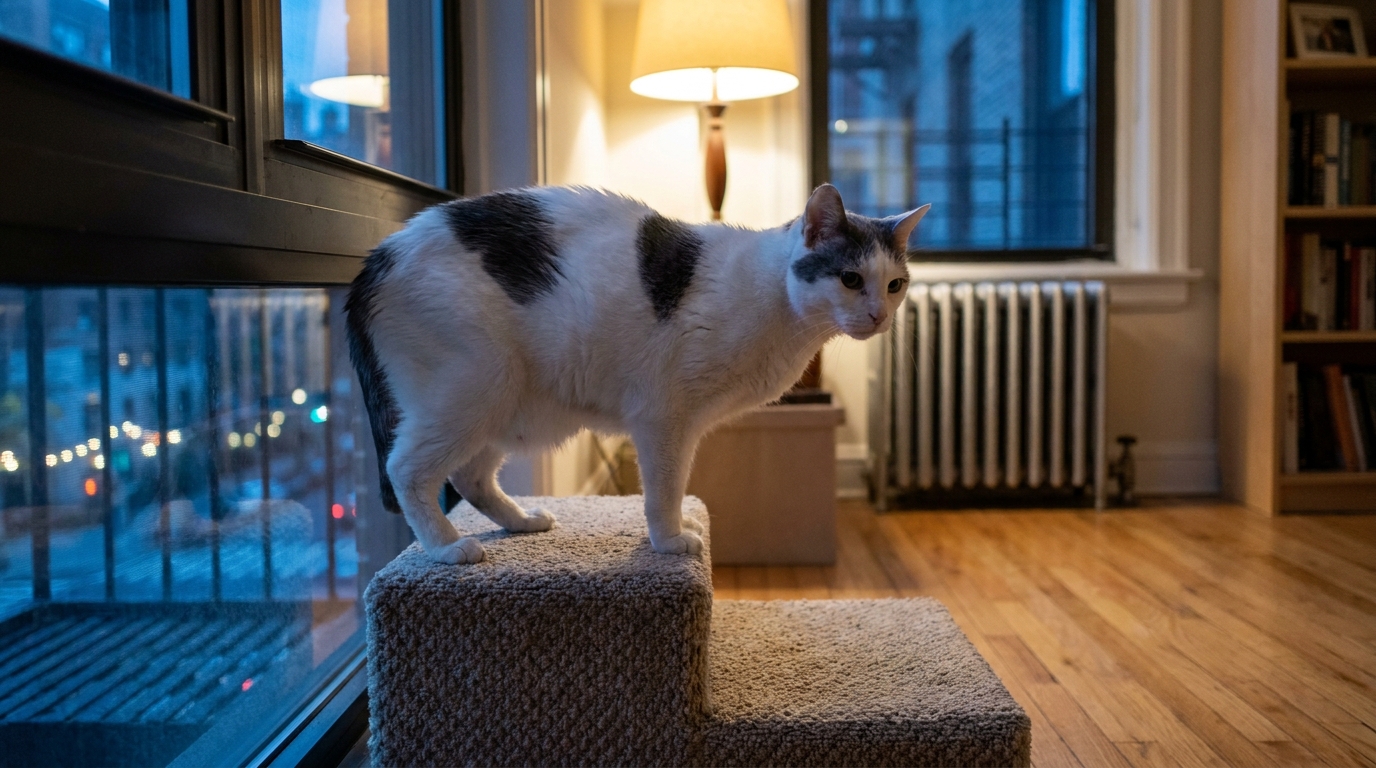
If your old cat's back legs went wobbly in the last few hours, treat it as urgent tonight; cold, painful or dragging legs mean an emergency vet now.
If your cat suddenly cannot use one or both back legs, is crying, panting or breathing fast, or the back paws feel cold and the pads look pale or bluish next to the front paws, this may be a blood clot (aortic thromboembolism): go to an in-person emergency vet right now, do not wait until morning.
If you searched "old cat back legs suddenly wobbly" tonight, here is a fast decision, what to do in the next hour, and whether an online veterinarian can help. If any sign in the bold line is present, go now; if she is wobbly but walking, keep reading.
Is it an emergency? A three-minute check you can do right now
Do this in one calm pass:
- Touch both back paw pads, then both front. Back paws noticeably cooler than the front are a warning sign.
- Compare pad and nailbed color, back against front. Pale or bluish on the back feet is a warning sign VCA Animal Hospitals lists for a clot.
- Can she stand and put weight on the back legs, or does she sit down, sway or drag them?
- Is she crying, panting, open-mouth breathing or breathing fast?
- Did this happen in seconds, or has she been slowing down for weeks?
Then decide:
- Sudden, painful, with cold or pale back paws: emergency clinic now. A cat that cannot stand at all also goes now, even with warm paws.
- Sudden weakness in only one back leg, even without obvious pain: treat it as the clot branch and go now.
- Sudden but not painful, both legs, paws warm and pink, still eating and drinking: a veterinarian with bloodwork within 24 hours.
- Slow stiffness over weeks: an arthritis workup; an online visit is a good first step.
The paw check is a reason to go, never a reason to stay home; do not try to feel for a pulse yourself to rule out a clot. The RexVet guide to emergency vets in Florida, New York and Virginia shows where to go tonight.
Sudden, painful and cannot walk: a blood clot (saddle thrombus) and why it cannot be treated at home
What you see: your cat was fine an hour ago and now cannot use her back legs and cries when touched. VCA Animal Hospitals says the most common signs of aortic thromboembolism (a saddle thrombus) are sudden paralysis and pain, usually in the rear legs; the nailbeds and foot pads may be pale or bluish, the pulses in the femoral arteries may be decreased or absent, and rapid or difficult breathing may be seen.
What it means: A clot forms in the heart and lodges where the aorta splits into 3 branches near the hips (the Merck Veterinary Manual calls this a saddle thrombus). Merck lists cold back legs and signs of heart failure among the signs. VCA says affected cats often have underlying hypertrophic cardiomyopathy. The Cornell Feline Health Center notes that many cats with HCM do not appear to be ill, and that these clots most often block blood flow to the hind limbs, causing sudden pain or, in extreme cases, paralysis. That is why the clot is often the first sign. If you searched "cat stroke", in cats the sudden version is usually a clot to the legs, not a brain stroke.
The milder version still counts: Merck notes that an incomplete blockage can cause mild signs in both back legs or weakness in only one, and that one-leg cases do better. A cat suddenly weak in only one back leg still belongs in the emergency line, even if she seems comfortable.
Where to go: an in-person emergency hospital, now. An online veterinarian cannot treat a clot or rule one out; cold paws or pale pads are a reason to go, not to book a call. VCA is honest that the prognosis for a full recovery is guarded to poor and that clots often recur; what an emergency hospital can do tonight is control the pain and assess the heart. For background, see RexVet's page on hypertrophic cardiomyopathy in Maine Coons.
Sudden but not painful: nerve and metabolic causes that need bloodwork within 24 hours
What you see: weak or wobbly in both back legs, but warm pink paws, no crying, and she still wants dinner. That is more likely a nerve or metabolic problem a blood test can find; see a veterinarian within 24 hours.
Low potassium from kidney disease. Merck describes feline hypokalemic polymyopathy, a generalized muscle weakness from low potassium that most cats develop secondary to chronic kidney disease, with signs that are typically acute in onset: generalized weakness, the head held low, a stiff, stilted gait, poor appetite and muscle pain; a blood test shows it, and the prognosis is excellent when diagnosed and treated early. Kidney cats in Florida heat dehydrate easily; see RexVet's guide to early signs of kidney disease in cats.
Nerve damage from diabetes. Cornell says that in rare cases of uncontrolled diabetes, a cat can develop nerve damage in the hind limbs and walk or stand with the hocks on or close to the ground, a plantigrade stance; it is not painful and often resolves with treatment. The two signs owners notice most, per Cornell, are weight loss despite a good appetite and drinking and urinating more. Cornell also notes that uncontrolled diabetes can lead to ketoacidosis, a medical emergency that requires hospitalization. Hyperthyroidism is another background cause that Merck names among the diseases leading to heart clots; see RexVet's guide to a cat losing weight but eating normally.
One exception that cannot wait. If your cat is on insulin and becomes weak, uncoordinated, vomits, is lethargic or has a seizure, this may be low blood sugar, which Cornell says can be fatal if untreated: offer her regular food immediately and bring her to a veterinarian immediately, and never force food or fluids into the mouth of a convulsing or comatose cat.
Wobbly after a fall, a jump or a fright: injury and spinal problems
What you see: the wobble started right after a fall from a bed, a window or a balcony, a door, a dog or a car; Virginia indoor-outdoor cats and New York apartment cats with high windows see both. A cat that walked away from a fall can still have a fracture or a spinal injury.
Where to go: a cat that will not put weight on one leg, has a limp or dragging tail, or cannot posture to urinate needs an in-person exam and X-rays; a witnessed fall or trauma is an in-person visit tonight, because the online veterinarian cannot treat a fracture or a spinal injury. Do not test the leg by moving it; carry her in a carrier or a box lined with a towel.
The "sudden" that was actually gradual: arthritis in senior cats
This applies only if your cat is walking, not in pain, with warm pink paws, and the change has been building for weeks. If it came on in minutes or hours with pain, go back to the three-minute check.
Cornell reports that in a study of X-rays from 100 middle-aged or elderly cats, 90 percent of cats over the age of 12 showed evidence of degenerative joint disease. Cornell says the earliest visible sign is apparent stiffness and a subtle reduction in activity, and that an affected cat may have trouble hopping in and out of the litter box and may avoid stairs.
Arthritis is managed by a veterinarian: weight control, ramps, a low-sided litter box, food and water on the floor, and pain treatment the veterinarian chooses, for some cats the injectable arthritis therapy on RexVet's Solensia for cats page. Never human painkillers.
What to do tonight while you decide
For a cat who passed the three-minute check; if she has any sign from the bold line, go now.
- Keep her in one warm, quiet, ground-level room with food, water and a low-sided litter box within a few steps. No stairs, no jumping.
- Do not rub, massage, stretch or manipulate the legs.
- Do not give any human pain medicine such as ibuprofen, acetaminophen or aspirin, which are toxic to cats and can be fatal, and do not give any leftover pet medication.
- Write down when it started, what she ate and drank, any vomiting and how many trips to the box.
- Record a 20-second phone video of her walking to show the veterinarian.
When to see a vet in person vs. when an online vet visit helps
In person now:
- Cold, pale or bluish back paws.
- Screaming, crying or panting.
- Cannot stand at all, is dragging both back legs, or is suddenly weak in only one.
- Breathing fast or with an open mouth.
- A known heart condition.
- A witnessed fall or other trauma.
- A treated diabetic cat with low-blood-sugar signs.
Online first:
- A cat who is wobbly but walking, still eating and using the box.
- You cannot tell whether this is a tonight or a tomorrow problem.
- An older cat who has slowly gotten stiff over weeks.
- A follow-up after a diagnosis.
On a video visit, a RexVet veterinarian watches your phone video of her walking, has you compare paw temperature and pad color on camera, counts her breaths, asks about thirst, appetite and weight, then routes you to the emergency hospital tonight, a daytime clinic for bloodwork, or a home plan with follow-up. The online veterinarian cannot treat a clot or a fracture and will tell you so; see RexVet's post on online vet vs emergency vet.
If your cat is wobbly but walking and eating, you can book a RexVet video visit now for $64.99. RexVet's veterinarians are licensed in Florida, New York and Virginia only and are available 24/7.
What the vet will check and what happens next
- A hands-on exam of the pulses in the back legs, paw temperature, reflexes and pain response.
- Blood pressure.
- Blood and urine tests for kidney values, potassium, glucose and thyroid.
- A heart ultrasound if a clot or heart disease is suspected.
- X-rays if there was a fall or injury, or to confirm arthritis.
Treatment follows the cause and is decided by the veterinarian; medication is prescribed only if the veterinarian decides it is appropriate and state rules allow, and no outcome can be promised before the exam. For the longer view, see RexVet's senior cat care guide.
If your cat is wobbly but walking, eating and using the box, you can book a video visit with RexVet for $64.99, 24/7; RexVet's veterinarians are licensed in Florida, New York and Virginia only. It tells you which door to walk through; it cannot treat a clot or a fracture.
Frequently asked questions
Why are my old cat's back legs suddenly wobbly?
The search "old cat back legs suddenly wobbly" covers four things: a blood clot, a metabolic problem such as low potassium or diabetes, an injury, or arthritis that finally showed itself. Sudden with pain and cold paws means an emergency vet now; sudden without pain means bloodwork within 24 hours, unless only one leg is affected: then go now.
How do I know if my cat has a blood clot (saddle thrombus)?
You cannot confirm it at home, but VCA lists sudden paralysis and pain in the rear legs (the cat may cry out), rapid or difficult breathing, and pale or bluish pads and nailbeds; Merck adds cold limbs. If you see back paws colder than the front with any of these, go to an in-person emergency hospital right away.
Can wobbly back legs in an old cat just be arthritis?
Sometimes; Cornell reports X-ray evidence of joint disease in 90 percent of cats over 12, but arthritis usually shows as a gradual decline: hesitating to jump, avoiding stairs, trouble with the litter box. A sudden wobble or collapse is more than joint pain until a veterinarian says so.
Should I give my cat anything for pain tonight?
No. Never give human pain medication such as ibuprofen, acetaminophen or aspirin, which are toxic to cats and can be fatal, and no leftover pills. Keep her quiet in one warm room and let a veterinarian choose any pain treatment.
Can an online vet help if my old cat's back legs are suddenly wobbly?
Yes, as a first step for a cat who is walking, eating and not in obvious pain. A RexVet veterinarian watches her on video and tells you whether this is an emergency-hospital trip tonight, a daytime clinic visit or a home plan. A cat with cold paws, pain or paralysis needs an in-person emergency vet.
Sources
- VCA Animal Hospitals: Aortic Thromboembolism in Cats
- Merck Veterinary Manual: Blood Clots and Aneurysms in Cats
- Cornell Feline Health Center: Hypertrophic Cardiomyopathy
- Cornell Feline Health Center: Feline Diabetes
- Merck Veterinary Manual: Feline Hypokalemic Polymyopathy
- Cornell Feline Health Center: Is Your Cat Slowing Down?
FAQs
Why are my old cat's back legs suddenly wobbly?
The search "old cat back legs suddenly wobbly" covers four things: a blood clot, a metabolic problem such as low potassium or diabetes, an injury, or arthritis that finally showed itself. Sudden with pain and cold paws means an emergency vet now; sudden without pain means bloodwork within 24 hours, unless only one leg is affected: then go now.
How do I know if my cat has a blood clot (saddle thrombus)?
You cannot confirm it at home, but VCA lists sudden paralysis and pain in the rear legs (the cat may cry out), rapid or difficult breathing, and pale or bluish pads and nailbeds; Merck adds cold limbs. If you see back paws colder than the front with any of these, go to an in-person emergency hospital right away.
Can wobbly back legs in an old cat just be arthritis?
Sometimes; Cornell reports X-ray evidence of joint disease in 90 percent of cats over 12, but arthritis usually shows as a gradual decline: hesitating to jump, avoiding stairs, trouble with the litter box. A sudden wobble or collapse is more than joint pain until a veterinarian says so.
Should I give my cat anything for pain tonight?
No. Never give human pain medication such as ibuprofen, acetaminophen or aspirin, which are toxic to cats and can be fatal, and no leftover pills. Keep her quiet in one warm room and let a veterinarian choose any pain treatment.
Can an online vet help if my old cat's back legs are suddenly wobbly?
Yes, as a first step for a cat who is walking, eating and not in obvious pain. A RexVet veterinarian watches her on video and tells you whether this is an emergency-hospital trip tonight, a daytime clinic visit or a home plan. A cat with cold paws, pain or paralysis needs an in-person emergency vet.
Sources
- VCA Animal Hospitals: Aortic Thromboembolism in Cats
- Merck Veterinary Manual: Blood Clots and Aneurysms in Cats
- Cornell Feline Health Center: Hypertrophic Cardiomyopathy
- Cornell Feline Health Center: Feline Diabetes
- Merck Veterinary Manual: Feline Hypokalemic Polymyopathy
- Cornell Feline Health Center: Is Your Cat Slowing Down?
Medically Reviewed
Reviewed by Dr. Tiffany Delacruz, DVM — licensed veterinarian and CEO of RexVet. Last reviewed September 19, 2026.
Content is for informational purposes and does not replace professional veterinary advice.
Chief Executive Officer · Licensed Veterinarian
Dr. Delacruz is a licensed Doctor of Veterinary Medicine specializing in preventive care and veterinary telehealth. She reviews all health content on RexVet to ensure accuracy and clinical relevance.
Sources & References
- · American Veterinary Medical Association — Telehealth Guidelines
- · AVMA — Pet Care Resources
- · U.S. FDA — Animal & Veterinary
Need an Expert Opinion on This Topic?
Connect with a certified vet via video call in minutes
Talk to Vet Now