
Is My Dog Going Deaf? Signs of Hearing Loss and What Helps
By RexVet Team | Reviewed by Dr. Tiffany Delacruz, DVM
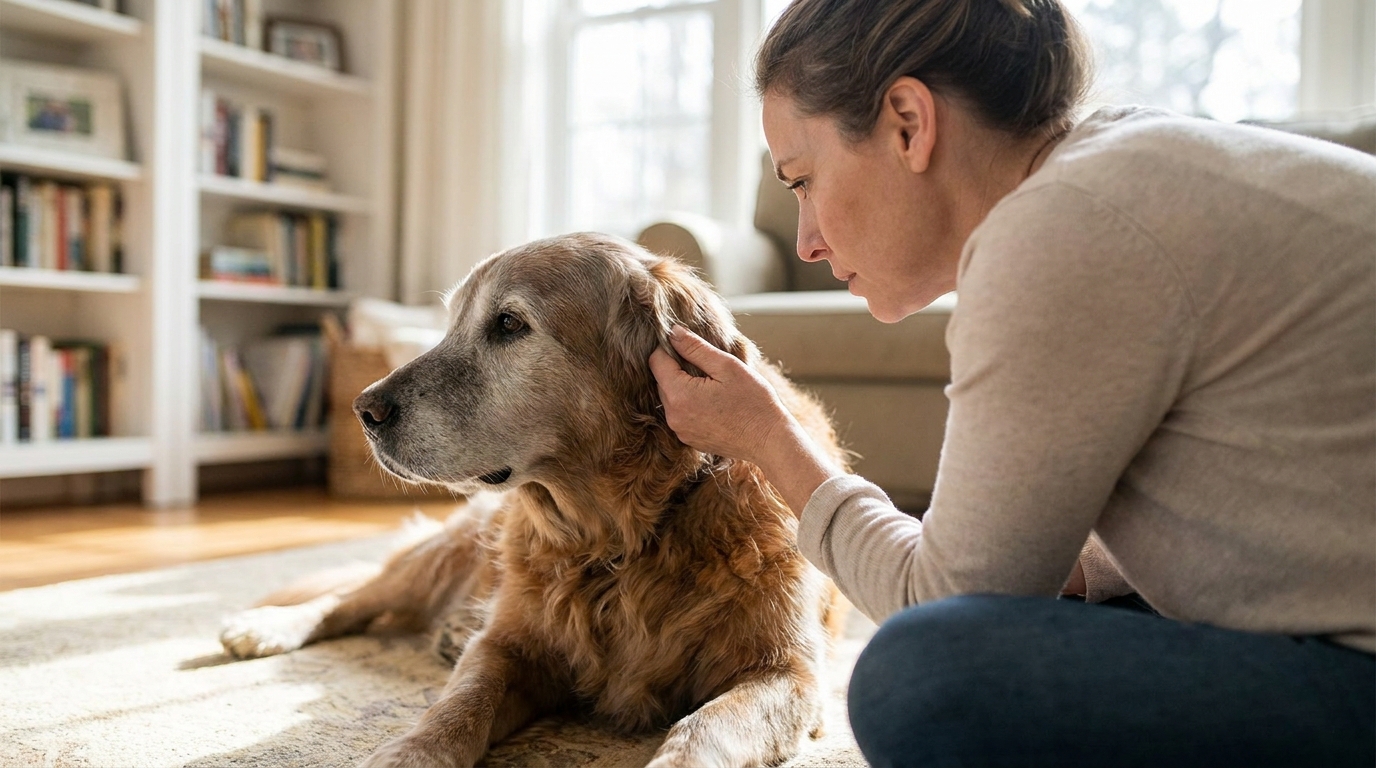
How to spot hearing loss in a dog, test it safely at home, tell it from dementia or an ear infection, and know when it is an emergency.
Quick answer: A dog going deaf stops coming when called, sleeps through the doorbell and startles when touched from behind. Hearing that fades slowly over months needs a routine vet exam to rule out wax or infection. Hearing loss that seems sudden needs an emergency vet now, as do a head tilt, loss of balance, flicking eyes or severe ear pain. Ear smell or extra wax needs a vet soon.
This article is general information, not a diagnosis. If you think your pet is in danger, go to the nearest emergency animal hospital.
Is sudden hearing loss in a dog an emergency?
A dog that loses its hearing suddenly, or loses hearing along with a head tilt, loss of balance, circling, flicking eyes, a drooping face, severe ear pain or bleeding from the ear canal, needs an emergency vet now. Hearing that seems to vanish over hours or a few days counts as sudden, and if you are not sure how fast it went, treat it as sudden; only an exam can tell the two apart.
Also go to the nearest emergency vet now for:
- Any hearing change after a head injury, especially with bleeding from the ear or pupils of different sizes.
- Sudden deafness, a head tilt or lost balance after ear drops or an ear cleaning. Stop, put nothing more in the ear, and go.
- An older dog with a sudden tilt, flicking eyes or falling, with or without vomiting, even with no ear signs, because an owner cannot tell an inner-ear cause from a brain cause at home.
- Hearing loss with new confusion, circling, a seizure or sudden vision loss.
- Waking from anesthesia unable to hear. This is rare and no reason to skip a needed dental or ear procedure; call the clinic that did it now, or go to an emergency vet now.
If your dog swallowed ear cleaner or ear medicine, call ASPCA Animal Poison Control at (888) 426-4435 (a consultation fee may apply) or Pet Poison Helpline at (855) 764-7661 (a per-incident fee applies), and call an emergency vet.
Pus draining from the ear, pain when opening the mouth or chewing, refusing food or extreme lethargy with ear pain, or sudden, violent head shaking or pawing at one ear after time in grass or brush needs an in-person vet the same day. Fading hearing with a new ear smell, itch, redness or extra wax needs a clinic visit soon. If hearing seems to fade while your dog takes a medicine other than ear drops, call the vet who prescribed it before stopping it. If an ear gets redder or more painful after prescribed drops, with no hearing change, tilt or balance problem, call the prescribing vet. If hearing fades during or after ear drops, put nothing more in the ear and go to an emergency vet now.
| What you see | How soon | Where |
|---|---|---|
| Sudden hearing loss | Now | ER |
| Head tilt or falling | Now | ER |
| Flicking eyes | Now | ER |
| Drooping face, no blink | Now | ER |
| Severe ear pain | Now | ER |
| Fever with ear pain | Now | ER |
| Bleeding from ear | Now | ER |
| After a head injury | Now | ER |
| Deaf after drops | Now | ER |
| Swallowed ear product | Now | Poison line, ER |
| Pus or pain chewing | Same day | Vet |
| Sudden head shaking, grass | Same day | Vet |
| Ear smell, itch, wax | Soon | Clinic |
| Slow fade over months | Routine | Vet exam |
Same day means your vet today, or an emergency clinic if no clinic can see your dog today. If you are not sure the loss was gradual, treat it as sudden.
Signs your dog is going deaf
A dog losing its hearing stops coming when called, sleeps through the doorbell or your return home, startles when touched from behind, may bark more or louder, and stops reacting to sounds it used to fear, such as fireworks or thunder. The Merck Veterinary Manual also lists voice changes, confusion with spoken commands and less ear movement, and PetMD adds deeper sleep and acting nervous, clingy or confused.
Merck says middle and high pitches go first, so a dog may still react to a loud clap while missing your normal voice. A dog deaf in only one ear shows few signs beyond trouble telling where a sound comes from.
One warning: a dog that does not respond to its name during a shaking or trembling episode, or that paddles, collapses or loses bladder control, needs an emergency vet now, because that can be a seizure.
How can I test my dog's hearing at home?
To test a dog's hearing at home, stand behind your resting or distracted dog, out of sight and without causing vibration or a breeze, and squeak a toy, jingle keys or clap; try different distances and pitches, and repeat on another day. The American Kennel Club (AKC) says a dog that pricks its ears or looks toward the sound can hear, though this is not a definitive test.
Merck notes a home test cannot find deafness in one ear, a stressed dog reacts less, and a sound repeated too often stops getting a reaction. Move other pets out of the room first, since a deaf dog may copy them.
Deaf dogs startle more easily, which can raise the risk of a bite, Merck says. Test from a few steps away, never touch or startle a sleeping dog as part of the test, keep children out of it, and never use air horns, fireworks or banged pans.
Why do dogs lose their hearing?
Most older dogs lose hearing slowly from age-related changes in the inner ear, but ear wax, long-term ear infections, a damaged eardrum, some medicines, a head injury and loud noise can cause hearing loss at any age, and some dogs are born deaf. The Merck Veterinary Manual says age-related loss usually starts in the last third of a breed's typical lifespan and can progress to complete deafness if the dog lives long enough.
Merck says blockage-type loss usually comes from a middle-ear infection, a long-term outer-ear infection or too much wax, while nerve-type loss comes from aging, injury, loud noise, some medicines or, rarely, anesthesia.
A hardened wax plug against the eardrum can cause temporary hearing loss and is removed by a vet, often under anesthesia; see what dog ear wax color means. Ear infections that keep coming back matter too, because Merck says hearing loss can stay after severe or long-term middle- and inner-ear infections. Merck also says many ear treatments can damage hearing, so vets confirm the eardrum is intact first.
George M. Strain, PhD, of Louisiana State University (LSU) notes that fireworks can be even louder than guns, and loud noise can cause temporary or permanent loss. Inherited deafness, linked to white, piebald or merle coats and often blue eyes, affects more than 100 breeds, Merck says, including the Dalmatian, Bull Terrier, Australian Cattle Dog, English Setter and Boston Terrier. It usually develops in the first weeks of life, so when an adult dog of any breed starts losing hearing, the usual causes are age, ear disease, some medicines or loud noise, and an ear exam comes first.
Is it hearing loss, dementia or an ear infection?
Deafness, an ear infection and dementia can all look like a dog ignoring you, but a deaf dog still responds to sight and touch, an ear infection usually brings smell, head shaking or scratching, and dementia adds getting lost or stuck at home, waking at night, house accidents and repetitive pacing. The Merck Veterinary Manual links outer-ear infection with head shaking, itching, a bad smell and redness, and inner-ear infection with a head tilt and flicking eyes.
An old dog can have both: Merck lists hearing loss as a normal aging change and cognitive dysfunction, or dementia, as a separate aging disorder, and PetMD says dementia can cause signs like those of hearing loss, so a confused older dog needs a vet check. Sudden confusion with a tilt, flicking eyes, circling, falling or a seizure means an emergency vet now.
| Clue | Points to | Next step |
|---|---|---|
| Ignores sound, sees you | Hearing loss | Vet exam |
| Smell, head shaking, wax | Ear infection | Vet soon |
| Lost at home, up at night | Dementia | Vet exam |
| Hears some calls, not all | Early loss | Vet first |
| Deaf and confused | Can be both | Vet exam |
| Tilt, flicking eyes, falls | Inner ear or brain | ER now |
Rule out hearing loss with a vet before working with a trainer.
Can a dog's hearing come back?
Hearing lost to wax, a blocked canal or a middle-ear infection often improves once a vet treats it, but age-related and inherited deafness are permanent, and hearing lost to very loud noise, a head injury or some medicines usually does not come back. The Merck Veterinary Manual says recovery after a middle-ear infection can take weeks, and LSU's Strain says an inner-ear infection that is not treated quickly causes permanent deafness. Because treatable causes look the same at home, "it is just old age" should come only after an ear exam.
Put nothing in the ear until a vet has checked it: no vinegar, oils, peroxide, rubbing alcohol, cotton swabs, digging at wax, old or another pet's drops, or human ear products.
How does a vet confirm deafness?
A vet starts with an ear exam to look for wax, infection or a damaged eardrum, and the brainstem auditory evoked response (BAER) test, which records the response to clicks in each ear separately, confirms deafness and is usually done at a specialty or university hospital. The Merck Veterinary Manual says an otoscope check, middle-ear imaging and a nerve exam may find the cause. LSU says the BAER test rarely causes pain, usually takes 10 to 15 minutes and usually needs no sedation. PetMD notes it is not commonly used when a vet thinks an older dog's loss is age-related.
Living with a deaf or hard-of-hearing senior dog
Most deaf dogs adapt well once owners switch to hand signals, a gentle touch on the same spot such as the shoulder, a flashing porch light or flashlight at night, and a leash or securely fenced yard every time outside. The Merck Veterinary Manual says dogs that lose hearing later in life seem to cope well, with no evidence that deafness itself causes pain.
- To wake a sleeping deaf dog, the AKC suggests holding a hand near its nose so it wakes to your smell, then touching gently and giving a reward.
- Keep an ID tag and microchip current, and add a tag, vest or leash sign that says the dog is deaf.
- Ask holiday guests, especially children, to approach only when the dog is looking at them, as PetMD advises.
Most deaf dogs do not need a vibration collar, which can startle or confuse a dog, says Beth Turner, DVM, of Preventive Vet; if you are considering one, talk to a force-free trainer experienced with deaf dogs first.
Eyesight can fade along with hearing in old dogs, Merck notes. A slow haze in a comfortable older dog needs a routine exam, but sudden bumping into things, one pupil bigger than the other, or a red, painful or bulging eye needs an emergency vet now.
When a video visit helps
A video visit with RexVet, a nonprofit online vet service that serves pets located in Florida, New York and Virginia, can help sort out a dog's slowly fading hearing, but sudden hearing loss needs an emergency vet now. Your dog must be in one of those states during the visit.
41% of RexVet video visits were for pets aged 7 or older.
A $64.99 live video visit with a licensed RexVet vet, a veterinarian licensed in your pet's state, fits a dog whose hearing has faded over weeks or months and who is otherwise eating, walking and acting normally, or an owner who wants help telling hearing loss from dementia or a training gap. Live slots run about 8 AM to 11 PM ET, and you can book a video visit online.
The veterinarian can watch your home hearing test on camera, look at the outer ear for wax, redness or discharge, ask about medicines and past ear infections, coach hand signals and safety, and say whether an in-person ear exam or a BAER referral is needed; RexVet does not perform BAER tests. For a senior dog you will check on through the year, the one-time $120 Family Plan covers 4 visits over 12 months for every pet in the home and never auto-renews.
A camera cannot see a dog's eardrum, clean the ears or test hearing electronically. Many FDA-approved dog ear medicines are labeled for use only after a vet confirms the eardrum is intact, so ear medicine after a video visit depends on a recent in-person ear exam; a first infection, a new flare or a sore ear needs an in-person exam, as does fading hearing with an ear smell, discharge, redness or extra wax.
No prescription is promised; any medicine is the veterinarian's decision after the visit, within state and federal rules. Florida s.474.2021 limits a video-only prescription to FDA-approved animal drugs used as labeled, for up to 14 days (1 month for products labeled solely for fleas and ticks), with no renewal without an in-person exam; human-labeled, controlled and compounded anti-infective drugs need an in-person exam. Federal rules (21 CFR 530.3) require an in-person vet relationship for off-label or human-drug use. Virginia allows the exam to be done electronically, and New York's telehealth prescribing rules are not settled. RexVet is not a pharmacy, and a pharmacy transfer fee applies if a prescription is sent to an outside pharmacy.
Not a fit for video. Go to the nearest emergency vet now for sudden hearing loss; a head tilt, loss of balance or circling; flicking eyes; a drooping face or an eye that cannot blink; severe ear pain, fever with ear pain or ear bleeding; a head injury; or hearing loss with new confusion or a seizure. The same goes for any of these after ear drops or a cleaning: put nothing more in the ear and go. Pus draining from the ear, or pain when chewing, needs an in-person vet the same day.
Need an Expert Opinion on This Topic?
Book a video visit with a licensed vet, evenings and weekends included
See open timesFrequently Asked Questions
At what age do dogs start going deaf?
There is no set age: the Merck Veterinary Manual says age-related hearing loss usually starts in the last third of a breed's typical lifespan. It gets worse slowly, high pitches first, and can progress to complete deafness. An ear exam comes first, because hearing lost to wax or infection can often be treated.
Can ear infections make a dog deaf?
Yes: the Merck Veterinary Manual lists middle-ear infections, long-term outer-ear infections and too much wax as the usual causes of blockage-type hearing loss. That loss often improves with treatment. An inner-ear infection that is not treated quickly causes permanent deafness, according to LSU, so a head tilt, loss of balance or flicking eyes needs an emergency vet now.
Is my dog deaf or just ignoring me?
An older dog that answers hand signals but not your voice from behind may be losing hearing, so book a vet exam first. High-pitched and quiet sounds usually go first, so a dog can hear some calls and miss others. A dog that stops responding to its name suddenly, or during a shaking or trembling episode, needs an emergency vet now.
Can a deaf dog live a normal life?
Yes: the Merck Veterinary Manual says dogs that go deaf later in life seem to cope well. There is no evidence that deafness itself causes pain. Switch to hand signals taught with treats, and use a leash or fenced yard every time outside.
Do deaf dogs bark more?
Some do: Merck lists more barking and voice changes among signs of deafness, though PetMD notes some deaf dogs bark less instead. New night barking with confusion, pacing or house accidents can point to dementia, so book a vet exam.
Can an online vet check my dog's hearing in Florida, New York or Virginia?
Partly: a licensed RexVet vet can watch a home hearing test on video, but an eardrum check and a BAER test need an in-person visit. For a dog located in Florida, New York or Virginia during the visit, the veterinarian can review past ear infections and medicines, look at the outer ear and say how soon your dog needs an in-person ear exam, which a first ear problem or a sore ear needs before any drops. No prescription is guaranteed. Florida law (s.474.2021) limits a video-only prescription to FDA-approved animal drugs used as labeled, for up to 14 days (1 month for products labeled solely for fleas and ticks), with no renewal without an in-person exam; human-labeled, controlled and compounded anti-infective drugs need an in-person exam. Federal rules (21 CFR 530.3) require an in-person vet relationship for off-label or human-drug use. Virginia allows the exam to be done electronically, and New York's telehealth prescribing rules are not settled. Sudden hearing loss or a head tilt needs an emergency vet now, not a video visit.
FAQs
At what age do dogs start going deaf?
There is no set age: the Merck Veterinary Manual says age-related hearing loss usually starts in the last third of a breed's typical lifespan. It gets worse slowly, high pitches first, and can progress to complete deafness. An ear exam comes first, because hearing lost to wax or infection can often be treated.
Can ear infections make a dog deaf?
Yes: the Merck Veterinary Manual lists middle-ear infections, long-term outer-ear infections and too much wax as the usual causes of blockage-type hearing loss. That loss often improves with treatment. An inner-ear infection that is not treated quickly causes permanent deafness, according to LSU, so a head tilt, loss of balance or flicking eyes needs an emergency vet now.
Is my dog deaf or just ignoring me?
An older dog that answers hand signals but not your voice from behind may be losing hearing, so book a vet exam first. High-pitched and quiet sounds usually go first, so a dog can hear some calls and miss others. A dog that stops responding to its name suddenly, or during a shaking or trembling episode, needs an emergency vet now.
Can a deaf dog live a normal life?
Yes: the Merck Veterinary Manual says dogs that go deaf later in life seem to cope well. There is no evidence that deafness itself causes pain. Switch to hand signals taught with treats, and use a leash or fenced yard every time outside.
Do deaf dogs bark more?
Some do: Merck lists more barking and voice changes among signs of deafness, though PetMD notes some deaf dogs bark less instead. New night barking with confusion, pacing or house accidents can point to dementia, so book a vet exam.
Can an online vet check my dog's hearing in Florida, New York or Virginia?
Partly: a licensed RexVet vet can watch a home hearing test on video, but an eardrum check and a BAER test need an in-person visit. For a dog located in Florida, New York or Virginia during the visit, the veterinarian can review past ear infections and medicines, look at the outer ear and say how soon your dog needs an in-person ear exam, which a first ear problem or a sore ear needs before any drops. No prescription is guaranteed. Florida law (s.474.2021) limits a video-only prescription to FDA-approved animal drugs used as labeled, for up to 14 days (1 month for products labeled solely for fleas and ticks), with no renewal without an in-person exam; human-labeled, controlled and compounded anti-infective drugs need an in-person exam. Federal rules (21 CFR 530.3) require an in-person vet relationship for off-label or human-drug use. Virginia allows the exam to be done electronically, and New York's telehealth prescribing rules are not settled. Sudden hearing loss or a head tilt needs an emergency vet now, not a video visit.
Medically Reviewed
Reviewed by Dr. Tiffany Delacruz, DVM — licensed veterinarian and CEO of RexVet. Last reviewed November 16, 2026.
Content is for informational purposes and does not replace professional veterinary advice.
Chief Executive Officer · Licensed Veterinarian
Dr. Delacruz is a licensed Doctor of Veterinary Medicine specializing in preventive care and veterinary telehealth. She reviews all health content on RexVet to ensure accuracy and clinical relevance.
Sources & References
- · American Veterinary Medical Association — Telehealth Guidelines
- · AVMA — Pet Care Resources
- · U.S. FDA — Animal & Veterinary