
Dog Threw Up After Taking Medication: Do I Give It Again?
By RexVet Team | Reviewed by Dr. Tiffany Delacruz, DVM
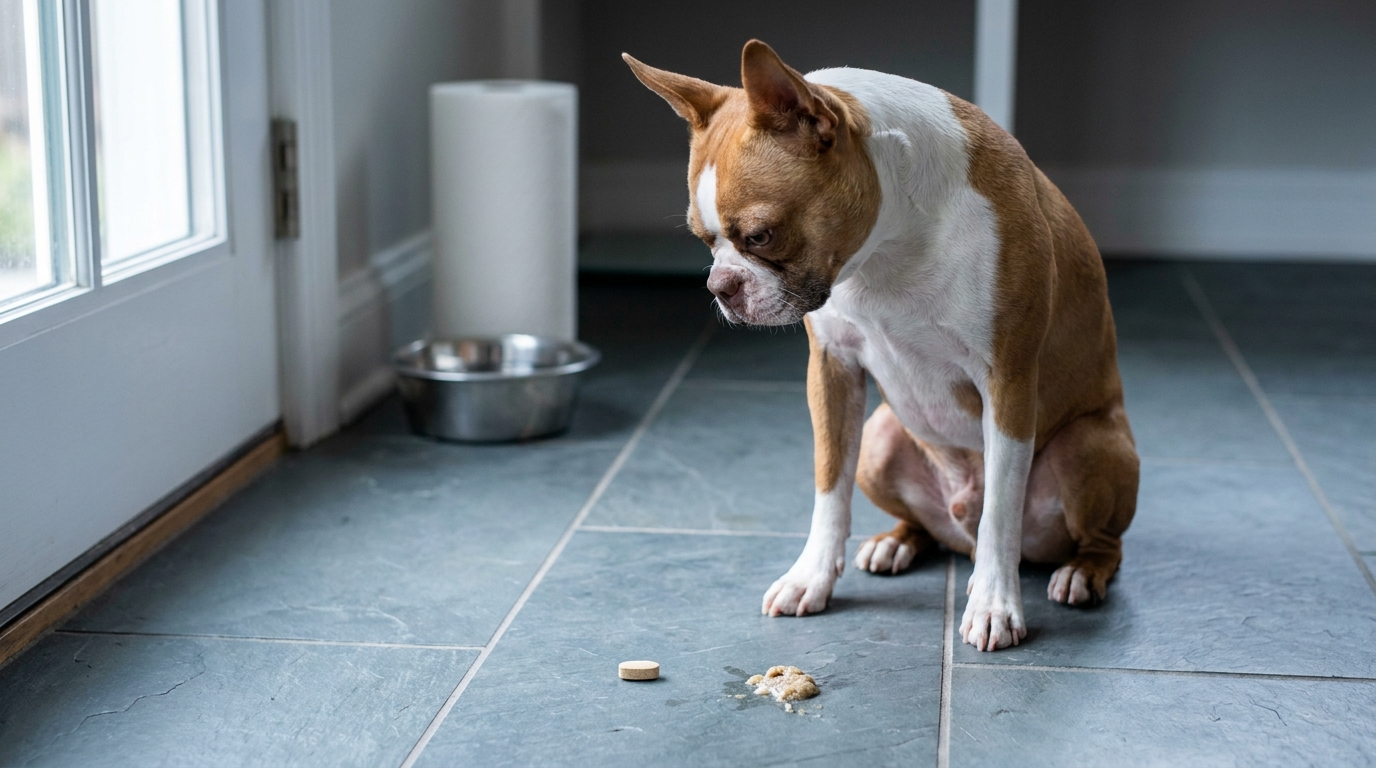
Do not re-dose on a guess: whether to give the pill again depends on the drug, how long ago you gave it, and what you can see in the vomit.
If your dog has vomited more than once or twice, there is blood in the vomit, the belly looks swollen or painful, or your dog is weak, wobbly, trembling, struggling to breathe or collapsed, go to an in-person emergency vet now; and if you may have given a second dose of a heart, seizure, pain, thyroid or insulin medication by mistake, call a vet or an animal poison control line right away instead of waiting to see.
If your dog threw up after taking medication and is otherwise acting normally, you have time to work this out; because every medication acts differently, there is no single answer for every situation.
Dog threw up after taking medication: the three things to check first
- Look at the vomit: an intact tablet, chew or capsule, or only dissolved material?
- Note the exact time between dosing and vomiting; any cutoff is set by the product's label or your vet, not a general rule.
- Identify the exact product, its strength and how it was given: dry, in a pill pocket, in food or as a liquid, on an empty or full stomach.
Then photograph the vomit and keep the packaging; these are the facts a vet needs. Pill fragments are a fact for the vet, not permission to re-dose.
The one-hour rule is a label statement, not a law of nature
Many pet parents assume there is a universal waiting period; there is not. Some labels use one hour as their cutoff; the window is product-specific, and applying one number to the wrong drug can lead to an accidental overdose.
The Trifexis label says that if vomiting occurs within an hour of administration, redose with another full dose, and to give it with food for maximum effectiveness. The Interceptor Plus label gives no time window: make sure the dog consumes the complete dose, observe it for a few minutes so no part is lost or rejected, and redose if any of the dose is suspected lost.
Other products use different windows or say nothing. RexVet's NexGard for dogs and amoxicillin for dogs pages quote the window for those products; the Trifexis for dogs and Interceptor Plus for dogs pages cover those chews. If the label is silent or confusing, do not guess: the veterinarian decides.
Spat out vs. vomited up: why the difference changes the answer
A dry, intact pill found on the floor or in the bed was never swallowed: a lost dose, and the label's lost-or-rejected instruction or your vet's instruction applies. A chewed treat with the pill spat out is the same; Cornell's Riney Canine Health Center advises watching to make sure your dog completely swallows the treat and the medication, because some dogs chew the treat and spit out the pill.
A whole pill in the vomit means most of the dose probably came back up, but how much dissolved first cannot be judged at home; apply the product's own vomiting rule, or ask the vet.
A partly dissolved pill or mushy material means some drug may already be in your dog's system; how much is unknowable at home, which is exactly why guessing is risky.
Drug classes where you may re-dose only if the label or your vet says so, and where you must never guess
The first group is monthly flea, tick and heartworm chews and some antibiotics, only where the label or RexVet's product page gives a written re-dose instruction for that exact product. In Florida, where those chews run year-round, the answer is still the written rule, never "one more to be sure".
The second group must never be re-dosed at home: NSAIDs such as carprofen, steroids, heart and blood-pressure drugs, seizure medications, thyroid drugs, sedatives and behavior drugs. For carprofen, VCA Animal Hospitals says never to give two doses at once or give extra doses, and if a missed dose is close to the next one, to skip it and return to the regular schedule. A vomited dose in this group means no replacement dose at home: call the vet, who decides whether the next scheduled dose goes ahead.
Insulin: according to VCA, a single missed dose is usually not life-threatening; contact your veterinarian about when to give the next dose, and never double up, because that will cause an overdose. If your dog is not eating, do not give the insulin and consult the veterinarian, VCA says. Weakness, lethargy or unresponsiveness after insulin are signs of low blood sugar, and hypoglycemia is a potentially fatal emergency. A diabetic dog that vomits and refuses dinner needs that call tonight.
Is the medicine causing the vomiting?
Like other NSAIDs, carprofen can cause vomiting, lack of appetite, diarrhea, constipation and lethargy, and VCA says to give it with food to reduce them. Stomach irritation is a common side effect of many oral treatments, especially on an empty stomach; a meal often acts as a buffer. Some chewables cause nausea with the first dose or two.
If your dog vomits every time a particular drug is given, the veterinarian may change the timing, the formulation or the drug. That is the vet's decision, not a home experiment; see the guide to pet medication side effects and when to ask a vet online.
Was it the pill, or is your dog sick? Red flags that need an in-person exam
The Merck Veterinary Manual says long-term vomiting, vomiting more often than once or twice daily, and vomiting with blood, abdominal pain, depression, dehydration, weakness, fever, weight loss or other signs requires a more detailed examination.
- A single vomit after a routine pill in a dog that is otherwise bright: possibly a minor side effect, and a question for a video visit.
- Repeated vomiting, or a dog that is lethargic, feverish or has a painful belly: possible illness or toxicity. Go to an in-person vet now.
- Blood or dark material in the vomit: go in person now.
- Retching that brings nothing up, especially in a large, deep-chested breed, or a swollen belly: emergency hospital now.
Check that it was vomiting at all: Merck describes regurgitation as passive, with no effort or abdominal contraction, bringing up undigested food that may be tube-shaped. A dog on medication for a serious illness who vomits may be showing the illness, not the drug; see the dog vomiting guide.
What to do tonight, step by step
- Do not give a second dose yet.
- Photograph the vomit and the product label.
- Write down the dosing time and the vomiting time.
- Check the label or the RexVet product page for a written re-dose instruction. Many labels have none, and a missed-dose line is not the same thing.
- If you may have given an extra dose by accident, call a vet or an animal poison control line now.
- Offer water. If your dog seems queasy, hold the next meal briefly, but do not fast a diabetic dog or a puppy.
- If no re-dose rule applies, give the next scheduled dose on time, and never double it.
When to see a vet in person vs. when an online vet visit helps
Go in person now for:
- Any of the emergency signs in the bold line above.
- A suspected double dose of any drug in the second group above, or of insulin: call an animal poison control line or an emergency vet right away.
- A dog that cannot keep water down.
An online visit is the right first step for a single vomit after a routine pill in a dog that is otherwise bright: whether to re-dose, when the next dose is due, how to give it so it stays down, and whether the vomiting needs a workup. On video, an online vet in Florida, New York or Virginia looks at your vomit photo and the packaging, confirms the product and timing, applies that product's rule, and adjusts how the next dose is given; anything that looks like an emergency gets sent in person.
RexVet's veterinarians are licensed in Florida, New York and Virginia only and are available 24/7. A video visit is $64.99: book a RexVet video visit now.
How to give the next dose so it stays down
Give the next dose with a small meal unless the label or your veterinarian says otherwise. Pill pockets, soft food or a treat molded around the pill hide most tablets. Watch your dog swallow, then check the mouth and the floor.
Ask the vet before crushing, splitting or hiding a pill in food, because some products must be given whole. If you keep struggling, Cornell advises checking in with your veterinarian: alternatives include a pill instead of a liquid, or a flavored version from a compounding pharmacy; if the condition being treated involves dietary restrictions, ask before wrapping anything in food. Keep a simple dosing log.
If you still do not know whether that pill counts, do not guess. RexVet's veterinarians are licensed in Florida, New York and Virginia only and see dogs by video 24/7 for $64.99: book a video visit and show the vet the photo and the label.
Frequently asked questions
Should I give my dog his medication again if he threw it up?
Not automatically. It depends on the drug, the time elapsed and whether the pill was swallowed or spat out; some medications are dangerous if doubled, so check the label or ask a veterinarian first.
What if I can see the whole pill in the vomit?
Most of the dose probably came back up, but you cannot tell at home how much dissolved first. Follow the product's own vomiting rule, or ask the vet.
How long after a pill does it count as absorbed in dogs?
There is no universal absorption time, so never assume one. The Trifexis label uses a one-hour vomiting rule, RexVet's NexGard and amoxicillin pages give their own product-specific instructions, and many labels give none; confirm the rule for your product or ask a veterinarian.
Which medications should I never re-dose without asking a vet?
NSAIDs such as carprofen, steroids, heart and blood-pressure drugs, seizure medications, thyroid drugs, sedatives and behavior drugs, and insulin. Do not give a replacement dose at home; ask a veterinarian about the next scheduled dose.
Can an online vet tell me whether to give the dose again?
Yes, for the non-emergency case: a RexVet veterinarian looks at the vomit photo and the packaging on video, confirms the product and timing, and applies that product's rule. With any emergency sign, or a possible extra dose of a high-risk drug, go in person or call an animal poison control line instead.
Sources
- DailyMed: Trifexis (spinosad and milbemycin oxime) tablet label
- DailyMed: Interceptor Plus (milbemycin oxime and praziquantel) chewable tablet label
- Cornell Riney Canine Health Center: How to medicate your dog
- VCA Animal Hospitals: Carprofen
- VCA Animal Hospitals: Insulin Glargine
- Merck Veterinary Manual: Vomiting in Dogs
FAQs
Should I give my dog his medication again if he threw it up?
Not automatically. It depends on the drug, the time elapsed and whether the pill was swallowed or spat out; some medications are dangerous if doubled, so check the label or ask a veterinarian first.
What if I can see the whole pill in the vomit?
Most of the dose probably came back up, but you cannot tell at home how much dissolved first. Follow the product's own vomiting rule, or ask the vet.
How long after a pill does it count as absorbed in dogs?
There is no universal absorption time, so never assume one. The Trifexis label uses a one-hour vomiting rule, RexVet's NexGard and amoxicillin pages give their own product-specific instructions, and many labels give none; confirm the rule for your product or ask a veterinarian.
Which medications should I never re-dose without asking a vet?
NSAIDs such as carprofen, steroids, heart and blood-pressure drugs, seizure medications, thyroid drugs, sedatives and behavior drugs, and insulin. Do not give a replacement dose at home; ask a veterinarian about the next scheduled dose.
Can an online vet tell me whether to give the dose again?
Yes, for the non-emergency case: a RexVet veterinarian looks at the vomit photo and the packaging on video, confirms the product and timing, and applies that product's rule. With any emergency sign, or a possible extra dose of a high-risk drug, go in person or call an animal poison control line instead.
Sources
- DailyMed: Trifexis (spinosad and milbemycin oxime) tablet label
- DailyMed: Interceptor Plus (milbemycin oxime and praziquantel) chewable tablet label
- Cornell Riney Canine Health Center: How to medicate your dog
- VCA Animal Hospitals: Carprofen
- VCA Animal Hospitals: Insulin Glargine
- Merck Veterinary Manual: Vomiting in Dogs
Medically Reviewed
Reviewed by Dr. Tiffany Delacruz, DVM — licensed veterinarian and CEO of RexVet. Last reviewed September 16, 2026.
Content is for informational purposes and does not replace professional veterinary advice.
Chief Executive Officer · Licensed Veterinarian
Dr. Delacruz is a licensed Doctor of Veterinary Medicine specializing in preventive care and veterinary telehealth. She reviews all health content on RexVet to ensure accuracy and clinical relevance.
Sources & References
- · American Veterinary Medical Association — Telehealth Guidelines
- · AVMA — Pet Care Resources
- · U.S. FDA — Animal & Veterinary
Need an Expert Opinion on This Topic?
Connect with a certified vet via video call in minutes
Talk to Vet Now