
Dog Licking Lips and Gulping at Night? Causes and ER Signs
By RexVet Team | Reviewed by Dr. Tiffany Delacruz, DVM
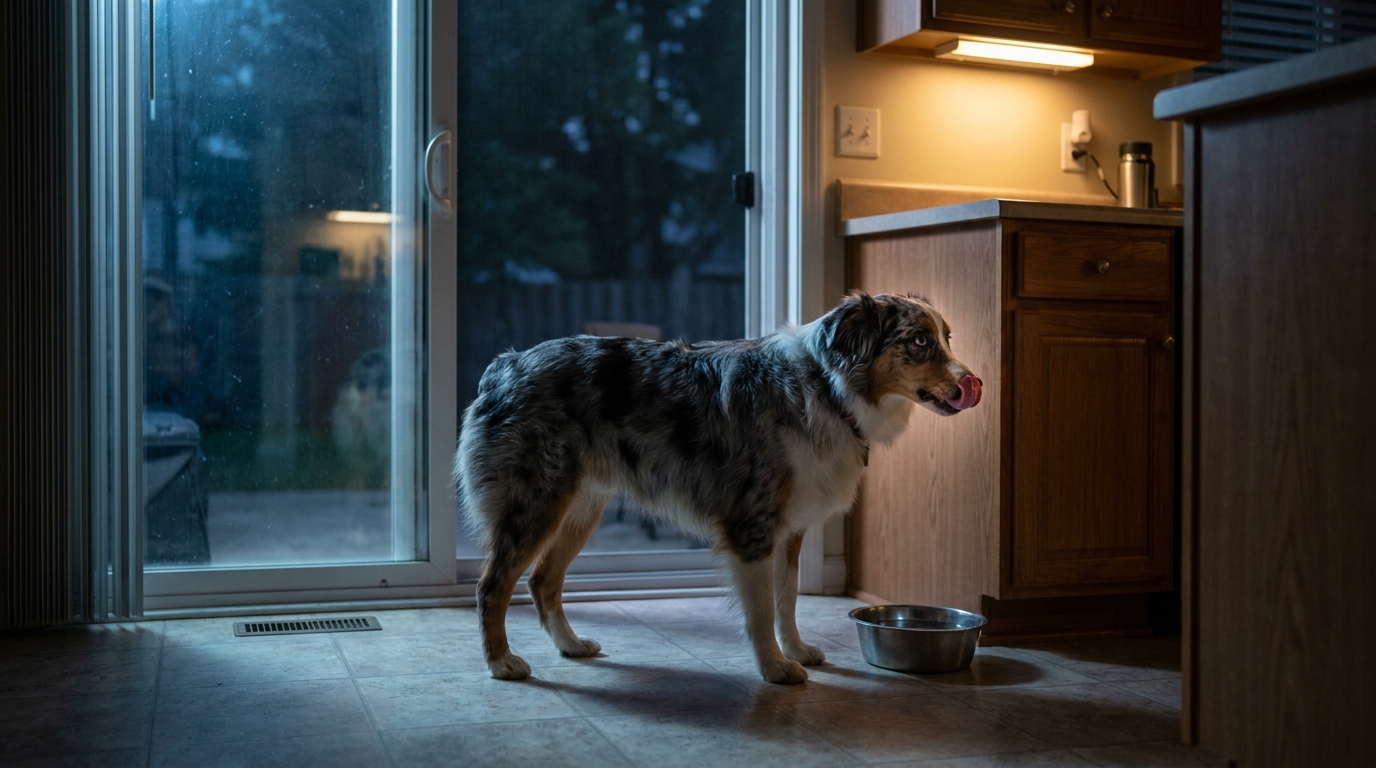
Dog licking lips and gulping at night? It often points to nausea, reflux or something in the mouth. Dry heaving or a swollen belly means the ER now.
Go to an emergency vet now if your dog retches without bringing anything up, has a swollen or painful belly, has pale gums, is struggling to breathe or choking, paws frantically at its mouth, collapses, or started gulping right after swallowing a bone, stick, rawhide or toy.
It is the middle of the night. Your dog smacks his lips, swallows over and over, stretches his neck, paces and scratches at the door to eat grass, and your regular vet is closed.
Dog licking lips and gulping at night: what's going on
These episodes tend to fall into three families: nausea, acid coming up from the stomach into the esophagus (the food pipe), and something in the mouth or throat.
Nausea
PetMD explains that "A dog with an upset stomach or nausea might resort to lip licking to deal with discomfort from eating something inappropriate or from motion sickness." PetMD also notes that "Excessive lip licking and drooling can be a precursor to vomiting."
Acid coming up into the esophagus
In its guide to reflux disease in dogs, VCA lists possible signs of reflux that include:
- "Licking the lips"
- "Difficulty swallowing"
- "Pacing or restlessness at night"
The Merck Veterinary Manual says that "Inflammation of the esophagus is usually caused by foreign objects or acid reflux from the stomach into the esophagus." It adds: "When seen, signs include regurgitation, drooling, repeated swallowing, pain, depression, lack of appetite, trouble eating, or extension of the head or neck."
Something in the mouth or throat
PetMD's examples of mouth trouble include "a foreign object lodged between their teeth or gums (like pieces of a stick or bone shards)." Sore teeth or gums from dental disease can bother a dog too.
If your dog has been mouthing or eating beetles this fall, read about lady beetles stuck in the mouth.
Emergency signs: go to an ER now, not a video call
Go to the nearest emergency vet now, not a video call, if you see any one of these:
- retching or dry heaving that brings nothing up
- a swollen, tight or painful belly
- pale gums
- struggling to breathe, or choking
- pawing frantically at the mouth
- weakness, lethargy or collapse
- sudden heavy drooling or gagging, or food coming back up
- pacing or restlessness together with drooling
- blood or coffee-ground material in the vomit, or vomiting again and again
- gulping that started right after chewing or swallowing a bone, stick, rawhide or toy
Why reflux and bloat can look alike
Bloat is what vets call gastric dilatation volvulus, or GDV. The Cornell University College of Veterinary Medicine lists these bloat signs: "Non-productive retching or attempting to vomit with no production," "Excessive drooling," "Bloated abdomen," "Painful abdomen," "Restlessness, pacing," "Pale gums" and "Weakness or collapse." Cornell is clear that "GDV requires immediate medical and surgical intervention."
Pacing, restlessness and drooling can show up with reflux and with bloat, so on their own they cannot tell the two apart. The tie-breakers are retching that brings nothing up and a swollen or painful belly. Either one means go now. But do not let the overlap talk you out of going: pale gums, weakness or collapse, or restlessness and pacing with drooling also mean the ER now. If you are unsure, go anyway.
Cornell also notes that "While GDV can occur in any sized dog or breed, it is far more common in large, deep-chested dogs."
Something stuck in the throat
The Merck Veterinary Manual warns that "Sudden and excessive drooling, gagging, regurgitation, and repeated attempts to swallow are signs of an esophageal foreign object." It also says that "If a foreign object is detected in the esophagus, it should be removed immediately."
So gulping that begins right after your dog chewed or swallowed something means the ER now. So does sudden heavy drooling or gagging with repeated swallowing, or food coming back up while your dog gulps, even if you saw nothing swallowed. For more on heavy drooling, see why a dog suddenly drools a lot and what to do tonight. If you think your dog swallowed something poisonous, go to an emergency vet now or call an animal poison control line.
If you are not sure whether it is an emergency, treat it as one and go now.
Nausea, reflux or something stuck? Clues you can watch for
These clues are for a dog with none of the emergency signs above.
Vomiting or regurgitation?
VCA says: "Vomiting is an active process that involves obvious abdominal heaving." By contrast, "Regurgitation is a passive process in which a dog appears to simply open its mouth and material comes out."
Cornell adds: "Remember, regurgitation does not include retching. With regurgitation, there's no warning, and it may indicate an esophageal problem." If your dog regurgitates, go to the ER now; Merck lists regurgitation among the signs of something stuck.
Mouth and throat clues
- Pawing at the mouth, especially after chewing a bone or stick. PetMD says that if a dog was eating a bone and then begins "pawing at their mouth and lip licking," there is a good chance it has "something in their teeth or stuck in the throat, requiring help." So pawing after a bone means seeing a vet in person now (at night, an emergency vet), and frantic pawing or any trouble breathing means the ER now.
- Chomping or working the jaw. PetMD says this "could be foreign material stuck in the cheek, between the teeth or gums, or in the roof of the mouth."
- Gulping or repeated swallowing. This can go with nausea or reflux, but Merck lists "repeated attempts to swallow" among the signs of something stuck in the esophagus. If it started after chewing a bone, stick, rawhide or toy, came on suddenly with heavy drooling or gagging, or food comes back up with it, go to the ER now.
- Retching with nothing coming up, or a swollen belly. That points to possible bloat, which means the ER now.
Grass
If your dog wants out to eat grass during an episode, note it for your vet. Cornell says: "Infrequent vomiting, such as after eating grass, is likely an isolated incident. But vomiting even once a week may indicate a disease."
Timing
Notice when the episodes happen: after a long stretch since the last meal, after a rich treat, or after your dog chewed on something.
When lip licking at night is normal
Not every lick is a problem. PetMD says "It's normal for your pup to occasionally lick their lips," and that "many pups smack their mouths and lick their lips repeatedly as they start to get comfortable in their dog bed and fall asleep."
A few smacks while your dog settles, followed by sleep, is normal. Repeated gulping, pacing, stretching the neck, a frantic push to eat grass, or episodes that keep coming back are not.
Lip licking can also be a sign of anxiety or stress.
What to do tonight while you decide
If none of the emergency signs are present, these steps help while you watch:
- Keep your dog calm in a quiet room with the lights low.
- Offer fresh water, but do not force it.
- Keep your dog on a leash outside so it cannot gorge on grass or anything else.
- Do not give any human medicine or stomach remedy, and do not try to make your dog vomit.
- Do not put your fingers down the throat or pull at anything in the mouth or throat you cannot see clearly. You could be bitten.
- Write down when your dog last ate, what it ate, and anything it chewed, such as a bone, stick, rawhide or toy.
- Film the next mild episode so a vet can see it.
Filming is only for episodes without emergency signs. If any emergency sign appears while you wait, or you are unsure whether one is there, stop filming and go to the ER now.
If your dog chewed or swallowed acorns, see what to do if your dog ate acorns and is throwing up.
What a RexVet online vet can and cannot do tonight
For a dog with none of the emergency signs, a video visit can help you decide what comes next. RexVet's veterinarians are licensed in Florida, New York and Virginia.
On a video visit, a veterinarian can:
- watch your video or a live episode
- look at the gums and inside the mouth on camera, if you can do it safely
- talk through a gulping or lip-licking episode with no emergency signs (possible retching with nothing coming up means the ER, not a video)
- go over food, treats, timing and anything your dog chewed
- help you decide between the ER now, a hands-on exam soon, or watching at home with a clear plan
A video visit cannot take x-rays, pass an endoscope, remove something stuck in the mouth or throat, or operate. It also cannot rule out bloat or something stuck in the throat, so any sign on the emergency list above means an emergency vet now.
A veterinarian decides on any treatment after assessing your dog. If the veterinarian decides medication is appropriate, they can prescribe where state rules allow.
If your dog has no emergency signs and you want a veterinarian to look tonight, you can book a RexVet video visit for $64.99, 24/7, for pet parents in Florida, New York and Virginia only.
How a vet looks into repeat night episodes in person
A vet may start with an exam, blood work and imaging to rule out other causes.
VCA notes that "GERD is often diagnosed based on endoscopy." GERD stands for gastroesophageal reflux disease. Merck notes that in many cases "a veterinarian will use an endoscope (a flexible tube with a tiny camera at one end) to explore the esophagus, search for foreign objects, and assess the extent of tissue damage."
Feeding changes are made together with your vet. VCA says "Feeding small, frequent meals can also help reduce reflux into the esophagus."
When to be seen in person in Florida, New York or Virginia
Any sign on the emergency list above means an emergency vet now, including a swollen, tight or painful belly, choking or trouble breathing, a swallowed bone, stick, rawhide or toy, sudden heavy drooling or gagging, food coming back up, or pacing with drooling. Blood in the vomit, vomit that looks like coffee grounds (digested blood), lethargy, weakness or collapse, or vomiting that keeps coming back tonight also means an emergency vet now.
These need a hands-on exam soon, even if tonight's episode passes:
- episodes that come back night after night
- weight loss
- coughing after eating
- not eating
If there is no emergency sign and you want a veterinarian to watch the next episode with you, you can book a RexVet video visit for $64.99. Vets are available 24/7 for pet parents in Florida, New York and Virginia only.
Frequently Asked Questions
Why does my dog wake up at night licking his lips and swallowing?
The usual causes are nausea, acid coming up into the esophagus, or a problem in the mouth or throat. VCA lists "Pacing or restlessness at night" among possible reflux signs, along with licking the lips, but Cornell also lists restlessness and pacing among bloat signs. Go to an emergency vet now if your dog retches with nothing coming up, has a swollen or painful belly or pale gums, is weak or collapses, chokes or struggles to breathe, paws frantically at his mouth, drools heavily, gags, paces while drooling, brings food back up, or started gulping after chewing or swallowing a bone, stick, rawhide or toy. If you are unsure, go anyway.
Could lip licking and gulping be bloat?
Lip licking and gulping alone cannot rule bloat in or out. Bloat signs Cornell lists include retching with nothing coming up, a bloated or painful belly, excessive drooling, restlessness or pacing, pale gums, and weakness or collapse. Go to an emergency vet now if your dog retches with nothing coming up, has a swollen or painful belly or pale gums, is weak or collapses, chokes or struggles to breathe, paws frantically at his mouth, drools heavily, gags, paces while drooling, brings food back up, or started gulping after chewing or swallowing a bone, stick, rawhide or toy. If you are unsure, go anyway.
Why does my dog frantically want to eat grass when he's gulping?
On its own, the urge to eat grass does not tell you the cause. Cornell notes that vomiting once in a while, such as after eating grass, is likely an isolated incident, but vomiting even once a week may indicate a disease. Keep him on a leash outside, and go to an emergency vet now if he retches with nothing coming up, has a swollen or painful belly or pale gums, is weak or collapses, chokes or struggles to breathe, paws frantically at his mouth, drools heavily, gags, paces while drooling, brings food back up, or started gulping after chewing or swallowing a bone, stick, rawhide or toy. If you are unsure, go anyway.
Can I give my dog something from my medicine cabinet for reflux at night?
No. Do not give any human medicine or stomach remedy at home; a veterinarian decides on any treatment after looking at your dog. Go to an emergency vet now if your dog retches with nothing coming up, has a swollen or painful belly or pale gums, is weak or collapses, chokes or struggles to breathe, paws frantically at its mouth, drools heavily, gags, paces while drooling, brings food back up, or started gulping after chewing or swallowing a bone, stick, rawhide or toy. If you are unsure, go anyway.
Is it normal for my dog to smack his lips as he falls asleep?
Yes. PetMD notes that many dogs smack their mouths and lick their lips repeatedly as they get comfortable in bed and drift off. Repeated gulping, pacing or neck stretching is different: go to an emergency vet now if your dog retches with nothing coming up, has a swollen or painful belly or pale gums, is weak or collapses, chokes or struggles to breathe, paws frantically at his mouth, drools heavily, gags, paces while drooling, brings food back up, or started gulping after chewing or swallowing a bone, stick, rawhide or toy. If you are unsure, go anyway.
FAQs
Why does my dog wake up at night licking his lips and swallowing?
The usual causes are nausea, acid coming up into the esophagus, or a problem in the mouth or throat. VCA lists "Pacing or restlessness at night" among possible reflux signs, along with licking the lips, but Cornell also lists restlessness and pacing among bloat signs. Go to an emergency vet now if your dog retches with nothing coming up, has a swollen or painful belly or pale gums, is weak or collapses, chokes or struggles to breathe, paws frantically at his mouth, drools heavily, gags, paces while drooling, brings food back up, or started gulping after chewing or swallowing a bone, stick, rawhide or toy. If you are unsure, go anyway.
Could lip licking and gulping be bloat?
Lip licking and gulping alone cannot rule bloat in or out. Bloat signs Cornell lists include retching with nothing coming up, a bloated or painful belly, excessive drooling, restlessness or pacing, pale gums, and weakness or collapse. Go to an emergency vet now if your dog retches with nothing coming up, has a swollen or painful belly or pale gums, is weak or collapses, chokes or struggles to breathe, paws frantically at his mouth, drools heavily, gags, paces while drooling, brings food back up, or started gulping after chewing or swallowing a bone, stick, rawhide or toy. If you are unsure, go anyway.
Why does my dog frantically want to eat grass when he's gulping?
On its own, the urge to eat grass does not tell you the cause. Cornell notes that vomiting once in a while, such as after eating grass, is likely an isolated incident, but vomiting even once a week may indicate a disease. Keep him on a leash outside, and go to an emergency vet now if he retches with nothing coming up, has a swollen or painful belly or pale gums, is weak or collapses, chokes or struggles to breathe, paws frantically at his mouth, drools heavily, gags, paces while drooling, brings food back up, or started gulping after chewing or swallowing a bone, stick, rawhide or toy. If you are unsure, go anyway.
Can I give my dog something from my medicine cabinet for reflux at night?
No. Do not give any human medicine or stomach remedy at home; a veterinarian decides on any treatment after looking at your dog. Go to an emergency vet now if your dog retches with nothing coming up, has a swollen or painful belly or pale gums, is weak or collapses, chokes or struggles to breathe, paws frantically at its mouth, drools heavily, gags, paces while drooling, brings food back up, or started gulping after chewing or swallowing a bone, stick, rawhide or toy. If you are unsure, go anyway.
Is it normal for my dog to smack his lips as he falls asleep?
Yes. PetMD notes that many dogs smack their mouths and lick their lips repeatedly as they get comfortable in bed and drift off. Repeated gulping, pacing or neck stretching is different: go to an emergency vet now if your dog retches with nothing coming up, has a swollen or painful belly or pale gums, is weak or collapses, chokes or struggles to breathe, paws frantically at his mouth, drools heavily, gags, paces while drooling, brings food back up, or started gulping after chewing or swallowing a bone, stick, rawhide or toy. If you are unsure, go anyway.
Medically Reviewed
Reviewed by Dr. Tiffany Delacruz, DVM — licensed veterinarian and CEO of RexVet. Last reviewed October 1, 2026.
Content is for informational purposes and does not replace professional veterinary advice.
Chief Executive Officer · Licensed Veterinarian
Dr. Delacruz is a licensed Doctor of Veterinary Medicine specializing in preventive care and veterinary telehealth. She reviews all health content on RexVet to ensure accuracy and clinical relevance.
Sources & References
- · American Veterinary Medical Association — Telehealth Guidelines
- · AVMA — Pet Care Resources
- · U.S. FDA — Animal & Veterinary
Need an Expert Opinion on This Topic?
Connect with a certified vet via video call in minutes
Talk to Vet Now