
Dog Ate Lawn Fertilizer? When It's Mild and When to Go In
By RexVet Team | Reviewed by Dr. Tiffany Delacruz, DVM
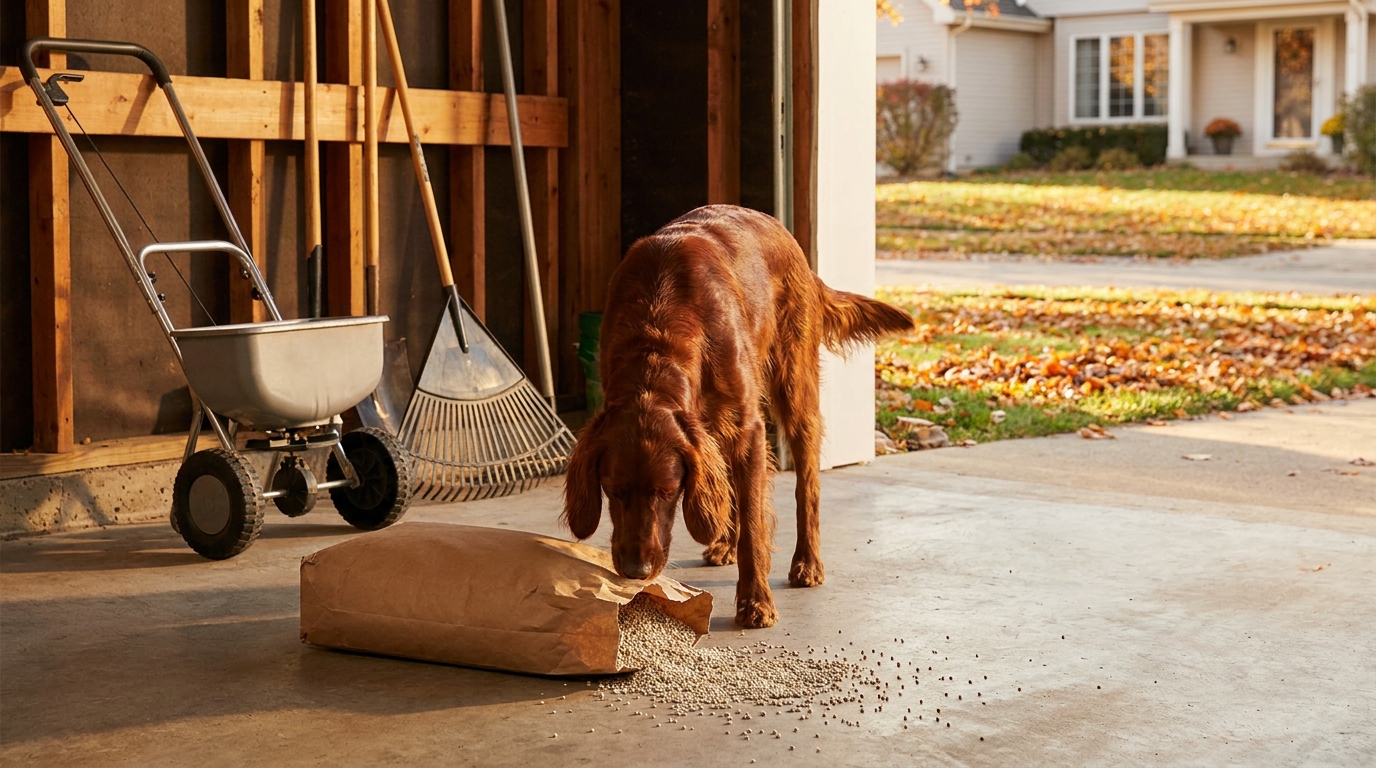
Dog ate lawn fertilizer? Small amounts usually mean mild stomach upset, but a whole bag, insecticide add-ins or bone meal can be serious.
Call a poison line and go to an emergency vet now if your dog ate from an open bag or spreader, the label lists an insecticide or says it is a rose or garden product with insect control, the fertilizer was moldy, or your dog has tremors, a seizure, trouble breathing, a swollen or painful belly, repeated vomiting or stiffness.
Dog ate lawn fertilizer: what is in the bag
Lawn fertilizer is mostly plant food. Pet Poison Helpline explains: "Most fertilizers contain varying amounts of nitrogen, phosphorus and potassium (potash) as indicated by the three numbers on the packaging."
That is the part that tends to cause a mild upset stomach. The trouble is what else can be in the bag. Pet Poison Helpline adds that fertilizers "may also contain herbicides, pesticides, and fungicides which increases the risk of poisoning."
The good news comes from PetMD: "In general, fertilizers have a low-level toxicity and symptoms are typically mild and limited to gastrointestinal irritation." ASPCApro says much the same: "Most fertilizer ingestions cause mild GI upset and are not a huge concern."
So lawn fertilizer is usually only mildly toxic to dogs, unless the label, the amount or the state of the product says otherwise.
Emergency signs: go now
Call a poison line and go to an emergency vet now if any of these apply:
- Your dog ate from an open bag or a spreader, not just a few granules off the grass.
- The label lists an insecticide, or says it is a rose or garden product with insect control.
- The fertilizer was moldy.
- Your dog has tremors or a seizure.
- Your dog has trouble breathing.
- Your dog has a swollen or painful belly.
- Your dog is vomiting repeatedly.
- Your dog is stiff or wobbly.
Why the insecticide rule matters: PetMD warns, "Disulfoton is a highly toxic insecticide often included in rose fertilizer." PetMD also says products with organophosphates or carbamates "can be toxic to dogs and cause more severe clinical signs such as tremors or seizures." If you see any insect-control wording on the bag, do not wait for signs.
Why the amount matters: ASPCApro notes, "Some pets will ingest such a large amount that food bloat or GDV are concerns."
Why mold matters: ASPCApro also says that "if the product is moldy, there may be tremors and seizures." An old bag left open in a damp garage or shed is worth a close look.
The two animal poison lines are open 24/7. A fee may apply.
- ASPCA Animal Poison Control: (888) 426-4435
- Pet Poison Helpline: (855) 764-7661
If you are unsure whether what you are seeing counts, our pet emergency checklist walks through the signs. If your dog is shaking or twitching, read what dog seizures look like and what to do while someone else drives.
Read the bag: five things to look for
The label tells you more than anything else. Find the bag, or the spreader it came from, and look for these five things.
- Any insecticide, herbicide or fungicide. These add-ins raise the risk. A "weed and feed" product, as the name says, pairs fertilizer with a weed killer, so read its ingredient list closely. Anything with insect control, especially a rose or garden product, is a go-now item.
- Iron. Some lawn products include iron. PetMD says "the iron can be an issue if a large volume is ingested."
- Bone, blood or fish meal. These show up often in "organic" or natural products, and dogs find them tasty. PetMD says large amounts of bone meal "can form a large, cement-like rock in the dog's stomach that can cause an obstruction," and Pet Poison Helpline notes "meal-based fertilizers can form a concretion in the stomach." If your dog ate bone meal fertilizer in quantity, call right away.
- Cocoa bean mulch mixed in. PetMD explains that dogs eating it "can experience obstruction from the hulls themselves as well as chocolate toxicity."
- Mold. Check the product for fuzzy growth or a musty smell. Treat a clumped bag as possibly moldy, too. Moldy product means a poison line and an emergency vet now.
Keep the bag, and take a clear photo of the front and the ingredient panel. If you go anywhere, bring the bag or the photo with you.
Lawn granules vs the bag
A dog that nibbled a few granules off a treated lawn is in a very different spot from a dog that ripped open a sack in the garage. PetMD says granular products usually have "a lower risk once spread across the entire yard." It adds: "The bigger risk is if the dog gets into the entire bag or spreader full of fertilizer."
Pet Poison Helpline puts it this way: "While small ingestions of fertilizer may only result in mild stomach upset, larger ingestions can result in severe poisoning."
A quick way to sort it:
- A few granules off the lawn, plain fertilizer, dog acting normal: follow the steps below, call a poison line or your vet with the label, and watch closely.
- An open bag or spreader, however much seems missing: call a poison line and go to an emergency vet now.
- Any insecticide or rose/garden insect-control product, or any moldy product, even a small amount: call a poison line and go to an emergency vet now.
What to do right now
If your dog got into fertilizer and has none of the emergency signs above, take these steps in order.
- Move your dog away from the spill or the treated patch, and keep other pets away too.
- Pick up any spilled granules so there is nothing more to eat.
- Rinse your dog's paws and the outside of the mouth with water, and offer fresh water to drink. Do not put your fingers in the mouth of a dog that is trembling or seizing.
- Note roughly how much is missing and when it happened.
- Do not try to make your dog vomit at home. Pet Poison Helpline says, "Your veterinarian may induce vomiting for decontamination."
- Call ASPCA Animal Poison Control at (888) 426-4435 or Pet Poison Helpline at (855) 764-7661 (both 24/7; a fee may apply) with the bag in hand, or call your vet.
If your dog got into the bag or the spreader, or shows any emergency sign above, go to an emergency vet now. Call the poison line on the way if you can.
What to watch, and for how long
PetMD gives a useful timeline: "Clinical signs are usually mild and occur within 2 to 10 hours after ingestion. Symptoms typically resolve after 12 to 24 hours."
That describes the usual mild case. It is not a reason to wait. Keep your dog where you can see them and watch for:
- Vomiting or diarrhea
- Drooling
- Not eating
- Belly pain
- Stiffness or wobbliness
Call a vet or poison line any time mild signs are not easing as expected. Go to an ER right away for repeated vomiting, tremors, stiffness, wobbliness, a swollen or painful belly or trouble breathing.
A hard, swollen or painful belly means go to an emergency vet now: ASPCApro notes some pets eat so much that "food bloat or GDV are concerns."
If your dog throws up once and then seems fine, our guide to why dogs vomit can help you think through what you are seeing. Note each sign and the time.
Fall lawn care in New York, Virginia and Florida
Whether you feed your lawn in the fall in New York or Virginia or on a different schedule in Florida, a few habits keep curious dogs out of trouble.
- Follow the product's own re-entry directions. PetMD's rule of thumb is to "keep pets off the yard for 48 hours after applying fertilizer." The label comes first if it says something different.
- Keep pets in until liquid products are dry.
- Store bags sealed and off the floor, and keep them dry so they do not go moldy.
- Empty the spreader after use and store it where your dog cannot reach it.
- Rinse paws after walks. If your dog walked across a neighbor's treated lawn, rinse their paws when you get home. If your dog actually ate some, go back to the steps in "What to do right now."
Do not lean on a "pet safe" label. PetMD is clear: "None of these fertilizers should be ingested, even if they are labeled 'safe for pets.'"
Fertilizer is one of many yard and garage hazards. Our room-by-room household toxins guide covers the garage and shed, and our list of poisonous plants for pets covers the garden beds you may be feeding.
What a RexVet online vet can and cannot do
RexVet is a 501(c)(3) non-profit veterinary telehealth service. RexVet's veterinarians are licensed in Florida, New York and Virginia.
If your dog has none of the emergency signs, a video visit can help you decide what comes next. On a call, a veterinarian can:
- Read the bag label and ingredient list with you, live.
- Weigh roughly how much is missing against your dog's size.
- Look at your dog's gums, breathing and belly posture on camera.
- Help you decide between watching at home, calling a poison line or going to an ER.
A video visit has real limits. A vet on video cannot induce vomiting, give activated charcoal, take X-rays to look for a concretion, or treat tremors or seizures. If any emergency sign is present, skip the video visit and go to an ER. If the veterinarian decides medication is appropriate, they can prescribe where state rules allow. In Florida, a veterinarian who has seen your pet only by video may prescribe only FDA-approved animal drugs used as labeled, for up to 14 days (1 month for flea-and-tick-only products), and cannot renew without an in-person exam.
If your dog seems well and you want a veterinarian to look at the label with you, book a RexVet video visit. A visit is $64.99, veterinarians are available 24/7, including nights, weekends and holidays, and the service is for pet parents in Florida, New York and Virginia only.
When to go in person in Florida, New York or Virginia
Some fertilizer cases need hands, tools and a clinic. Go in person, to an emergency vet if your regular clinic is closed, for:
- A whole bag or a spreader, or you cannot tell how much is gone
- Any insecticide, including rose or garden products with insect control
- A large amount of an iron or meal-based (bone, blood or fish meal) product
- Moldy product
- Tremors, a seizure, stiffness or wobbliness
- Trouble breathing
- A swollen or painful belly
- Repeated vomiting
Bring the bag or a photo of the label.
In Florida, a telehealth veterinarian must give you the contact information for at least one physical veterinary clinic in the vicinity of your location (Fla. Stat. 474.2021). For more on how online vet care works where you live, see our pages for Florida, New York and Virginia.
Frequently Asked Questions
Is lawn fertilizer toxic to dogs?
Usually only mildly. PetMD says, "In general, fertilizers have a low-level toxicity and symptoms are typically mild and limited to gastrointestinal irritation." The exceptions are products with an insecticide, large amounts of iron or meal-based products, moldy product, and a dog that got into the whole bag. Those need a poison line and an emergency vet.
How much fertilizer will make a dog sick?
There is no single amount. It depends on what is in the product and on your dog's size, which is why the label matters so much. If your dog ate some, call a poison line or your vet with the label in hand and tell them roughly how much is missing.
Is pet-safe fertilizer safe if my dog eats it?
No. PetMD says, "None of these fertilizers should be ingested, even if they are labeled 'safe for pets.'" Follow the product's own label directions for use, and if your dog ate some, call a poison line or your vet with the label.
How long after fertilizing can my dog go on the lawn?
Start with the product's own re-entry directions. PetMD's rule of thumb is to "keep pets off the yard for 48 hours after applying fertilizer." With liquid products, keep your dog inside until the grass is dry.
My dog walked on fertilized grass and licked its paws; is that a problem?
Usually not a big one. PetMD describes spread granules as "a lower risk once spread across the entire yard, even if the pet were to lick its paws after running through the yard." Rinse the paws, then watch for vomiting, diarrhea, drooling or not eating, and call a vet or poison line if you see any. If the lawn was treated with a product containing an insecticide, or your dog shows tremors or stiffness, go to an emergency vet.
The label and the amount decide how serious a fertilizer snack is. If your dog is acting normally and you want a veterinarian to go over the bag with you, book a video visit now. A RexVet visit is $64.99, veterinarians are available 24/7, and the service is for pet parents in Florida, New York and Virginia only.
FAQs
Is lawn fertilizer toxic to dogs?
Usually only mildly. PetMD says, "In general, fertilizers have a low-level toxicity and symptoms are typically mild and limited to gastrointestinal irritation." The exceptions are products with an insecticide, large amounts of iron or meal-based products, moldy product, and a dog that got into the whole bag. Those need a poison line and an emergency vet.
How much fertilizer will make a dog sick?
There is no single amount. It depends on what is in the product and on your dog's size, which is why the label matters so much. If your dog ate some, call a poison line or your vet with the label in hand and tell them roughly how much is missing.
Is pet-safe fertilizer safe if my dog eats it?
No. PetMD says, "None of these fertilizers should be ingested, even if they are labeled 'safe for pets.'" Follow the product's own label directions for use, and if your dog ate some, call a poison line or your vet with the label.
How long after fertilizing can my dog go on the lawn?
Start with the product's own re-entry directions. PetMD's rule of thumb is to "keep pets off the yard for 48 hours after applying fertilizer." With liquid products, keep your dog inside until the grass is dry.
My dog walked on fertilized grass and licked its paws; is that a problem?
Usually not a big one. PetMD describes spread granules as "a lower risk once spread across the entire yard, even if the pet were to lick its paws after running through the yard." Rinse the paws, then watch for vomiting, diarrhea, drooling or not eating, and call a vet or poison line if you see any. If the lawn was treated with a product containing an insecticide, or your dog shows tremors or stiffness, go to an emergency vet.
The label and the amount decide how serious a fertilizer snack is. If your dog is acting normally and you want a veterinarian to go over the bag with you, book a video visit now. A RexVet visit is $64.99, veterinarians are available 24/7, and the service is for pet parents in Florida, New York and Virginia only.
Medically Reviewed
Reviewed by Dr. Tiffany Delacruz, DVM — licensed veterinarian and CEO of RexVet. Last reviewed September 23, 2026.
Content is for informational purposes and does not replace professional veterinary advice.
Chief Executive Officer · Licensed Veterinarian
Dr. Delacruz is a licensed Doctor of Veterinary Medicine specializing in preventive care and veterinary telehealth. She reviews all health content on RexVet to ensure accuracy and clinical relevance.
Sources & References
- · American Veterinary Medical Association — Telehealth Guidelines
- · AVMA — Pet Care Resources
- · U.S. FDA — Animal & Veterinary
Need an Expert Opinion on This Topic?
Connect with a certified vet via video call in minutes
Talk to Vet Now