
Dog Ate Charcoal, Ashes, Matches or a Lighter: What to Do
By RexVet Team | Reviewed by Dr. Tiffany Delacruz, DVM
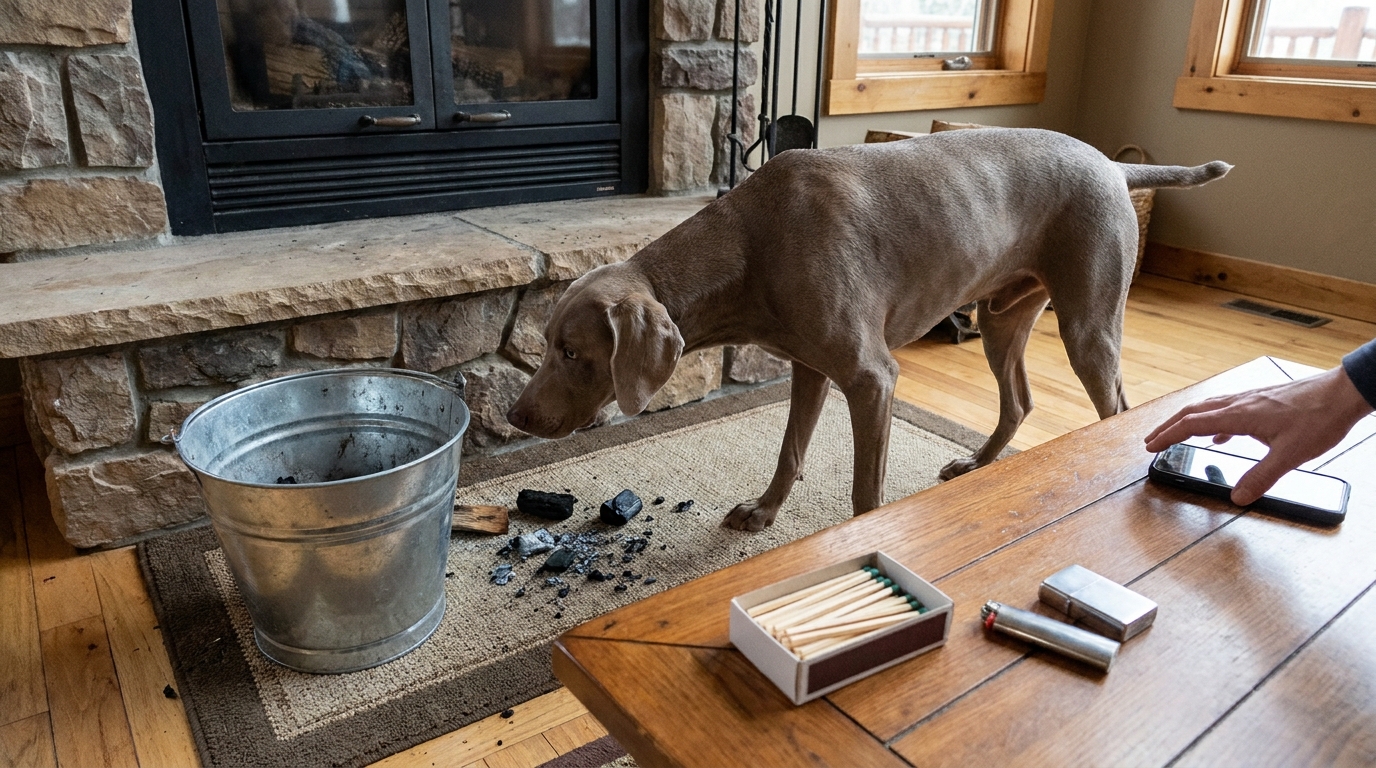
Fireplace ash, grill charcoal, fire starters, matches and lighters carry different risks. See which ones mean a poison line, an X-ray or the ER.
Quick answer: A lick of cold, dry ash from plain firewood usually causes mild upset. Call a poison line now for a mouthful of ash, wet ash, matches, a fire starter, a chewed lighter, or coal, treated-wood or trash ash. Go to an emergency vet now for lighter fluid, hot embers, a swallowed lighter piece, a chewed electric lighter, coughing, or vomiting after swallowing a chunk. Never make your dog vomit.
This article is general information, not a diagnosis. If you think your pet is in danger, go to the nearest emergency animal hospital.
Two animal poison lines answer 24 hours a day, 365 days a year: ASPCA Animal Poison Control, (888) 426-4435 (a consultation fee may apply), and Pet Poison Helpline, (855) 764-7661 (a per-incident fee applies).
Go to an emergency vet now if you see these signs
A dog with mouth burns, heavy drooling, coughing, gagging or fast breathing, wobbling, tremors or seizures, retching, a swollen belly, weakness or collapse, or pale, gray, blue or brown gums after a fireplace, fire pit, grill or lighter needs an emergency vet now. Call a poison line on the way, and never make your dog vomit.
Also go now, even if your dog seems fine, for:
- Any lighter fluid, chewed pre-soaked charcoal, or a fuel smell on the breath.
- Hot embers, a warm briquette, or burns on the mouth, lips or paws (apply cool, not icy, water to a burn on the way).
- A swallowed lighter piece, sparkler wire, skewer or nail, or a chewed electric lighter.
- Any vomiting after a possible swallow of charcoal, a fire log or starter chunk, pellets or a lighter piece, or black, tarry stool.
What to do in the first few minutes at home
If a dog gets into a fireplace, fire pit or grill, move the dog away from the fire, check for hot material or burns without putting your fingers deep in its mouth, and call a poison line first, or on the way if anything above means the ER.
Rinse ash off the lips, paws and fur with plenty of lukewarm water, and flush an eye gently if ash or fuel got in it; a red or squinting eye needs an in-person vet now. Keep the bag, box or lighter, and note the time and your dog's weight.
Don't make your dog vomit (see when making a dog throw up helps and when it harms), never give charcoal, and give no food, milk or human medicine unless the poison line says to.
| Tell the poison line | Why it matters |
|---|---|
| What burned | Wood, coal, trash differ |
| Lit or cold | Burn risk |
| Any fuel used | Lung risk |
| How much, when | Sets the plan |
| Dog's weight | Small dogs, more risk |
| The bag or label | Shows additives |
| Signs so far | Sets urgency |
What did your dog get into? A quick decision table
A dog's next step depends on which fire-related item it got into, from a call and home watch after a lick of cold ash to an emergency vet now for lighter fluid.
| Item | Main risk | Next step |
|---|---|---|
| Cold ash, a lick | Mild upset | Call, then watch |
| Ash, a mouthful | Caustic | Poison line now |
| Wet ash paste | Caustic | Poison line now |
| Hot embers, coals | Burns | ER now |
| Charcoal bits | Upset | In-person vet today |
| Whole briquette | Blockage | In person now |
| Lighter fluid | Lungs | ER now |
| Pre-soaked charcoal | Fuel, lungs | ER now |
| Fire log chunk | Blockage | Poison line; in person now |
| Starter cube | Varies | Poison line now |
| Lighter hissed | Gas breathed | Fresh air; poison line |
| Lighter pieces | Cuts, blockage | ER now |
| Electric lighter | Battery | Make safe; ER now |
| Few match heads | Upset | Poison line |
| Book or box | Kidneys, blood | Poison line; in person now |
| Many pellets | Blockage | In person now |
| Coal or trash ash | Metals | Poison line now |
| Sparkler wire | Sharp | ER now |
Never make your dog vomit for any row unless a poison line or vet says to. "In person now" means your own vet if they can see your dog right away, otherwise an emergency vet.
Is fireplace or wood ash toxic to dogs?
Cold ash from plain, untreated firewood is a caustic irritant (Iowa State University Extension says wood ash can be caustic), so a dog that licks a little usually gets only mild upset, but a mouthful or any wet ash means calling a poison line now. Wet ash is harsher: a Missouri Poison Center case in Pediatric Dermatology (2021) described skin injury in a 2-year-old child from wood ash mixed with water.
The EPA says ash from burned household trash can contain toxic metals such as lead and arsenic and warns against burning treated wood at home; coal ash can carry metals too. Ash from coal, painted or treated wood, trash, or spent sparklers or fireworks means a poison line now. Drooling, refusing food or painful swallowing after wet ash means an emergency vet now, even if the mouth looks normal.
What happens if a dog eats charcoal briquettes?
The ASPCA says swallowed charcoal briquettes can upset and irritate a dog's stomach and gut and may cause a blockage, and briquettes that haven't cooled can cause internal burns. Pet Poison Helpline says plain briquettes are not toxic but can cause vomiting and diarrhea. Charcoal bits mean an in-person vet today, a whole briquette in person now, a warm one an emergency vet now, and pre-soaked charcoal follows the lighter fluid rule below.
The National Capital Poison Center says barbecue briquettes are not activated charcoal and do not adsorb poisons. A chewed or swallowed charcoal odor bag or water-filter cartridge means an in-person vet now, and eaten activated-charcoal capsules or supplements mean a poison line now. Don't give charcoal at home: Merck notes it can push sodium dangerously high and is unsafe after caustics or fuels. The black powder in a torn single-use hand warmer is mostly iron, so it means a poison line now; see what to do if a dog ate a hand warmer.
Are lighter fluid, pre-soaked charcoal and fire starter logs dangerous?
Yes: a dog that licked or swallowed lighter fluid or chewed pre-soaked charcoal needs an emergency vet now with a poison-line call on the way, because the ASPCA says lighter fluid can get into the lungs if a pet vomits. The Merck Veterinary Manual says the main danger of lighter fluid is the lungs, and that in dogs and cats, vomiting should not be induced. Breathing problems can start hours later and worsen over days, even in a dog that seemed fine.
The ASPCA says fire starter logs are typically sawdust mixed with paraffin, which can irritate the stomach and, if a dog eats enough, cause an intestinal blockage. Call a poison line now with the label in hand, and get a dog that swallowed a chunk seen in person now. For plain wax, see dog ate a candle or wax melt.
If fuel gets on the coat, keep your dog away from flames, wash it gently with mild soap and plenty of cool water, and call a poison line; the Merck Veterinary Manual says dogs and cats can swallow fuel while grooming. For lamp oil, torch fuel or gel fireplace fuel, read the label to a poison line now, and go to an emergency vet now if your dog licked or swallowed any.
My dog chewed a lighter: butane, plastic pieces and electric lighters
If a dog chewed a lighter, move the dog to fresh air if you smell gas and call a poison line now; any swallowed lighter piece, or a chewed electric or arc lighter, which runs on a rechargeable lithium battery, means an emergency vet now even with no signs.
Butane is mainly a breathing risk, so open windows and keep flames away until the smell is gone. A wick lighter holds liquid fuel and follows the lighter fluid rule. Count the plastic shell, metal hood, spark wheel, flint and spring: a missing piece can cut or block the gut, and a clear first X-ray doesn't always rule out plastic.
The FAA lists arc and flux lighters among lithium battery-powered lighters, so treat a chewed one like a chewed battery (see what to do if a dog ate a battery): don't charge or use it, and only if it is safe, use tongs or gloves to move it away from anything that can burn; if it is smoking, get everyone outside and call 911.
Are matches poisonous to dogs?
Pet Poison Helpline says match heads contain potassium chlorate: a few heads usually cause stomach irritation with drooling and vomiting, while a large number can damage a dog's kidneys and red blood cells. Call a poison line for a few heads or any matches eaten by a puppy, small dog or cat; a dog that ate a book or box of matches also needs an in-person vet now. More than one vomit, weakness, dark brown or red urine, or pale or brown gums means an emergency vet now. Wooden sticks can block the gut in very small dogs and cats.
Are wood pellets for stoves and grills toxic to dogs?
Wood fuel pellets are compressed sawdust held together by the wood's own lignin, Penn State Extension says, and a dog that eats a large amount can develop a blockage, so a mouthful or more means an in-person vet now. For less, call your vet or a poison line and check the bag for added flavor oils. Any vomiting after pellets means an emergency vet now.
Is black poop normal after a dog eats charcoal or ash?
Gritty gray or black bits in the stool of a dog that is eating and acting normally may simply be ash or charcoal passing, but black, tarry, sticky stool or straining with no stool means an emergency vet now. The Merck Veterinary Manual says black, tarry feces may be a sign of bleeding in the stomach or small intestine; for straining, see intestinal blockage in dogs.
| What you see | May mean | Next step |
|---|---|---|
| Gritty gray or black bits, dog normal | Ash passing | Keep watching |
| Tarry, sticky, shiny | Possible bleeding | ER now |
| Black, plus vomiting or weakness | Bleeding, blockage | ER now |
| Straining, no stool | Possible blockage | ER now |
"Keep watching" means checking each stool and going in for any row below it or for vomiting, not eating, pale gums or belly pain.
Can cats get sick from fireplace ash, matches or lighters?
A cat that gets fireplace ash on its paws or fur can lick it off, wet ash can irritate a cat's mouth, and Pet Poison Helpline says match sticks can block a cat's gut. Rinse ash off with lukewarm water. Call a poison line now for any matches eaten or fuel on the fur, which the Merck Veterinary Manual says cats can swallow while grooming. Drooling, pawing at the mouth, refusing food or painful swallowing after ash, any lighter fluid licked or swallowed, or open-mouth or fast breathing means an emergency vet now; never make a cat vomit.
My dog keeps eating ashes: pica and holiday fire-proofing
A dog that keeps eating ash, coal or other non-food items (pica) is worth a vet check. The ASPCA says grease and food debris from a grill can cause pancreatitis, so watch for 4 days after grill drippings alone; charcoal or foil eaten from the drip tray, or refusing food, means an in-person vet today, and vomiting more than once, belly pain, weakness or collapse means an emergency vet now.
The U.S. Fire Administration says to put ashes in a metal container with a lid and place the container outside at least 10 feet from your home. Use a fireplace screen, keep lighters and matches in a closed drawer, store fire starters in a lidded bin, and pick bones, skewers and foil out of a fire pit. NFPA advises carbon monoxide alarms in a central location outside each sleeping area and on every level of the home; see carbon monoxide poisoning in dogs and cats.
When a video visit helps and when it does not
A dog that ate charcoal, ashes, matches or a lighter needs a call to a pet poison line or an emergency vet first; a video visit fits only after a poison line or vet has said watching at home is OK, or when you are sure nothing was swallowed.
RexVet, a nonprofit online vet service, serves pets located in Florida, New York and Virginia by video visit. If your pet is in one of those states during the visit, a $64.99 live video visit with a licensed RexVet vet fits into an open slot between about 8 AM and 11 PM ET; a same-day slot is not guaranteed, and holiday hours aren't confirmed.
The veterinarian can go over what was eaten and the poison line's advice, check the mouth, gums, breathing and belly on camera, set a watch plan with the signs that mean going in, and say whether your dog needs an in-person exam or X-rays. Video can also fit a chewed disposable lighter or matchbook once a poison line has cleared home watching, every piece and match head is accounted for, nothing leaked and the dog is acting normally. Then book a video visit.
Anything this guide sends to an emergency vet or an in-person vet, from burns and lighter fluid to a swallowed piece, is not a video case, because a video visit cannot take X-rays, treat burns, give fluids or examine your dog in person. Never make your dog vomit or give charcoal at home, least of all after lighter fluid, fuel or hot embers.
Outside those hours, if no slot is open or anything changes, call the poison line back or go to an emergency vet; both poison lines answer 24 hours a day, and RexVet video visits do not.
No prescription is promised; any medicine is the veterinarian's call (state limits are in the FAQ). RexVet is not a pharmacy; a pharmacy transfer fee applies if a prescription is sent to an outside pharmacy.
Need an Expert Opinion on This Topic?
Book a video visit with a licensed vet, evenings and weekends included
See open timesFrequently Asked Questions
Will my dog be OK after eating ash from the fire pit?
Usually, after a lick of cold, dry ash from plain wood. A mouthful, wet ash, or ash from coal, treated wood or trash means a poison line now. Fire-pit ash can also hide bones, corn cobs, foil and skewers: a bone or cob means in person now, foil an in-person vet today, and anything sharp an emergency vet now.
My dog ate ashes and threw up. What should I do?
Call a poison line now after one vomit. Vomiting again, blood, drooling, or refusing food or water means an emergency vet now, and so does any vomiting if the ash held charcoal chunks, a fire log, bones, nails or foil.
Can charcoal kill a dog?
It can, through a blockage, internal burns or lighter fluid in the lungs, though plain cold briquettes mostly cause stomach upset. Bits mean an in-person vet today, a whole briquette in person now, and a warm or pre-soaked one an emergency vet now.
My dog chewed a fire starter cube but seems fine. Do I still call?
Yes. Call a poison line now with the package in hand. A swallowed chunk means an in-person vet now, and a fuel smell, coughing or fast breathing means an emergency vet now, even if it starts hours or days later.
My dog chewed a lighter but no gas came out. Is it OK?
Not yet: call a poison line now. A missing piece, an electric or arc lighter, which runs on a rechargeable lithium battery, or a wick lighter, which holds lighter fluid, means an emergency vet now even with no signs.
Can a dog die from eating matches?
It can be serious. Pet Poison Helpline says a large number of match heads can damage a dog's kidneys and red blood cells, while a few usually cause stomach irritation. Call a poison line for any matches; more than one vomit, weakness, dark brown or red urine, or pale or brown gums means an emergency vet now.
Why is my dog's poop black after eating ash or charcoal?
It may simply be ash or charcoal passing if the stool is formed and gritty and your dog is eating and acting normally. Tarry, sticky stool, straining with no stool, vomiting or weakness means an emergency vet now, because black, tarry feces can mean bleeding in the stomach or small intestine.
Can an online vet help if my dog ate ash, charcoal or a lighter in Florida, New York or Virginia?
Sometimes, but not first: call a poison line or emergency vet now, and use video only after they say watching at home is OK. For a dog located in Florida, New York or Virginia during the visit, a veterinarian licensed in that state can review the poison line's plan and check breathing, gums and belly on camera; X-rays, burn care and fluids need an in-person vet. No prescription is promised. In Florida (s.474.2021), a telehealth-only prescription is limited to FDA-approved animal drugs used as labeled, for up to 14 days (1 month for products labeled only for flea and tick control), with no renewal without an in-person exam and no human-labeled, controlled or compounded anti-infective drugs. Federal rules (21 CFR 530.3) require an in-person exam or timely premises visits before human-labeled or extralabel drug use in all three states. Virginia allows an electronic exam; New York's rules are not settled.
FAQs
Will my dog be OK after eating ash from the fire pit?
Usually, after a lick of cold, dry ash from plain wood. A mouthful, wet ash, or ash from coal, treated wood or trash means a poison line now. Fire-pit ash can also hide bones, corn cobs, foil and skewers: a bone or cob means in person now, foil an in-person vet today, and anything sharp an emergency vet now.
My dog ate ashes and threw up. What should I do?
Call a poison line now after one vomit. Vomiting again, blood, drooling, or refusing food or water means an emergency vet now, and so does any vomiting if the ash held charcoal chunks, a fire log, bones, nails or foil.
Can charcoal kill a dog?
It can, through a blockage, internal burns or lighter fluid in the lungs, though plain cold briquettes mostly cause stomach upset. Bits mean an in-person vet today, a whole briquette in person now, and a warm or pre-soaked one an emergency vet now.
My dog chewed a fire starter cube but seems fine. Do I still call?
Yes. Call a poison line now with the package in hand. A swallowed chunk means an in-person vet now, and a fuel smell, coughing or fast breathing means an emergency vet now, even if it starts hours or days later.
My dog chewed a lighter but no gas came out. Is it OK?
Not yet: call a poison line now. A missing piece, an electric or arc lighter, which runs on a rechargeable lithium battery, or a wick lighter, which holds lighter fluid, means an emergency vet now even with no signs.
Can a dog die from eating matches?
It can be serious. Pet Poison Helpline says a large number of match heads can damage a dog's kidneys and red blood cells, while a few usually cause stomach irritation. Call a poison line for any matches; more than one vomit, weakness, dark brown or red urine, or pale or brown gums means an emergency vet now.
Why is my dog's poop black after eating ash or charcoal?
It may simply be ash or charcoal passing if the stool is formed and gritty and your dog is eating and acting normally. Tarry, sticky stool, straining with no stool, vomiting or weakness means an emergency vet now, because black, tarry feces can mean bleeding in the stomach or small intestine.
Can an online vet help if my dog ate ash, charcoal or a lighter in Florida, New York or Virginia?
Sometimes, but not first: call a poison line or emergency vet now, and use video only after they say watching at home is OK. For a dog located in Florida, New York or Virginia during the visit, a veterinarian licensed in that state can review the poison line's plan and check breathing, gums and belly on camera; X-rays, burn care and fluids need an in-person vet. No prescription is promised. In Florida (s.474.2021), a telehealth-only prescription is limited to FDA-approved animal drugs used as labeled, for up to 14 days (1 month for products labeled only for flea and tick control), with no renewal without an in-person exam and no human-labeled, controlled or compounded anti-infective drugs. Federal rules (21 CFR 530.3) require an in-person exam or timely premises visits before human-labeled or extralabel drug use in all three states. Virginia allows an electronic exam; New York's rules are not settled.
Medically Reviewed
Reviewed by Dr. Tiffany Delacruz, DVM — licensed veterinarian and CEO of RexVet. Last reviewed November 9, 2026.
Content is for informational purposes and does not replace professional veterinary advice.
Chief Executive Officer · Licensed Veterinarian
Dr. Delacruz is a licensed Doctor of Veterinary Medicine specializing in preventive care and veterinary telehealth. She reviews all health content on RexVet to ensure accuracy and clinical relevance.
Sources & References
- · American Veterinary Medical Association — Telehealth Guidelines
- · AVMA — Pet Care Resources
- · U.S. FDA — Animal & Veterinary