
Dog Ate a Penny, Coin or Magnet? Why It Is an Emergency
By RexVet Team | Reviewed by Dr. Tiffany Delacruz, DVM
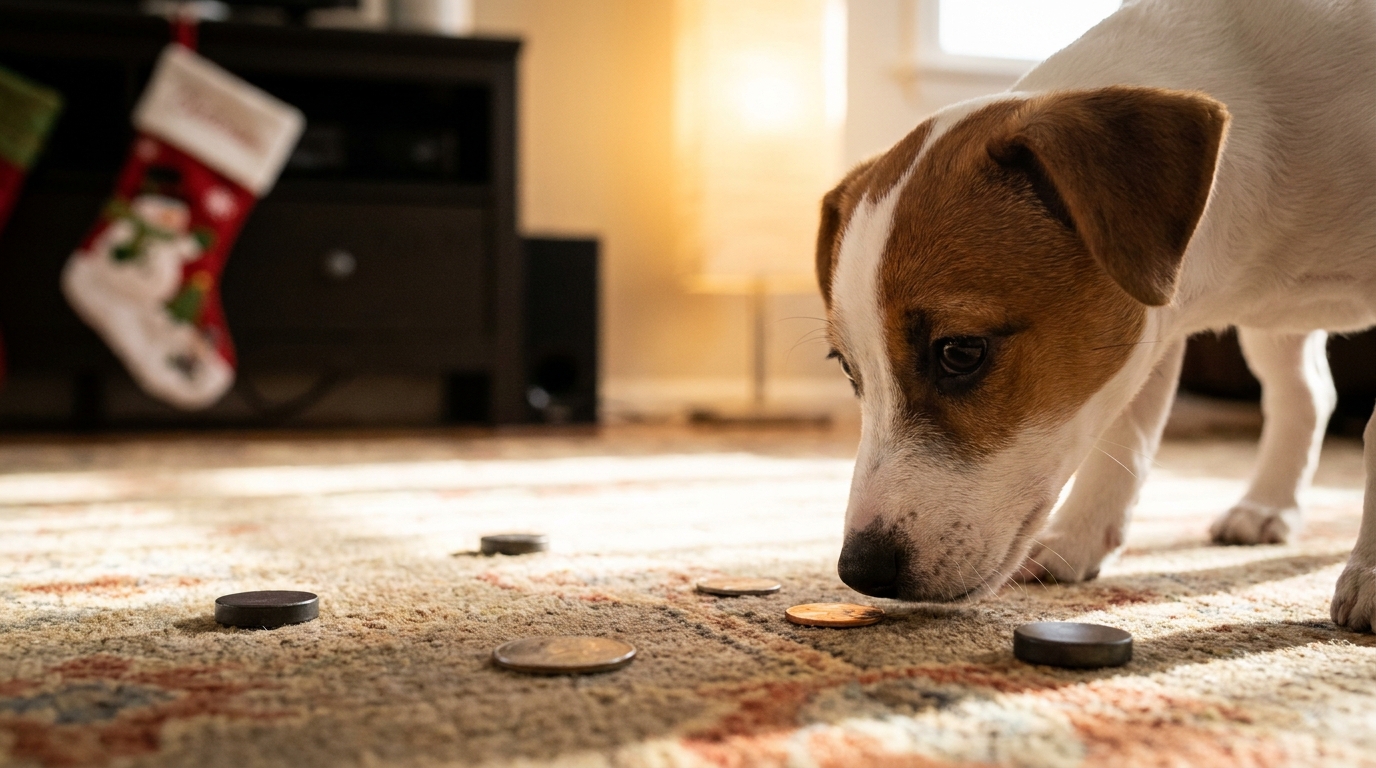
A swallowed penny can poison a dog with zinc, and magnets can tear the bowel. See which coins mean the ER now and what never to try at home.
Quick answer: A dog that swallowed a penny, any magnet, or a dollar, foreign or unknown coin needs an emergency vet now, even if it seems fine; a US nickel, dime or quarter needs an in-person vet now for X-rays. The Merck Veterinary Manual says US pennies minted since 1982 are 97.5% zinc, which can destroy red blood cells. Magnets can pinch the bowel wall. Don't make your dog vomit at home.
This article is general information, not a diagnosis. If you think your pet is in danger, go to the nearest emergency animal hospital.
Go to an emergency vet now if your dog swallowed any of these
Go to an emergency vet now, even if your dog seems fine, after a swallowed penny, any magnet, a foreign or US dollar coin, a coin you can't identify, a coin-cell battery or a sharp metal object, or if coins or magnets have gone missing; gagging, choking, drooling, vomiting, not eating, belly pain, pale or yellow gums, red or brown urine, or weakness also means the ER now.
An identified US nickel, dime, quarter or half dollar in a dog with no signs means an in-person vet now: your own vet if they can see your dog right away, otherwise an emergency vet. Any sign, or any doubt about which coin it was, makes it the ER now.
Also go now for struggling to breathe, or for string hanging from the mouth or bottom, which you should never pull or cut.
A small, shiny "coin" you can't confirm was a real coin may have been a coin-cell battery; see dog ate a battery. Grab the coin jar or the rest of the magnet set (or a photo) on the way out, but never delay leaving to find it.
Call on the way, not instead of going: ASPCA Animal Poison Control at (888) 426-4435 (a consultation fee may apply) or Pet Poison Helpline at (855) 764-7661 (a per-incident fee applies). Both poison lines take calls every day, including holidays.
Why is a penny dangerous for a dog?
A US penny minted since 1982 is mostly zinc under a thin copper coat: the Merck Veterinary Manual says these pennies are 97.5% zinc, and stomach acid frees that zinc, which can break down red blood cells and harm the kidneys, liver and pancreas.
Treat any penny as zinc, whatever the year. Pet Poison Helpline warns that even one US penny could be toxic for a dog. Merck lists kidney or liver failure, pancreatitis and a serious clotting disorder (DIC) among the possible complications.
The US stopped making pennies for circulation in late 2025, but existing pennies are still in circulation and remain legal tender, according to the US Treasury.
Besides pennies, Merck lists zinc-coated tinsel and garland, game dice, zippers, toys, jewelry, galvanized nuts and bolts, and BB pellets as zinc sources.
Are quarters, dimes and nickels toxic to dogs?
US nickels, dimes, quarters and half dollars are copper and nickel rather than zinc, according to US Mint specifications, so their main danger is a blockage or getting stuck in the food pipe, and a dog that swallowed one still needs an in-person vet now for X-rays.
The Merck Veterinary Manual says US dollar coins contain some zinc and that coins around the world similarly contain zinc, so a dollar coin, a foreign coin or any coin you can't identify means the ER now. A 2009 German case report by Weingart and Kohn describes a Yorkshire terrier that developed zinc poisoning, kidney failure and pancreatitis after eating euro cent coins and recovered after surgery, so tell the vet the coin's country if you know it.
Any coin plus gagging, choking, drooling, pawing at the mouth, swallowing over and over, bringing food or water back up, vomiting, not eating, belly pain or weakness means the ER now; see intestinal blockage in dogs.
Why are magnets an emergency for dogs?
Two or more magnets, or a magnet plus a metal object such as a coin, can attract each other through loops of a dog's bowel and pinch the wall until it tears, and a 2010 case report in the Journal of the American Animal Hospital Association recommends surgery for dogs suspected of swallowing more than one magnet, or a magnet and metal.
A single swallowed magnet still means the ER now, because owners rarely know it was only one. In that report (Kiefer and colleagues), both dogs did well after surgery.
A 2015 case report in the Journal of the American Veterinary Medical Association, about a Yorkshire terrier that swallowed magnetic desk toys, says swallowing several magnets carries a high risk of a gut tear, twisting and blockage, and recommends immediate surgery.
Magnets also come from building sets, toy parts, fridge magnets, jewelry clasps and phone mounts.
My dog swallowed a penny and seems fine. Can I wait for it to pass?
No: a dog that swallowed a penny and seems fine still needs an emergency vet now, because Pet Poison Helpline says pennies may sit in the stomach and keep releasing zinc, and the Merck Veterinary Manual says signs can take hours to days to appear.
Pet Poison Helpline says some coins do pass, but without treatment a swallowed zinc penny can be fatal, and the coin has to come out before severe red blood cell damage sets in. No home wait is safe for any coin or magnet: a penny, a magnet, or a foreign, dollar or unknown coin means the ER now, and an identified nickel, dime, quarter or half dollar means an in-person vet now.
Signs of zinc poisoning, a stuck coin or a magnet injury
A dog with zinc poisoning from a swallowed penny often vomits, stops eating, has diarrhea or low energy first, then can develop pale or yellow gums, red or brown urine, fast breathing or collapse; any of these means an emergency vet now.
Pet Poison Helpline also lists a fast heart rate and weakness, and Merck notes that stomach upset can progress to ulcers and black stool. After magnets, belly pain, a swollen belly, fever, weakness, a fast heart rate or collapse can signal a gut tear; any of them means the ER now. Signs after a coin or magnet swallow:
| Sign | May mean | Do this |
|---|---|---|
| Seems fine, penny | Zinc risk | ER now |
| Seems fine, magnet | Gut pinch | ER now |
| Foreign, dollar coin | Zinc risk | ER now |
| Unknown coin | Zinc, battery | ER now |
| Coin missing | Treat as eaten | ER now |
| Nickel, dime, quarter | Can block | In person now |
| Gagging, drooling | Stuck high | ER now |
| Choking, pawing | Stuck high | ER now |
| Vomiting, no food | Zinc, block | ER now |
| Black, tarry stool | Gut bleed | ER now |
| Belly pain, bloat | Tear, block | ER now |
| Pale or yellow gums | Red cell harm | ER now |
| Red or brown urine | Red cell harm | ER now |
| Weak, collapse | Red cell harm | ER now |
In person now means your own vet if they can see your dog right away, otherwise an emergency vet. Any symptom in this table, from gagging to collapse, with any coin means the ER now.
Should I make my dog throw up a coin or magnet?
No: don't make a dog vomit at home after it swallows a coin or magnet, because Pet Poison Helpline warns that a sharp or large swallowed object can get stuck or damage the food pipe on the way back up, so only a vet or a poison line should decide.
Pet Poison Helpline also advises giving no home antidotes. At home, don't:
- Use hydrogen peroxide, salt or any other way to make your dog vomit.
- Give activated charcoal; the Merck Veterinary Manual says it doesn't bind zinc.
- Reach down the throat, or pull or cut anything hanging out.
- Feed bread, pumpkin, rice, oil or fiber, or give a laxative or an enema.
- Give human stomach, antacid or anti-diarrhea medicine, or withhold water.
See when making a dog throw up helps or harms.
What will the emergency vet do?
An emergency vet will X-ray a dog to find and count the metal, remove a penny or a single object still in the stomach with an endoscope where possible, use surgery if it has moved on, the bowel is damaged or more than one magnet (or a magnet and metal) was swallowed, and may run blood tests for zinc damage.
The Merck Veterinary Manual says not seeing metal on an X-ray does not rule out zinc poisoning, and that the outcome is usually favorable with early diagnosis and treatment. Kitchen foil may not show clearly on X-rays; see dog ate aluminum foil with food on it.
In a 2023 case series of 55 dogs with zinc poisoning from swallowed metal at six US veterinary teaching hospitals (Henke and colleagues, Journal of Veterinary Emergency and Critical Care), 45 of 55 dogs (81.8%) survived, 10 of 55 (18.2%) died or were euthanized, and 67.3% required blood products.
After discharge, any new or returning sign means going back to the ER.
Chocolate coins, stockings and magnet toys: holiday risks
Holiday risks for a dog include coins in stockings and gift money, foil-wrapped chocolate coins, zinc-coated tinsel and garland, and magnetic toys or ornaments unpacked on the floor; keep them up high and count magnet pieces.
Hanukkah begins at sundown on Friday, December 4. If your dog ate chocolate coins, foil and all, call a poison line now about the chocolate, and plan on an in-person vet today for the swallowed foil; any vomiting, gagging, not eating, belly pain, straining, restlessness, shaking, a racing heart, a seizure or collapse means the ER now, even if it starts hours later. Swallowed tinsel means the ER now even with no signs; see dog ate string, tinsel or ribbon.
Holiday coin and magnet sources:
| Source | Hidden risk | Do this |
|---|---|---|
| Chocolate coins | Foil, cocoa | Poison line, vet today |
| Coin jar, purse | Pennies | Lid, up high |
| Stockings | Coins, toys | Hang high |
| Magnet toys | Many magnets | Count pieces |
| Fridge magnets | Small magnets | Up high |
| Tinsel, garland | Strand, zinc | ER now |
Sugar-free candy, or a wrapper that held it, means the ER now; call a poison line on the way. A real coin mixed in with chocolate coins follows the coin rules above.
My cat swallowed a coin or magnet. What should I do?
A cat that swallowed a penny or any magnet needs an emergency vet now; never make a cat vomit at home, and never pull or cut anything hanging from the mouth or bottom.
Pet Poison Helpline says zinc poisoning occurs in cats too. Other coins in a cat follow the same rules as for a dog, so gagging, drooling, vomiting or not eating after any coin means the ER now, and missing coins or magnets are treated as eaten. If string, thread or a hair tie may be involved, see cat ate a hair tie, rubber band or string.
When a video visit helps and when it does not
A dog or cat that swallowed a coin or magnet needs an in-person vet first, and a penny, any magnet, or a foreign, dollar or unknown coin means an emergency vet now, even with no signs, because a video visit can't X-ray, remove metal or run blood tests.
RexVet, a nonprofit online vet service, serves pets located in Florida, New York and Virginia by video visit. A $64.99 live video visit with a licensed RexVet vet, a veterinarian licensed in your pet's state, is for a dog or cat located in one of those states during the visit. Live slots run about 8 AM to 11 PM ET, a same-day slot is not guaranteed, and holiday hours aren't confirmed.
A video visit can help when:
- An emergency vet has treated your dog and sent it home. On a video visit, a licensed RexVet vet can go over the discharge plan with you: appetite, vomiting, stool, urine and gum color, and which changes mean going straight back to the ER. Follow the ER's instructions and keep every recheck and blood test in person; a video visit does not replace them.
- Your dog keeps eating non-food objects (pica). The veterinarian can help you plan how to keep coins, magnets and small toys out of reach, and say whether an in-person exam is needed.
A video visit does not fit a coin, magnet or coin-cell battery that may have been swallowed and has not been X-rayed in person, any sign in the signs table above, any new sign after discharge (that means back to the ER), or a pet outside those three states.
No prescription is promised; any medicine is the veterinarian's decision after the visit, within the state and federal rules in the last question below. If the emergency hospital sent your dog home with medicine, ask that hospital or your regular vet about refills. RexVet is not a pharmacy; a pharmacy transfer fee applies when RexVet sends a prescription to an outside pharmacy.
If one of those after-ER cases fits, book a video visit for after-ER questions.
Need an Expert Opinion on This Topic?
Book a video visit with a licensed vet, evenings and weekends included
See open timesFrequently Asked Questions
Is a penny toxic to dogs?
Yes: a US penny can poison a dog with zinc, so go to an emergency vet now even if your dog seems fine. The Merck Veterinary Manual says US pennies minted since 1982 are 97.5% zinc. Treat any penny as zinc, whatever the year on it, and don't make your dog vomit at home.
How long does it take a dog to pass a coin?
Don't wait at home for any swallowed coin or magnet to pass: take your dog to a vet now for X-rays. A penny, a magnet, or a foreign, dollar or unknown coin means an emergency vet now; an identified US nickel, dime, quarter or half dollar means an in-person vet now. Some small, smooth objects do pass, and a vet may watch one in a stable dog with repeat X-rays; Merck says to remove it if it hasn't passed in 36 to 48 hours, stops moving or the dog gets worse. That is hospital X-ray monitoring, never a wait at home, and it does not apply to a penny, which needs to come out, or to more than one magnet, where case reports recommend surgery.
My dog swallowed a quarter. Is that as dangerous as a penny?
Not for zinc, but your dog still needs an in-person vet now for X-rays; any sign or doubt about the coin means the ER now. US Mint specifications list quarters as copper and nickel, but a quarter can still block the gut or get stuck in the food pipe.
Can one magnet hurt my dog?
Yes: treat even one swallowed magnet as an emergency and go to the ER now, because you rarely know it was only one. Two magnets, or a magnet plus metal such as a coin, can pinch loops of bowel together until the wall tears. Bring the rest of the set or a photo so the vet can count pieces.
Will a coin show up on an X-ray?
Usually yes: coins and magnets are metal and show on X-rays. But the Merck Veterinary Manual says a clear X-ray doesn't rule out zinc poisoning, so the vet may also run blood tests. Kitchen foil may not show clearly.
What if coins or magnets are missing but nobody saw my dog eat them?
Treat missing coins or magnets as swallowed and take your dog to an emergency vet for X-rays now, even if it seems fine. Signs of zinc poisoning can take hours to days to appear, so a dog that eats and acts normal can still have a penny inside. Tell the vet what may be missing and how many magnet pieces are unaccounted for.
Can an online vet help if my dog swallowed a coin in Florida, New York or Virginia?
Not for the swallow: a dog that swallowed a coin or magnet needs X-rays in person now; video can help with after-ER questions. For a dog or cat located in Florida, New York or Virginia during the visit, the veterinarian can check energy, breathing and gum color on camera and go over the ER discharge plan; X-rays, blood tests and every recheck stay in person. If medicine comes up, nothing is promised. Florida (s.474.2021) limits a video-only prescription to FDA-approved animal drugs used as labeled, for up to 14 days (1 month for products labeled solely for flea and tick control), with no renewal without an in-person exam, and human-labeled drugs, controlled drugs and compounded antibacterial, antifungal, antiviral or antiparasitic drugs need an in-person exam. Federal rules require an in-person exam before any vet prescribes a human or off-label drug. Virginia allows an electronic exam, but that does not make a swallowed penny, coin or magnet a video-visit case. New York's telehealth prescribing rules are not settled, so the veterinarian decides.
FAQs
Is a penny toxic to dogs?
Yes: a US penny can poison a dog with zinc, so go to an emergency vet now even if your dog seems fine. The Merck Veterinary Manual says US pennies minted since 1982 are 97.5% zinc. Treat any penny as zinc, whatever the year on it, and don't make your dog vomit at home.
How long does it take a dog to pass a coin?
Don't wait at home for any swallowed coin or magnet to pass: take your dog to a vet now for X-rays. A penny, a magnet, or a foreign, dollar or unknown coin means an emergency vet now; an identified US nickel, dime, quarter or half dollar means an in-person vet now. Some small, smooth objects do pass, and a vet may watch one in a stable dog with repeat X-rays; Merck says to remove it if it hasn't passed in 36 to 48 hours, stops moving or the dog gets worse. That is hospital X-ray monitoring, never a wait at home, and it does not apply to a penny, which needs to come out, or to more than one magnet, where case reports recommend surgery.
My dog swallowed a quarter. Is that as dangerous as a penny?
Not for zinc, but your dog still needs an in-person vet now for X-rays; any sign or doubt about the coin means the ER now. US Mint specifications list quarters as copper and nickel, but a quarter can still block the gut or get stuck in the food pipe.
Can one magnet hurt my dog?
Yes: treat even one swallowed magnet as an emergency and go to the ER now, because you rarely know it was only one. Two magnets, or a magnet plus metal such as a coin, can pinch loops of bowel together until the wall tears. Bring the rest of the set or a photo so the vet can count pieces.
Will a coin show up on an X-ray?
Usually yes: coins and magnets are metal and show on X-rays. But the Merck Veterinary Manual says a clear X-ray doesn't rule out zinc poisoning, so the vet may also run blood tests. Kitchen foil may not show clearly.
What if coins or magnets are missing but nobody saw my dog eat them?
Treat missing coins or magnets as swallowed and take your dog to an emergency vet for X-rays now, even if it seems fine. Signs of zinc poisoning can take hours to days to appear, so a dog that eats and acts normal can still have a penny inside. Tell the vet what may be missing and how many magnet pieces are unaccounted for.
Can an online vet help if my dog swallowed a coin in Florida, New York or Virginia?
Not for the swallow: a dog that swallowed a coin or magnet needs X-rays in person now; video can help with after-ER questions. For a dog or cat located in Florida, New York or Virginia during the visit, the veterinarian can check energy, breathing and gum color on camera and go over the ER discharge plan; X-rays, blood tests and every recheck stay in person. If medicine comes up, nothing is promised. Florida (s.474.2021) limits a video-only prescription to FDA-approved animal drugs used as labeled, for up to 14 days (1 month for products labeled solely for flea and tick control), with no renewal without an in-person exam, and human-labeled drugs, controlled drugs and compounded antibacterial, antifungal, antiviral or antiparasitic drugs need an in-person exam. Federal rules require an in-person exam before any vet prescribes a human or off-label drug. Virginia allows an electronic exam, but that does not make a swallowed penny, coin or magnet a video-visit case. New York's telehealth prescribing rules are not settled, so the veterinarian decides.
Medically Reviewed
Reviewed by Dr. Tiffany Delacruz, DVM — licensed veterinarian and CEO of RexVet. Last reviewed November 15, 2026.
Content is for informational purposes and does not replace professional veterinary advice.
Chief Executive Officer · Licensed Veterinarian
Dr. Delacruz is a licensed Doctor of Veterinary Medicine specializing in preventive care and veterinary telehealth. She reviews all health content on RexVet to ensure accuracy and clinical relevance.
Sources & References
- · American Veterinary Medical Association — Telehealth Guidelines
- · AVMA — Pet Care Resources
- · U.S. FDA — Animal & Veterinary