
Cat With Kidney Disease Won't Eat the Kidney Diet? Try This
By RexVet Team | Reviewed by Dr. Tiffany Delacruz, DVM
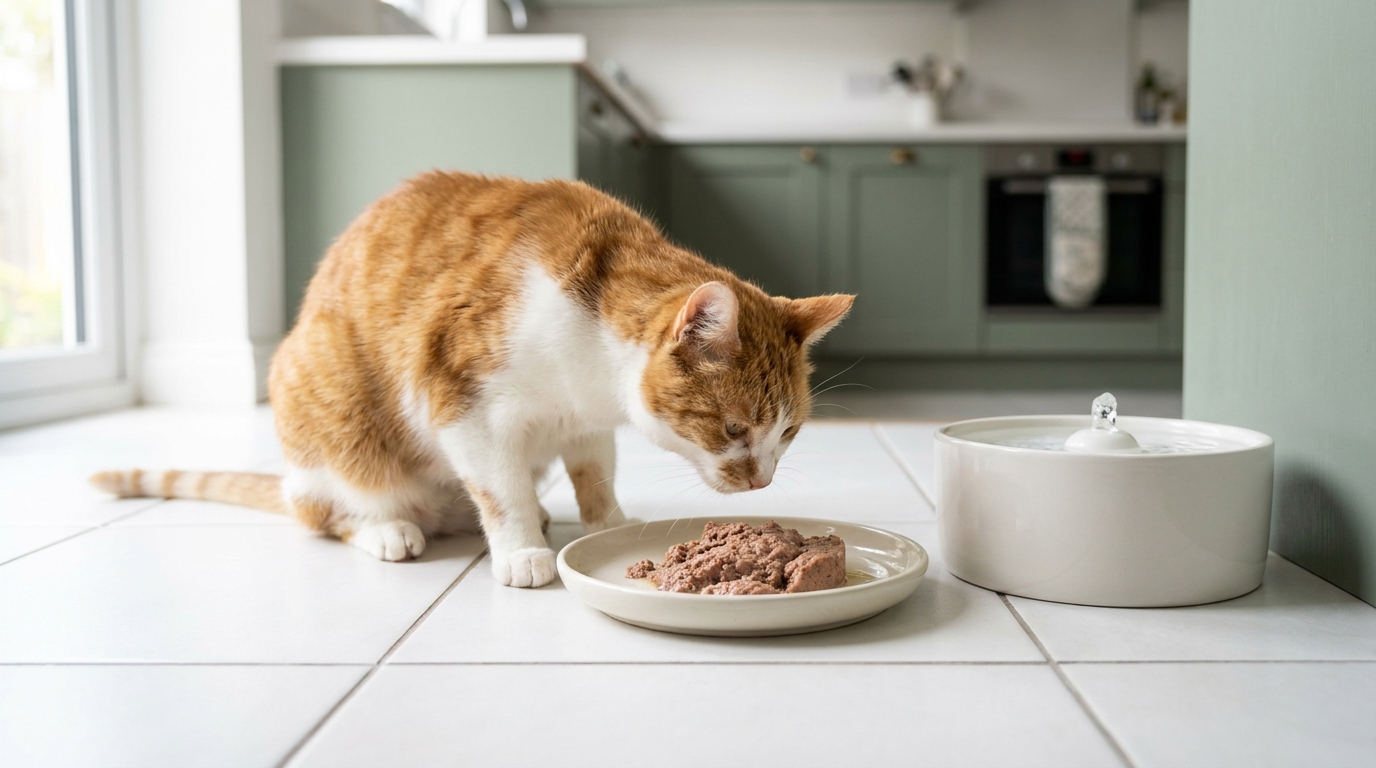
Feed your cat something tonight and switch to the kidney diet slowly; a kidney cat that stops eating gets sick fast, so never starve it into new food.
If your cat has eaten nothing for 24 hours, is vomiting repeatedly, is weak or wobbly, has yellow gums or ears, or is passing very little urine, call a veterinarian now and go in person tonight.
You came home with cans of therapeutic kidney food, the clinic is closed until Monday, and now your cat with kidney disease won't eat the kidney diet. This refusal is common and usually has a reason you can work on, from unfamiliar taste and texture to nausea from the disease itself, and each has a different fix. Tonight the priority is calories; the kidney diet is a project for the coming weeks.
Why a cat with kidney disease won't eat the kidney diet
The usual reasons:
- A new taste, smell and texture. VCA explains that a kidney support diet delivers reduced phosphorus, sodium and protein compared with over-the-counter adult cat foods, with added potassium and omega-3 fatty acids (EPA and DHA). That recipe helps the kidneys, but it smells and tastes different.
- Nausea from the disease itself. When the kidneys cannot clear waste products, they build up in the blood and can make a cat feel queasy at the bowl. VCA lists weight loss, a poor coat, an on-and-off appetite and drinking and urinating more as early signs of chronic kidney disease (CKD), and poor appetite, lethargy, vomiting, anemia and bad breath as signs of more advanced disease.
- Mouth or dental pain. Older cats often have sore teeth or gums, and CKD can add mouth ulcers.
- Dehydration. A dehydrated cat feels unwell and eats less.
- Learned aversion. If the new food was first offered while your cat felt sick or was in the hospital, the cat may now link that bowl with feeling ill.
The cause matters: a texture problem is solved in the kitchen, while nausea and mouth pain need a veterinarian. If you are unsure whether your cat's symptoms fit CKD, see the post on early signs of kidney disease in cats.
Tonight's rule: eating something beats eating nothing
Offer your cat's familiar food tonight. The Cornell Feline Health Center notes that cats with CKD that go without food for even relatively short periods may develop significant health problems, so it stresses keeping the cat eating during a transition to a therapeutic diet. One night on the old food is not the emergency; not eating is.
The Merck Veterinary Manual notes that a disease causing anorexia or food deprivation sets the stage for hepatic lipidosis (fatty liver) in overweight cats, and it lists forced weight loss with unacceptable food substitutions among the stresses that can trigger inappetence. Merck adds that nutritional support is the cornerstone of recovery from fatty liver, which is one more reason to keep calories going in now.
Note roughly how much your cat ate and drank tonight, and check the litter box. If your cat will not eat the familiar food either and reaches 24 hours with nothing eaten, call a veterinarian now and go in person; the guide to a cat that is not eating covers what else to check.
How to transition to the kidney diet the right way
Cornell advises a gradual transition to a therapeutic diet and attention to food temperature, texture and flavor. That means weeks, not days, with no fixed schedule:
- Mix a small amount of the kidney food into the familiar food at each meal.
- Increase the share slowly, and only when your cat is eating the current mix well.
- If your cat refuses a step, go back to the previous ratio until it is eating well again.
- Do not force it; a cat pushed too fast can learn to dislike the kidney food for good.
Start only when your cat feels well at home, never during a hospital stay, a nausea spell or a Florida heat wave; the goal is to link the new food with feeling fine. Keep a simple daily log of what was offered, what was eaten, water drunk, litter box output and any vomiting; it is the most useful thing you can show a veterinarian.
Tricks that make a kidney diet more tempting
- Warm it to about body temperature. Stir in a little warm water or stand the dish in warm water; warm, never hot.
- Change the form. Try canned if dry is refused, and the reverse. VCA notes that canned kidney support food is high in moisture and helps water intake.
- Add a topper. VCA suggests adding water, tuna juice or low-sodium broth to improve flavor and palatability. Use only tuna juice with no added salt and broth free of onion and garlic.
- Rotate within kidney-support lines. Most makers offer several flavors and textures; a cat that hates one may accept another.
- Fix the setting. A shallow, wide bowl in a quiet spot away from other pets, and small frequent meals.
- Keep pills out of the bowl. If a medication has been spoiling the food, ask your veterinarian about timing; some CKD medications, such as phosphate binders, must be given with meals, so do not change this on your own.
- Do not hover. Put the bowl down and walk away; pressure and hand-feeding create a standoff.
Nausea, mouth pain and other hidden reasons: what to look for and show the vet
Watch your cat at the bowl. Lip licking, drooling, approaching the dish then backing away, vomiting or foamy saliva, bad breath, chewing on one side or dropping food, and weight loss are all worth writing down. These are not diagnostic on their own, but they change what the veterinarian looks for.
VCA notes that the bad breath of advanced CKD may be associated with mouth ulcers. Older cats often have dental disease as well, so a look inside the mouth belongs in the work-up. Never give a cat any human pain reliever; these are toxic to cats, and pain relief is a veterinarian's decision.
Nausea has veterinarian-directed options too. Cornell says appetite stimulants, anti-nausea medications and phosphate binders have the potential to help certain cats with CKD, and the Merck Veterinary Manual names maropitant or ondansetron for nausea and vomiting, and appetite stimulants such as mirtazapine or capromorelin to encourage adequate intake. These are choices the treating veterinarian may add, never a home fix; RexVet's pages on Cerenia for cats and Mirataz for cats explain what they are.
Plan B: if your cat never accepts the kidney diet
Some cats never take to a renal diet. What happens next is the treating veterinarian's decision, not a home switch. The diet is doing real work. VCA explains that a restricted-protein, low-phosphorus diet reduces waste products in the blood and the kidneys' workload. Merck recommends renal diets from IRIS stage 2 (staged by blood creatinine and SDMA) and reports longer survival in cats that eat them. Cornell adds that therapeutic diets restricted in protein, phosphorus and sodium may prolong life and improve quality of life, and that some studies show cats with CKD on a prescription kidney diet live 2-3 times longer than cats on standard commercial food.
Still, a therapeutic food only helps if the cat eats it; the goal is enough calories and controlled phosphorus. The treating veterinarian may choose:
- A different kidney formula or texture; one refusal does not rule out the whole category.
- A lower-phosphorus regular food plus a phosphate binder given with meals. VCA says oral phosphate binders reduce phosphorus absorption through the gut wall, and Merck describes binders as the next step when diet alone does not normalize blood phosphorus within 2-3 months.
- A feeding tube for a cat that cannot meet its daily energy needs by mouth; VCA notes a tube can deliver nutrition, medications and fluids.
Never move your cat off the kidney diet permanently on your own, and never let it go hungry while the plan is worked out.
Hydration while you sort out the food
Cats with CKD drink more to make up for water lost in dilute urine. VCA says it is critical to provide an unlimited supply of fresh, clean water every day, and Cornell warns that dehydration can speed up damage to the kidneys. Put water in several spots, try a fountain, and use canned food to add moisture to every meal. Florida heat and the dry indoor air of a New York apartment in winter both increase water loss.
In later stages of CKD, VCA notes, cats cannot drink enough on their own; subcutaneous fluids are well tolerated by cats and can improve quality of life. Fluids at home are something a veterinarian prescribes and teaches, never a do-it-yourself step. A cat that is weak, wobbly, passing very little urine, or whose skin stays tented when gently lifted at the shoulders needs an in-person veterinarian now, not a video call. The post on cat dehydration signs shows how to check.
When to see a vet in person vs. when an online vet visit helps
Go in person now if your cat:
- Has eaten nothing for 24 hours.
- Is vomiting repeatedly.
- Is weak or wobbly.
- Has yellow gums or ears.
- Is passing very little urine.
- Has collapsed.
A video visit cannot treat a collapsed, jaundiced or severely dehydrated cat. If none of those apply and your cat is simply refusing the renal food, an online visit helps first. A RexVet veterinarian can:
- Review the bloodwork and IRIS stage you upload.
- Build a step-by-step transition plan for this cat.
- Watch your cat approach the bowl on camera for nausea or mouth-pain signs.
- Help you decide whether appetite support, binders or fluids are worth discussing with the treating veterinarian; if the veterinarian decides medication is appropriate, they can prescribe where state rules allow.
- Set weekly weight check-ins.
If your cat is eating something and acting like itself, you can book a RexVet video visit now for $64.99. RexVet's veterinarians are licensed in Florida, New York and Virginia only and are available 24/7, including the weekend when your Virginia clinic is closed. The visit is for triage and a transition plan, not a promise of a prescription. See also the senior cat care guide.
You do not have to solve this alone at midnight. Feed your cat what it will eat tonight, keep the log, and then book a video visit with a RexVet veterinarian for $64.99, 24/7; RexVet's veterinarians are licensed in Florida, New York and Virginia only. The visit gives you a transition plan and a clear answer on whether your cat needs to be seen in person; it is not a promise of a prescription.
Frequently asked questions
Can my cat with kidney disease eat regular cat food if she refuses the kidney diet?
Yes, for tonight: familiar regular food is far better than letting a CKD cat go hungry. Cornell notes that cats with CKD that stop eating for even short periods can develop significant health problems. Use the regular food as a bridge and let your veterinarian decide the long-term plan.
How long should I take to transition my cat to a kidney diet?
Take weeks, not days, and let your cat set the pace. Mix a small amount of kidney food into the familiar meal, increase it only when your cat is eating the mix well, and step back if it refuses.
Is it OK to mix tuna juice or broth into my cat's kidney food?
Yes, if it has no onion, garlic or added salt. VCA suggests water, tuna juice or low-sodium broth to improve flavor and palatability. Check the label of any broth, because onion and garlic are toxic to cats, and keep amounts small.
Why does my cat sniff the kidney food, lick it and walk away?
Usually nausea, mouth pain or a learned dislike of that food. The cat wants to eat but feels queasy, has a sore mouth, or links this food with feeling sick. Show the behavior to a veterinarian, ideally on video; nausea and dental pain need a veterinary plan, not a new flavor.
Can an online vet help if my cat with kidney disease won't eat the kidney diet?
Yes for planning and triage; no for an emergency. A RexVet veterinarian can review your cat's history and bloodwork, watch it at the bowl on camera and help you build a transition plan. If your cat has any of the go-now signs, an in-person visit comes first.
Sources
FAQs
Can my cat with kidney disease eat regular cat food if she refuses the kidney diet?
Yes, for tonight: familiar regular food is far better than letting a CKD cat go hungry. Cornell notes that cats with CKD that stop eating for even short periods can develop significant health problems. Use the regular food as a bridge and let your veterinarian decide the long-term plan.
How long should I take to transition my cat to a kidney diet?
Take weeks, not days, and let your cat set the pace. Mix a small amount of kidney food into the familiar meal, increase it only when your cat is eating the mix well, and step back if it refuses.
Is it OK to mix tuna juice or broth into my cat's kidney food?
Yes, if it has no onion, garlic or added salt. VCA suggests water, tuna juice or low-sodium broth to improve flavor and palatability. Check the label of any broth, because onion and garlic are toxic to cats, and keep amounts small.
Why does my cat sniff the kidney food, lick it and walk away?
Usually nausea, mouth pain or a learned dislike of that food. The cat wants to eat but feels queasy, has a sore mouth, or links this food with feeling sick. Show the behavior to a veterinarian, ideally on video; nausea and dental pain need a veterinary plan, not a new flavor.
Can an online vet help if my cat with kidney disease won't eat the kidney diet?
Yes for planning and triage; no for an emergency. A RexVet veterinarian can review your cat's history and bloodwork, watch it at the bowl on camera and help you build a transition plan. If your cat has any of the go-now signs, an in-person visit comes first.
Sources
Medically Reviewed
Reviewed by Dr. Tiffany Delacruz, DVM — licensed veterinarian and CEO of RexVet. Last reviewed September 19, 2026.
Content is for informational purposes and does not replace professional veterinary advice.
Chief Executive Officer · Licensed Veterinarian
Dr. Delacruz is a licensed Doctor of Veterinary Medicine specializing in preventive care and veterinary telehealth. She reviews all health content on RexVet to ensure accuracy and clinical relevance.
Sources & References
- · American Veterinary Medical Association — Telehealth Guidelines
- · AVMA — Pet Care Resources
- · U.S. FDA — Animal & Veterinary
Need an Expert Opinion on This Topic?
Connect with a certified vet via video call in minutes
Talk to Vet Now