
Cat's Lip Is Swollen? Rodent Ulcer, Allergy or Abscess
By RexVet Team | Reviewed by Dr. Tiffany Delacruz, DVM
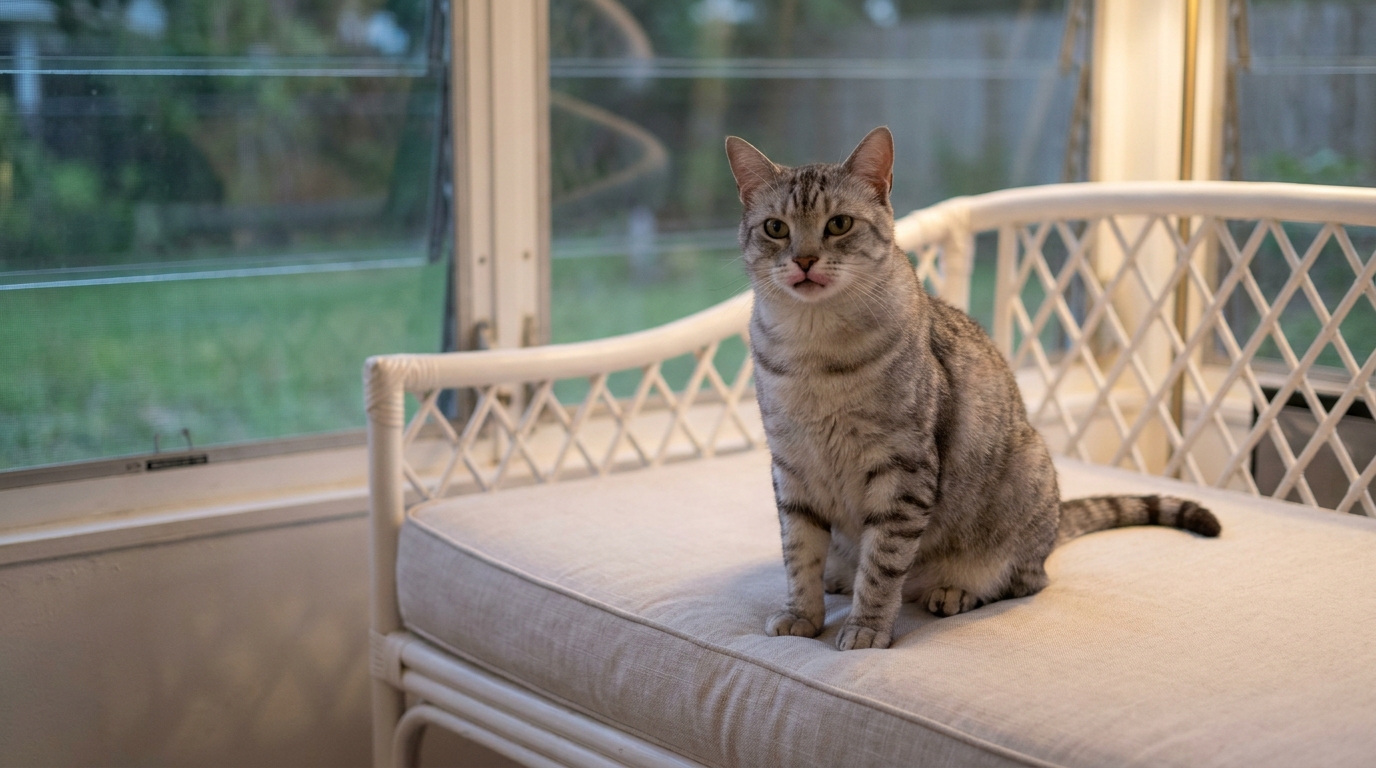
Cat's lip is swollen? A red, usually painless upper-lip sore is often a rodent ulcer. Sudden swelling or trouble breathing needs an ER now.
Go to an emergency vet now if your cat's lips or face puff up within minutes or hours or keep swelling while you watch, or if your cat has trouble breathing or is breathing with its mouth open, has hives, vomiting, heavy drooling, swollen eyes, pale gums, a seizure or collapse, cannot eat or drink, has a sore that keeps bleeding, or has a hot, painful swelling and is hiding, listless and off its food.
Your cat's lip is swollen: what you may be looking at
Vets sort lip changes in cats into a few groups.
The first is the rodent ulcer, also called an indolent ulcer. The Merck Veterinary Manual says, "Eosinophilic ulcers (also called 'rodent ulcers' or indolent ulcers) are well-defined, red, skin ulcers that are usually not painful or itchy." Merck adds, "They are most commonly found on the upper lip." The name is a myth: VCA explains it stuck "because people once thought the lesions were caused by rodent bites, but they are not."
The second is the eosinophilic granuloma. Veterinary Partner says it "produces a classical swollen lower lip or chin."
The third is a bite-wound abscess after a fight. Veterinary Partner says, "Common areas for bite wound abscesses include the facial cheeks, the legs, and the base of the tail."
The fourth is a sudden allergic reaction. Merck says hives and areas of swelling "are caused by allergic reactions to drugs, vaccines, chemicals, something eaten, insect bites, or even sunlight." The next section covers what to watch for.
Other causes include a dental or mouth problem, an injury, or a growth. Flat, dark spots are different; read about black spots on a cat's lips.
Emergency signs: go to an ER now, not a video call
Go to an emergency vet now if your cat has any of these:
- Lips or face puffing up within minutes or hours, or still swelling
- Trouble breathing or open-mouth breathing
- Hives
- Vomiting
- Heavy drooling
- Swollen eyes
- Pale gums
- A seizure or collapse
- Cannot eat or drink
- A sore that keeps bleeding
- A hot, painful swelling, with hiding, listlessness and no appetite
In its section on hives and swelling, the Merck Veterinary Manual says face and lip swelling is more serious than hives: "Swelling on the face, especially on the lips, the nose, and around the eyes, is more serious." Among the signs of anaphylactic shock, which Merck calls "a rare, life-threatening, immediate allergic reaction," Merck notes that "Facial swelling may occur." Merck calls anaphylaxis "an extreme emergency."
Sending hives and fast lip or face swelling to the ER is our own caution, not Merck's: at home you cannot tell whether a fast swelling is the start of anaphylaxis, so go to an emergency vet now.
For a fight abscess, Veterinary Partner notes, "If the abscess has not yet ruptured, your cat will likely be feverish, which means you will see listlessness and appetite loss." A hot, painful swelling in a cat that is hiding, listless and off its food means go to an emergency vet now.
Lips or face that are still puffing up, or a swelling that is getting bigger when you are not sure how fast it appeared, means go to an emergency vet now. If you are unsure whether any sign on the list is present, go now; do not wait, film or book a video call first.
If you think your cat licked or ate something toxic, such as a houseplant or a household chemical, call ASPCA Animal Poison Control (888) 426-4435 or Pet Poison Helpline (855) 764-7661 right away, both 24/7 (a fee may apply), and follow their advice; do not wait for or book a video call first, and any sign on the list above means go to an emergency vet now.
Slow sore, sudden swelling or a fight wound? Clues you can check without handling the lip much
Merck says hives and swelling "generally develop within 20 minutes of being exposed to the allergen (antigen)." Lips or face that are still puffing up mean go to an emergency vet now.
A rodent ulcer is usually "not painful or itchy," Merck says. VCA notes, "Bleeding occurs from some lesions," but a sore that keeps bleeding means go to an emergency vet now.
For a fight abscess, Veterinary Partner says, "If you look closely, a small scab from the tooth mark that caused the abscess may still be visible on the surface of the swollen area."
Veterinary Partner says, "Sometimes, a proliferative eroded structure also develops on the tongue so if your cat has a classical lip ulcer, it is a good idea to open the cat's mouth and check." Look only if your cat is calm and lets you; never force the mouth open, and stop if your cat growls, swats or tries to bite.
If your cat also keeps licking its lips or seems to have mouth pain, read about a cat that keeps licking its lips.
What to do tonight if there are no emergency signs
If your cat is alert, eating and drinking, and has no sign on the emergency list:
- Do not squeeze, pop, cut or lance a lump.
- Do not put any human cream, ointment or medicine on the lip, because your cat will lick it off.
- Do not give your cat any human medicine.
- Keep your cat indoors and away from other cats.
Take clear close-up photos in good light of the upper lip, lower lip and chin, plus a short video of your cat eating. Note when you first saw the swelling, any fight or time outdoors, any new food, treat, bowl or product, and when flea control was last given. Comb the coat for fleas or flea dirt.
When the lesions are in or around the mouth, Veterinary Partner says the allergen may be getting in by mouth, "such as food allergy or contact allergy from a plastic feeder," so glass, ceramic or metal bowls are worth considering.
If your cat cannot eat or drink, go to an emergency vet now. Check again before bed and in the morning. Lips or face that are still puffing up, or a swelling that is getting bigger when you are not sure how fast it appeared, means go to an emergency vet now, as does any other sign on the emergency list.
Why rodent ulcers happen: fleas, food and other allergies
Rodent ulcers and granulomas belong to the eosinophilic granuloma complex, which Merck says "can be due to insects (especially fleas), dietary and environmental allergies, infectious agents, and genetic or hereditary factors." Merck adds, "The cause cannot be identified in some cats." For this complex, Veterinary Partner says, "The most common cause is some kind of allergy."
VCA says, "Flea and insect control is very important in the treatment of this condition." Use only a cat-labeled flea product your vet has chosen, and never put a dog flea product on a cat. Treat every pet in the home, each with a product for its own species chosen by your vet. Read more about flea allergy and scabs in Florida cats.
Your vet may also suggest a diet trial. Veterinary Partner warns, "Remember that it is impossible to completely control the diet of a cat that roams outdoors."
How a vet confirms it in person
VCA says, "The characteristic lip ulcers are highly suggestive of EGC, and a biopsy may not be required." When a sample is needed, the vet may draw a few cells out with a thin needle, a test called fine needle aspiration (FNA). VCA notes, "In some cases, results from FNA may not be clear, and a biopsy may be necessary."
Veterinary Partner says, "In general, the appearance of the indolent ulcer is classical and a biopsy is not needed; though occasionally these are precancerous conditions and a biopsy may be needed to rule out a malignant skin tumor." Merck says, "Progression to squamous cell carcinoma is extremely rare, although it can occur."
An abscess is handled differently. Veterinary Partner says, "If the abscess has not ruptured, it will need to be lanced."
What a RexVet online vet can and cannot do for a swollen lip
For a cat with no emergency sign, a RexVet veterinarian can look closely at the lip, chin and, if your cat allows, gums and tongue on live video and in your photos, ask about timing, fleas, diet, bowls and fights, and help you choose between an in-person exam soon and a home plan.
A video vet cannot take a needle sample or biopsy, lance or flush an abscess, take a temperature, or tell an ulcer from a tumor without a sample. If any sign on the emergency list shows up, go to an emergency vet now, not a video call.
If the veterinarian decides medication is appropriate, they can prescribe where state rules allow. In Florida, a veterinarian who has seen your pet only by video may prescribe only FDA-approved animal drugs used as labeled, for up to 14 days (1 month for flea-and-tick-only products), and cannot renew without an in-person exam.
If your cat has no emergency sign, you can book a RexVet video visit for $64.99, 24/7. RexVet's veterinarians are licensed in Florida, New York and Virginia.
Living with a cat that gets rodent ulcers
VCA says, "Most cases respond well to medical treatment and management." VCA also notes, "Since recurrence is common, life-long intermittent treatment is needed in many cases."
Keep flea control going all year, using a cat-labeled product your vet has chosen. If your vet starts a diet trial, Merck advises: "Follow the recommended diet carefully to help identify the food that causes your pet's allergic reaction, and do not feed any treats or table food unless directed."
If your cat fights, keep it indoors with its rabies vaccination current; Veterinary Partner warns, "Bite wounds transmit rabies." Take a dated photo each time the lip flares so your vet can compare.
When to be seen in person in Florida, New York or Virginia
Any sign on the emergency list means go to an emergency vet now. Lips or face that are still puffing up, or a swelling that is getting bigger when you are not sure how fast it appeared, means go to an emergency vet now.
When no ER sign is present, book a hands-on exam soon for any of these: a swelling that looks like a fight abscess in a cat that is eating, alert and not getting worse (it may need lancing); a slow lip sore that is not healing or keeps coming back; a firm lump in a cat that is eating and acting normally; any sore in the mouth or on the tongue; or a lesion your vet wants sampled.
Florida law (Fla. Stat. 474.2021) requires a telehealth vet to give "the contact information for at least one physical veterinary clinic in the vicinity of the patient's location."
If your cat has no emergency sign, you can book a RexVet video visit 24/7 for $64.99. RexVet's veterinarians are licensed in Florida, New York and Virginia.
Frequently Asked Questions
What is a rodent ulcer on a cat's lip?
The Merck Veterinary Manual describes rodent (eosinophilic) ulcers in cats as "well-defined, red, skin ulcers that are usually not painful or itchy" and says, "They are most commonly found on the upper lip." VCA notes the name comes from an old belief that rodent bites caused them, "but they are not."
Is a swollen lip on a cat an emergency?
If your cat's lips or face are puffing up fast or still swelling, or your cat has trouble or open-mouth breathing, hives, vomiting, heavy drooling, swollen eyes, pale gums, a seizure or collapse, can't eat or drink, has a sore that keeps bleeding, or has a hot, painful swelling and is hiding, listless and off its food, go to an emergency vet now. If your cat may have licked a toxic plant or chemical, call ASPCA Animal Poison Control (888) 426-4435 or Pet Poison Helpline (855) 764-7661 right away (a fee may apply). A slow, painless sore on your cat's lip, in a cat that is eating and acting normally and has none of these signs, can wait for a vet check soon, by video or in person. If you are not sure, go now.
Could my cat's swollen lip be an abscess from a fight?
It can be: Veterinary Partner lists the facial cheeks among common sites for bite-wound abscesses and says a small scab from the tooth mark may still be visible on the swollen area. A swelling like this in a cat that is eating, alert and not getting worse may need lancing at an in-person exam soon. If your cat's lips or face are puffing up fast or still swelling, or your cat has trouble or open-mouth breathing, hives, vomiting, heavy drooling, swollen eyes, pale gums, a seizure or collapse, can't eat or drink, has a sore that keeps bleeding, or has a hot, painful swelling and is hiding, listless and off its food, go to an emergency vet now.
Can a rodent ulcer turn into cancer?
The Merck Veterinary Manual says progression of a cat's rodent ulcer to squamous cell carcinoma, a skin cancer, is "extremely rare, although it can occur." Veterinary Partner notes that "occasionally these are precancerous conditions and a biopsy may be needed to rule out a malignant skin tumor." A sore on your cat's lip that is not healing needs a hands-on exam.
Will my cat's rodent ulcer go away on its own?
Don't wait it out: Veterinary Partner warns, "If allowed to go untreated, the ulcer can be very destructive to the upper lip," and VCA says, "Since recurrence is common, life-long intermittent treatment is needed in many cases." Have your cat's lip checked soon, by video or in person. If your cat's lips or face are puffing up fast or still swelling, or your cat has trouble or open-mouth breathing, hives, vomiting, heavy drooling, swollen eyes, pale gums, a seizure or collapse, can't eat or drink, has a sore that keeps bleeding, or has a hot, painful swelling and is hiding, listless and off its food, go to an emergency vet now.
FAQs
What is a rodent ulcer on a cat's lip?
The Merck Veterinary Manual describes rodent (eosinophilic) ulcers in cats as "well-defined, red, skin ulcers that are usually not painful or itchy" and says, "They are most commonly found on the upper lip." VCA notes the name comes from an old belief that rodent bites caused them, "but they are not."
Is a swollen lip on a cat an emergency?
If your cat's lips or face are puffing up fast or still swelling, or your cat has trouble or open-mouth breathing, hives, vomiting, heavy drooling, swollen eyes, pale gums, a seizure or collapse, can't eat or drink, has a sore that keeps bleeding, or has a hot, painful swelling and is hiding, listless and off its food, go to an emergency vet now. If your cat may have licked a toxic plant or chemical, call ASPCA Animal Poison Control (888) 426-4435 or Pet Poison Helpline (855) 764-7661 right away (a fee may apply). A slow, painless sore on your cat's lip, in a cat that is eating and acting normally and has none of these signs, can wait for a vet check soon, by video or in person. If you are not sure, go now.
Could my cat's swollen lip be an abscess from a fight?
It can be: Veterinary Partner lists the facial cheeks among common sites for bite-wound abscesses and says a small scab from the tooth mark may still be visible on the swollen area. A swelling like this in a cat that is eating, alert and not getting worse may need lancing at an in-person exam soon. If your cat's lips or face are puffing up fast or still swelling, or your cat has trouble or open-mouth breathing, hives, vomiting, heavy drooling, swollen eyes, pale gums, a seizure or collapse, can't eat or drink, has a sore that keeps bleeding, or has a hot, painful swelling and is hiding, listless and off its food, go to an emergency vet now.
Can a rodent ulcer turn into cancer?
The Merck Veterinary Manual says progression of a cat's rodent ulcer to squamous cell carcinoma, a skin cancer, is "extremely rare, although it can occur." Veterinary Partner notes that "occasionally these are precancerous conditions and a biopsy may be needed to rule out a malignant skin tumor." A sore on your cat's lip that is not healing needs a hands-on exam.
Will my cat's rodent ulcer go away on its own?
Don't wait it out: Veterinary Partner warns, "If allowed to go untreated, the ulcer can be very destructive to the upper lip," and VCA says, "Since recurrence is common, life-long intermittent treatment is needed in many cases." Have your cat's lip checked soon, by video or in person. If your cat's lips or face are puffing up fast or still swelling, or your cat has trouble or open-mouth breathing, hives, vomiting, heavy drooling, swollen eyes, pale gums, a seizure or collapse, can't eat or drink, has a sore that keeps bleeding, or has a hot, painful swelling and is hiding, listless and off its food, go to an emergency vet now.
Medically Reviewed
Reviewed by Dr. Tiffany Delacruz, DVM — licensed veterinarian and CEO of RexVet. Last reviewed October 2, 2026.
Content is for informational purposes and does not replace professional veterinary advice.
Chief Executive Officer · Licensed Veterinarian
Dr. Delacruz is a licensed Doctor of Veterinary Medicine specializing in preventive care and veterinary telehealth. She reviews all health content on RexVet to ensure accuracy and clinical relevance.
Sources & References
- · American Veterinary Medical Association — Telehealth Guidelines
- · AVMA — Pet Care Resources
- · U.S. FDA — Animal & Veterinary
Need an Expert Opinion on This Topic?
Connect with a certified vet via video call in minutes
Talk to Vet Now