
Cat Drooling After Flea Treatment? What to Do Right Now
By RexVet Team | Reviewed by Dr. Tiffany Delacruz, DVM
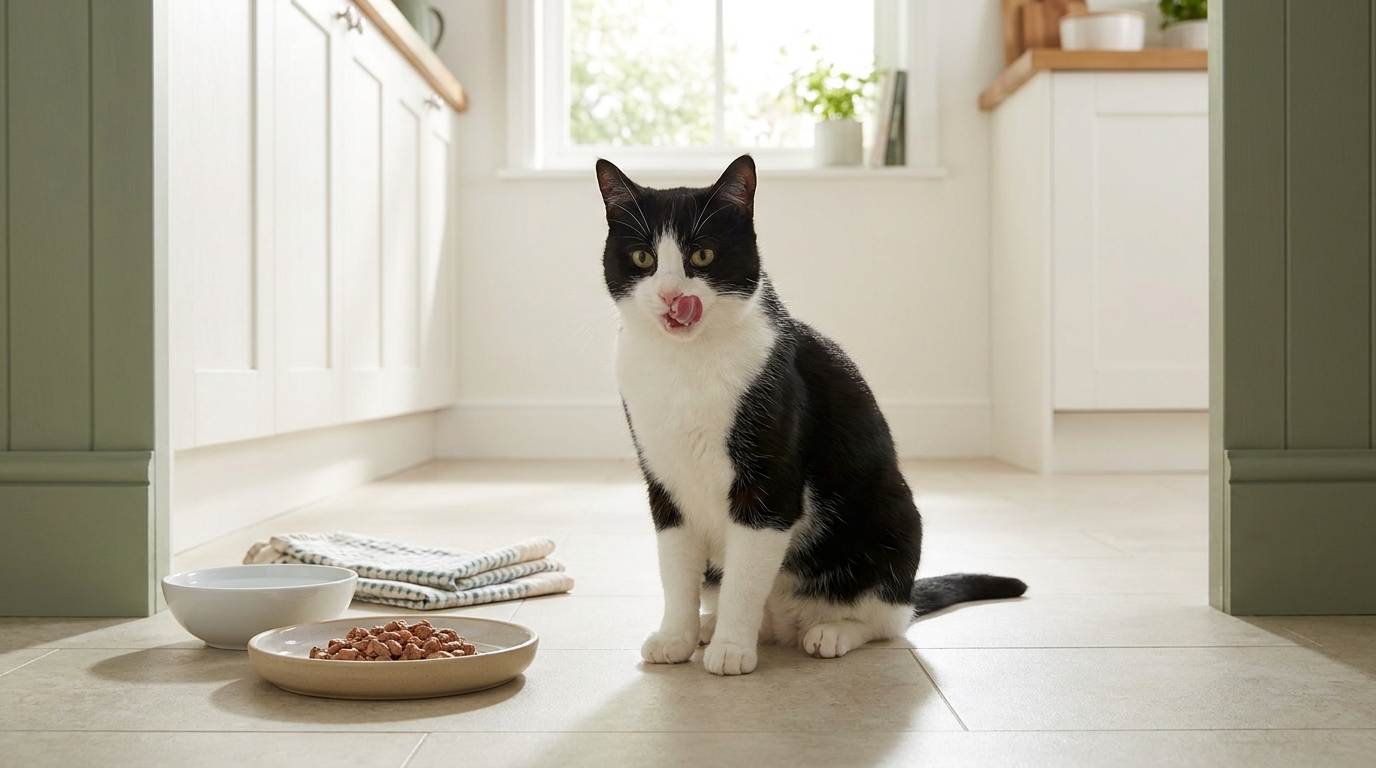
Cat drooling after flea treatment? If your cat licked a cat product, bitter taste is the usual cause. If it was a dog product, act now.
Go to an emergency vet now if your cat is trembling, twitching, wobbly, seizing, breathing hard or collapses after any flea product, and call a poison line right away if a dog flea product touched your cat.
Your cat is foaming, drooling or tearing around the house minutes after the drops went on. Check the box or tube first. If the product was made for cats and your cat licked it while it was still wet, Pet Poison Helpline says the reaction is only due to the taste. If it was a dog product, or your cat has any sign in the bold line above, it is an emergency: go to an emergency vet or call a poison line now.
Cat drooling after flea treatment: why the bitter taste causes it
According to Pet Poison Helpline, topical flea and tick medications "contain active ingredients and a carrier that adheres to your cat's skin." Trouble starts when a cat licks the spot before it dries.
Pet Poison Helpline explains that, if ingested, the medicine "may cause agitation, hyperactivity, vomiting, foaming at the mouth, and excessive salivation due to the bitter taste."
It can look dramatic. In its flea and tick questions and answers, Pet Poison Helpline notes that "some cats have been known to become agitated and run around the house." For a cat that licked a topical product, it adds: "This is only due to the taste and systemic toxicity would not be expected."
That reassurance has limits. It applies only to a product labeled for cats that your cat licked while it was still wet. It does not apply to a dog product, to a cat that groomed a freshly treated dog, or to a cat that is trembling, twitching, wobbly, seizing, breathing hard or collapsing.
Our post on why the drooling after a glow stick bite looks so scary covers another drooling scare.
Emergency signs: go to an ER or call a poison line now, not a video call
VCA Animal Hospitals lists these warning signs of pyrethrin and pyrethroid poisoning in cats:
- Excessive salivation (drooling)
- Agitation or restlessness
- Incoordination or difficulty jumping, standing or walking (a wobbly cat)
- Shaking, twitching, tremors
- Seizures
- Dyspnea (difficulty breathing)
Read that list with the label in hand. When drooling, foaming or agitation and running around are the only signs, right after your cat licked a wet cat-labeled product, Pet Poison Helpline says the reaction is "only due to the taste." The same signs after a dog product or after grooming a treated dog, or together with trembling, twitching, wobbliness, seizures, trouble breathing or collapse, mean calling a poison line or going to the ER now, not booking a video call.
Why the hurry? VCA warns that life-threatening signs can follow "even a small exposure" to pyrethroid products, and that this toxicity "can be fatal for cats if not treated immediately."
Call ASPCA Animal Poison Control at (888) 426-4435 or Pet Poison Helpline at (855) 764-7661. Both answer 24/7, and a fee may apply. If your cat already shows a sign from the bold line at the top, head to the nearest emergency vet and have someone call while you drive.
For other situations, our practical emergency checklist for dog and cat owners walks through what counts as an emergency.
First, read the box: was it a cat product or a dog product?
The label decides what happens next. A cat product licked while wet usually means a bad taste. A dog product is a poisoning risk.
The mix-up does happen. VCA notes that some owners apply a dog flea and tick product, a high-concentration pyrethrin or pyrethroid product, to their cats by mistake or on purpose. It is just as direct about a tempting shortcut: "Never apply a 'small dog' flea and tick medication to a cat."
Look at the active ingredients as well. Pet Poison Helpline notes that "any active ingredient ending in -thrin is a Permethrin product." Still, the label is the deciding check, and a dog label means calling a poison line now.
There is a second route that catches people off guard: the family dog. VCA explains that cats that groom or sleep next to a dog can be exposed if that dog was recently treated with a high-concentration pyrethrin or pyrethroid product.
Whatever you find, keep the box or tube to show a vet or the poison line.
If it was a cat product: what to do in the next few minutes
If the box says the product is for cats, your cat licked it while it was still wet, and your cat is only drooling, foaming or agitated, Pet Poison Helpline's advice is simple: "Normal treatment would be to feed the animal a tasty snack and entice them to drink water or flush their mouth with room temperature water." It adds that "for cats, wet cat food, tuna or tuna juice can be given."
- Offer a little wet food, tuna or tuna juice.
- Set out fresh, room-temperature water and let your cat drink on its own.
- Never force liquid into your cat's mouth.
Pet Poison Helpline says the symptoms "should be mild and self-limiting." It also advises that "you should try to prevent the animal from licking until the product has fully dried," because, once dried, it "should not cause the same reaction when licked."
If the drooling does not settle, or your cat trembles, twitches, turns wobbly, seizes or has trouble breathing, move straight to a poison line or the ER.
If it was a dog product, or your cat groomed a freshly treated dog
This is not a wait-and-see situation, even if your cat looks completely fine right now.
Pet Poison Helpline says: "If a cat has been exposed to a dog flea product, then immediately contact a veterinarian, the emergency number on the product package or Pet Poison Helpline." You can reach Pet Poison Helpline at (855) 764-7661.
VCA describes close contact with a recently treated dog as a route of exposure too, so if your cat groomed or slept against a freshly treated dog, call a poison line or your vet now.
If your cat is already showing signs, skip everything else. Pet Poison Helpline is direct: "If your cat is exhibiting symptoms such as tremors or seizures, immediately take them to the veterinary clinic for medical help."
The poison line or your vet may talk you through a bath. For a cat with no symptoms, Pet Poison Helpline's guidance is to "bathe them thoroughly three times with liquid dish soap to remove the product from them." Do this only if the poison line or a veterinarian advises it. Never bathe a cat that is trembling or seizing; that cat goes to the clinic now.
Speed matters. VCA notes that "there is no antidote for pyrethrin or pyrethroid poisoning," but "if your veterinarian can provide prompt, early treatment, the prognosis is usually good." Have the box or tube with you when you call or arrive.
Vomiting, hiding or acting strange after a flea treatment
Pet Poison Helpline says: "Vomiting after flea treatment is unfortunately one of the common side effects cats can experience from topical treatments like spot-ons and shampoos if they ingest the product."
Common does not mean watch at home. Its advice is plain: "If your cat is having a reaction, such as vomiting, after being treated with a flea product, you should call your veterinarian and Pet Poison Helpline right away." That means your regular vet and Pet Poison Helpline at (855) 764-7661, and the emergency vet if a sign from the bold line appears.
Hiding deserves attention too. VCA lists hiding among the warning signs, so a cat that hides after a treatment should be checked the same day. Wobbliness, twitching or trembling go straight to the ER or a poison line.
What a RexVet online vet can and cannot do after a flea product mishap
If the product was made for dogs, or your cat shows a sign from the bold line at the top, skip the video call and go to the ER or call a poison line. A video visit fits the calmer case: a cat product licked while wet, and a cat that is otherwise acting like itself.
RexVet is a 501(c)(3) non-profit, and RexVet's veterinarians are licensed in Florida, New York and Virginia. On a video visit, a veterinarian can:
- Read the product box and the active ingredient on camera with you
- Watch the drooling, your cat's pupils and the way your cat walks
- Coach the food-and-water mouth rinse, or a dish-soap bath if the poison line advises one
- Help you decide between watching at home, calling the poison line and going to the ER
- Recheck your cat by video later
A video vet cannot stop tremors or seizures, give fluids, monitor temperature or run bloodwork. Those need a hospital; VCA notes that the hospital team "will carefully monitor your cat's temperature for an elevated or lowered reading."
The visit is about choosing the next step safely. If the veterinarian decides medication is appropriate, they can prescribe where state rules allow.
If your cat licked a flea product made for cats and you want a veterinarian to check the label and watch your cat with you, you can book a RexVet video visit. A visit is $64.99, veterinarians are available 24/7, and care is for pet parents in Florida, New York and Virginia only.
Preventing the next reaction
VCA offers a few habits worth keeping for every dose:
- "Only use cat products on cats."
- "Keep your cat separate from any dogs that have been treated for 12 to 24 hours."
- When in doubt, VCA says you can put a T-shirt on your dog "to prevent accidental exposure to your cat until the product is dried."
- Be careful about stacking treatments; VCA cautions that "many products are not designed to be used in combination with other products."
Flea collars carry a different risk. Pet Poison Helpline warns that "ingesting parts of a flea collar can cause a foreign body obstruction," so a collar your cat has chewed is worth a call to your vet.
When to be seen in person in Florida, New York or Virginia
See your veterinarian or an emergency vet in person if:
- Your cat was exposed to a dog flea product, even with no signs yet (call a poison line on the way)
- Your cat groomed or slept against a freshly treated dog
- The drooling does not settle
- Your cat keeps vomiting
- You see any trembling, twitching or wobbliness
- Your cat is hiding or not eating afterward
If the drooling started without any flea product, our guide to cat drooling causes for pet parents in Florida, New York and Virginia covers the other reasons a cat may drool.
In Florida, when a veterinarian's first exam of your pet is by telehealth, they must give you "the contact information for at least one physical veterinary clinic in the vicinity of the patient's location" (Fla. Stat. 474.2021).
When it is a cat product and a bitter taste, a veterinarian can help you settle the question. RexVet's veterinarians are licensed in Florida, New York and Virginia and are available 24/7, including nights, weekends and holidays. A video visit is $64.99, and you can book a RexVet video visit whenever you need one. For a dog product or a sign from the bold line, the poison line or ER comes first.
Frequently Asked Questions
Is it normal for a cat to foam at the mouth after flea treatment?
It can be, if the product was made for cats and your cat licked it while it was wet. Pet Poison Helpline says this is "only due to the taste and systemic toxicity would not be expected." If it was a dog product, or your cat trembles, twitches, turns wobbly or has trouble breathing, go to the ER or call a poison line.
How long does drooling last after my cat licked flea medicine?
Pet Poison Helpline gives no set time, but says that for a cat product licked while wet, the symptoms "should be mild and self-limiting." If the drooling does not settle, or a sign from the bold line appears, call a poison line or head to the ER.
My cat groomed my dog after the dog's flea treatment. What now?
Treat it as a dog-product exposure. VCA explains that a cat can be exposed by grooming or sleeping next to a recently treated dog. Call Pet Poison Helpline at (855) 764-7661, ASPCA Animal Poison Control at (888) 426-4435 or your emergency vet now, even if your cat seems fine.
Should I wash the flea treatment off my cat?
Only if a veterinarian or poison line advises it and your cat has no symptoms. In that case, Pet Poison Helpline says to bathe your cat thoroughly three times with liquid dish soap. If your cat is trembling or seizing, skip the bath and go to the clinic now.
Can I use my dog's flea medicine on my cat if I use less?
No. VCA says to "never apply a 'small dog' flea and tick medication to a cat," and warns that even a small exposure to pyrethroid products can cause life-threatening signs in cats. Use only products labeled for cats.
FAQs
Is it normal for a cat to foam at the mouth after flea treatment?
It can be, if the product was made for cats and your cat licked it while it was wet. Pet Poison Helpline says this is "only due to the taste and systemic toxicity would not be expected." If it was a dog product, or your cat trembles, twitches, turns wobbly or has trouble breathing, go to the ER or call a poison line.
How long does drooling last after my cat licked flea medicine?
Pet Poison Helpline gives no set time, but says that for a cat product licked while wet, the symptoms "should be mild and self-limiting." If the drooling does not settle, or a sign from the bold line appears, call a poison line or head to the ER.
My cat groomed my dog after the dog's flea treatment. What now?
Treat it as a dog-product exposure. VCA explains that a cat can be exposed by grooming or sleeping next to a recently treated dog. Call Pet Poison Helpline at (855) 764-7661, ASPCA Animal Poison Control at (888) 426-4435 or your emergency vet now, even if your cat seems fine.
Should I wash the flea treatment off my cat?
Only if a veterinarian or poison line advises it and your cat has no symptoms. In that case, Pet Poison Helpline says to bathe your cat thoroughly three times with liquid dish soap. If your cat is trembling or seizing, skip the bath and go to the clinic now.
Can I use my dog's flea medicine on my cat if I use less?
No. VCA says to "never apply a 'small dog' flea and tick medication to a cat," and warns that even a small exposure to pyrethroid products can cause life-threatening signs in cats. Use only products labeled for cats.
Medically Reviewed
Reviewed by Dr. Tiffany Delacruz, DVM — licensed veterinarian and CEO of RexVet. Last reviewed September 29, 2026.
Content is for informational purposes and does not replace professional veterinary advice.
Chief Executive Officer · Licensed Veterinarian
Dr. Delacruz is a licensed Doctor of Veterinary Medicine specializing in preventive care and veterinary telehealth. She reviews all health content on RexVet to ensure accuracy and clinical relevance.
Sources & References
- · American Veterinary Medical Association — Telehealth Guidelines
- · AVMA — Pet Care Resources
- · U.S. FDA — Animal & Veterinary
Need an Expert Opinion on This Topic?
Connect with a certified vet via video call in minutes
Talk to Vet Now