
Can Dogs Eat Cheese? Holiday Boards, Blue Cheese and Safety
By RexVet Team | Reviewed by Dr. Tiffany Delacruz, DVM
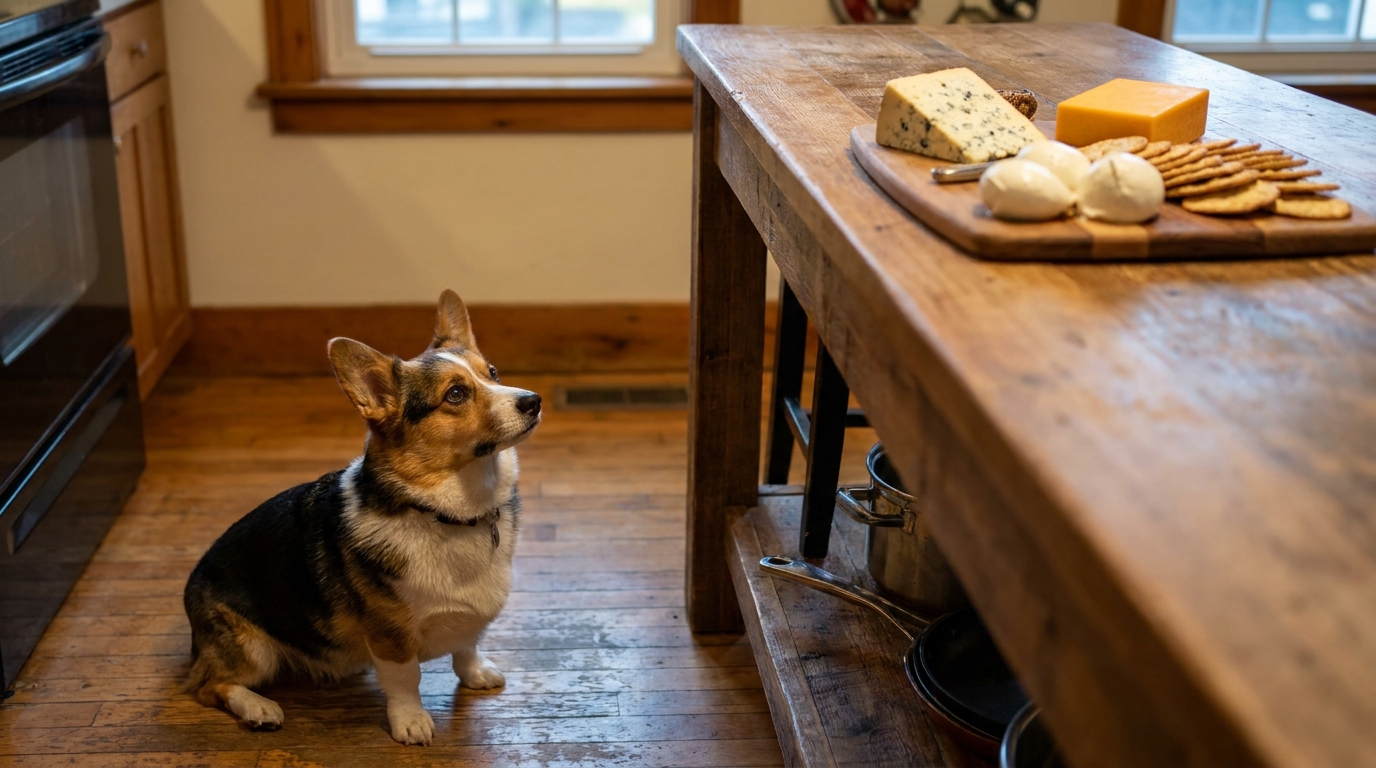
Which cheeses suit a dog, why blue and moldy cheese are different risks, and what to do when your dog raids a holiday cheese board.
Quick answer: Yes, most dogs can eat a small piece of plain, lower-fat cheese, such as mozzarella or cottage cheese, as an occasional treat. Skip blue or moldy cheese, cheeses with garlic, onion or chives, and big helpings, which can lead to pancreatitis. If your dog raided a cheese board, grapes or raisins mean a poison line and an in-person vet now; xylitol or a swallowed toothpick means an emergency vet now.
This article is general information, not a diagnosis. If you think your pet is in danger, go to the nearest emergency animal hospital.
Dog ate a cheese or charcuterie board: check what else was on it
On a cheese or charcuterie board, the real emergencies for a dog are usually grapes, raisins, macadamia nuts, chocolate, garlic or onion spreads, xylitol-sweetened items, alcohol and toothpicks, not the cheese itself. Keep any labels, and if more than one row fits, follow the most urgent.
| Board item | Risk | Do this |
|---|---|---|
| Grapes, raisins, currants | Kidney injury | Poison line, get seen now |
| Macadamia nuts | Weak legs, tremors | Poison line or vet now |
| Garlic, onion, chive cheese | Red cell damage | Poison line now |
| Chocolate | Heart, tremors | Poison line now |
| Wine, liqueur | Alcohol | Poison line now |
| Sugar-free jam, sweets | Xylitol | Emergency vet now |
| Blue cheese, a lot | Mold toxin | Poison line or vet now |
| Moldy cheese, trash | Tremors | Clinic now, even if fine |
| Toothpicks, picks, twine | Pierce, block gut | ER now, even if fine |
| Olive or fruit pits, in-shell nuts | Blockage | In person now |
| Wax, wrap, cheese paper | Blockage | In-person vet today |
| A lot, or high-risk dog | Pancreas | Call a vet today |
| Few bites, bright dog | Fat, salt | Watch 4 days |
Any grapes, raisins or currants, including cheese, crackers or breads made with them, mean a call to a poison line and an in-person vet now, even if your dog seems fine, because Pet Poison Helpline says kidney damage can start before clear signs appear. The ASPCA says macadamia nuts can cause weakness, vomiting, tremors and overheating, usually within 12 hours. Garlic, onion or chive cheese, spreads or dips mean a poison line now, even if your dog seems fine, and a large or unknown amount means an emergency vet now, calling a poison line on the way. Garlic, onion and chives damage red blood cells over days, so weakness, pale or yellow gums, fast breathing or a fast heartbeat on days 1 to 5 means an emergency vet now, and red, brown or near-black urine is also an alarm sign. The FDA says xylitol can drop a dog's blood sugar within 10 to 60 minutes, so get to an emergency vet now, even if your dog seems fine, calling a poison line on the way. After wine, liqueur or spiked eggnog, wobbling, vomiting, trembling, very slow breathing, a cold body or collapse means an emergency vet now, calling a poison line on the way. See why any amount of grapes or raisins is an emergency, what to do after a dog eats macadamia nuts and how much onion or garlic is toxic.
Make no dog vomit at home unless a vet or poison line says to, and never after a pick, skewer, pit or string. Never pull on string you can see. Don't give milk, bread or oil to soak anything up. The ASPCA says salt poisoning can cause vomiting, tremors and seizures, so vomiting with extreme thirst, wobbliness or tremors after salami or parmesan means an emergency vet now. Keep fresh water out as usual, but don't force your dog to drink.
When a dog ate only plain cheese, crackers and cured meat, fat is the main worry, unless a salami or sausage label lists garlic or onion and your dog ate more than a taste (a poison line now) or your dog swallowed salami netting (the ER now). Pet Poison Helpline says pancreatitis signs can appear up to 4 days later, so see the 4-day pancreatitis watch after a dog eats fat. A dog that ate a lot of cheese or salami for its size, such as a whole block, wedge or board, or a high-risk dog needs a vet call today, even if it seems fine, then a 4-day watch. A high-risk dog has had pancreatitis, eats a low-fat prescription diet, is a Miniature Schnauzer or another prone breed, or has Cushing's disease, high blood fats, diabetes or extra weight. For a diabetic dog, call the vet who manages the insulin before changing meals or treats. Each new fatty snack starts a new 4 days.
- One vomit in a bright, eating dog: call a vet today.
- Refusing food, vomiting plus diarrhea, or more than a few red streaks of blood in the stool: an in-person vet today.
- Vomiting more than once; vomiting with lethargy (dull or listless), even once; not keeping water down; blood in the vomit; black, tarry or "raspberry jam" stool; a painful or hunched belly; pale, yellow or gray gums; weakness or collapse: an emergency vet now.
- A large, deep-chested dog that is dry-retching, restless, breathing fast or swollen in the belly: possible bloat (GDV), which the Merck Veterinary Manual calls a life-threatening emergency, so go to an emergency vet now.
ASPCA Animal Poison Control: (888) 426-4435 (a consultation fee may apply). Pet Poison Helpline: (855) 764-7661 (a per-incident fee applies). Both poison lines take calls every day, including holidays.
Is cheese safe for dogs?
Plain cheese is not toxic to a dog, but it is high in fat and often salty, and the ASPCA says pets lack enough lactase to digest milk sugar well, so cheese works only as a small, occasional treat. The American Kennel Club says cheese is a common training reward, especially for puppies, but some dogs can't tolerate it, and feeding too much regularly can cause weight gain and could lead to pancreatitis.
Which cheeses are better and which to skip
Lower-fat cheeses such as mozzarella and cottage cheese, in small pieces, are the easiest choices for a dog; cheddar, cream cheese, Swiss and brie are all high in fat, so keep them to tiny bites, and skip blue cheese, parmesan, and any cheese made with garlic, onion, chives, raisins or nuts.
| Cheese | Verdict | Why |
|---|---|---|
| Mozzarella | Small pieces | Lower fat |
| Cottage cheese | Occasional | Low fat, has lactose |
| Cheddar | Tiny bites | High fat |
| Swiss | Tiny bites | Low salt, high fat |
| Cream cheese | Plain, tiny bites | High fat, lactose |
| Brie | Tiny bites | High fat |
| Parmesan | Skip | Very salty |
| Blue cheese | Skip | Mold, salt, fat |
| Herb or garlic cheese | Skip | Garlic, onion |
| Cheese with fruit, nuts | Skip | Raisins, nuts |
USDA food data show cheddar and cream cheese are about one-third fat by weight, Swiss nearly a third, blue cheese and brie more than a quarter, whole-milk mozzarella about a fifth, and cottage cheese only a few percent. The same data show blue cheese and parmesan carry nearly twice the salt of cheddar, while Swiss is among the lowest-salt cheeses.
Blue cheese and moldy cheese
Blue cheese is a poor choice for a dog: it is salty and high in fat, and its mold makes roquefortine C, which the Royal Kennel Club (UK) says can cause tremors and seizures in more extreme cases, while moldy, spoiled cheese from the trash is the bigger danger and needs a clinic now. The Merck Veterinary Manual says roquefortine C may not be an important tremor toxin, but molds on dairy, nuts or compost can make toxins that cause vomiting, wobbliness, tremors and seizures. These signs can start within a few hours. Fresh blue cheese is mold-ripened on purpose; spoiled cheese is not.
- A small bite of fresh blue cheese: watch at home.
- A large amount of fresh blue cheese: a poison line or vet now.
- Moldy or spoiled cheese, or a trash or compost raid: a clinic now (an emergency hospital if yours is closed), even with no signs, as with moldy nuts.
- Trembling, wobbliness, agitation or a seizure: an emergency vet now, calling a poison line on the way.
Lactose intolerance in dogs
Many dogs are lactose intolerant to some degree, the American Kennel Club says, so cheese, milk and ice cream can cause gas, loose stool, vomiting or belly pain in a dog, and aged hard cheeses such as cheddar and Swiss carry the least lactose. USDA food data show that fresh cheeses such as cottage cheese and cream cheese contain more lactose, so cottage cheese is low in fat but not in lactose.
If a bright adult dog gets mild gas or soft stool after a little dairy, stop the cheese, keep water available, and call a vet if diarrhea lasts past 2 days (a toy breed or senior dog: today). Don't give Pepto-Bismol or Imodium unless a vet says to.
Dogs that should skip cheese
A dog that has had pancreatitis, is overweight, has heart disease on a low-salt diet, eats a prescription kidney diet (ask the vet first), has a dairy allergy or is on a food trial should skip cheese. The Merck Veterinary Manual says Miniature Schnauzers are dramatically overrepresented for pancreatitis and that dogs in heart failure should avoid salty human table snacks. A 2016 review in BMC Veterinary Research lists dairy among the food allergens most often behind skin reactions in dogs, and Merck says a dog on an elimination diet trial must avoid every food-based extra, pill pockets included.
Using cheese to hide pills
A small piece of plain cheese can hide a pill for many dogs, but ask your vet or pharmacist first, because some medicines should not be given with food or dairy, and a dog on a food trial or a low-fat, low-salt or kidney diet needs another option. The Merck Veterinary Manual says milk products can reduce how well some older tetracycline antibiotics are absorbed, though not doxycycline or minocycline. If you use nut butter instead, the FDA says to check the label first for xylitol.
How much cheese is too much?
The American Animal Hospital Association says treats, table scraps included, should make up no more than 10% of a dog's daily calories, so a small dog should get a far smaller piece of cheese than a large dog. Training treats and cheese used to hide pills count toward that 10%, and the high-fat cheeses use it up fastest.
Keeping dogs off the board at parties
To keep a dog away from a cheese board at a party, set the board on a high table or counter, clear it before it sits out unattended, ask guests not to share, and give the dog a quiet room. Count the toothpicks and cocktail picks before and after, throw used picks, twine and wrappers into a lidded trash can, and before the party, find the nearest emergency hospital that is open on the holiday. If your dog gets anxious or pushy around guests, see how to keep holiday guest visits calm.
When a video visit helps
RexVet, a nonprofit online vet service, serves pets located in Florida, New York and Virginia by video visit, and your dog must be in one of those states during the visit. A video visit helps when you want to know which treats suit your dog's diet, when your bright adult dog gets gas or soft stools after dairy with no vomiting, when you want help with a weight-loss plan or food trial, or when a poison line or emergency vet has said watching at home is reasonable after a board raid. Book a $64.99 live video visit with a licensed RexVet vet. Live slots run about 8 AM to 11 PM ET, and there are no overnight visits; outside those hours, use an emergency vet or a poison line. Holiday availability isn't confirmed, so check open slots when you book.
The veterinarian reviews what and how much your dog ate, its weight and health history (pancreatitis, kidney or heart disease, allergies), tells you what to watch for over the next few days, says whether your dog needs to be seen in person, and helps you set a treat and holiday-food plan. Video can't feel the belly, make a dog vomit, run tests or give IV fluids, so it is not a fit for any row in the board table above marked "now" or "in-person", or for repeated vomiting, a painful belly, weakness, trembling or a seizure, which mean an emergency vet now. Any puppy that vomits, has diarrhea or won't eat needs an in-person vet today.
No prescription is promised; any medicine is the veterinarian's decision after the visit. In Florida, a prescription based only on a video visit is limited to FDA-approved animal drugs used as labeled, for up to 14 days (1 month for products labeled solely for flea and tick control), and can't be renewed without an in-person exam; human-labeled drugs, controlled drugs, and compounded antibacterial, antifungal, antiviral or antiparasitic drugs need an in-person exam first. Virginia allows the exam to be electronic, but federal rules still require an in-person exam before any vet prescribes a human or off-label drug. New York's rules for veterinary video care, including prescribing, are still unsettled, so a visit there may cover less. RexVet isn't a pharmacy: if the veterinarian prescribes and you ask RexVet to send the prescription to an outside pharmacy, a pharmacy transfer fee applies.
Need an Expert Opinion on This Topic?
Book a video visit with a licensed vet, evenings and weekends included
See open timesFrequently Asked Questions
Can I give my puppy cheese as a training treat?
Yes, a tiny piece of plain, lower-fat cheese is fine for most puppies as an occasional training reward. Give a small puppy a far smaller piece than a large one. Any puppy that vomits, has diarrhea or won't eat after cheese needs an in-person vet today, and never give a puppy Imodium.
Can dogs eat string cheese?
Yes, a small piece of plain string cheese is fine for most dogs as an occasional treat. Tear it small, skip flavored or seasoned versions, and keep the wrapper away: a swallowed wrapper means an in-person vet today, so bring the packaging.
Is it okay to give my dog cheese every day?
Not as a daily habit for most dogs: cheese is high in fat, and regular large amounts can lead to weight gain and pancreatitis. Keep all treats within the American Animal Hospital Association's 10% of daily calories, and ask a vet before making cheese a daily pill pocket.
Can dogs eat mac and cheese or pizza?
No: mac and cheese and pizza are too fatty and salty for dogs, and pizza sauce and toppings can contain garlic or onion. Garlic or onion toppings mean a poison line now. A bite or two in a bright, low-risk dog means a 4-day watch; a lot, or a higher-risk dog, means a vet call today. Vomiting with extreme thirst, wobbliness or tremors means an emergency vet now.
My dog ate blue cheese. What should I do?
A small bite of fresh blue cheese means watching at home; a large amount means a call to a poison line or vet now. Moldy or spoiled cheese, or cheese from the trash, means a clinic now, even with no signs. Trembling, wobbliness, agitation or a seizure means an emergency vet now, calling a poison line on the way. Blue cheese is also salty and high in fat, so watch 4 days for pancreatitis signs such as vomiting, belly pain, refusing food or weakness, and call a vet today if your dog is higher-risk.
Can my cat eat cheese too?
A tiny piece of plain cheese at most: Cornell's Feline Health Center says many cats are lactose intolerant and can get stomach upset from dairy. Keep treats within Cornell's 10 to 15 percent of daily calories. Cats are the most sensitive species to garlic, onion and chives, so cheese with any of them means a poison line now. Never give a cat Pepto-Bismol or try to make a cat vomit at home, and a cat that vomits repeatedly or stops eating needs a vet today, and a cat that seems weak or has pale or yellow gums needs an emergency vet now.
Can an online vet help with my dog's diet or an upset stomach after cheese in Florida, New York or Virginia?
Often, yes, for a bright adult dog located in Florida, New York or Virginia that ate plain cheese and vomited once at most. On camera, a veterinarian licensed in your pet's state can review what was eaten, look at gums, posture and stool photos, set up the 4-day pancreatitis watch, help with a treat or food-trial plan, and say whether your dog needs to be seen in person. Video can't feel the belly, run tests, give fluids or make a dog vomit. Grapes or raisins mean a poison line and an in-person vet now; garlic, onion, macadamias, chocolate or alcohol, a poison line now; moldy cheese, a clinic now; a swallowed toothpick, the ER now; possible xylitol, repeated vomiting, belly pain, weakness, trembling or a seizure, an emergency vet now; and refusing food, vomiting plus diarrhea, or any puppy with vomiting or diarrhea, an in-person vet today. No prescription is promised: in Florida, a video-only prescription is limited to FDA-approved animal drugs used as labeled, for up to 14 days (1 month for products labeled solely for flea and tick control), with no renewal without an in-person exam; federal rules require an in-person exam for any human or off-label drug; Virginia allows an electronic exam; and New York's rules are still unsettled.
FAQs
Can I give my puppy cheese as a training treat?
Yes, a tiny piece of plain, lower-fat cheese is fine for most puppies as an occasional training reward. Give a small puppy a far smaller piece than a large one. Any puppy that vomits, has diarrhea or won't eat after cheese needs an in-person vet today, and never give a puppy Imodium.
Can dogs eat string cheese?
Yes, a small piece of plain string cheese is fine for most dogs as an occasional treat. Tear it small, skip flavored or seasoned versions, and keep the wrapper away: a swallowed wrapper means an in-person vet today, so bring the packaging.
Is it okay to give my dog cheese every day?
Not as a daily habit for most dogs: cheese is high in fat, and regular large amounts can lead to weight gain and pancreatitis. Keep all treats within the American Animal Hospital Association's 10% of daily calories, and ask a vet before making cheese a daily pill pocket.
Can dogs eat mac and cheese or pizza?
No: mac and cheese and pizza are too fatty and salty for dogs, and pizza sauce and toppings can contain garlic or onion. Garlic or onion toppings mean a poison line now. A bite or two in a bright, low-risk dog means a 4-day watch; a lot, or a higher-risk dog, means a vet call today. Vomiting with extreme thirst, wobbliness or tremors means an emergency vet now.
My dog ate blue cheese. What should I do?
A small bite of fresh blue cheese means watching at home; a large amount means a call to a poison line or vet now. Moldy or spoiled cheese, or cheese from the trash, means a clinic now, even with no signs. Trembling, wobbliness, agitation or a seizure means an emergency vet now, calling a poison line on the way. Blue cheese is also salty and high in fat, so watch 4 days for pancreatitis signs such as vomiting, belly pain, refusing food or weakness, and call a vet today if your dog is higher-risk.
Can my cat eat cheese too?
A tiny piece of plain cheese at most: Cornell's Feline Health Center says many cats are lactose intolerant and can get stomach upset from dairy. Keep treats within Cornell's 10 to 15 percent of daily calories. Cats are the most sensitive species to garlic, onion and chives, so cheese with any of them means a poison line now. Never give a cat Pepto-Bismol or try to make a cat vomit at home, and a cat that vomits repeatedly or stops eating needs a vet today, and a cat that seems weak or has pale or yellow gums needs an emergency vet now.
Can an online vet help with my dog's diet or an upset stomach after cheese in Florida, New York or Virginia?
Often, yes, for a bright adult dog located in Florida, New York or Virginia that ate plain cheese and vomited once at most. On camera, a veterinarian licensed in your pet's state can review what was eaten, look at gums, posture and stool photos, set up the 4-day pancreatitis watch, help with a treat or food-trial plan, and say whether your dog needs to be seen in person. Video can't feel the belly, run tests, give fluids or make a dog vomit. Grapes or raisins mean a poison line and an in-person vet now; garlic, onion, macadamias, chocolate or alcohol, a poison line now; moldy cheese, a clinic now; a swallowed toothpick, the ER now; possible xylitol, repeated vomiting, belly pain, weakness, trembling or a seizure, an emergency vet now; and refusing food, vomiting plus diarrhea, or any puppy with vomiting or diarrhea, an in-person vet today. No prescription is promised: in Florida, a video-only prescription is limited to FDA-approved animal drugs used as labeled, for up to 14 days (1 month for products labeled solely for flea and tick control), with no renewal without an in-person exam; federal rules require an in-person exam for any human or off-label drug; Virginia allows an electronic exam; and New York's rules are still unsettled.
Medically Reviewed
Reviewed by Dr. Tiffany Delacruz, DVM — licensed veterinarian and CEO of RexVet. Last reviewed November 4, 2026.
Content is for informational purposes and does not replace professional veterinary advice.
Chief Executive Officer · Licensed Veterinarian
Dr. Delacruz is a licensed Doctor of Veterinary Medicine specializing in preventive care and veterinary telehealth. She reviews all health content on RexVet to ensure accuracy and clinical relevance.
Sources & References
- · American Veterinary Medical Association — Telehealth Guidelines
- · AVMA — Pet Care Resources
- · U.S. FDA — Animal & Veterinary