
Which States Allow Online Vet Prescriptions? 2026 State-by-State Guide
By RexVet Team | Reviewed by Dr. Tiffany Delacruz, DVM
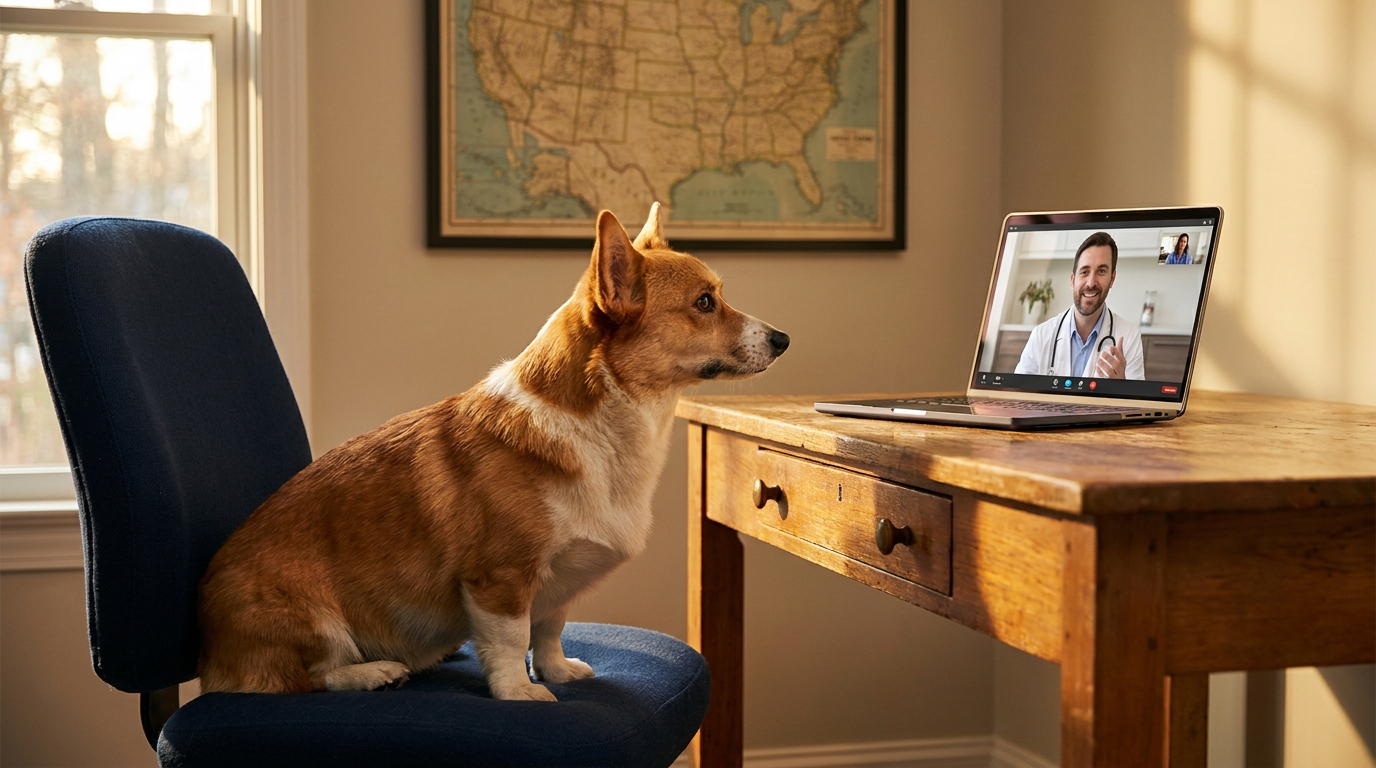
Seven states and D.C. let a vet start care and prescribe by video. See all 50 states, the federal rule on off-label drugs, and what applies to you.
Quick answer: As of October 2026, seven states (Arizona, California, Florida, New Jersey, Ohio, Rhode Island and Virginia) plus Washington, D.C. let a veterinarian start caring for a new patient over live video and prescribe from that visit, usually with limits. Twenty-nine states require an in-person exam first, and 14 have no clear rule. In every state, federal rules require an in-person exam before a vet uses any drug off-label, including human drugs such as gabapentin or trazodone. If a vet has already examined your pet in person, video follow-ups are generally allowed.
Laws checked October 2026. This is general information, not legal or veterinary advice. State rules change often, so confirm with your state's veterinary board before you rely on them.
Triage, Follow-Up and Starting Care by Video: Three Different Questions
"Can an online vet prescribe?" is really three different questions, and the law treats them differently:
- General advice and triage. A vet can talk you through whether a problem needs to be seen and how urgently. The AAHA and AVMA telehealth guidelines describe triage as deciding whether a referral is needed, without a diagnosis. Most states allow this with no prior relationship, but it does not include a prescription.
- Continuing care by video. If a vet has examined your pet in person, usually within the past year, that vet can generally follow up, recheck and adjust treatment by video in most states, within that state's limits.
- Starting care by video. This is the hard one: a vet who has never seen your pet establishes the relationship, diagnoses and prescribes over a live video call. Only the eight places listed above clearly allow it.
The Vet-Client-Patient Relationship (VCPR)
Almost every prescribing rule hangs on the veterinarian-client-patient relationship, or VCPR. In plain terms: the vet takes responsibility for your pet's care, knows the pet well enough to make at least a preliminary diagnosis, has examined it recently, and is available for follow-up. A vet needs a valid VCPR to prescribe. The state-by-state differences come down to one question: can the examination that starts a VCPR happen over video, or must it happen in person?
The Federal Rule for Off-Label and Human Drugs
Federal rules sit on top of every state law. Under the Animal Medicinal Drug Use Clarification Act and the FDA's rule (21 CFR 530.3), a vet may use a drug in a way its label doesn't cover only within a VCPR based on an examination of the animal or timely visits to the premises. That includes any human drug given to a pet. The FDA says that, for this federal definition, a VCPR cannot be established solely through telemedicine.
So in every state, including the most permissive ones, a first video visit cannot lawfully start a pet on a human medication such as gabapentin or trazodone, or on an animal drug used in a way its label doesn't cover. Once a vet has recently examined the pet in person, they can manage those drugs by telehealth where state law allows. For one common example, see whether gabapentin is a controlled substance.
State-by-State Breakdown of Online Vet Prescription Laws
Video can start care (8): Arizona, California, District of Columbia, Florida, New Jersey, Ohio, Rhode Island, Virginia.
In-person exam first (29): Alabama, Alaska, Arkansas, Colorado, Connecticut, Georgia, Hawaii, Illinois, Iowa, Kentucky, Louisiana, Maryland, Michigan, Minnesota, Mississippi, Montana, Nevada, New Hampshire, New Mexico, North Carolina, North Dakota, Oregon, South Carolina, Tennessee, Texas, Utah, Washington, West Virginia, Wisconsin.
No clear rule (14): Delaware, Idaho, Indiana, Kansas, Maine, Massachusetts, Missouri, Nebraska, New York, Oklahoma, Pennsylvania, South Dakota, Vermont, Wyoming. These states neither clearly allow nor clearly forbid starting care by video. Because these rules generally expect an examination, the cautious approach is to plan on an in-person exam unless your state board says video is enough.
| State | Video rule, key limits and law |
|---|---|
| Alabama | No, in person first. Exam within 12 months; triage only without an existing relationship. Ala. Code 34-29-61 |
| Alaska | No, in person first. Exam or premises visit, repeated every 12 months; narrow remote-area exception. 12 AAC 68.215 |
| Arizona | Yes, with limits. Live audio-video; time limits on prescriptions (changed in 2026); no controlled substances; Arizona license. A.R.S. 32-2240.03 |
| Arkansas | No, in person first. Telemedicine prescribing only within an in-person relationship; urgent video care must be followed by an in-person visit. Arkansas Board rules; Act 18 of 2025 |
| California | Yes, with limits. Live audio-video only; antimicrobials up to 14 days; prescriptions up to 6 months; no controlled substances; more changes Jan. 1, 2027. Bus. & Prof. Code 4826.6 |
| Colorado | No, in person first. Teleadvice and triage allowed. C.R.S. 12-315-104 |
| Connecticut | No, in person first. Only general advice without an existing relationship. Conn. Gen. Stat. 20-197 |
| Delaware | Unclear. Requires a "timely examination"; silent on video. 24 Del. C. 3303A |
| District of Columbia | Yes. Telehealth can establish the relationship; same standard of care. D.C. Code 3-1201.05; 17 DCMR 2814 |
| Florida | Yes, with limits. Live audio-video only; FDA-approved animal drugs as labeled, up to 14 days (1 month for flea/tick-only products); no renewals, human drugs, compounded anti-infectives or controlled substances without an in-person exam. Fla. Stat. 474.2021 |
| Georgia | No, in person first. Prescribing needs a recent physical exam or premises visit; teleadvice and triage allowed. O.C.G.A. 43-50-120 to -122 |
| Hawaii | No, in person first. Telemedicine only after an in-person relationship; Hawaii license. HRS 471-1, 471-2.5 |
| Idaho | Unclear. Requires an exam within 12 months; silent on video. IDAPA 24.38.01.200 |
| Illinois | No, in person first. Telemedicine only within an existing relationship. 225 ILCS 115/3, 115/4.5 |
| Indiana | Unclear. Requires "an examination" without saying in person; extra rules for controlled substances. IC 25-38.1-1-14.5 |
| Iowa | No, in person first. Hands-on exam or premises visit within 12 months. 811 IAC 12.1 |
| Kansas | Unclear. No telehealth law; the board has said statute and rules do not authorize telemedicine. K.S.A. 47-816 |
| Kentucky | No, in person first. Exam or visit every 12 months; Kentucky credential. KRS 321.185 |
| Louisiana | No, in person first. Physical exam or premises visit. La. Admin. Code 46:LXXXV.700 |
| Maine | Unclear. Telehealth allowed in scope, but no board rules adopted. 32 M.R.S. 4877 |
| Maryland | No, in person first. Exam within 12 months to renew long-term prescriptions. COMAR 15.14.01 |
| Massachusetts | Unclear. Requires a "timely examination"; no telehealth rule. 256 CMR 2.01 |
| Michigan | No, in person first. Telehealth requires a recent in-person exam, except emergencies. Mich. Admin. Code R 338.4901a |
| Minnesota | No, in person first. Telemedicine only within an existing relationship; triage allowed. Minn. Stat. 156.001, 156.16 |
| Mississippi | No, in person first. No relationship by electronic means; seen within 12 months. Miss. Code 73-39-59 |
| Missouri | Unclear. Requires "an examination"; no telehealth provision. RSMo 340.200 |
| Montana | No, in person first. Physical exam or premises visit. Admin. R. Mont. 24.225.301 |
| Nebraska | Unclear. Requires "an examination"; no telehealth provision. Neb. Rev. Stat. 38-3316 |
| Nevada | No, in person first. Relationship cannot be established by telemedicine alone. NRS 638.1521 |
| New Hampshire | No, in person first. In-person exam or site visit. N.H. Admin. R. Vet 604.01 |
| New Jersey | Yes, with limits. Real-time audio-video; no questionnaire-only prescribing; Schedule II drugs need in-person exams; New Jersey license. N.J.A.C. 13:44-4A |
| New Mexico | No, in person first. Electronic consults for existing clients only. 16.25.9.8 NMAC |
| New York | Unclear. No statute or regulation; telehealth bill A1782 still in committee. NYSED practice guidelines |
| North Carolina | No, in person first. Telemedicine only within an existing relationship. 21 NCAC 66.0211 |
| North Dakota | No, in person first. In-person exam or premises visit. N.D.C.C. 43-29-12.2 |
| Ohio | Yes, with limits. Real-time exam with informed consent; 14-day prescriptions, one 14-day refill after another telehealth visit; no controlled substances. Ohio Rev. Code ch. 4741 |
| Oklahoma | Unclear. Telehealth defined, but the relationship rule is silent. 59 O.S. 698.2 |
| Oregon | No, in person first. Physical exam within the last year. OAR 875-005-0005 |
| Pennsylvania | Unclear. Requires "an examination"; no telehealth provision. 63 P.S. 485.3 |
| Rhode Island | Yes, with limits. Live audio-video; 30-day prescriptions, one renewal after another exam; no controlled substances; Rhode Island license (2026 law). R.I. Gen. Laws 5-25 |
| South Carolina | No, in person first. In-person exam or premises visit. S.C. Code 40-69-520 |
| South Dakota | Unclear. No telehealth law. SDCL 39-18-34.1 |
| Tennessee | No, in person first. No relationship by phone or electronic means; seen within 12 months. Tenn. Code 63-12-103 |
| Texas | No, in person first. No relationship by phone or electronic means. Tex. Occ. Code 801.351 |
| Utah | No, in person first. Recent personal exam required. Utah Code 58-28-102 |
| Vermont | Unclear. Requires "an examination"; general telehealth law applies in-person standards. 26 V.S.A. 2433 |
| Virginia | Yes. Exam may be physical or by electronically transmitted images and records; no state day-supply cap, but federal rules require an in-person exam for any off-label or human-drug use; horses excluded. Va. Code 54.1-3303 |
| Washington | No, in person first. Physical exam within the last year; limited video relationships allowed from July 1, 2027. WAC 246-933-200 |
| West Virginia | No, in person first. Face-to-face exam within 12 months. W. Va. Code 30-10-24 |
| Wisconsin | No, in person first. Relationship may not be established by telehealth; triage and emergency exceptions. Wis. Admin. Code VE 1.50 |
| Wyoming | Unclear. Requires an "examination"; silent on video. Wyo. Admin. Code 251-0001-9 |
Several states changed their rules in 2025 and 2026, and more changes take effect in California and Washington in 2027. Treat this table as a starting point and check your state board's current rules.
Florida: Video Can Start Care, With Tight Limits
Florida's 2024 telehealth law (s. 474.2021) lets a Florida-licensed vet establish the relationship through a live, two-way audio-video evaluation. Phone calls, texts, questionnaires and chatbots don't count. After a video-only evaluation, the vet may prescribe only:
- FDA-approved animal drugs, used as their label directs;
- for up to 14 days, or up to one month for products labeled only for flea and tick control;
- with no renewal unless the pet has an in-person exam.
Without an in-person exam or timely premises visit, a Florida vet cannot prescribe human drugs (such as gabapentin or trazodone) or compounded antibacterial, antifungal, antiviral or antiparasitic drugs. Controlled substances need an in-person exam within the past year. Florida telehealth vets must also know local emergency resources and give you the details of at least one physical clinic near your pet. In practice, if the vet decides it's appropriate, a first video visit in Florida can lead to a short course (up to 14 days) of an FDA-approved animal drug used as labeled, while renewals, longer therapy and human drugs need an in-person exam. More on online vet care in Florida.
Virginia: The Exam Can Be Done Electronically
Virginia's law (Va. Code 54.1-3303) lets a vet show a valid relationship by examining the animal "either physically or by the use of instrumentation and diagnostic equipment" that transmits images and medical records electronically. A Virginia-licensed vet can therefore establish care through a video exam supported by photos, video and records, and must be available for follow-up. Virginia sets no telehealth day-supply cap. The limits come from elsewhere: the federal rule still requires an in-person exam or premises visit before any drug is used off-label, including every human drug and any animal drug used outside its label directions; controlled substances must meet state and DEA rules, and Virginia lists gabapentin as a Schedule V controlled substance. The definition does not cover horses. More on online vet care in Virginia.
New York: No Telehealth Law Yet
New York has no statute or regulation on veterinary telehealth. The state education department's practice guidelines describe a relationship based on a timely examination, and the department notes that guidelines do not carry the force of law. A bill to authorize veterinary telehealth (A1782) has sat in the Assembly Higher Education Committee since January 2025 and has not passed. A New York-licensed vet can generally offer video advice, triage, second opinions and follow-up for a pet they have examined. Whether a first video visit alone can support a new prescription is unsettled, and the cautious reading is to start with an in-person exam. More on online vet care in New York.
Controlled Substances and Licensing
- Controlled substances are effectively in-person only almost everywhere. Florida requires an in-person exam within the past year. Arizona, California, Ohio and Rhode Island bar them after a video-only visit. New Jersey requires in-person exams for Schedule II drugs. Several states, including Virginia, schedule gabapentin.
- The vet generally must be licensed where your pet is. A vet licensed only in Florida cannot treat a pet located in Georgia, even by video. Arizona, Rhode Island, New Jersey, Hawaii and Kentucky spell this out, and California will from 2027.
- You can usually choose the pharmacy. Prescriptions can generally be filled at an outside or online pharmacy, which must verify that the prescription is valid. See how Chewy Pharmacy prescriptions work.
Why the Veterinarian Always Makes the Call
Legal permission is a ceiling, not a promise. Every state holds telehealth to the same standard of care as an in-person visit. Even where video can start care, the vet decides whether video is enough for your pet's problem, and may ask for an in-person exam, a test such as a heartworm test or bloodwork, or a referral. A service that guarantees a prescription before a vet has assessed your pet is a red flag. For the most common medication questions, see what online vets can and can't prescribe and whether an online vet can prescribe antibiotics.
If Your State Requires an In-Person Exam
You still have options. See a local vet once to establish the relationship, then ask whether they offer telehealth rechecks and refills, which most states allow once an in-person exam is on file, though the vet decides whether a refill is appropriate. For anything urgent, such as trouble breathing, collapse, a seizure or a possible poisoning, go straight to an emergency hospital; don't wait for a video visit. For problems that aren't emergencies, a vet can give general advice by video and help you decide how soon your pet needs to be seen in person.
Preparing for a Video Vet Visit
- Take short videos of the problem (the limp, the cough, the scratching) and clear photos in good light.
- Have your pet's weight, current medications and doses, and any recent records or lab results ready.
- Know which pharmacy you want to use if the vet prescribes.
- Join from a quiet, well-lit room where your pet is comfortable, and keep treats handy so the vet can see your pet move.
Online Vet Care in Florida, New York and Virginia With RexVet
RexVet is a 501(c)(3) nonprofit veterinary telehealth service with licensed vets for pets in Florida, New York and Virginia. A RexVet vet can see your pet on live video, assess the problem, and tell you plainly what can be handled by video under your state's rules and what needs an in-person visit. Any prescription is at the vet's discretion. A video visit is not for emergencies: if your pet has trouble breathing, collapses, has a seizure or may have been poisoned, go straight to an emergency hospital. A live video visit is $64.99, and the Family Plan is a one-time $120 for four visits over 12 months, no subscription. Book a video visit, or read how prescriptions from a RexVet vet work.
Frequently Asked Questions
Can an online vet prescribe medication?
Sometimes. In Arizona, California, Florida, New Jersey, Ohio, Rhode Island, Virginia and Washington, D.C., a vet can start care over live video and prescribe from that visit, within limits. Elsewhere, an online vet can usually prescribe only after the pet has been examined in person. In every state the vet decides whether a prescription is appropriate.
Can an online vet prescribe gabapentin or trazodone?
Not from a first video visit. These are human drugs used off-label in pets, and federal rules require a relationship that includes an in-person exam or premises visit. After a recent in-person exam, a vet can manage them by telehealth where state law allows. Gabapentin is also a controlled substance in some states, including Virginia.
Can I get a prescription from an online vet in Florida?
Possibly. A Florida-licensed vet can establish care by live video and prescribe FDA-approved animal drugs as labeled for up to 14 days (one month for flea-and-tick-only products). Those prescriptions can't be renewed without an in-person exam, and human drugs, compounded anti-infectives and controlled substances need an in-person exam first.
Can an online vet prescribe in New York?
New York has no veterinary telehealth law, and a bill to create one is still in committee. A New York vet can generally give advice and follow-up care by video, but whether a first video visit can support a new prescription is unsettled. Many vets will ask to see the pet in person first.
Can an online vet prescribe antibiotics?
It depends on the state and the drug. In Florida, if the vet decides it's appropriate, an FDA-approved animal antibiotic used as labeled can be prescribed for up to 14 days after a video visit, with no renewal without an in-person exam; compounded anti-infectives also need an in-person exam. California limits antimicrobials from a video-only relationship to 14 days. In states that require an in-person exam first, the pet must be seen before any prescription.
Why can't a vet in another state treat my pet online?
Veterinary licenses are issued by each state, and the vet generally must be licensed in the state where your pet is located. A video call does not change that.
How often do these laws change?
Often. In 2025 and 2026 Ohio and Rhode Island opened video-started care, several states tightened or restated in-person rules, and California and Washington have more changes scheduled for 2027. Check your state veterinary board for the current rules.
FAQs
Can an online vet prescribe medication?
Sometimes. In Arizona, California, Florida, New Jersey, Ohio, Rhode Island, Virginia and Washington, D.C., a vet can start care over live video and prescribe from that visit, within limits. Elsewhere, an online vet can usually prescribe only after the pet has been examined in person. In every state the vet decides whether a prescription is appropriate.
Can an online vet prescribe gabapentin or trazodone?
Not from a first video visit. These are human drugs used off-label in pets, and federal rules require a relationship that includes an in-person exam or premises visit. After a recent in-person exam, a vet can manage them by telehealth where state law allows. Gabapentin is also a controlled substance in some states, including Virginia.
Can I get a prescription from an online vet in Florida?
Possibly. A Florida-licensed vet can establish care by live video and prescribe FDA-approved animal drugs as labeled for up to 14 days (one month for flea-and-tick-only products). Those prescriptions can't be renewed without an in-person exam, and human drugs, compounded anti-infectives and controlled substances need an in-person exam first.
Can an online vet prescribe in New York?
New York has no veterinary telehealth law, and a bill to create one is still in committee. A New York vet can generally give advice and follow-up care by video, but whether a first video visit can support a new prescription is unsettled. Many vets will ask to see the pet in person first.
Can an online vet prescribe antibiotics?
It depends on the state and the drug. In Florida, if the vet decides it's appropriate, an FDA-approved animal antibiotic used as labeled can be prescribed for up to 14 days after a video visit, with no renewal without an in-person exam; compounded anti-infectives also need an in-person exam. California limits antimicrobials from a video-only relationship to 14 days. In states that require an in-person exam first, the pet must be seen before any prescription.
Why can't a vet in another state treat my pet online?
Veterinary licenses are issued by each state, and the vet generally must be licensed in the state where your pet is located. A video call does not change that.
How often do these laws change?
Often. In 2025 and 2026 Ohio and Rhode Island opened video-started care, several states tightened or restated in-person rules, and California and Washington have more changes scheduled for 2027. Check your state veterinary board for the current rules.
Medically Reviewed
Reviewed by Dr. Tiffany Delacruz, DVM — licensed veterinarian and CEO of RexVet. Last reviewed October 9, 2026.
Content is for informational purposes and does not replace professional veterinary advice.
Chief Executive Officer · Licensed Veterinarian
Dr. Delacruz is a licensed Doctor of Veterinary Medicine specializing in preventive care and veterinary telehealth. She reviews all health content on RexVet to ensure accuracy and clinical relevance.
Sources & References
- · American Veterinary Medical Association — Telehealth Guidelines
- · AVMA — Pet Care Resources
- · U.S. FDA — Animal & Veterinary
Need an Expert Opinion on This Topic?
Connect with a certified vet via video call in minutes
Talk to Vet Now