
How Long Between Kittens? Normal Rest or a Stuck Kitten
By RexVet Team | Reviewed by Dr. Tiffany Delacruz, DVM
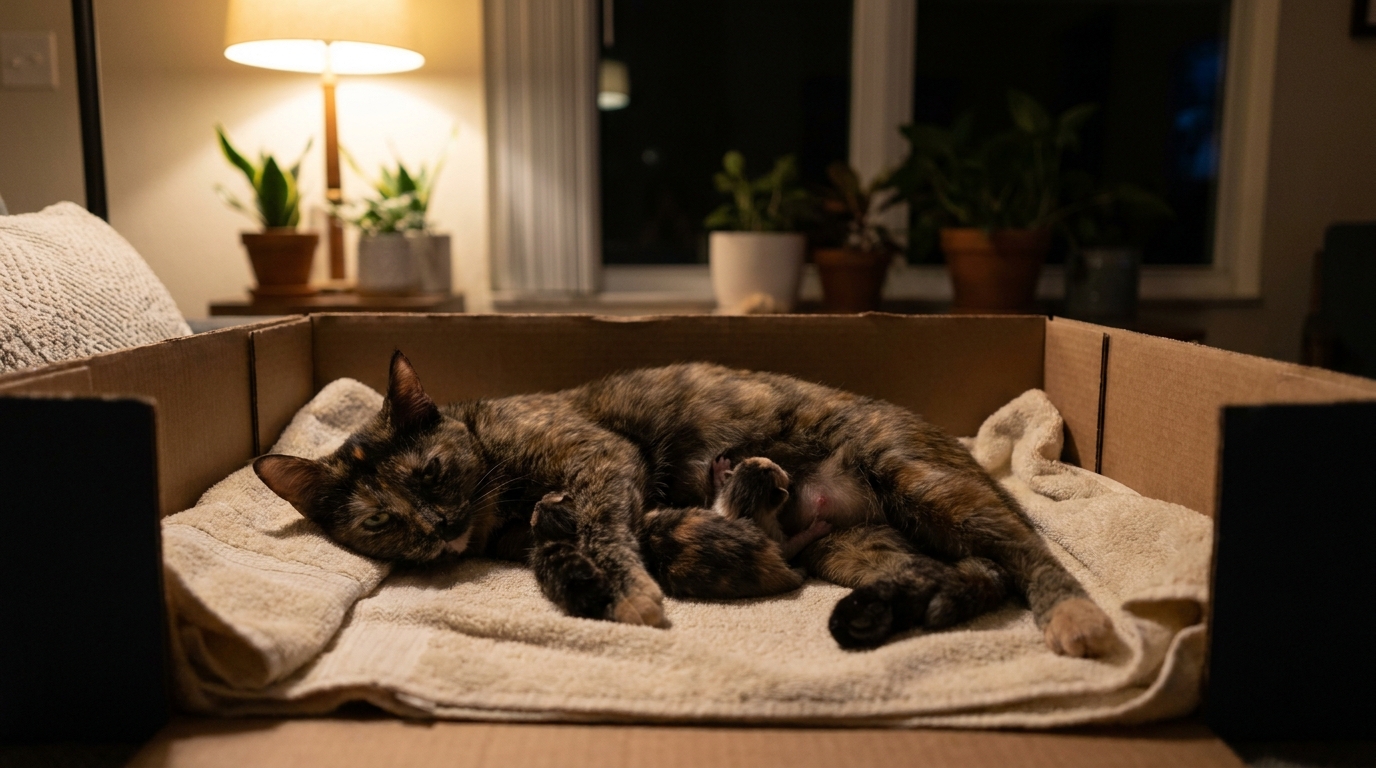
How long between kittens? Often 10 minutes to an hour. Hard straining for 20–30 minutes with no kitten means get help now.
Go to an emergency vet now if your cat strains hard for 20–30 minutes with no kitten, a kitten is stuck partway out, she passes fresh blood or dark green discharge before a kitten arrives, or she is crying in pain, very weak, or collapses.
How Long Between Kittens Is Normal?
International Cat Care says the time between kittens varies: "It can be as little as 10 minutes or up to an hour." Once she is visibly straining, "the kitten will normally be born within 30 minutes."
The Merck Veterinary Manual says "The kittens are usually delivered at intervals of less than 1 to 2 hours, but that can vary considerably," and "Cats typically alternate between stages II and III until delivery is complete." Stage II is the pushing stage that delivers a kitten; stage III is the passing of its placenta.
Merck also sets an outer limit: it treats "more than 1 to 4 hours between delivery of kittens during stage II" as prolonged labor. For contractions without pushing, act on the earlier end.
Emergency Signs: Go Now, Not a Video Call
Each of these signs on its own means leave now:
- She has strained for 20–30 minutes with no kitten, or she is crying out in pain. International Cat Care lists both as reasons to get help. Weak straining counts too.
- A kitten is stuck partway out. Merck notes that unless the kitten's head is out so it can breathe, it must be delivered within 10 to 20 minutes. A stuck kitten always means go now, even if its head is out. Do not pull on it.
- Fresh blood, dark green or discolored discharge before a kitten, or a very bloody discharge during labor. Merck lists "fresh blood or dark green discharge before any kittens are born," and International Cat Care lists "discoloured discharge" before a kitten and "very bloody discharge during labour."
- She is very weak or collapses, or shows obvious pain, such as crying or licking or biting at her vulva, which Merck lists as signs of pain.
Merck's owner guide mentions "strong contractions for more than 1 to 2 hours with no birth," but where the sources differ, follow the stricter one: 20–30 minutes of any straining with no kitten is the point to leave. Put her in a towel-lined carrier and go.
Later, read about how to choose between an online vet and an emergency vet.
A Resting Cat or a Stalled Labor? How to Tell the Difference
Case A: A calm rest with no contractions
International Cat Care describes a normal pause: "After one or more kittens have been born, you may notice your cat stops straining and rests happily, suckling her kittens." It adds that "This resting stage can last up to 24 or even 36 hours, after which she'll start straining again, and the remainder of the litter is born."
In a normal interrupted labor, International Cat Care says, "it will be obvious that your cat is not in distress, has a normal appetite and is perfectly happy with the kittens already born." A cat who seems exhausted, has given up straining, or goes off her food or stops nursing is not resting: go to an emergency vet now.
But Merck's owner guide flags "a resting period during labor that lasts more than 4 to 6 hours." Act on the earlier call: if kittens are still expected, get her a hands-on vet exam by the 4-hour mark of the rest, even if she seems content.
Case B: Still contracting, but no kitten
If her belly keeps tightening but she is not pushing and nothing comes, this is not a calm rest, and she must not be left to wait out a 24- or 36-hour pause.
Merck says a difficult birth "can be diagnosed if the uterine contractions are too infrequent or too weak to deliver the fetuses," and treats more than 1 to 4 hours between kittens in the pushing stage as prolonged labor. International Cat Care notes that "Primary inertia is the most common cause of dystocia in cats," meaning the uterus contracts too weakly, or not at all, to push a kitten out.
Go by the shorter limit: if her belly is still tightening an hour after the last kitten, with nothing coming, she needs a hands-on exam now, not a video call. Pushing of any strength for 20–30 minutes with no kitten, or doubt about whether she is pushing, is case C: go now.
Case C: Go now
If she strains again, even weakly, for 20–30 minutes with nothing coming, passes green, dark or bloody discharge before a kitten, has a kitten stuck partway out, cries in pain, or turns weak or collapses, take her straight to an emergency vet. The calmer steps in cases A and B apply only when none of these signs is present.
If you have a pregnant dog too, see our guide to how long between puppies is normal.
Is She Really in Labor? The First Stage Can Be Slow
Merck says "Pregnancy lasts 60 to 65 days" and "Stage I lasts 12 to 24 hours." Merck describes the stage-one signs as hiding, restlessness and nest building, sometimes with vomiting, trembling or refusing to eat, and a clear, watery vaginal discharge.
International Cat Care notes that in a first litter this stage "may last up to 36 hours, which can be normal." But Merck treats "more than 24 hours for stage I" as prolonged labor. Follow Merck's shorter limit: after 24 hours of stage-one signs with no straining and no kitten, get her checked by a vet, first litter or not. If labor signs start before her due date, go to an emergency vet now.
What to Do Right Now While You Wait
International Cat Care says "a normal birth needs no intervention from you."
- Keep a written log of when straining started and when each kitten and placenta arrived. It shows whether you have crossed the 20–30 minute, 1-hour or 4-hour lines above.
- Keep her somewhere familiar and quiet. Merck says "Cats should be allowed to deliver their kittens in a familiar area where they will not be disturbed."
- Count placentas. International Cat Care advises checking there is one per kitten, "as any left behind could pose an infection risk." Merck adds that placentas "can be rapidly consumed, be passed unnoticed, or pass normally within 24 hours," so if the count does not match or you are unsure, have a vet check her.
- Keep the newborns warm. International Cat Care notes: "Warmth is essential for newborn kittens as they can't react to cold by shivering, or control their own body temperature."
- Never pull on a kitten, reach inside her, or give her any medicine or supplement to speed up labor.
- Have a carrier, clean towels and the route to the nearest 24-hour emergency vet ready.
- Only while no emergency sign is present, film a short phone clip of her resting so a vet can see what you see; never delay leaving to film.
Why a Long Pause Worries Vets: Dystocia in Cats
The ASPCA describes "dystocia, or the inability to expel a fetus through the birth canal during labor." According to the ASPCA, "Symptoms of dystocia include early labor, abnormal vaginal discharge, vomiting, stalled labor, straining without delivery, a fetus trapped in the birth canal, fever, vocalizing and extreme lethargy or weakness without delivering."
On that list, early labor before her due date, abnormal discharge, crying or vocalizing, straining without delivery, a trapped kitten, fever, and extreme lethargy or weakness each mean an emergency vet now. Stalled labor follows the three cases above. On its own, vomiting can be a normal stage-one sign, as Merck notes above.
What a RexVet Online Vet Can and Cannot Do During the Birth
If any emergency sign above appears, go to an emergency vet now; do not wait for a video call.
By video, a veterinarian can:
- watch her live with you and help judge whether a pause looks like a calm rest (case A) or belly tightening without pushing (case B)
- help you count kittens and placentas (green, dark or bloody discharge before a kitten, or any doubt about it, means an emergency vet now, not a video call)
- check that the newborns look warm and are nursing
- remind you of the go-now signs so you leave the moment one appears
A video vet cannot feel her belly, do an internal exam, take x-rays or an ultrasound, deliver a stuck kitten or do a C-section. So case B always ends at a clinic.
If the veterinarian decides medication is appropriate, they can prescribe where state rules allow.
If she is resting calmly with no emergency sign and you want a veterinarian to watch with you, you can book a RexVet video visit. A visit is $64.99, and vets licensed in Florida, New York and Virginia are available 24/7.
After the Last Kitten: What Is Normal for Mom and the Newborns
Merck says "Physical examination, and in some cases x-rays, are used to ensure that all kittens have been delivered."
Merck notes that "Normally, lochia is dark red to black, odorless, and heavy for the first few days after parturition." Lochia is the normal discharge after birth. But "Excessive bleeding from the vagina after delivery is rare and requires veterinary intervention when seen," so bright red, steady or excessive bleeding calls for an emergency vet right away.
Watch for metritis, an inflammation of the uterus. Merck's guide to reproductive disorders in female cats says "The primary sign of metritis is pus-like discharge from the vulva" and that affected cats "are usually depressed, have a fever, and may neglect their offspring." If she seems depressed or feverish, neglects her kittens, or is trembling, stiff or wobbly while nursing, go to an emergency vet now. Pus-like discharge in a bright mother who is eating and nursing needs a hands-on exam promptly.
The mother cat normally licks her kittens to help them pee and poop. If she is not doing it, learn how to help a newborn kitten who is not pooping.
When to Be Seen in Person in Florida, New York or Virginia
Any emergency sign above, or bright red, steady or excessive bleeding, means an emergency vet now; so does a mother who seems dull or feverish or ignores her kittens. These need a hands-on exam, and the first one needs it without delay:
- her belly is still tightening, without pushing, an hour after the last kitten (case B)
- she is still round-bellied after a long rest, or an earlier x-ray count says more kittens are due
- the placenta count does not match the kitten count
- after the last kitten, foul-smelling or pus-like discharge in a bright mother who is eating and nursing
If she is resting calmly, eating and nursing, with no contractions and no emergency sign, and you want a veterinarian to watch with you before the 4-hour mark, you can book a RexVet video visit tonight. A visit is $64.99 and vets are available 24/7. RexVet's veterinarians are licensed in Florida, New York and Virginia.
Frequently Asked Questions
Can a cat stop labor and start again the next day?
Sometimes. International Cat Care says a calm, eating, nursing cat with no contractions can rest for up to 24 or even 36 hours, but Merck flags a rest of more than 4 to 6 hours, so if kittens are still expected, get her a hands-on exam by the 4-hour mark. If her belly is still tightening, without pushing, an hour after the last kitten, she needs a hands-on vet exam now. If she strains, even weakly, for 20–30 minutes with no kitten, passes green, dark or bloody discharge, cries in pain, has a kitten stuck, or turns weak or collapses, go to an emergency vet now.
How long can a cat push before a kitten comes out?
International Cat Care says that once she is visibly straining, a kitten will normally be born within 30 minutes. If she strains, even weakly, for 20–30 minutes with no kitten, cries in pain, passes green, dark or bloody discharge before a kitten, or turns weak or collapses, go to an emergency vet now. A kitten stuck partway out is just as urgent: Merck says that unless its head is out so it can breathe, it must be delivered within 10 to 20 minutes. Go now even if its head is out.
How do I know if there are more kittens inside my cat?
Only a hands-on vet exam, x-ray or ultrasound can tell for sure; a late-pregnancy x-ray count and a placenta count help, but a mother cat may eat a placenta or pass one unnoticed. If the counts do not match or more kittens may be inside, she needs a hands-on exam: by the 4-hour mark if she is resting calmly, or now if her belly is still tightening, without pushing, an hour after the last kitten. If she strains, even weakly, for 20–30 minutes with no kitten, passes green, dark or bloody discharge, cries in pain, has a kitten stuck, or turns weak or collapses, go to an emergency vet now.
Should I pull a kitten that is stuck?
No. Never pull on a kitten or reach inside your cat. A kitten stuck partway out is an emergency: put her in a towel-lined carrier and take her to an emergency vet right away. Also go to an emergency vet now if she strains, even weakly, for 20–30 minutes with no kitten, passes green, dark or bloody discharge before a kitten, cries in pain, or turns weak or collapses.
What discharge is normal after my cat gives birth?
Once all the kittens are out, normal discharge is dark red to black, odorless and can be heavy for the first few days, Merck notes. If more kittens may still be inside, go to an emergency vet now for green, dark, discolored or bloody discharge before the next kitten, any straining for 20–30 minutes, a kitten stuck partway out, or crying in pain. Bright red, steady or excessive bleeding is an emergency, and so is a mother cat who turns weak, collapses, seems dull or feverish, ignores her kittens, or trembles or goes stiff while nursing: go to an emergency vet now. After the last kitten, pus-like or foul-smelling discharge in a bright mother who is eating and nursing needs a hands-on vet exam promptly.
FAQs
Can a cat stop labor and start again the next day?
Sometimes. International Cat Care says a calm, eating, nursing cat with no contractions can rest for up to 24 or even 36 hours, but Merck flags a rest of more than 4 to 6 hours, so if kittens are still expected, get her a hands-on exam by the 4-hour mark. If her belly is still tightening, without pushing, an hour after the last kitten, she needs a hands-on vet exam now. If she strains, even weakly, for 20–30 minutes with no kitten, passes green, dark or bloody discharge, cries in pain, has a kitten stuck, or turns weak or collapses, go to an emergency vet now.
How long can a cat push before a kitten comes out?
International Cat Care says that once she is visibly straining, a kitten will normally be born within 30 minutes. If she strains, even weakly, for 20–30 minutes with no kitten, cries in pain, passes green, dark or bloody discharge before a kitten, or turns weak or collapses, go to an emergency vet now. A kitten stuck partway out is just as urgent: Merck says that unless its head is out so it can breathe, it must be delivered within 10 to 20 minutes. Go now even if its head is out.
How do I know if there are more kittens inside my cat?
Only a hands-on vet exam, x-ray or ultrasound can tell for sure; a late-pregnancy x-ray count and a placenta count help, but a mother cat may eat a placenta or pass one unnoticed. If the counts do not match or more kittens may be inside, she needs a hands-on exam: by the 4-hour mark if she is resting calmly, or now if her belly is still tightening, without pushing, an hour after the last kitten. If she strains, even weakly, for 20–30 minutes with no kitten, passes green, dark or bloody discharge, cries in pain, has a kitten stuck, or turns weak or collapses, go to an emergency vet now.
Should I pull a kitten that is stuck?
No. Never pull on a kitten or reach inside your cat. A kitten stuck partway out is an emergency: put her in a towel-lined carrier and take her to an emergency vet right away. Also go to an emergency vet now if she strains, even weakly, for 20–30 minutes with no kitten, passes green, dark or bloody discharge before a kitten, cries in pain, or turns weak or collapses.
What discharge is normal after my cat gives birth?
Once all the kittens are out, normal discharge is dark red to black, odorless and can be heavy for the first few days, Merck notes. If more kittens may still be inside, go to an emergency vet now for green, dark, discolored or bloody discharge before the next kitten, any straining for 20–30 minutes, a kitten stuck partway out, or crying in pain. Bright red, steady or excessive bleeding is an emergency, and so is a mother cat who turns weak, collapses, seems dull or feverish, ignores her kittens, or trembles or goes stiff while nursing: go to an emergency vet now. After the last kitten, pus-like or foul-smelling discharge in a bright mother who is eating and nursing needs a hands-on vet exam promptly.
Medically Reviewed
Reviewed by Dr. Tiffany Delacruz, DVM — licensed veterinarian and CEO of RexVet. Last reviewed October 1, 2026.
Content is for informational purposes and does not replace professional veterinary advice.
Chief Executive Officer · Licensed Veterinarian
Dr. Delacruz is a licensed Doctor of Veterinary Medicine specializing in preventive care and veterinary telehealth. She reviews all health content on RexVet to ensure accuracy and clinical relevance.
Sources & References
- · American Veterinary Medical Association — Telehealth Guidelines
- · AVMA — Pet Care Resources
- · U.S. FDA — Animal & Veterinary
Need an Expert Opinion on This Topic?
Connect with a certified vet via video call in minutes
Talk to Vet Now