
Dog Yelping When Picked Up? Back Pain Signs to Check Now
By RexVet Team | Reviewed by Dr. Tiffany Delacruz, DVM
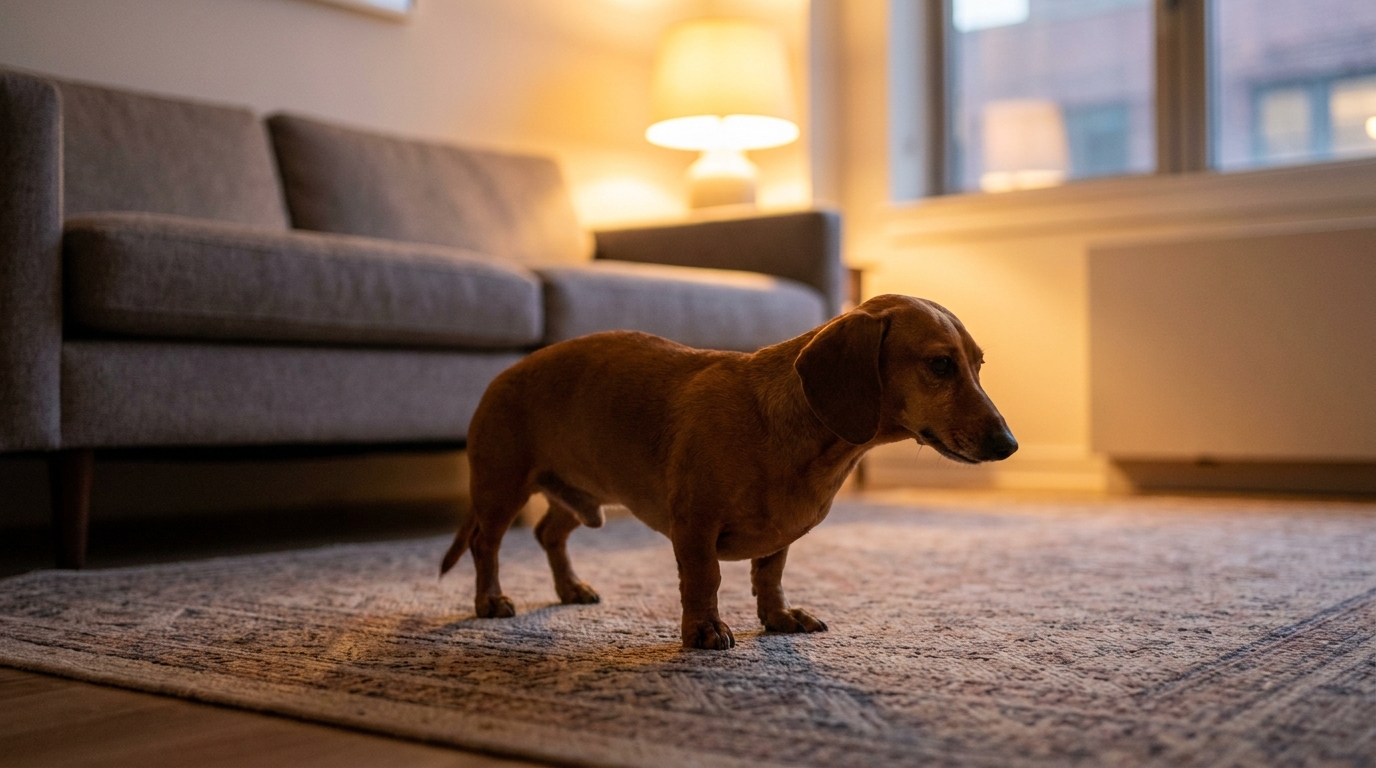
Dog yelping when picked up? It often means neck or back pain. Stop the jumping and stairs tonight; weak or wobbly legs mean an ER now.
Go to an emergency vet now if your dog is wobbly, knuckling or dragging a leg, can't stand or walk, can't pee, has a swollen belly and retches without bringing anything up, collapses, or started yelping after a fall, car accident or other hard knock.
Dog yelping when picked up: what the yelp is telling you
A dog that used to be lifted without any fuss and now yelps is telling you that something hurts. You slide your hands under your dog the way you always have, and this time there is a sharp cry. It often points to the neck or back.
Disc problems are one important cause. VCA Animal Hospitals explains that a bulging disc presses on the spinal cord or the nerve roots next to it, and that "This pressure can cause symptoms ranging from severe pain to weakness to paralysis."
Where the disc sits changes what you see. The Merck Veterinary Manual puts it this way:
- "A herniated disc in the neck leads to neck pain, stiffness, and muscle spasms."
- "A herniated disc in the middle of the back leads to back pain, and possibly curvature in the spine and a reluctance to move."
Disc problems are more common in some small breeds, according to Merck, "particularly the Dachshund, Beagle, Shih Tzu, Lhasa Apso, and Pekingese."
The spine is not the only possibility. Other kinds of pain can cause a yelp too, and your dog cannot point to the sore spot, which is why a veterinarian's exam matters. If your dog is also trembling, our guide to why dogs shake can help you make sense of it.
Emergency signs: go to an ER now, not a video call
These signs mean an in-person emergency vet now. Each one on its own is enough:
- Your dog is wobbly, knuckling (walking on the tops of the paws) or dragging a leg.
- Your dog can't stand or can't walk.
- Your dog can't pee, or is leaking urine.
- Your dog has a swollen belly and is retching with nothing coming up. VCA's list of bloat signs includes "Retch without producing anything."
- Your dog collapses. VCA's bloat list also includes "Collapse or be unable to stand."
- The yelping started after a fall, a car accident or any other hard knock.
Speed matters with a spine. In VCA's words, "Some dogs go from walking to total paralysis in less than one hour." That is why a dog with any of the signs above should not wait for morning or for a callback.
If you see any of these, or you are not sure, go to an emergency vet now. To get your dog to the car, support the chest and hindquarters together so the back stays level, and do not let your dog jump in or out of the car. For a wider list of signs that need a clinic tonight, see our pet emergency checklist.
Neck or back? Clues you can spot without handling your dog
You do not need to poke or press to learn a lot. Watch your dog from a few feet away for a few minutes.
Cornell's Riney Canine Health Center describes a telling pattern: "A dog with a spinal disc problem may avoid turning their head in one direction. They may walk over to their food or water bowls, but then just look at them."
VCA lists these neck signs:
- "Stiff neck with reluctance to move the head and neck"
- "Lowered head stance, with muscle spasms of the head, neck, and shoulders"
Also watch for a hunched back, refusing to jump or climb, trembling, or crying when the belly is touched. A dog with a stiff neck or a hunched back needs a vet exam soon, not a wait-and-see at home. Neck pain in particular can be severe.
There is one more pattern to know about. The VCA guide to disc disease notes: "Back injuries often cause paralysis without severe pain, while neck injuries usually cause severe pain without paralysis." So a dog with a back problem that stops crying is not necessarily getting better. Weakness or wobbling without any yelping is still an emergency sign.
Be careful with your own hands and face. As Cornell puts it, "Even a sweet dog may snap or growl." Move slowly, speak softly, and don't force an exam. Leave the hands-on checking to a veterinarian.
What to do in the next hour
This section is for a dog with none of the emergency signs above. For the next hour, your job is to stop your dog moving around.
Stop the lifting, the jumping and the stairs. Cornell's advice on lowering the odds of a spinal injury fits here too: "Minimize time spent going up and down stairs, and jumping on and off a deck, bed or sofa." Block off the couch and the bed, and carry or gate your dog past any stairs.
Keep your dog in a small, quiet space with good footing until a vet has looked. A crate, a pen, or a small room with a rug or yoga mat on a slick floor works well. Merck explains why rest matters: "If the dog increases its activity, the disc(s) may extrude further and worsen the spinal cord compression."
If you must carry your dog, support the chest and hindquarters together so the back stays level. Avoid scooping your dog up under the belly or by the front legs.
Swap the collar for a harness for trips outside. In its guidance on caring for dogs with a neck disc problem, VCA says: "All affected dogs should be fitted with a harness instead of a neck collar." Keep potty breaks short and slow, on a leash, on flat ground.
Watch whether your dog pees normally and walks steadily. If your dog can't pee, leaks urine, or starts wobbling or knuckling, go to an emergency vet now.
Do not give any human pain reliever. Do not give any pain medicine at home unless a veterinarian who has examined your dog tells you to. Tell the vet about any medicines your dog already takes.
A short video can help whichever vet sees your dog next. Film your dog walking on a non-slip floor, turning its head if it does so on its own, and eating from a bowl on the floor. Do not coax your dog into anything that makes it cry. Our guide on how to upload pet photos and videos for an online vet review walks you through sharing the clip.
How a vet confirms a disc problem in person
There is no home test that tells you whether a disc is involved. Cornell is clear about where it starts: "The first step for diagnosis is a thorough physical exam by your veterinarian."
After the exam, imaging may be needed to see the spine itself. According to Merck, "Diagnosis of herniated discs requires x-rays, myelography, computed tomography (CT), or magnetic resonance imaging (MRI)." Which of these your dog needs is a decision for the veterinarian who examines it.
Some dogs need surgery, and timing matters. Merck states: "In dogs with severe neurologic signs, surgery must be performed promptly to relieve the pressure on the spinal cord." Cornell's advice to owners is short: "If surgery is recommended as a treatment, don't wait."
Whether or not surgery is part of the plan, rest is. VCA says: "Strict rest is required in the first 3–6 weeks following a disc protrusion or rupture, with or without surgery." Your veterinarian will tell you what rest looks like for your dog and when it can end.
What a RexVet online vet can and cannot do for a dog yelping when picked up
If any sign on the emergency list is present, skip the video call and go to an emergency vet.
For a dog with none of those signs, a video visit lets a veterinarian see how your dog moves without you having to load a sore dog into the car. A RexVet veterinarian can:
- watch your dog walk, turn and sit on camera;
- look for wobbling, knuckling or a hunched back;
- go over what happened just before the yelp;
- help you sort ER tonight vs an in-person exam soon vs strict rest and watching at home.
A video vet cannot:
- do a hands-on neurologic exam;
- take x-rays or an MRI;
- operate.
That means a video visit cannot diagnose or grade a disc problem; the exam and imaging described above happen in a clinic. If the veterinarian decides medication is appropriate, they can prescribe where state rules allow. In Florida, a veterinarian who has seen your pet only by video may prescribe only FDA-approved animal drugs used as labeled, for up to 14 days (1 month for flea-and-tick-only products), and cannot renew without an in-person exam.
RexVet is a 501(c)(3) non-profit, and RexVet's veterinarians are licensed in Florida, New York and Virginia and are available 24/7. A video visit is $64.99, and you can book a RexVet video visit now.
Lifting and living with a sore back
The way you pick your dog up matters, now and after recovery. Slide one hand under the chest and one under the hindquarters, lift slowly, and keep the back level the whole way. Set your dog down the same way, back feet and front feet together.
Cut out the jumps. Ramps or pet steps up to the couch, the bed and the car let your dog get where it wants to go without leaping. Rugs or runners on slick floors help too.
Leashes matter for neck problems. VCA advises: "Dogs with cervical disc disease should always be walked using a harness rather than with a leash attached to a collar."
Weight matters as well. Cornell's prevention advice is simple: "Keep your dog trim and fit."
Once your veterinarian says your dog is past the strict-rest stage, Cornell's advice for everyday life is easy to remember: "Walking is safe for any dog. Leaping for a thrown toy, not so much." Until then, stick with the rest plan your vet gave you.
When to be seen in person in Florida, New York or Virginia
Any weakness, wobbling, knuckling or trouble peeing means an emergency vet tonight, not a video call. The same goes for any sign on the emergency list above.
Some dogs need a hands-on exam soon, even without emergency signs. Book one if:
- the pain keeps coming back;
- your dog still won't jump or won't turn its head;
- the pain is not easing with strict rest.
Don't wait for the pain to become a pattern. Cornell's guidance: "At the first sign of back discomfort, contact your veterinarian."
If you are in Florida and your pet's first evaluation with a veterinarian happens by video, Florida's telehealth law (Fla. Stat. 474.2021) requires the vet to give you "the contact information for at least one physical veterinary clinic in the vicinity of the patient's location."
If none of the emergency signs above apply and you want a veterinarian to watch your dog move tonight, you can book a video visit now. RexVet's veterinarians are licensed in Florida, New York and Virginia and available 24/7, including nights, weekends and holidays, and a video visit is $64.99.
Frequently Asked Questions
Why does my dog yelp when I pick him up but act normal otherwise?
Neck or back pain is a common reason. Cornell notes: "A dog with a spinal disc problem may avoid turning their head in one direction. They may walk over to their food or water bowls, but then just look at them." Book a vet check soon, and go to an ER if any weakness or trouble peeing appears.
Is a dog yelping when picked up an emergency?
Yes, if your dog is wobbly, knuckling or dragging a leg, can't stand or walk, can't pee, has a swollen belly and is retching without producing anything, collapses, or started yelping after a fall, car accident or other hard knock, go to an emergency vet now. If you are not sure, go anyway. If none of these apply, keep your dog on strict rest and have a vet check soon.
Can a slipped disc get worse overnight?
Yes. VCA warns that "Some dogs go from walking to total paralysis in less than one hour," and Merck warns that "If the dog increases its activity, the disc(s) may extrude further and worsen the spinal cord compression." Less crying does not always mean your dog is better. If your dog becomes wobbly, weak or can't pee overnight, go to an emergency vet right away.
Should I keep my dog confined if I think it's his back?
Yes. Keep him in a small, quiet space with good footing, with no jumping and no stairs, until a vet has looked. Use a harness instead of a collar for short potty trips. The next-hour steps above cover the rest.
Can I give my dog something for the pain tonight?
Do not give your dog any human pain reliever or any other home medicine. Tell the vet about any medicines your dog already takes. Treatment for back or neck pain is a decision for the veterinarian who sees your dog; tonight, rest and a safe, quiet space are what you can offer.
FAQs
Why does my dog yelp when I pick him up but act normal otherwise?
Neck or back pain is a common reason. Cornell notes: "A dog with a spinal disc problem may avoid turning their head in one direction. They may walk over to their food or water bowls, but then just look at them." Book a vet check soon, and go to an ER if any weakness or trouble peeing appears.
Is a dog yelping when picked up an emergency?
Yes, if your dog is wobbly, knuckling or dragging a leg, can't stand or walk, can't pee, has a swollen belly and is retching without producing anything, collapses, or started yelping after a fall, car accident or other hard knock, go to an emergency vet now. If you are not sure, go anyway. If none of these apply, keep your dog on strict rest and have a vet check soon.
Can a slipped disc get worse overnight?
Yes. VCA warns that "Some dogs go from walking to total paralysis in less than one hour," and Merck warns that "If the dog increases its activity, the disc(s) may extrude further and worsen the spinal cord compression." Less crying does not always mean your dog is better. If your dog becomes wobbly, weak or can't pee overnight, go to an emergency vet right away.
Should I keep my dog confined if I think it's his back?
Yes. Keep him in a small, quiet space with good footing, with no jumping and no stairs, until a vet has looked. Use a harness instead of a collar for short potty trips. The next-hour steps above cover the rest.
Can I give my dog something for the pain tonight?
Do not give your dog any human pain reliever or any other home medicine. Tell the vet about any medicines your dog already takes. Treatment for back or neck pain is a decision for the veterinarian who sees your dog; tonight, rest and a safe, quiet space are what you can offer.
Medically Reviewed
Reviewed by Dr. Tiffany Delacruz, DVM — licensed veterinarian and CEO of RexVet. Last reviewed September 29, 2026.
Content is for informational purposes and does not replace professional veterinary advice.
Chief Executive Officer · Licensed Veterinarian
Dr. Delacruz is a licensed Doctor of Veterinary Medicine specializing in preventive care and veterinary telehealth. She reviews all health content on RexVet to ensure accuracy and clinical relevance.
Sources & References
- · American Veterinary Medical Association — Telehealth Guidelines
- · AVMA — Pet Care Resources
- · U.S. FDA — Animal & Veterinary
Need an Expert Opinion on This Topic?
Connect with a certified vet via video call in minutes
Talk to Vet Now