
Dog Sprayed by Skunk in the Face: What to Do Tonight
By RexVet Team | Reviewed by Dr. Tiffany Delacruz, DVM
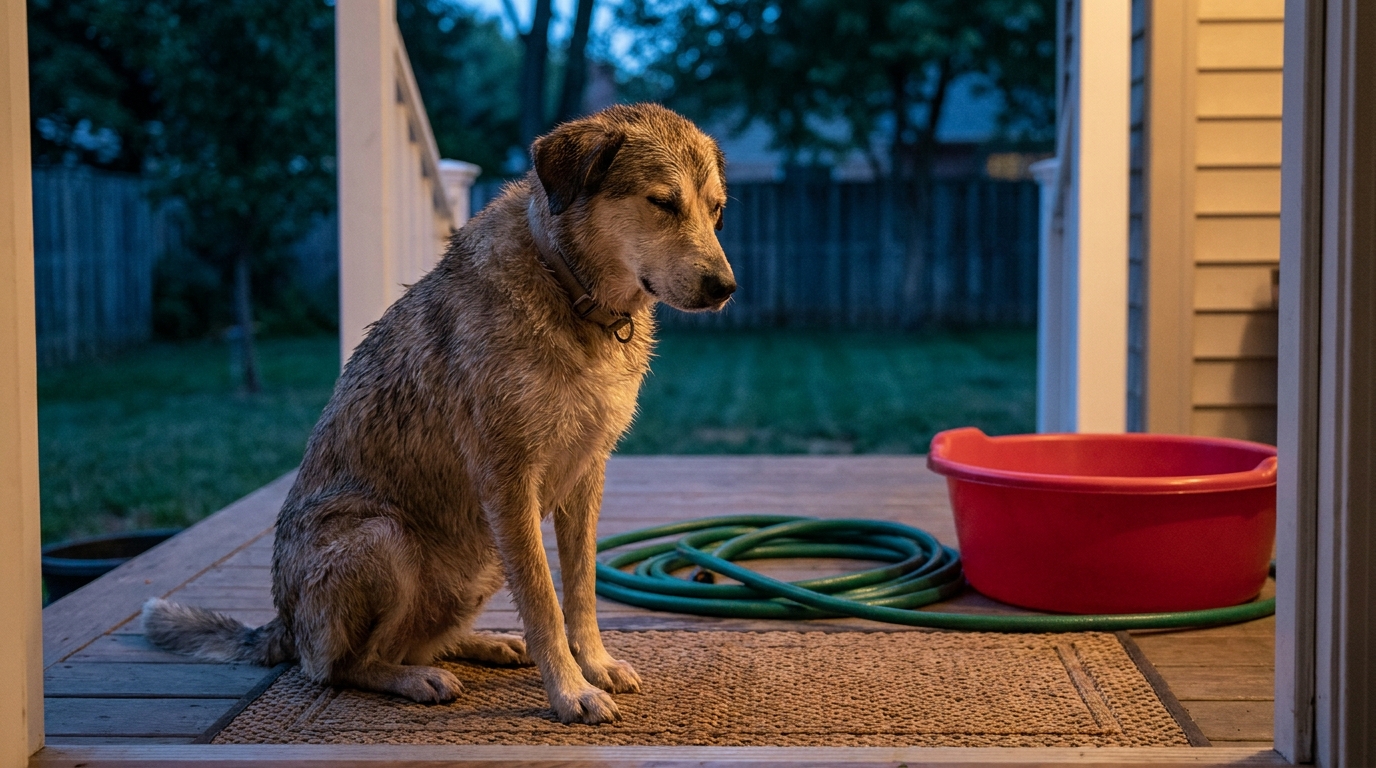
Dog sprayed by skunk in the face? Rinse the eyes with cool water first, then de-skunk the coat, and watch for weakness or brown gums for days.
Get veterinary care right away if the spray hit your dog's eyes or mouth and an eye stays shut, cloudy or red after rinsing, or if your dog was bitten or scratched by the skunk, is weak or collapses, or has pale, gray or chocolate-brown gums.
Your dog just came in from the yard reeking, rubbing its face on the rug, with red or squinting eyes. The smell is the loud part, but a hit to the face can also affect the eyes, the mouth and breathing. This guide walks you through what to check first, how to clean up without making things worse, and which signs mean you should go in tonight.
Dog Sprayed by Skunk in the Face: Why It's More Than a Bad Smell
Skunk spray is made of sulfur-containing compounds called thiols, and a hit to the face puts them right where your dog is most sensitive. The Cornell Riney Canine Health Center puts it plainly: "Getting sprayed in the face can often cause eye irritation or damage."
In the eyes, the spray "can cause swelling and redness to the eye, damage the cornea (outer surface of the eye) and even cause temporary blindness." That is why the eyes come before the smell.
The eyes are not the only target. A dog hit in the face can breathe the spray in and end up with respiratory irritation, and spray in the mouth "can cause nausea, drooling and vomiting." So if your dog is drooling, retching or throwing up after a skunk encounter, the spray is the likely reason, and it deserves your attention.
Emergency Signs: When to Get Veterinary Care Right Away
Cornell's guidance is direct: "Seek immediate veterinary care if your dog gets sprayed directly in the eyes or mouth." In practice, that means two levels of urgency.
Go to your regular vet now, or to an emergency vet if your clinic is closed, if you see any of these:
- An eye stays shut, cloudy or red after you rinse it.
- Your dog was bitten or scratched by the skunk, or you find a wound under the fur.
- Your dog is weak, wobbly or collapses.
- Your dog is struggling to breathe.
- The gums look pale, gray or chocolate-brown.
If the spray hit the eyes or mouth directly but none of the signs above apply, your dog still needs a veterinarian now, not tomorrow. Rinse the eyes first. At night, when your regular clinic is closed, a veterinary video visit is often the fastest way to reach a vet who can look at the eyes on camera, talk you through the rinse, and tell you whether your dog needs an in-person eye exam tonight. It does not replace that exam for an eye that is shut, cloudy or red.
Bites are their own category. "Rabies is transmitted by bites from an infected animal," and skunks are carriers of the virus. The rule for a bite is the same as for the signs in the list: "If a skunk bites your dog, seek veterinary care immediately."
If you are not sure whether what you are seeing counts as an emergency, our pet emergency checklist for dog and cat owners can help you decide quickly. When in doubt about anything on that list, go in.
The First Minutes: Eyes First
Before you think about the smell, protect the eyes. The Cornell instruction is simple: "Rinse the dog's eyes with cool water if sprayed in the face."
- Use a gentle, steady stream of cool, plain water.
- Flush from the inner corner of the eye outward, so the spray runs away from the eye rather than across it.
- Keep going until the visible spray is gone.
- Stop your dog from pawing at or rubbing its face while you work. A towel wrapped loosely around the body can help.
It helps to have a second person hold your dog while you rinse.
Once you have rinsed, look closely at both eyes in good light. Is your dog squinting? Is one eye held shut, cloudy or red? An eye that is still like that after rinsing needs a hands-on exam tonight, because a scratch on the cornea cannot be properly checked through a phone camera. For more on eye problems in dogs, see our guide to dog eye infections.
Getting the Smell Out Safely
Once the eyes are taken care of, you can work on the coat. An ordinary bath alone will not do it, because, as Cornell explains, "the thiol chemical in skunk spray is not water-soluble, even with soap."
The fix is a fresh homemade mix of baking soda, hydrogen peroxide and a little dish soap. A combination of baking soda and hydrogen peroxide "will oxidize the thiols into water-soluble sulfonates and neutralize the thiols." That chemical change is what finally lets the smell rinse away. Follow the Cornell page for the exact mix rather than guessing at amounts.
A few safety points while you work:
- Wear gloves, and old clothes you don't mind ruining.
- Bathe your dog outside if you can, since the oily spray is hard to get out of fabric.
- Mix it fresh and use it right away.
- Never store it in a closed container. The reaction between the peroxide and baking soda "will make the container burst."
- Keep it on the body only. The face gets a damp cloth instead.
- Know that it can change coat color: the peroxide "will lighten the fur of black dogs to a bronze color."
A commercial de-skunking product made for dogs is an alternative if you would rather not mix anything at home. Follow the label, and keep it off the face too.
If your dog seems weak, is struggling to breathe, or has an eye that will not open, stop cleaning and go. The smell can wait.
The Rare but Serious One: Skunk-Spray Anemia
Being skunked can generally be handled at home, but Cornell describes a less common problem worth knowing about: "In rare cases, severe anemia (Heinz body anemia or methemoglobinemia) can develop a few hours to 24 hours after exposure."
It happens when the spray's chemicals damage red blood cells, and it may be more likely after a heavy spray, repeat exposures or swallowing the spray. The dog "may become weak, turning their mucous membranes into a chocolate color," and "dogs should be closely monitored for 1-3 days after exposure and taken to a veterinarian immediately if these signs occur."
The Merck Veterinary Manual lists the general signs of anemia as "pale gums" and "loss of energy, weakness, and loss of appetite."
If your dog took a heavy spray, was sprayed more than once, or swallowed some of the spray, tell the veterinarian. Veterinarians may recommend blood work to monitor your dog's health after a heavy spray or repeat exposures, and blood work has to happen at a clinic.
What to Watch Over the Next Few Days
Once the bath is done, the job shifts to watching. Cornell advises that severely skunked dogs should be monitored for lethargy, weakness and lack of appetite, and the 1-3 day window above is the stretch to pay attention to. A short check each morning and evening covers it:
- Gums: lift the lip and look at the gum color in daylight, so you know what normal looks like for your dog.
- Energy: is your dog moving, playing and greeting you as usual?
- Appetite: is your dog eating its normal meals?
- Vomiting: any retching or throwing up after the first night?
- Eyes: is your dog comfortable, with both eyes open and clear?
- Skin: part the fur on the face, neck, chest and legs and look for any scratch or bite mark.
A small mark can be easier to spot in daylight than on the night of the spray, so check again the next morning. Any scratch or bite mark means a trip to the vet because of the rabies question. Our guide to minor pet wounds and when to go in explains why a wound from a wild animal is never a watch-and-wait wound.
What a RexVet Online Vet Can and Cannot Do After a Skunk Spray
RexVet is a 501(c)(3) non-profit veterinary telehealth service. RexVet's veterinarians are licensed in Florida, New York and Virginia and are available 24/7, including nights, weekends and holidays. When your regular vet is closed and you are unsure whether tonight's problem needs a drive, a video visit is the fastest way to reach a veterinarian.
On a video visit, the veterinarian can:
- Look at your dog's eyes and gums on camera.
- Coach you through rinsing the eyes properly.
- Help you search the coat for bite or scratch marks.
- Review your dog's rabies vaccine record with you.
- Decide with you whether your dog needs the ER now, an in-person eye exam, or home care with a recheck plan.
A video vet cannot stain the eye to look for a corneal scratch, run blood work for anemia, give a rabies booster or treat a bite wound. For an eye that stays shut, cloudy or red, a bite, or a wound, the video visit is a way to get directions, not a substitute for the exam, and the veterinarian can give you contact details for a clinic near you.
If the veterinarian decides medication is appropriate, they can prescribe where state rules allow. In Florida, telehealth-only prescribing is limited to a 14-day supply with no renewal without an in-person exam (Florida Statutes 474.2021), and no controlled substances are prescribed by video.
If the spray reached your dog's eyes or mouth and you want a veterinarian to judge tonight whether your dog needs to be seen in person, you can book a RexVet video visit for $64.99, 24/7, for pet parents in Florida, New York and Virginia only.
Skunks in New York and Virginia Yards, Rabies and When to Go In Person
Skunks live in suburban and rural yards across New York and Virginia, and Cornell notes they are "most active during dawn and dusk." Its prevention advice follows from that: use caution when your dog goes out in the yard at those times, and don't leave pet food, garbage or compost where a skunk can reach it.
Rabies is the worry that sits behind every skunk encounter, but a spray alone is not a bite. As the same page puts it, "most dogs that a skunk spray are not in close enough proximity to get bitten."
Keeping your dog's rabies vaccination current is the key protection: "All dogs should be kept up-to-date on rabies vaccinations." If you are not sure where your dog stands on rabies and other core vaccines, our guide to dog vaccinations and costs covers the basics.
Treat any bite or scratch as a possible exposure. That means a hands-on veterinary visit immediately, and your local health department or animal control will explain what your area requires after that.
For state-specific information on RexVet video visits, see our pages for New York, Virginia and Florida.
Frequently Asked Questions
Is skunk spray dangerous for a dog's eyes?
It can be. Spray in the eyes can cause swelling and redness, damage the cornea and even cause temporary blindness. Rinse the eyes with cool water right away. If an eye stays shut, cloudy or red after rinsing, your dog needs an in-person eye exam tonight.
Should I take my dog to the vet after it was sprayed by a skunk?
Spray directly in the eyes or mouth calls for immediate veterinary care. Go in now if an eye stays shut, cloudy or red after rinsing, if your dog was bitten or scratched, or if it is weak, collapses, has trouble breathing, or has pale, gray or chocolate-brown gums. If the eyes or mouth were hit but none of those signs apply, a video visit is a fast way to reach a veterinarian at night and decide whether your dog needs to be seen in person.
Can skunk spray make a dog sick?
Yes. Inhaled spray can irritate the airways, and spray in the mouth can cause nausea, drooling and vomiting. In rare cases, severe anemia can develop a few hours to 24 hours after exposure, so keep an eye on energy, appetite and gum color for 1-3 days.
Does my dog need a rabies shot after a skunk encounter?
A spray alone is not a bite, and rabies is transmitted by bites from an infected animal. If your dog was bitten or scratched, or you find a wound, get veterinary care immediately and follow your local health department's rules. Whether a booster is needed is a decision for the veterinarian who examines your dog.
How do I get skunk smell off my dog's face?
Keep the baking soda and hydrogen peroxide mix off the face entirely. Use it on the body only, and wipe the face gently with a damp cloth, working around the eyes and mouth rather than over them. Repeat the wipe if the smell lingers.
If your dog got skunked tonight and you want a veterinarian to help you choose between home care and a trip to the clinic, you can book a video visit now for $64.99. RexVet's veterinarians are licensed in Florida, New York and Virginia and are available 24/7, for pet parents in those states only.
FAQs
Is skunk spray dangerous for a dog's eyes?
It can be. Spray in the eyes can cause swelling and redness, damage the cornea and even cause temporary blindness. Rinse the eyes with cool water right away. If an eye stays shut, cloudy or red after rinsing, your dog needs an in-person eye exam tonight.
Should I take my dog to the vet after it was sprayed by a skunk?
Spray directly in the eyes or mouth calls for immediate veterinary care. Go in now if an eye stays shut, cloudy or red after rinsing, if your dog was bitten or scratched, or if it is weak, collapses, has trouble breathing, or has pale, gray or chocolate-brown gums. If the eyes or mouth were hit but none of those signs apply, a video visit is a fast way to reach a veterinarian at night and decide whether your dog needs to be seen in person.
Can skunk spray make a dog sick?
Yes. Inhaled spray can irritate the airways, and spray in the mouth can cause nausea, drooling and vomiting. In rare cases, severe anemia can develop a few hours to 24 hours after exposure, so keep an eye on energy, appetite and gum color for 1-3 days.
Does my dog need a rabies shot after a skunk encounter?
A spray alone is not a bite, and rabies is transmitted by bites from an infected animal. If your dog was bitten or scratched, or you find a wound, get veterinary care immediately and follow your local health department's rules. Whether a booster is needed is a decision for the veterinarian who examines your dog.
How do I get skunk smell off my dog's face?
Keep the baking soda and hydrogen peroxide mix off the face entirely. Use it on the body only, and wipe the face gently with a damp cloth, working around the eyes and mouth rather than over them. Repeat the wipe if the smell lingers.
If your dog got skunked tonight and you want a veterinarian to help you choose between home care and a trip to the clinic, you can book a video visit now for $64.99. RexVet's veterinarians are licensed in Florida, New York and Virginia and are available 24/7, for pet parents in those states only.
Medically Reviewed
Reviewed by Dr. Tiffany Delacruz, DVM — licensed veterinarian and CEO of RexVet. Last reviewed September 22, 2026.
Content is for informational purposes and does not replace professional veterinary advice.
Chief Executive Officer · Licensed Veterinarian
Dr. Delacruz is a licensed Doctor of Veterinary Medicine specializing in preventive care and veterinary telehealth. She reviews all health content on RexVet to ensure accuracy and clinical relevance.
Sources & References
- · American Veterinary Medical Association — Telehealth Guidelines
- · AVMA — Pet Care Resources
- · U.S. FDA — Animal & Veterinary
Need an Expert Opinion on This Topic?
Connect with a certified vet via video call in minutes
Talk to Vet Now