
Apoquel Not Working Anymore? Why Your Dog Is Still Itchy
By RexVet Team | Reviewed by Dr. Tiffany Delacruz, DVM
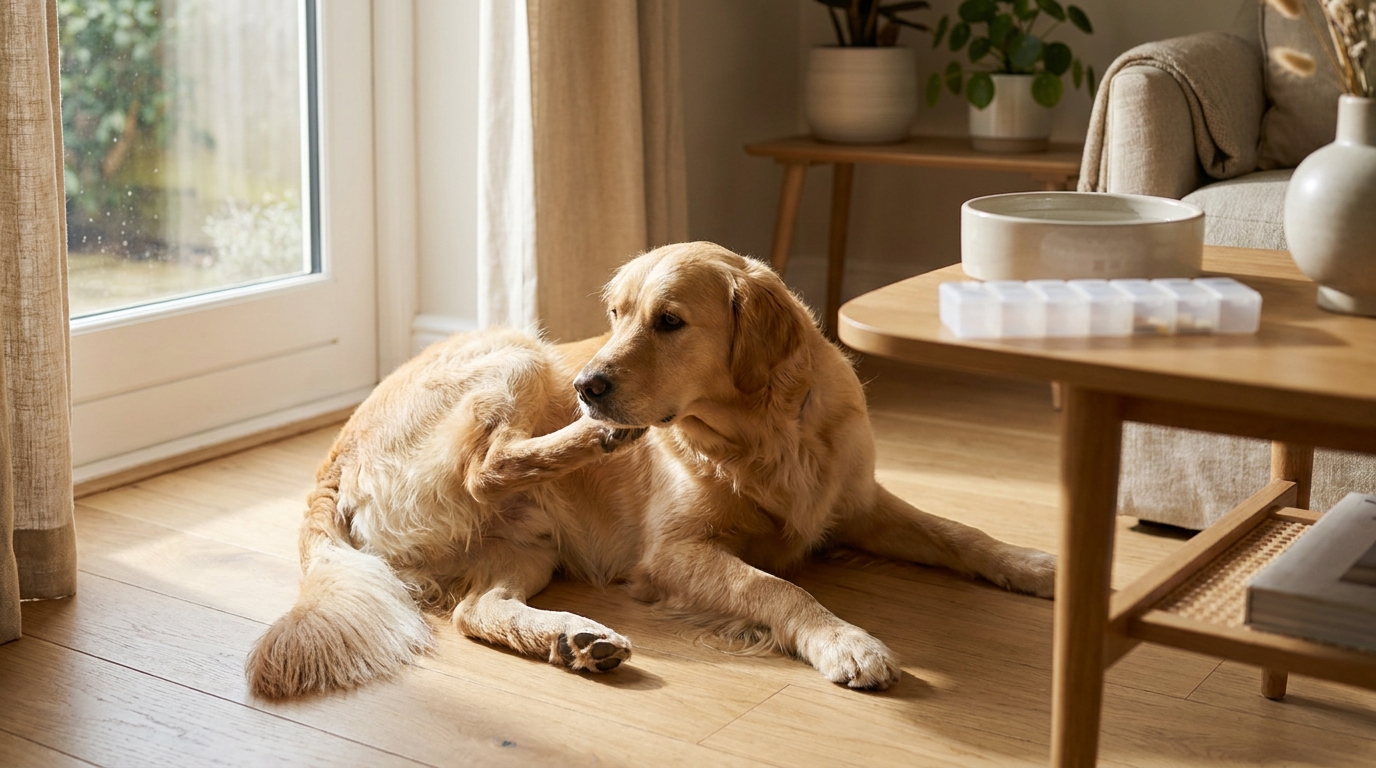
When Apoquel stops controlling itch, the cause is usually a skin infection, fleas, a dose-weight mismatch or a food trigger, not a failed drug.
One thing first: if your dog has facial swelling or spreading hives, open weeping or bleeding skin, a painful ear with discharge that they keep shaking, fever or lethargy, or has stopped eating, skip this article and go to an in-person or emergency clinic tonight.
If you typed "Apoquel not working anymore" into your phone tonight, start here. Owners often assume the dog has built up a tolerance; evidence for that is weak, and the ordinary causes below are far more common.
Why Apoquel "stopping" is usually a signal, not a failed drug
Apoquel (oclacitinib) turns down the itch signal; it cannot put out the fire sending it. When itch breaks through, something new is feeding it. The Merck Veterinary Manual lists the flare factors in atopic dogs as fleas, food and environmental allergens, and secondary infections: Malassezia yeast dermatitis, superficial pyoderma (bacterial skin infection) and otitis externa (ear infection). A relapse in a well-controlled dog, it advises, should prompt a search for the cause. In practice that means finding what changed before anyone changes the itch drug.
Atopic dermatitis is also lifelong. Merck's owner guide says it needs several treatments and regular veterinary rechecks; a dog that is itchy again is due for one.
Check 1: a hidden skin or ear infection Apoquel cannot treat
VCA Animal Hospitals describes oclacitinib as a medication to manage the itch of allergic dermatitis; it has no antibacterial or antifungal action and does not treat an infection. Infections hide in the paw webs, armpits, groin and ear canal and, as the dermatologist on the Dr Andy Roark podcast points out, in the claw folds at the base of each nail, which can look normal and still be full of yeast or bacteria. The only way to know is cytology: a tape or toothpick sample looked at under a microscope in a clinic. An infection needs its own treatment; Apoquel does not provide it.
The Apoquel label says it is not for dogs with serious infections and may increase susceptibility to infection, including demodicosis (Demodex mites). VCA adds that it should not be used with current or recent demodectic mange, and that dogs on it should be monitored for skin, urinary and respiratory infections with periodic bloodwork. Itch with patchy hair loss, crusts, a smell or discharge needs a clinic skin check; do not stop the drug on your own.
Check 2: fleas, even on prevention (Florida year-round, New York and Virginia late summer)
Merck lists fleas first among the flare factors. A flea-allergic dog can flare from a few bites you never see; look for flea dirt on the belly, rump and tail base.
Fleas are year-round in Florida; in New York and Virginia the pressure peaks in late summer. The dermatologist on the Dr Andy Roark podcast puts flea control among the "controllables" to confirm before calling Apoquel a failure, so re-verify the prevention: which product, when the last dose was actually given, and whether every pet is covered. If your dog is still getting fleas on prevention, that has its own explanation.
Check 3: the 14-day twice-daily phase just ended
The label, hosted on DailyMed, gives the schedule: twice daily for up to 14 days, then once daily for maintenance. Apoquel usually starts working within one to two days, and a little more scratching after the switch to once daily is common. Before you decide it is a case of Apoquel not working anymore, check the calendar: did the itch return right at the switch?
If so, look for a flare factor rather than changing the dose. Do not restart twice-daily dosing on your own; the label caps that phase at 14 days, and restarting it is the vet's decision. The Apoquel for dogs page explains the long-term plan.
Check 4: weight change, tablet strength and missed doses
Apoquel is dosed by body weight. A big weight change since the prescription, or a young dog that has kept growing, can leave the tablet no longer matching the dog; the label also says Apoquel is not for dogs under 12 months. Only the prescribing vet decides whether the tablet still fits; do not change the size or number of tablets yourself. See the label dosing chart.
Apoquel is short-acting, so a missed or late dose lets the itch come back quickly and can look like a treatment failure. If you missed a dose, do not give two to catch up; note it and tell the vet.
Check 5: a food trigger Apoquel only partly masks
Apoquel damps the itch and some of the inflammation but does nothing to the allergen. If your dog still eats a trigger food every day, the itch never switches off. The only reliable test is a strict elimination diet, fed exclusively for up to three months, then a re-challenge with the old food. Merck's owner guide notes that signs return between one hour and 14 days after the trigger is reintroduced.
If your dog is otherwise well, a RexVet veterinarian licensed in Florida, New York or Virginia can look at your dog by video ($64.99), go through these checks and help you decide whether a clinic visit is needed. See how an online vet visit for dogs works.
What not to do tonight: double-dosing, leftover steroids and the Benadryl question
Do not give an extra Apoquel tablet or go back to twice a day. The label allows twice-daily dosing for up to 14 days only, then once daily; any change is the vet's call. The label also warns that Apoquel may increase susceptibility to infection, one more reason an itchy dog needs the infection found and treated rather than more Apoquel.
Do not add leftover prednisone or any other steroid at home. The label states that Apoquel has not been evaluated with glucocorticoids, cyclosporine or other systemic immunosuppressive drugs, and a steroid can hide the infection your vet needs to find.
Benadryl: plain diphenhydramine has no known interaction with Apoquel, but it mostly adds drowsiness and rarely controls atopic itch. Never use Benadryl Allergy Plus, any "-D" product or any "PM" product: they add decongestants (pseudoephedrine, phenylephrine) or pain relievers (acetaminophen) that are dangerous to dogs. See the Benadryl for dogs page. Benadryl is never a reason to wait if a red flag is present.
What is safe tonight: keep Apoquel exactly as prescribed, check the flea product and last dose date, photograph the paw webs, armpits, belly and ear flaps, note your dog's weight and when the twice-daily phase ended, use a cone if the dog is chewing itself raw, and book a vet for tomorrow.
What a FL, NY or VA online vet can check on video, and what needs a clinic
On video, a RexVet veterinarian licensed in Florida, New York or Virginia will ask you to show the paw webs, armpits, belly and outer ear, check gum and skin color, ask when the twice-daily phase ended, compare the dog's current weight with the tablet it is on, and confirm the flea product and last dose date. From that, the vet can usually say whether this can wait for a recheck or needs a clinic today.
Skin cytology is a quick in-clinic test the vet may recommend to identify what is growing; a skin scraping for Demodex is another. Any change to an existing Apoquel plan happens only if the vet judges it clinically appropriate.
Red flags: when the itch needs in-person care today
These need an in-person clinic today, not a video visit:
- Open, weeping or bleeding skin
- Facial swelling, or hives spreading across the body
- A painful ear with discharge or a smell that the dog keeps shaking
- Fever or lethargy
- A dog that is not eating
Facial swelling, spreading hives or any trouble breathing means go to the nearest emergency clinic now.
If none of those apply, a RexVet veterinarian licensed in Florida, New York or Virginia can look at your dog by video ($64.99) and help you decide between a recheck of the Apoquel plan and a clinic visit.
Frequently asked questions
Why did Apoquel stop working right after the first two weeks?
Usually it did not stop; the schedule changed from twice daily to once daily, and some dogs itch a little more at that point. Look for a flare factor (fleas, a skin or ear infection, a food trigger) rather than changing the dose yourself.
Can I go back to giving Apoquel twice a day if my dog is itchy again?
No, not on your own. The label caps the twice-daily phase at 14 days, and changing the frequency without the prescribing vet does not address why your dog is still itchy. Keep the current dose and book a vet visit.
Can I give my dog Benadryl with Apoquel while I wait for a vet visit?
Plain diphenhydramine has no known interaction with Apoquel, but it rarely helps atopic itch and mostly makes dogs sleepy, and Allergy Plus, -D and PM products are never OK. If Benadryl was the step before Apoquel, see why Benadryl did not work.
Does Apoquel treat skin or ear infections?
No. Apoquel is not an antibiotic or an antifungal; it blocks the signals that cause itching. A yeast, bacterial or ear infection keeps hurting even when the allergy itch is controlled and needs its own treatment after clinic cytology.
Can an online vet in Florida, New York or Virginia help if my dog is still itchy on Apoquel?
Yes, for the sorting-out stage. On camera the vet checks the skin, ears and paws, reviews the medication timeline, weight and flea prevention, and says whether an in-person visit for cytology or a skin scraping is needed. Any of the red flags above belongs in a clinic today, not on a video call.
Sources
FAQs
Why did Apoquel stop working right after the first two weeks?
Usually it did not stop; the schedule changed from twice daily to once daily, and some dogs itch a little more at that point. Look for a flare factor (fleas, a skin or ear infection, a food trigger) rather than changing the dose yourself.
Can I go back to giving Apoquel twice a day if my dog is itchy again?
No, not on your own. The label caps the twice-daily phase at 14 days, and changing the frequency without the prescribing vet does not address why your dog is still itchy. Keep the current dose and book a vet visit.
Can I give my dog Benadryl with Apoquel while I wait for a vet visit?
Plain diphenhydramine has no known interaction with Apoquel, but it rarely helps atopic itch and mostly makes dogs sleepy, and Allergy Plus, -D and PM products are never OK. If Benadryl was the step before Apoquel, see why Benadryl did not work.
Does Apoquel treat skin or ear infections?
No. Apoquel is not an antibiotic or an antifungal; it blocks the signals that cause itching. A yeast, bacterial or ear infection keeps hurting even when the allergy itch is controlled and needs its own treatment after clinic cytology.
Can an online vet in Florida, New York or Virginia help if my dog is still itchy on Apoquel?
Yes, for the sorting-out stage. On camera the vet checks the skin, ears and paws, reviews the medication timeline, weight and flea prevention, and says whether an in-person visit for cytology or a skin scraping is needed. Any of the red flags above belongs in a clinic today, not on a video call.
Sources
Medically Reviewed
Reviewed by Dr. Tiffany Delacruz, DVM — licensed veterinarian and CEO of RexVet. Last reviewed September 14, 2026.
Content is for informational purposes and does not replace professional veterinary advice.
Chief Executive Officer · Licensed Veterinarian
Dr. Delacruz is a licensed Doctor of Veterinary Medicine specializing in preventive care and veterinary telehealth. She reviews all health content on RexVet to ensure accuracy and clinical relevance.
Sources & References
- · American Veterinary Medical Association — Telehealth Guidelines
- · AVMA — Pet Care Resources
- · U.S. FDA — Animal & Veterinary
Need an Expert Opinion on This Topic?
Connect with a certified vet via video call in minutes
Talk to Vet Now