
Dog Ate Super Glue or Expanding Glue: What to Do Now
By RexVet Team | Reviewed by Dr. Tiffany Delacruz, DVM
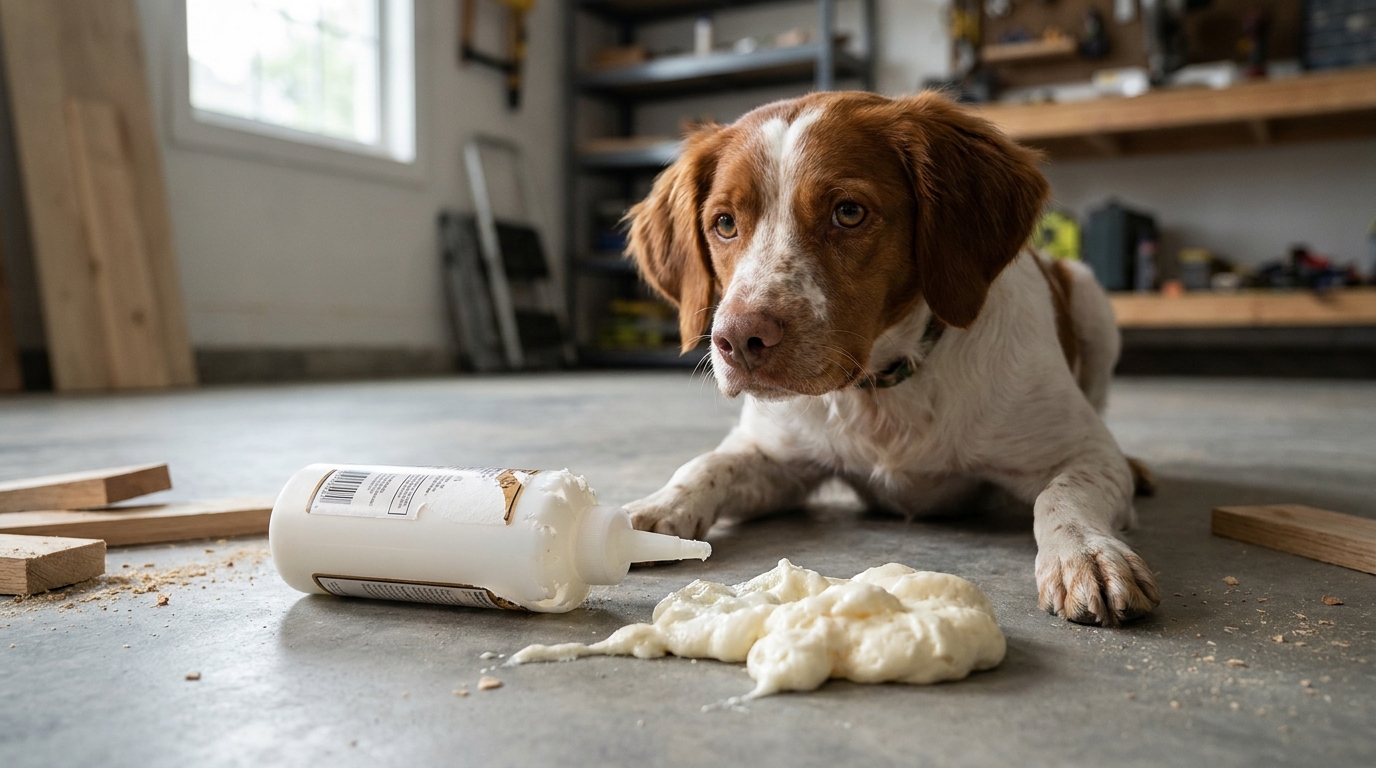
Wet expanding glue is an emergency even if your dog seems fine. Super glue is not poisonous but can seal a mouth or hurt an eye. What to do now.
Quick answer: A dog that licked, chewed or swallowed wet expanding glue (polyurethane or isocyanate on the label) needs an emergency vet now, even if it seems fine, because the ASPCA Animal Poison Control Center says any glue containing isocyanates can expand in the stomach. Super glue is not poisonous, but a mouth glued shut or glue in the eye means an emergency vet now, and a swallowed tube or cap means an in-person vet now. Don't make your dog vomit.
This article is general information, not a diagnosis. If you think your pet is in danger, go to the nearest emergency animal hospital.
What should I do right now if my dog ate glue?
A dog that ate glue with polyurethane, isocyanate, diisocyanate or MDI on the label, a product sold as expanding or foaming glue, or any glue you can't identify needs an emergency vet now; call a poison line on the way, not instead of going. Take the glue away, check whether other pets got into it, note the time and your best guess of the amount, and bring the bottle or a photo of the front and back label. The poison lines are ASPCA Animal Poison Control at (888) 426-4435 (a consultation fee may apply) and Pet Poison Helpline at (855) 764-7661 (a per-incident fee applies).
| Glue type | Main risk | Do this |
|---|---|---|
| Wet expanding glue | Swells, blocks | ER now |
| Wet spray foam | Swells, blocks | ER now |
| Unknown glue | May expand | ER now |
| Chewed expanding glue bottle | Counts as wet | ER now |
| Tacky, half dry glue | May expand | ER now |
| Rock hard glue chunk | Blockage | In person now |
| Super glue lick | Sticks in mouth | Call a vet |
| Mouth stuck shut | Choking | ER now |
| Glue in eye | Eye injury | Vet now |
| Chewed tube or cap | Blockage, cuts | In person now |
| School glue lick | Upset gut | Call a vet |
| Glue stick eaten | Blockage | In person now |
| Hot glue chunk | Burns, blockage | In person now |
| Epoxy or solvent glue | Burns, fumes | ER now |
In person now means your own vet if they can see your dog right away, otherwise an emergency vet. Vet now in the eye row means an immediate vet exam: your own vet if they can see your dog right away, otherwise an emergency vet. Stop the pawing and rubbing on the way. The Call a vet rows apply only when the label confirms the product; after a small lick of school glue, vomiting more than once, refusing food, belly pain or straining means an emergency vet now. In every in-person row, any vomiting, retching with nothing coming up, not eating, a swollen or painful belly, or weakness means the ER now.
Which glues expand in a dog's stomach, and how much is dangerous?
Glues that contain isocyanates expand in a dog's stomach, and there is no amount of wet expanding glue an owner can judge as safe at home, so any lick, chew or swallow means an emergency vet now. The ASPCA Animal Poison Control Center says any glue or adhesive that contains isocyanates can expand in the stomach. A Pet Poison Helpline veterinary toxicologist writing for VCA says not every product in a brand line contains expanding glue, so check the ingredients on the bottle, not the brand name. A label that doesn't list polyurethane or isocyanate does not by itself clear the glue: if you can't read the label or aren't sure what the glue is, treat it as expanding glue and go to an emergency vet now with the bottle.
VCA says anything more than a lick of wet expanding glue may be enough to cause a problem in a medium-sized dog, and as little as half a teaspoon has been reported to cause a blockage. Smaller dogs, puppies and cats have even less margin, and an unknown amount, such as a chewed bottle, counts as more than a lick. VCA also says fully dried, hardened glue that has already expanded is not expected to expand further, but you can't confirm a full cure at home: a chewed bottle, tube or nozzle and any piece that is tacky, soft inside or of unknown age count as wet (emergency vet now), and a chunk that was rock hard all the way through is treated like a swallowed rock or toy (in person now).
Signs and timeline after a dog eats expanding glue
A dog that ate expanding glue typically develops signs within 12 hours, according to a 2013 review in Topics in Companion Animal Medicine, but don't wait for them: after expanding or unknown glue, any vomiting, not eating or belly swelling means an emergency vet now, and a dog with no signs still needs an emergency vet now.
| What you see | Why it matters | Do this |
|---|---|---|
| Seems fine | Glue can still swell | ER now |
| Vomiting | May be blocked | ER now |
| Blood in vomit | Stomach injury | ER now |
| Not eating | May be blocked | ER now |
| Swollen belly | Stomach stretched | ER now |
| Retching, gagging | Throat or airway | ER now |
| Heavy drooling | Throat or airway | ER now |
| Trouble breathing | Airway | ER now |
| Weak, pale gums | Shock risk | ER now |
Every row is ER now because the table covers expanding or unknown glue; the 2013 review says the mass starts to form minutes after swallowing, can reach 4 to 8 times its original volume and can't always be felt in the belly. VCA says a glue mass is often noted on X-rays within 3 to 12 hours of exposure and a blockage is generally evident within 12 to 24 hours: those are when the problem shows up, not how long it is safe to wait, and a very early X-ray can look clear, so the hospital may keep your dog or repeat it. In a 2021 case series of 22 dogs in the Journal of the American Animal Hospital Association, the median time from swallowing to reaching a veterinary hospital was 42 hours, and vomiting was the most common sign; that is how late owners arrived, not when signs start. See the signs of an intestinal blockage.
Should I make my dog throw up or give bread after it ate glue?
No: don't make your dog vomit at home after it ate glue (no hydrogen peroxide or salt), and don't give bread, food, milk, water, pumpkin, oil, laxatives or an enema to dilute the glue or push it through. The 2013 review says inducing vomiting is contraindicated because the glue can be inhaled or the expanding mass can lodge in the esophagus. Pet Poison Helpline says giving water or other fluids could cause faster and greater expansion, and VCA says not to feed your pet or offer anything to decontaminate until a veterinarian or Pet Poison Helpline has been consulted. This is for wet expanding glue on the way in, not a rule to withhold water as home care. Read when making a dog throw up helps and when it harms.
Is super glue toxic to dogs, and what if the mouth is glued shut?
Super glue (cyanoacrylate) is not chemically toxic to dogs, but it can injure them: Pet Poison Helpline says these glues are not expanding glues and carry no toxicity risk, yet can be very damaging to the surface of the eye, so glue in a pet's eye needs an immediate veterinary exam. Super glue hardens on contact with saliva and can seal lips, tongue or gums together, and a chewed tube, cap or nozzle can cut the mouth or block the gut (in person now). With glue in or around the eye, don't pry the lids apart or put any remover, oil or solvent in the eye; go now. The not-toxic part holds only if the label really says cyanoacrylate; any glue you can't identify means an emergency vet now.
A dog whose lips or jaws are stuck together, or that is gagging, drooling heavily or struggling to swallow or breathe, needs an emergency vet now; don't pull the tissue apart or use acetone, nail polish remover, adhesive remover or any solvent near the mouth. A small hardened patch in a dog that is breathing, swallowing and opening its mouth normally is different: an ASPCA Animal Poison Control Center toxicologist writing in Today's Veterinary Practice (2018) says hardened glue wears off within a few days and is best left in place. Don't pick at it; call your vet or a poison line (in person now if it worries you).
What about school glue, glue sticks, glitter glue and hot glue?
White school glue usually causes mild to moderate stomach upset when eaten, the ASPCA says, so after a small lick call a vet or a poison line, and go to an emergency vet now if your dog vomits more than once, refuses food, has belly pain or strains. Glitter glue follows the same rule. A large amount of school glue or a chewed school-glue bottle means a call to a vet or a poison line now, and missing pieces of the bottle or cap mean in person now. Australia's Animal Poisons Helpline says a solid form such as a glue stick can obstruct the gut (in person now). Hot glue burns while hot, and burns to the mouth, lips or paws mean in person now; a hardened chunk is a foreign body: in person now. Epoxy, contact cement and other solvent glues mean an emergency vet now; Australia's Animal Poisons Helpline says epoxy resins can be very irritating or even corrosive.
What happens at the emergency vet after a dog eats glue?
At the emergency vet, a dog that ate expanding glue gets X-rays, and once a glue mass is confirmed it is removed by surgery or, in mild cases, with an endoscope. Tell the hospital it was glue. In the 2021 case series of 22 dogs, 15 had surgery. VCA says a hospital stay with fluids is likely; the 2013 review expects complete recovery when surgery is done early enough and warns that perforation, rupture and death can occur if the mass is left untreated. After surgery, any vomiting, worse appetite, lethargy, fever, a draining incision or a swelling belly in the first 5 days means call the surgeon or go to an ER now.
Cats and glue
A cat that licked wet expanding glue off its paws or fur, or swallowed any, needs an emergency vet now, and a cat is never made to vomit at home. The ASPCA says cats can be notorious for walking through adhesives used in home repairs, which can cause irritation and even burns to the skin. For super glue on skin or fur, Pet Poison Helpline says it can be removed at home with warm, soapy water while gently rolling the glue with your fingers, and never to put an adhesive remover on a pet's skin; stop the licking, use no scissors, and keep this method away from the eyes and mouth. It is for super glue only, not expanding or glue-trap glue. Open, bleeding, blistered or burned skin, or skin still stuck to something, needs an in-person vet.
Holiday crafts: keep glue away from your dog
Keep every glue capped and stored high, craft in a room your dog can't enter, never leave your dog alone with open supplies, and let glued ornaments and gift wrap cure out of reach. The ASPCA says polyurethane glues and spray foam belong in closed, secure cabinets. Ventilate while glue cures: VCA says a pet shut in a room where expanding glue is drying can get airway irritation, with coughing, sneezing, drooling or nasal discharge. Move a pet with those signs to fresh air and call a vet; any breathing trouble means an emergency vet now. See also what to do if a dog ate salt dough or play dough or wrapping paper, tape or a bow.
When a video visit helps and when it does not
A dog that licked, chewed or swallowed wet or tacky expanding glue, or any glue you can't identify, needs an emergency vet now, not a video visit, and so does glue in the eye, a mouth stuck shut, or any vomiting, belly swelling or trouble breathing. A swallowed tube, cap, glue stick or fully hardened chunk with no signs means in person now. Only an in-person vet can take X-rays, sedate, remove a glue mass or safely deal with a mouth that is stuck shut, so call a poison line on the way, not instead of going; a video visit cannot diagnose or rule out a glue mass or a blockage.
A live video visit with RexVet, a nonprofit online vet service for pets located in Florida, New York and Virginia, fits three situations: after a poison line or your own vet has identified the product from its label and said home monitoring is reasonable (say, a small lick of white school glue), to go over what to watch for and which signs mean going in; for mild redness on paws or skin after the glue is off (open, bleeding, blistered or burned skin, or skin still stuck to something, needs an in-person vet); and after an ER visit, to talk through the discharge instructions, which the veterinarian on video does not change or extend. RexVet serves pets in those three states by live video visit, and your pet must be located in one of them during the visit.
On a $64.99 live video visit, a licensed RexVet vet (a veterinarian licensed in your pet's state) can look at the label, your dog's mouth, skin, breathing and energy on camera and say whether your pet needs to be seen in person; a video visit cannot take X-rays, feel the belly, sedate or remove anything. Book when a slot is open (usually about 8 AM to 11 PM ET; holiday hours are not confirmed, and a same-day slot is not guaranteed); if no slot is open, or anything is getting worse, go to an emergency vet. No prescription is promised; any medicine is the veterinarian's decision within state rules, and medicines after surgery are the treating hospital's call.
Need an Expert Opinion on This Topic?
Book a video visit with a licensed vet, evenings and weekends included
See open timesFrequently Asked Questions
Will my dog be OK after eating glue?
It depends on the glue and how fast your dog is treated; wet expanding glue means an emergency vet now, even with no signs. VCA says the outcome is usually good if the glue mass is removed and vomiting and dehydration are treated, and in a 2021 case series of 22 dogs, short-term prognosis was very good following fluid therapy and surgical or endoscopic removal.
Can a dog pass super glue or expanding glue on its own?
No for expanding glue: Pet Poison Helpline says the hardened mass is too large to leave the stomach in either direction. Go to an emergency vet now. Super glue is different: a dog whose lips or jaws are stuck together, or that is gagging, drooling heavily or having any trouble swallowing or breathing, needs an emergency vet now. For a small hardened patch in a dog that is breathing, swallowing and opening its mouth normally, an ASPCA Animal Poison Control Center toxicologist writing in Today's Veterinary Practice (2018) says hardened glue in the mouth wears off within a few days and is best left in place, so don't pick at it; call your vet or a poison line. A swallowed tube, cap or nozzle is a foreign body: in person now, and the ER now with any vomiting, retching, not eating, belly pain or swelling, or weakness.
My dog ate dried expanding glue and seems fine; can I wait and watch?
No. Get your dog seen in person now, and treat any piece that was tacky, soft inside or of unknown age as wet glue: emergency vet now. VCA says dried, already expanded glue is not expected to expand further. You can't confirm a full cure at home, though, and a chewed bottle or tube always counts as wet. A rock-hard chunk is treated like a swallowed rock or toy: in person now, and the ER now with any vomiting, retching, not eating, belly pain or weakness. Seeming fine proves little: a 2013 veterinary review says the mass can't always be felt in the belly.
Should I give my dog bread, milk or water after it ate glue?
No. Don't give food, bread, milk, water, pumpkin, oil, laxatives or an enema to dilute expanding glue or push it through; leave for an emergency vet now. Pet Poison Helpline says giving water or other fluids could cause faster and greater expansion, and a 2013 veterinary review found liquids, activated charcoal and bulk-forming products ineffective. Don't make your dog vomit at home either. This is for wet expanding glue on the way in, not a reason to take water away at home.
Is wood glue toxic to dogs?
It depends on the label: wood glue listing polyurethane, isocyanate, diisocyanate or MDI can expand in the stomach and means an emergency vet now. The ASPCA says expandable construction and wood glues contain isocyanates and cause a blockage that only surgery can remove, and VCA says not every product in a brand line expands, so the ingredients decide. If you aren't sure, go now with the bottle.
Can an online vet help if my dog ate glue and we are in Florida, New York or Virginia?
Only after an emergency vet, your own vet or a poison line has said home monitoring is reasonable. Wet expanding glue or unknown glue needs an emergency vet now. For a pet located in Florida, New York or Virginia, a licensed RexVet vet can look at the label and your dog's mouth, skin and breathing on camera and say whether to go in; X-rays, sedation, removing a glue mass, glue in the eye and a mouth stuck shut all need an in-person or emergency vet, and a video visit cannot diagnose or rule out a glue mass. No prescription is promised. If medicine comes up: in Florida (s.474.2021), a prescription after a video-only visit is limited to FDA-approved animal drugs used as labeled, for up to 14 days (1 month for products labeled only for fleas and ticks), with no renewal without an in-person exam; human-labeled drugs, controlled drugs and compounded antibacterial, antifungal, antiviral or antiparasitic drugs need an in-person exam. Federal rules require an in-person exam before any vet prescribes a human or off-label drug. In Virginia, the exam behind a prescription may be done electronically, but the veterinarian still decides whether video is enough. New York's rules for veterinary video care, including prescribing, are not settled, so a visit there may cover less. RexVet is not a pharmacy; a pharmacy transfer fee applies if a prescription is sent to an outside pharmacy.
FAQs
Will my dog be OK after eating glue?
It depends on the glue and how fast your dog is treated; wet expanding glue means an emergency vet now, even with no signs. VCA says the outcome is usually good if the glue mass is removed and vomiting and dehydration are treated, and in a 2021 case series of 22 dogs, short-term prognosis was very good following fluid therapy and surgical or endoscopic removal.
Can a dog pass super glue or expanding glue on its own?
No for expanding glue: Pet Poison Helpline says the hardened mass is too large to leave the stomach in either direction. Go to an emergency vet now. Super glue is different: a dog whose lips or jaws are stuck together, or that is gagging, drooling heavily or having any trouble swallowing or breathing, needs an emergency vet now. For a small hardened patch in a dog that is breathing, swallowing and opening its mouth normally, an ASPCA Animal Poison Control Center toxicologist writing in Today's Veterinary Practice (2018) says hardened glue in the mouth wears off within a few days and is best left in place, so don't pick at it; call your vet or a poison line. A swallowed tube, cap or nozzle is a foreign body: in person now, and the ER now with any vomiting, retching, not eating, belly pain or swelling, or weakness.
My dog ate dried expanding glue and seems fine; can I wait and watch?
No. Get your dog seen in person now, and treat any piece that was tacky, soft inside or of unknown age as wet glue: emergency vet now. VCA says dried, already expanded glue is not expected to expand further. You can't confirm a full cure at home, though, and a chewed bottle or tube always counts as wet. A rock-hard chunk is treated like a swallowed rock or toy: in person now, and the ER now with any vomiting, retching, not eating, belly pain or weakness. Seeming fine proves little: a 2013 veterinary review says the mass can't always be felt in the belly.
Should I give my dog bread, milk or water after it ate glue?
No. Don't give food, bread, milk, water, pumpkin, oil, laxatives or an enema to dilute expanding glue or push it through; leave for an emergency vet now. Pet Poison Helpline says giving water or other fluids could cause faster and greater expansion, and a 2013 veterinary review found liquids, activated charcoal and bulk-forming products ineffective. Don't make your dog vomit at home either. This is for wet expanding glue on the way in, not a reason to take water away at home.
Is wood glue toxic to dogs?
It depends on the label: wood glue listing polyurethane, isocyanate, diisocyanate or MDI can expand in the stomach and means an emergency vet now. The ASPCA says expandable construction and wood glues contain isocyanates and cause a blockage that only surgery can remove, and VCA says not every product in a brand line expands, so the ingredients decide. If you aren't sure, go now with the bottle.
Can an online vet help if my dog ate glue and we are in Florida, New York or Virginia?
Only after an emergency vet, your own vet or a poison line has said home monitoring is reasonable. Wet expanding glue or unknown glue needs an emergency vet now. For a pet located in Florida, New York or Virginia, a licensed RexVet vet can look at the label and your dog's mouth, skin and breathing on camera and say whether to go in; X-rays, sedation, removing a glue mass, glue in the eye and a mouth stuck shut all need an in-person or emergency vet, and a video visit cannot diagnose or rule out a glue mass. No prescription is promised. If medicine comes up: in Florida (s.474.2021), a prescription after a video-only visit is limited to FDA-approved animal drugs used as labeled, for up to 14 days (1 month for products labeled only for fleas and ticks), with no renewal without an in-person exam; human-labeled drugs, controlled drugs and compounded antibacterial, antifungal, antiviral or antiparasitic drugs need an in-person exam. Federal rules require an in-person exam before any vet prescribes a human or off-label drug. In Virginia, the exam behind a prescription may be done electronically, but the veterinarian still decides whether video is enough. New York's rules for veterinary video care, including prescribing, are not settled, so a visit there may cover less. RexVet is not a pharmacy; a pharmacy transfer fee applies if a prescription is sent to an outside pharmacy.
Medically Reviewed
Reviewed by Dr. Tiffany Delacruz, DVM — licensed veterinarian and CEO of RexVet. Last reviewed November 10, 2026.
Content is for informational purposes and does not replace professional veterinary advice.
Chief Executive Officer · Licensed Veterinarian
Dr. Delacruz is a licensed Doctor of Veterinary Medicine specializing in preventive care and veterinary telehealth. She reviews all health content on RexVet to ensure accuracy and clinical relevance.
Sources & References
- · American Veterinary Medical Association — Telehealth Guidelines
- · AVMA — Pet Care Resources
- · U.S. FDA — Animal & Veterinary