
Vet Estimate Too High? How to Read It Line by Line Before You Sign
By RexVet Team | Reviewed by Dr. Tiffany Delacruz, DVM
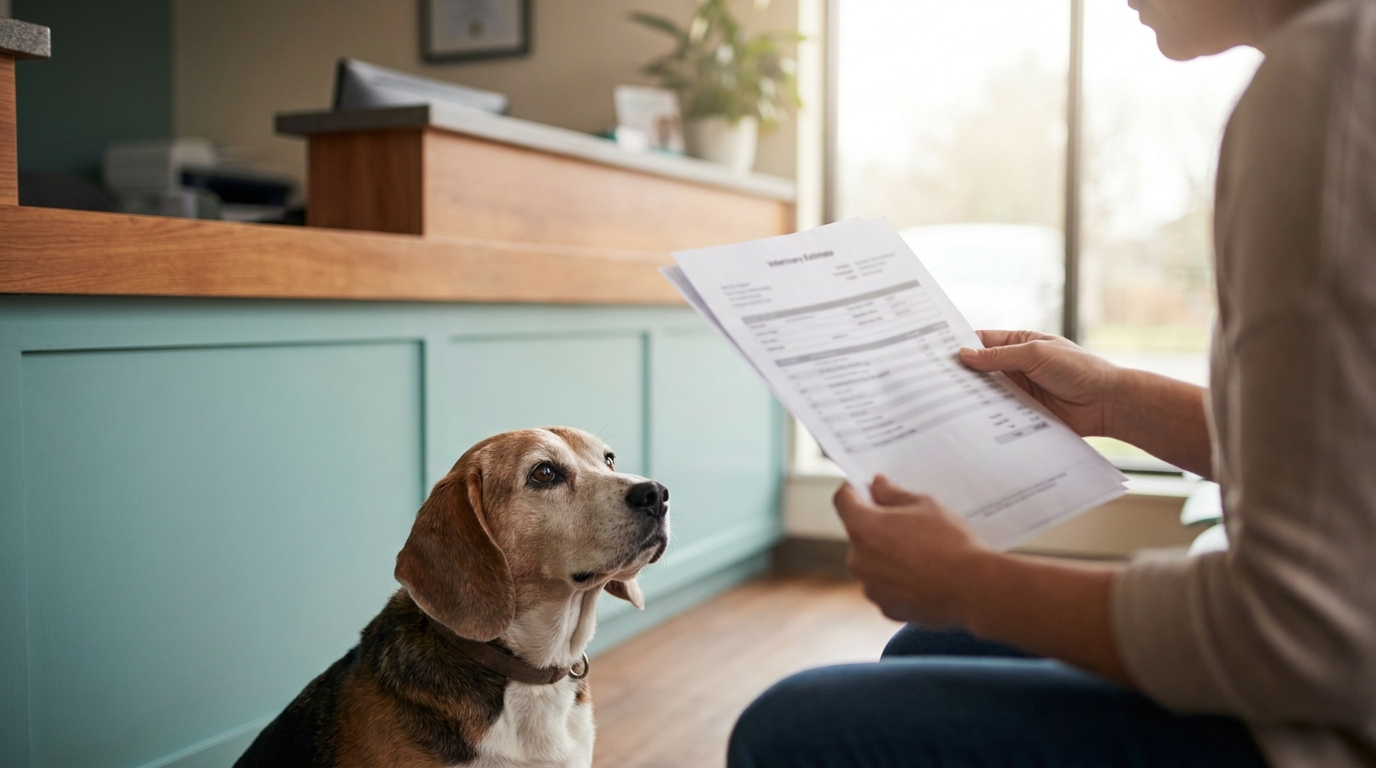
What each line on a vet estimate does, which lines protect your pet under anesthesia, what can wait if your pet is stable, and what to ask before you sign.
Quick answer: A vet estimate is a low-to-high projection, not a bill. If your pet is stable, ask the treating vet to sort each line into required for safety, recommended or optional, say what can wait, and call you before passing the high end. Never trade away anesthesia monitoring, IV access or pain control. If your pet shows an emergency sign, go to the nearest ER and approve stabilization now.
This article is general information, not veterinary or legal advice. Laws cited are current as of October 14, 2026.
Emergency? Stop Reading the Estimate
A video visit is not for emergencies. Go to the nearest emergency hospital now and call ahead on the way if your pet has any of these. These signs come from the Merck Veterinary Manual's list of complaints that need immediate evaluation:
- An allergic reaction, especially with collapse or trouble breathing
- Trouble breathing, or the heart or breathing stopping
- Collapse, being unable to stand or walk, loss of consciousness or a sudden change in mental state
- A male cat straining with little or no urine
- Bleeding, trauma or open wounds
- Pale gums or weakness
- Seizures
- Profuse vomiting or diarrhea
- A swollen or painful belly, or retching with nothing coming up
- Poison or toxin ingestion, or a snakebite
- Heatstroke or a low body temperature
- Trouble giving birth, or organs protruding
- Substantial pain
In an emergency, approve stabilization now: ask for a stabilization estimate so treatment starts right away while you talk through the full plan. Stabilization is still billed, and a deposit may be required. Some emergencies can't stop at stabilization. With bloat (GDV), surgery is part of the emergency; with a blocked male cat, so is relieving the blockage under anesthesia. Don't pause to compare prices. Waiting makes emergency anesthesia and surgery riskier, not safer.
Don't drive an unstable pet from hospital to hospital comparing prices; move your pet only if the treating vet says it is safe. A puppy with vomiting or bloody diarrhea needs to be seen today. If hospitalization for parvo isn't possible, ask the vet whether an outpatient protocol is an option. That is still veterinary treatment with clinic visits, not home care, and not every puppy is a candidate.
Everything below is for a pet that is stable and a procedure that can be planned.
Why Your Estimate Is a Projection, Not a Bill
An estimate is an approximate number, not a fixed price, and the cost can change as treatment goes on. That's why many clinics show a range: a low column for what they expect to do and a high column for what they might find. Practice-management advisers note that clients tend to remember the low end, so read the high end as the number to budget for.
Dental estimates are the clearest example. AAHA's dental guidelines say the full treatment plan, and its cost, can't be known until your pet's mouth is examined and X-rayed under anesthesia. Extractions are usually what sits in the high column.
Ranges, deposits and revisions are normal. A good estimate is a conversation tool: it shows you what the vet plans and gives you the chance to ask about it before you sign.
Anatomy of a Veterinary Estimate: What to Look For
- Low and high columns. Find out what's in the gap between them and what would push the bill toward the high end.
- Deposit. Deposits vary by hospital. Ohio State's veterinary hospital, for example, asks for 75% of the high end before admitting a patient, and Tufts asks inpatients for a 75% deposit of estimated costs. Ask what yours is and which end of the range it's based on.
- Expiration date. Estimates are usually valid for a limited time. Check yours if you're scheduling for later.
- Exclusions. Rechecks, follow-up tests, bandage changes and take-home medications may not be included. Read the fine print.
- Updates. Tufts' teaching hospital, for example, updates clients on charges each day of a hospital stay and says added care can require an added deposit. Asking how often you'll hear about charges is reasonable.
Safety First: What You Should Never Cut
Before you remove anything, ask your vet which lines are required for safety, which are recommended and which are optional. AAHA's anesthesia guidelines tie these steps to anesthetic safety: a pre-anesthetic exam, premedication, an IV catheter, a breathing tube and oxygen, monitoring (pulse oximetry, carbon dioxide, blood pressure, ECG and temperature), warming, recovery monitoring and pain control. Ask who will watch your pet while it's under anesthesia.
- IV catheter and fluids. AAHA calls an IV catheter optimal care in almost all anesthetic situations, and recommends IV fluids for dental procedures. Don't decline them to save money.
- Pain control. AAHA calls pain control obligatory for dental procedures, and local nerve blocks reduce the anesthetic and other pain drugs needed. Dogs and cats hide mouth pain, so a pet that's still eating can still have painful teeth.
- Dental X-rays. In studies AAHA cites, 28% of normal-looking dog teeth and 42% of normal-looking cat teeth had important findings on X-rays. They're a diagnosis and safety line, not an add-on.
- General anesthesia for dentals. AAHA calls anesthesia-free dentistry unacceptable, and the American Veterinary Dental College says removing visible tartar from an awake pet is purely cosmetic. Sedation isn't a cheaper substitute either: dental work needs general anesthesia with a breathing tube.
- Pre-anesthetic bloodwork. AAHA treats this as a case-by-case decision. If your pet had normal bloodwork in the last few months and nothing has changed since (no new symptoms, no new medications), ask whether it can be used. If those results were abnormal or your pet has been sick, AAHA says to repeat the tests right before anesthesia. Older pets and pets with heart, kidney or hormone problems may need more testing, not less.
The AVMA's ethics code expects vets to be prepared to offer a range of options, and a lower-cost plan should still meet an acceptable standard of care. Expect your vet to refuse some cuts, like anesthesia without an IV line or monitoring.
Sample Breakdown: A Dental Cleaning With Possible Extractions
Here's how to read the lines on a typical dental estimate for a stable adult dog. The low column usually covers the cleaning, full-mouth X-rays and anesthesia; the high column adds extractions with their nerve blocks, surgery time and take-home medication. Tags: Core means don't cut; Ask means ask what it changes; Stage means often stageable if your pet is stable; Shop means shop around or ask.
| Line item | Tag | Why |
|---|---|---|
| Pre-anesthetic exam | Core | First step on AAHA's safety list |
| Pre-anesthetic bloodwork | Ask | Recent normal results and no changes? Ask if they can be used. Abnormal or sick? Repeat |
| Chest X-rays or ECG first | Ask | Age, breed or a murmur can mean more testing, not less |
| Premedication and induction | Core | On AAHA's safety list; lowers the anesthetic needed |
| IV catheter and fluids | Core | AAHA recommends fluids for dentals |
| Breathing tube, gas, oxygen | Core | Dentals need general anesthesia with airway control |
| Monitoring and warming | Core | Ask who watches your pet |
| Full-mouth dental X-rays | Core | Finds disease you can't see |
| Scaling, polishing, probing, charting | Core | The treatment; each tooth is staged here |
| Local nerve blocks | Core | Pain control is obligatory for dentals |
| Extractions (high column) | Ask | Diseased teeth need treatment; give a reachable number and a dollar limit |
| Root canal or gum surgery | Ask | Extraction is a standard choice if home care or budget won't support saving the tooth |
| A second, staged procedure | Stage | May be advised if disease is extensive; vet's call; ask about pain control meanwhile |
| Recovery monitoring | Core | Monitoring continues into recovery |
| Take-home pain medication | Core | Needed from the first night; to fill it elsewhere, get a written prescription and fill it the same day |
| Recheck exam | Shop | Ask if your regular clinic can do it |
| Home-care products | Shop | Daily brushing; look for VOHC-accepted products |
If the clinic can't reach you during the procedure, AAHA says extra treatment that isn't on the consent form won't be done, and a separate procedure gets scheduled. That means a second anesthesia, with more cost and risk. Give the clinic a number you'll answer, and agree on a dollar limit up to which they may treat what they find.
Your estimate may also show a "grade" for the dental. That grade is the clinic's own label and isn't necessarily the same thing as the American Veterinary Dental College's periodontal stages (PD0 to PD4), which are assigned tooth by tooth after X-rays and probing under anesthesia. Ask what the grade is based on, and afterward ask for the dental chart and copies of the X-rays.
Sample Breakdown: Two Nights in the Hospital for a Vomiting Dog
This is for a dog that is stable on arrival with no signs of bloat. Retching with nothing coming up, a swollen belly, collapse or pale gums belong in the emergency box above, not this table. The low column usually covers two nights, IV fluids, lab work and X-rays; the high column adds ultrasound, an extra night, and surgery if a blockage is found.
| Line item | Tag | Why |
|---|---|---|
| Exam and triage | Core | Decides how urgent this is |
| Bloodwork and electrolytes | Core | Vomiting shifts electrolytes; guides fluids |
| Parvo test (young or unvaccinated dog) | Core | Changes isolation and treatment |
| Belly X-rays | Ask | Looks for a blockage; ask what result changes today's plan |
| Belly ultrasound (high column) | Ask | Ask what finding would trigger it |
| IV catheter and fluids | Core | The main treatment for dehydration |
| Anti-nausea and pain medicine | Core | Comfort; helps keep fluids and food down |
| Hospital nursing, per night | Core | Ask how often you'll get charge updates |
| Repeat bloodwork, day 2 | Ask | Rechecks electrolytes during fluids; ask what result would change the plan |
| Third night (high column) | Ask | Depends on response; ask what would trigger it |
| Surgery for a blockage (high column) | Core | A blockage can't safely wait; stay reachable so the vet can call you |
| Workup for longer-term causes | Stage | Often schedulable once vomiting is controlled; vet's call |
| Discharge medications | Shop | Ask for a written prescription; fill it the same day |
| Prescription diet | Shop | Ask about sizes or other places to buy |
| Recheck exam | Shop | Ask if your regular clinic can do it |
These tags are a starting point for questions, not a verdict. Only the vet who examined your pet can say which lines your pet needs.
Ten Questions to Ask Before You Sign
- Which lines are required for safety, which are recommended and which are optional, and if I need a lower total, which plan can you stand behind?
- Which lines are needed today, which could safely wait if my pet stays stable, and what signs would mean it can't wait?
- What pushes this toward the high end, how often will you update me on charges, and will you call me before going past the high end?
- For each test or imaging line, what would the result change about today's plan?
- My pet had normal bloodwork recently and nothing has changed since. Can you use it, or is there a reason to repeat it?
- Who watches my pet under anesthesia, and are the IV catheter, breathing tube, monitoring, warming and pain control all included?
- For a dental: what is the grade on this estimate based on, and what would it cost if the X-rays show more disease?
- For a dental: how will you reach me during the procedure, and up to what amount may you treat what you find without calling?
- What isn't included, when does this estimate expire, and can I get a written prescription for take-home medications?
- What deposit do you need and which end of the range is it based on? Do you offer a payment plan, and will you send copies of the records if I want a second opinion?
Normal vs. Worth Asking About
Ranges, deposits, revisions during treatment and daily updates on charges are all normal parts of veterinary billing, and the AVMA's ethics code says vets should share the estimated cost of care. If your estimate has no range, no expiration date, or a line nobody can explain, ask before you sign. Being unclear isn't the same as being wrong; often a short conversation clears it up.
If you want another opinion, you're entitled to copies of your pet's records. The AVMA's ethics code says the previous vet should provide the record with your consent. Florida law requires clinics to give copies of records, including X-rays, in a timely manner, and release can't depend on paying the bill, though a copying cost may be charged. New York requires a copy within a reasonable time after a written request. Virginia's veterinary board treats failing to release a copy of your pet's records on request as unprofessional conduct. In Florida, since July 1, 2026, a vet who dispenses a prescription medication must first tell you that you can get a written prescription to fill at the pharmacy of your choice, with exceptions such as when a drug must be dispensed right away or is a restricted controlled substance.
What to Do When the Number Still Won't Work
Start with the clinic. Ask about its payment plan, which lines can be staged if your pet is stable, and whether rechecks can happen at a lower-cost clinic. AAHA also notes that saving a tooth may not be the best choice for a family with limited resources, so ask whether extraction is a reasonable option.
- The Pet Fund gives grants of up to $500 for non-basic, non-urgent care (you pay the rest), and only when your vet confirms the procedure can safely wait for its waiting list. Ask about pain control in the meantime.
- RedRover Relief has urgent-care grants for life-threatening cases, typically $250 to $300; they don't cover exams or diagnostics and can't help if the remaining gap is $500 or more. Frankie's Friends has grants for emergency or specialty care. Both have strict rules on financial need, prognosis and where your pet is treated. Never hold off emergency treatment waiting for a grant decision.
- CareCredit and Scratchpay are credit options some clinics accept. Read the terms first: CareCredit's "no interest if paid in full" promotions charge interest back to the purchase date if the balance isn't paid off in time, and Scratchpay plans can carry an APR of up to 36%, with late fees.
Want a Second Look at a Big Estimate Before You Say Yes?
Not for emergencies. If your pet shows any sign in the emergency box above, go now.
For a stable pet and a large, planned estimate, a second pair of eyes on the paperwork can help. RexVet is a 501(c)(3) non-profit. Our veterinarian, Dr. Tiffany Delacruz, DVM, is licensed in Florida, New York and Virginia and sees pets located in those states by live video, with appointments roughly 8 AM to 11 PM Eastern. On a $64.99 video visit, or with the one-time $120 Family Plan (4 visits over 12 months, every pet in the home, no subscription), she can go through your estimate line by line, explain what each item is for and help you write questions for your clinic. Have the estimate and any records ready to share during the visit.
A video visit is not an exam. Dr. Delacruz can't examine your pet in person, take X-rays, stage dental disease or judge anesthetic risk, and she can't confirm or overrule the findings of the vet who examined your pet; that vet's exam decides. Prescriptions are never guaranteed. Book a $64.99 video visit.
Frequently Asked Questions
Is a vet estimate the same as the final bill?
No. An estimate is an approximate low-to-high projection, and final charges reflect what is actually done. Ranges, deposits and revisions are normal. Check what isn't included, such as rechecks, bandage changes and discharge medications, and when the estimate expires. Ask the clinic to call you before going past the high end.
Can I ask my vet to take items off the estimate?
You can ask, but let the treating vet do the sorting. Ask which lines are required for safety, which are recommended and which are optional, and which lower-cost plan they can stand behind. Under the AVMA's ethics code, a lower-cost option should still meet an acceptable standard of care, so expect some cuts to be refused. Declined treatment is recorded in the chart.
Is anesthesia-free dental cleaning a cheaper alternative?
No. AAHA calls anesthesia-free dentistry unacceptable, and the American Veterinary Dental College says removing visible tartar is purely cosmetic because cleaning below the gumline isn't possible in an awake pet. AAHA notes that approach can leave disease untreated for long periods, which costs more later. Sedation isn't a substitute either: dentals need general anesthesia with a breathing tube.
Why is my pet's dental estimate such a wide range?
AAHA says the full treatment plan, and its cost, can't be known until the mouth is examined and X-rayed under anesthesia. The high column usually covers possible extractions. Budget for the high end, give the clinic a number you'll answer, and agree on a dollar limit so problems found during the procedure can be treated the same day.
Does my pet need new bloodwork if it was done recently?
Maybe not. AAHA calls 3 to 6 months or less a reasonable window if results were normal and your pet is healthy, so ask whether recent results can be used if nothing has changed. If those results were abnormal or your pet has been sick, AAHA says to repeat the tests right before anesthesia. Older pets and pets with heart, kidney or hormone problems may need more testing.
Can I get copies of my pet's records and X-rays for a second opinion?
Yes, ask. Florida law requires clinics to give copies, including X-rays, in a timely manner, and release can't depend on paying the bill, though a copying cost may be charged. New York requires a copy within a reasonable time after a written request. Virginia's veterinary board treats failing to release copies on request as unprofessional conduct.
What can I do if I still can't afford the estimate?
Start with the clinic: ask about its payment plan, which lines can be staged if your pet is stable, and whether rechecks can happen at a lower-cost clinic. For non-urgent care that can safely wait, The Pet Fund gives grants of up to $500. For urgent cases, RedRover Relief and Frankie's Friends have grant programs with strict rules, but never hold off emergency treatment waiting for a decision. CareCredit and Scratchpay are credit options; read the terms first, including deferred interest on CareCredit promotions.
Can a RexVet video visit tell me whether my clinic's estimate is right?
No. For a stable pet in Florida, New York or Virginia, a $64.99 video visit with Dr. Tiffany Delacruz, DVM, can walk through your estimate line by line, explain what each item does and help you prepare questions for your clinic. It is not an exam, and it can't stage dental disease, judge anesthetic risk or overrule the vet who examined your pet. Prescriptions are never guaranteed, and it is not for emergencies.
FAQs
Is a vet estimate the same as the final bill?
No. An estimate is an approximate low-to-high projection, and final charges reflect what is actually done. Ranges, deposits and revisions are normal. Check what isn't included, such as rechecks, bandage changes and discharge medications, and when the estimate expires. Ask the clinic to call you before going past the high end.
Can I ask my vet to take items off the estimate?
You can ask, but let the treating vet do the sorting. Ask which lines are required for safety, which are recommended and which are optional, and which lower-cost plan they can stand behind. Under the AVMA's ethics code, a lower-cost option should still meet an acceptable standard of care, so expect some cuts to be refused. Declined treatment is recorded in the chart.
Is anesthesia-free dental cleaning a cheaper alternative?
No. AAHA calls anesthesia-free dentistry unacceptable, and the American Veterinary Dental College says removing visible tartar is purely cosmetic because cleaning below the gumline isn't possible in an awake pet. AAHA notes that approach can leave disease untreated for long periods, which costs more later. Sedation isn't a substitute either: dentals need general anesthesia with a breathing tube.
Why is my pet's dental estimate such a wide range?
AAHA says the full treatment plan, and its cost, can't be known until the mouth is examined and X-rayed under anesthesia. The high column usually covers possible extractions. Budget for the high end, give the clinic a number you'll answer, and agree on a dollar limit so problems found during the procedure can be treated the same day.
Does my pet need new bloodwork if it was done recently?
Maybe not. AAHA calls 3 to 6 months or less a reasonable window if results were normal and your pet is healthy, so ask whether recent results can be used if nothing has changed. If those results were abnormal or your pet has been sick, AAHA says to repeat the tests right before anesthesia. Older pets and pets with heart, kidney or hormone problems may need more testing.
Can I get copies of my pet's records and X-rays for a second opinion?
Yes, ask. Florida law requires clinics to give copies, including X-rays, in a timely manner, and release can't depend on paying the bill, though a copying cost may be charged. New York requires a copy within a reasonable time after a written request. Virginia's veterinary board treats failing to release copies on request as unprofessional conduct.
What can I do if I still can't afford the estimate?
Start with the clinic: ask about its payment plan, which lines can be staged if your pet is stable, and whether rechecks can happen at a lower-cost clinic. For non-urgent care that can safely wait, The Pet Fund gives grants of up to $500. For urgent cases, RedRover Relief and Frankie's Friends have grant programs with strict rules, but never hold off emergency treatment waiting for a decision. CareCredit and Scratchpay are credit options; read the terms first, including deferred interest on CareCredit promotions.
Can a RexVet video visit tell me whether my clinic's estimate is right?
No. For a stable pet in Florida, New York or Virginia, a $64.99 video visit with Dr. Tiffany Delacruz, DVM, can walk through your estimate line by line, explain what each item does and help you prepare questions for your clinic. It is not an exam, and it can't stage dental disease, judge anesthetic risk or overrule the vet who examined your pet. Prescriptions are never guaranteed, and it is not for emergencies.
Medically Reviewed
Reviewed by Dr. Tiffany Delacruz, DVM — licensed veterinarian and CEO of RexVet. Last reviewed October 14, 2026.
Content is for informational purposes and does not replace professional veterinary advice.
Chief Executive Officer · Licensed Veterinarian
Dr. Delacruz is a licensed Doctor of Veterinary Medicine specializing in preventive care and veterinary telehealth. She reviews all health content on RexVet to ensure accuracy and clinical relevance.
Sources & References
- · American Veterinary Medical Association — Telehealth Guidelines
- · AVMA — Pet Care Resources
- · U.S. FDA — Animal & Veterinary
Need an Expert Opinion on This Topic?
Connect with a certified vet via video call in minutes
Talk to Vet Now